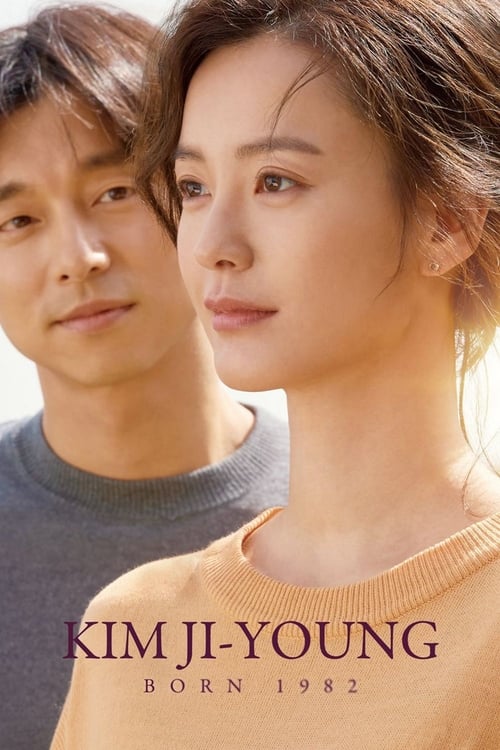
Kim Ji-young: Born 1982
2019 · Kim Do-young
For when you need a good cry that means something — a film to watch with someone you love and talk about after. It's emotionally direct and accessible, but the ache is real.
What it's about
Kim Ji-young is an ordinary woman in her early thirties in Seoul — a former marketing professional who left work to raise her daughter — who begins, without warning, to speak in the voices of other women from her life: her mother, her late grandmother, a lost friend. Her husband watches, frightened and helpless, as the episodes surface everything she's never been allowed to say. Adapted from Cho Nam-joo's bestselling novel, it treats her condition not as a supernatural mystery but as the visible weight of an entire life of quiet expectation.
The experience
Gentle on the surface and cumulatively devastating — it builds its case through small, recognizable moments rather than big confrontations, and the tears it earns come from recognition. Many viewers see their mother, their sister, or themselves in it.
Performances
Jung Yu-mi plays Ji-young with remarkable restraint, letting exhaustion and erasure show through a composed surface, while Gong Yoo gives the bewildered husband a tenderness that keeps the film from tipping into lecture.
The craft
Director Kim Do-young, in her feature debut, keeps the style unobtrusive so the accumulation of ordinary detail — offices, kitchens, family holidays — does the work. The dissociative episodes are staged with eerie calm rather than spectacle, which makes them land harder.
Why it matters
Adapted from one of the most read and most fought-over Korean novels of its decade, the film became both a box-office success and a lightning rod in South Korea's gender debates — a rare case of a quiet domestic drama becoming a national argument.
Snapshot
Kim Ji-young: Born 1982 (82년생 김지영) is a South Korean domestic drama adapted from Cho Nam-joo's 2016 novel, one of the most widely read and most fiercely contested books in recent Korean publishing. It follows an ordinary woman in her early thirties — a former marketing worker who has left her job to raise a child — as she begins, without warning, to speak in the voices of other women from her life: her mother, her late grandmother, a departed friend. The film treats these dissociative episodes not as horror or supernatural spectacle but as symptom: the visible surfacing of an accumulated, unspoken weight of gendered expectation. Directed by Kim Do-young in her feature debut and headlined by Jung Yu-mi and Gong Yoo, the film became both a commercial success and a lightning rod in Korea's gender politics, arriving at the height of the country's #MeToo reckoning. It is best understood as a work of social realism that borrows one modest, precise device from a stranger genre to make the interior costs of everyday patriarchy externally legible.
Industry & production
The film was produced within the mainstream Korean commercial system and distributed by Lotte Entertainment, one of the country's major studio-distributors, which positioned it as a wide autumn release. It opened on October 23, 2019. Its production was inseparable from the phenomenon of its source: Cho Nam-joo's novel had sold in the region of a million copies and had become a cultural touchstone, which gave the adaptation a built-in audience and, simultaneously, a built-in adversary — a vocal online contingent hostile to the book's feminism. That polarization shaped the film's commercial life before a frame was shot, and the casting of two stars with substantial mainstream followings can be read partly as a bid to carry a "controversial" property into the multiplex mainstream.
Commercially the gamble paid off. The film debuted at number one at the South Korean box office and drew roughly 3.6 million admissions domestically over its run, with a worldwide gross reported in the region of US$27 million — a strong result for a mid-budget, star-driven domestic drama with no action or genre hook. Precise below-the-line budget figures are not prominent in the English-language record, so claims about production scale should be treated as approximate.
Technology
This is a contemporary digital production made with the standard tools of late-2010s Korean commercial cinema; there is no notable technological novelty, and none is sought. The film is shot digitally in widescreen and finished for conventional theatrical projection. Its "technology," in any meaningful authorial sense, is invisible by design: the aesthetic program is transparency and legibility rather than any showcasing of apparatus. The one place technique verges on the technological is the handling of Ji-young's dissociative episodes, which are staged through performance and framing rather than through visual-effects transformation — a deliberate refusal of the digital morphing or overt effects a more sensational treatment would have used.
Technique
Cinematography
Lee Sung-jae's photography is keyed to domestic realism. The visual register is restrained and naturalistic — soft, even lighting; a muted, slightly desaturated palette of apartment interiors, offices, cafés and playgrounds; framing that keeps Ji-young legible within, rather than dominant over, her environments. The camera's default posture is observational and close, attentive to faces and to the small choreography of domestic labor (dishes, laundry, a child on the hip). Crucially, the film reserves its formal marking for the dissociative moments: the shift into Ji-young "becoming" another woman is achieved largely through the actor and through a subtle recalibration of light and stillness rather than through camera pyrotechnics. The photography's ethic is to make the extraordinary emerge from within the ordinary frame, not to signal it from outside.
Editing
Shin Min-gyung's cutting is patient and continuity-driven, favoring the durational hold over montage energy. The film's most consequential editorial decision is structural: it braids present-tense scenes with flashbacks — Ji-young's childhood, her working years, her mother's own history — so that the past is not delivered as a single explanatory block but seeps into the present as association and echo. This interleaving is what allows the dissociation to read as inheritance: when Ji-young speaks as her mother or grandmother, the edit has already made those women present to us. The rhythm is deliberately unhurried, trusting accumulation over incident.
Mise-en-scène / staging
The staging is domestic and quotidian, built around a small number of recurring spaces — the young couple's apartment, the in-laws' home, the grandparents' household, Ji-young's former workplace. Holiday gatherings, kitchen work, and the etiquette of serving elders become the film's primary stages, and the blocking is organized to make hierarchy visible: who sits and who stands, who is served and who serves, who speaks and who is spoken over. The production design is unshowy contemporary Korean middle-class realism. Meaning is loaded into ordinary objects and routines rather than into designed spectacle.
Sound
The soundscape is naturalistic, dominated by the ambient texture of domestic and urban life — kitchen sounds, a child's noise, office chatter, the muffled register of an apartment. Kim Tae-sung's score is used sparingly and in a minor, restrained key, underlining emotion without swelling into melodrama; the film generally trusts silence and the grain of the everyday. Detailed critical analysis of the film's sound design is thin in the available record, so finer claims about its mixing strategy should be held loosely.
Performance
Performance is the film's true special effect, and its center is Jung Yu-mi. She plays Ji-young with a carefully modulated ordinariness — warmth, fatigue, suppressed strain — so that the dissociative passages land as rupture rather than showcase; the "possessions" are achieved through voice, posture and gaze, a controlled shift into another woman's cadence that avoids theatrical excess. Gong Yoo, cast against a leading-man register, plays the husband as decent but limited, a man whose good intentions do not reach the structural problem — a performance that refuses both villainy and heroism. The supporting playing of the mother and of the older women in Ji-young's life is essential, since the film's argument is that these women's histories are literally speaking through her.
Narrative & dramatic mode
The dominant mode is social realism, inflected by a single controlled device drawn from the vocabulary of the uncanny. The dissociative episodes could belong to a possession film; here they are refunctioned as clinical symptom and as metaphor — the psychic overflow of a life narrowed by unacknowledged demands. The narrative is structured as accretion rather than plot: there is no antagonist to defeat and no twist to spring, only the gradual disclosure, through interwoven pasts, of how Ji-young arrived at her breaking point. A framing awareness — that Ji-young is being observed, diagnosed, and to some degree written — gives the film a reflexive edge about who gets to narrate a woman's experience. The dramatic engine is recognition: the film asks the viewer to see, in an unremarkable life, the shape of a systemic condition.
Genre & cycle
Formally the film sits in the tradition of the domestic melodrama and the woman's-picture — a genre lineage long central to Korean cinema and television — updated for a contemporary feminist argument. It belongs to a late-2010s cycle of Korean and East Asian screen work engaging directly with gender inequality, care labor, and the post-#MeToo social conversation, and it is unusual within its national mainstream for foregrounding that argument in a wide commercial release rather than in the art-house margin. Its light borrowing from possession-horror iconography also places it in dialogue with the broader Korean tendency to hybridize genre, though here the borrowing is homeopathic — a single motif, not a mode.
Authorship & method
The film is a debut feature by Kim Do-young, previously known as an actor, and her direction is marked by restraint: a refusal of the sensational readings the material invited, a preference for observation over editorializing, and a trust in performance and structure to carry a polemical subject. The adaptation credit belongs to screenwriter Yoo Young-ah, whose task — condensing a schematic, almost sociological novel into dramatically breathing scenes — is central to the film's achievement; the screenplay's key move is to dramatize through the braided-flashback structure what the novel often stated. Cinematographer Lee Sung-jae supplies the naturalistic, domestic visual register; editor Shin Min-gyung builds the past-into-present weave that makes the dissociation legible as inheritance; and composer Kim Tae-sung provides a sparing, minor-key score. The collaborative method is one of subtraction — muting spectacle so that ordinary life can bear the film's weight.
Movement / national cinema
The film is a product of the modern South Korean commercial film industry at a moment when that cinema, having achieved global visibility, was increasingly willing to route pointed social critique through mainstream stars and wide distribution. It is not part of a formal movement so much as a marker within a broader current of Korean feminist cultural production — books, television, and film — that crystallized around the mid-to-late 2010s. Within Korean cinema specifically, it stands out for taking a "small," interior, women-centered subject to the multiplex, a scale of ambition more often reserved for thrillers and historical epics.
Era / period
Made and set in the late 2010s, the film is precisely of its moment: the post-#MeToo years in Korea, a period of intense public argument over gender, work, marriage, and reproduction, and of a sharp online backlash-and-counter-backlash dynamic. Its title's "1982" locates its protagonist generationally — a woman coming of age and into working life in a specific window of Korean modernization — while the film's present tense captures the frictions of that generation's adulthood. The film cannot be separated from the contemporaneous controversy over its source novel, which had already made "Kim Ji-young" a shorthand in the national conversation.
Themes
The film's governing theme is the structural, cumulative nature of everyday sexism — the way small, individually deniable expectations (about caregiving, career sacrifice, deference to in-laws, the disproportionate labor of motherhood) aggregate into a life-altering pressure. Around this it develops: postpartum depression and unnamed mental strain as the body's protest against unlivable demands; the inheritance of women's experience across generations (mother, grandmother, friend literally speaking through Ji-young); the invisibility and devaluation of domestic and care labor, sharpened by the "mom-roach"-style contempt directed at stay-at-home mothers; and the question of narration and voice — who is permitted to describe a woman's suffering, and whether being named as a "case" is itself a further erasure. The dissociation device gathers all of this into one image: a woman whose own voice has been so displaced that others' must speak for her.
Reception, canon & influence
Critically, the film was widely received as a sober, humane, and deliberately unsensational adaptation, praised in particular for Jung Yu-mi's central performance and for its refusal of melodramatic excess; some critics found its very restraint and its schematic origins limiting, reading it as more illustrative than searching. Its reception cannot be told apart from controversy: the source novel had already provoked organized online hostility, and the film attracted review-bombing and gendered backlash of the kind that had earlier greeted public figures — including K-pop idols — merely for mentioning the book. That the film nonetheless topped the box office and drew millions of admissions became, in itself, part of its cultural meaning.
The influences on the film run backward primarily through its literary source — Cho Nam-joo's novel and the broader wave of Korean feminist writing and #MeToo activism — and through the long domestic-melodrama tradition of Korean screen storytelling, with a glancing debt to possession-film iconography that it deliberately underplays. Looking forward, its legacy is less a matter of stylistic imitation than of demonstration: it showed that an explicitly feminist, interior, women-centered story could succeed commercially in the Korean mainstream and travel internationally as a reference point in discussions of gender and care. The film's longer-range influence continues to unfold and is best stated modestly; what is already clear is that "Kim Ji-young" became a durable cultural shorthand, and the film gave that shorthand a face and a voice.
Reception
It arrived in 2019 as a literal battleground in South Korea's gender wars — review-bombed before anyone had seen it, boycotted by men's groups, championed by women organizing group screenings — yet still topped the box office; today it's remembered less as a movie than as the flashpoint moment of Korea's feminist reckoning.
How Kim Ji-young: Born 1982 was received, from release to now →
Influences: the films it descends from and the films it influenced
- Jeanne Dielman, 23 quai du Commerce, 1080 Bruxelles (1975) — Establishes the durational-hold editing and static observational framing of unremarked domestic female labor as an accretion-not-plot structure, the exact grammar Kim Ji-young uses to let repeated household routine, rather than dramatic incident, carry the film's weight.
- A Woman Under the Influence (1974) — Models the unglamorous, close-observed filming of a wife's psychological unraveling inside the home, with a dissociative-transformation lead performance that reads breakdown as a response to household and social pressure rather than pathology.
- Safe (1995) — Supplies the clinical, distanced long-shot framing of a housewife whose body somatizes a diffuse social malaise, plus the against-type interiorized performance that withholds emotional legibility.
- Late Spring (1949) — Origin of the low domestic staging and hierarchy-blocking within tatami-level interiors that encode patriarchal family expectation spatially, a compositional logic Kim Ji-young applies to the in-law household.
- The Housemaid (1960) — Founds the Korean domestic-melodrama strain that fuses the household interior with a gothic/horror register, the tradition Kim Ji-young draws its possession-film iconography from before deliberately muting it.
- The Exorcist (1973) — Provides the possession grammar of a woman's body and voice being taken over by another presence, which Kim Ji-young borrows literally in the dissociative scenes where she speaks as her mother and grandmother, but strips of all horror spectacle.
- Secret Sunshine (2007) — Demonstrates Korean social-realist observation of a woman's psychological disintegration carried entirely by an against-type lead (Jeon Do-yeon), refusing score-driven melodrama in favor of naturalistic minor-key restraint.
- Poetry (2010) — Extends the durational, accretive attention to an ordinary woman's interior life pressed against social and familial forces, with observational framing that trusts performance over editorializing.
- Wanda (1970) — Pioneers unadorned observational realism of a woman adrift with a plotless, accretive structure that indicts social constraint through drift and passivity rather than argument.
- Never Rarely Sometimes Always (2020) — Carries forward the post-#MeToo observational realism and durational hold on a young woman's ordeal, achieving polemical force through restraint and refusal of melodramatic excess.
- Nomadland (2020) — Extends the accretion-not-plot structure and domestic/observational naturalism carried by an against-type, interiorized lead performance that lets a social condition emerge from texture rather than exposition.
- 4 Months, 3 Weeks and 2 Days (2007) — Shares the durational-hold long-take and observational framing that dramatize women's bodily experience under patriarchal constraint through real-time endurance rather than plot mechanics.
- Tokyo Sonata (2008) — Uses domestic-naturalist staging and hierarchy blocking to render a family's quiet patriarchal fracture, the same technique of encoding power in who sits, serves, and stands within the home.
- Little Forest (2018) — A contemporary of the same Korean-feminist-culture wave, built on women-centered durational domestic naturalism and an accretion of seasonal routine over dramatic incident.
- Microhabitat (2017) — Post-2015 Korean feminist social-realism centering a single woman's economic precarity with observational restraint and a refusal of sensational framing.
- House of Hummingbird (2018) — Reconstructs a girl's coming-of-age through braided, accretive vignettes and observational domestic framing that surface inherited women's history within an ordinary family, a near-simultaneous debut sharing Kim Ji-young's structural DNA.
Similar films
- Little Forest (2018) — influence & lineage
- Poetry (2010) — influence & lineage
- Her Story (2024) — shared sensibility
- House of Hummingbird (2019) — shared sensibility
- 20th Century Girl (2022) — shared sensibility
- Even If This Love Disappears Tonight (2025) — shared sensibility
- Soulmate (2023) — shared sensibility
- A Tale of Two Sisters (2003) — shared sensibility