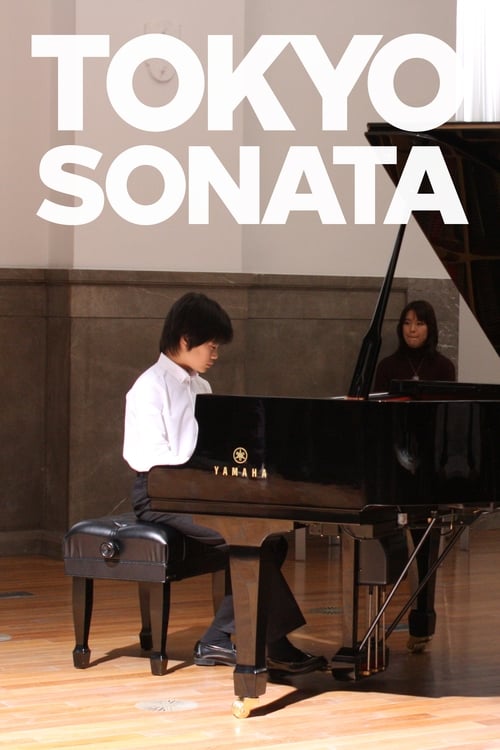
Tokyo Sonata
2008 · Kiyoshi Kurosawa
The J-horror master's prolific late run (Cloud at Venice, the Serpent's Path self-remake) fuels a "finally getting his flowers in the West" appreciation cycle among genre cinephiles.
When you want a film to chew on for days — a slow, serious family drama that earns its emotion honestly. Bring patience; it repays it with one of the more moving endings you'll encounter.
What it's about
A middle-aged Tokyo salaryman loses his office job to outsourcing and can't bring himself to tell his family — so he puts on his suit every morning and disappears into the city, joining an invisible army of unemployed men keeping up appearances. At home, his wife holds the household together while sensing something is wrong, one son looks to the U.S. military for purpose, and the younger one secretly wants piano lessons. The family drifts apart under a roof where nobody says what's actually happening.
The experience
Quiet, precise, and quietly devastating — the tension comes not from events but from everything unsaid at the dinner table. There's dry, uncomfortable humor in the father's charade, and the film builds toward passages of unexpected, hard-won grace.
Performances
Teruyuki Kagawa is heartbreaking as the father, wearing his humiliation like a second suit, and Kyoko Koizumi gives the film its soul as the wife whose composure masks a deep, dawning unrest.
The craft
Kiyoshi Kurosawa, best known for eerie horror, brings a horror director's control of framing and silence to domestic drama — doorways, hallways, and empty rooms carry as much dread as any ghost. The stillness of the camera makes the smallest gesture land hard, and the use of piano music in the final stretch is unforgettable.
Why it matters
It caught the anxiety of an era of downsizing and precarious work with rare clarity, and marked a celebrated pivot for a genre director into humanist drama.
Snapshot
A mid-career pivot for a director best known for metaphysical horror, Tokyo Sonata exchanges ghosts for a different order of haunting: the slow erasure of the Japanese salaryman. Ryuhei Sasaki (Teruyuki Kagawa), a middle-management office worker in his forties, is made redundant when his position is outsourced to cheaper Chinese labor. Rather than disclose the humiliation to his family, he puts on his suit each morning and disappears into the city, joining a vast, invisible cohort of men queuing at soup kitchens and unemployment offices. Meanwhile his wife Megumi (Kyoko Koizumi) maintains domestic ritual with the rote efficiency of someone who senses but refuses to name the collapse around her; his older son Takashi enlists in the United States military, seeking purpose his own country cannot offer; and his younger son Kenji secretly takes piano lessons with money cadged from his lunch allowance, nurturing a talent expressly forbidden by his father. The film ends with Kenji performing Debussy's Clair de lune at a school recital, a resolution that is at once devastatingly simple and — given everything that has preceded it — almost inexplicably moving. Winner of the Jury Prize in Cannes's Un Certain Regard section in 2008, Tokyo Sonata is the film that forced international critics to reconsider Kurosawa's range.
Industry & production
Tokyo Sonata was produced through a co-production arrangement involving the Japanese company Bitters End alongside international partners including Fortissimo Films, the Dutch sales company that had long championed difficult Asian cinema for festival and art-house markets. The international co-production structure was significant: it gave Kurosawa access to the kind of modest but stable financing that allowed for festival ambition without requiring the horror-franchise economics that had dominated his commercial output through the 2000s. The project originated partly from a story concept by Australian screenwriter Max Mannix, though the finished screenplay was developed by Sachiko Tanaka and Masashi Todayama, two writers with roots in Japanese television drama. The combination of Kurosawa's directorial instincts with a more conventionally plotted domestic script produced a productive tension: the film observes the grammar of family melodrama while quietly destabilising it at every turn.
The casting of Teruyuki Kagawa and Kyoko Koizumi was itself a kind of industrial statement. Kagawa, by 2008 a fixture of both prestige television and art cinema, brought an almost unbearable quality of bottled-up shame to Ryuhei. Koizumi, a former pop idol turned serious actress, played Megumi with a stillness that conceals enormous internal pressure — her performance in a late sequence involving a home intruder and an overnight coastal drive is among the strangest and most affecting in contemporary Japanese cinema.
Technology
Tokyo Sonata was shot on 35mm film, in anamorphic widescreen. The choice matters aesthetically. Kurosawa, even as digital acquisition was becoming standard practice for lower-budget Japanese productions, retained photochemical capture for a film whose subject is, in part, the texture of things quietly decaying. The anamorphic frame allows the suburban interiors to breathe — to feel both spacious and constricting, household space rendered as a kind of trap. No unusual or proprietary technology distinguishes the production; its technical accomplishment is instead one of restraint, of using conventional tools with exceptional precision.
Technique
Cinematography
Akiko Ashizawa, who served as cinematographer, worked with Kurosawa to produce images that consistently refuse to be comfortable. The palette is cool and de-saturated, all grays and pale interior light, occasional blue urban dusk. Compositions favour the wide shot over the close-up: faces are rarely isolated and magnified in the classical Hollywood manner. Instead, characters inhabit their environments fully — often small within the frame, peripheral, observed at a remove that implicates the viewer in a certain cold spectatorship. The film's most famous image is the final close-up of Kenji's hands on the piano keys, which lands with such force precisely because Ashizawa and Kurosawa have withheld the close-up for nearly two hours.
Shallow focus is used sparingly and purposefully; Kurosawa more often opts for deep-focus compositions in which background details — a doorway, a street beyond a window — carry as much unease as the foreground. Off-screen space, a persistent obsession in Kurosawa's horror work, remains important here: what characters cannot see, what the camera declines to show, accumulates into a generalized anxiety that has no single source.
Editing
Koichi Takahashi's editing respects the rhythm of long takes and sustained observation, but the film is more conventionally cut than Kurosawa's horror work. The domestic scenes between Ryuhei and Megumi maintain an almost clinical pace — conversations that do not quite meet, actions that do not quite synchronize. The editing's most significant contribution is tonal control across a film that modulates through absurdist comedy (the queuing scenes carry a Kafkaesque deadpan), slow-burn domestic dread, and — in the film's final act — something approaching melodrama. The transitions between these registers are handled without signaling, which is part of what makes Tokyo Sonata formally demanding for an audience expecting a single genre key.
Mise-en-scène / staging
Kurosawa's staging owes a conscious, if revisionary, debt to Yasujiro Ozu. The Sasaki household is rendered with the same commitment to spatial clarity and object-significance that Ozu brought to the postwar bourgeois home. But where Ozu's staging implies order, cycles, a world in balance even when altered, Kurosawa's staging implies encroachment: doors that open onto the wrong rooms, furniture that obstructs movement, the family dining table as a space of enforced performance. Characters rarely face each other directly; they speak to adjacent walls, to the middle distance, to the grain of the table. The failure of communication is staged as a failure of physical orientation.
The scenes outside the home — Ryuhei in the unemployment queue, the soup kitchen, the street — are shot with more lateral movement and a sense of the city as indifferent crowd. The contrast between interior paralysis and exterior drift is one of the film's primary spatial arguments.
Sound
The sound design is characteristically Kurosawa in its deployment of ambient texture — the hum of fluorescent lights, the distant noise of traffic, silences that are never quite silence — but Tokyo Sonata adds a layer that Kurosawa's genre work rarely foregrounded: music as thematic substance. Kenji's secret piano practice, heard through walls and floors, becomes a counter-melody to the family's official dysfunction. The Debussy — Claude Debussy's Clair de lune from the Suite bergamasque — is not incidental to the film's meaning; it is its thesis, the argument that something in the human registers beauty even when, especially when, the social apparatus has failed. Composer Kazuya Nagaya's original score is restrained, supporting rather than editorialising, which gives the Debussy its full weight when it arrives.
Performance
Kagawa's performance is a study in masculine humiliation as a form of dissociation. Ryuhei moves through the film with the studied normalcy of someone performing competence for an audience that is no longer watching. The performance's brilliance is in its withholding: Kagawa gives almost nothing that reads as conventional interiority, which makes the rare moment of collapse — when the mask briefly slips — devastating. Koizumi's Megumi is the film's moral center, a woman who has so thoroughly internalized the role of domestic supporter that she can barely locate herself beneath it. Her late-film sequence with the intruder — in which she moves through danger with an eerie calm that might be dissociation or might be a deeper liberation — ranks among the more daring stretches of performance in Japanese cinema of the decade. Young Kai Inowaki as Kenji carries the film's genuine emotional core with an unsentimental naturalism that never tips into precocity.
Narrative & dramatic mode
The film operates through parallel tracks of concealment: Ryuhei conceals his unemployment; Kenji conceals his piano lessons; the older son conceals his intention to enlist; Megumi conceals the extent of her own estrangement. Each secret is a form of care — no one wishes to burden the others — and each secret is also a form of violence, the maintenance of a family fiction that requires everyone to perform roles that no longer fit. The dramatic mode is realist, but a realism under pressure, constantly threatening to tip into something stranger. The intruder plot in the film's final third is genuinely disjunctive — it feels, briefly, as though Kurosawa's horror sensibility has surfaced — and the film does not entirely resolve the tonal rupture, which seems deliberate rather than miscalculated.
The narrative's refusal of conventional resolution — Ryuhei does not find redemption; the family does not fully reconcile; Kenji performs his recital to a hall of parents, and the camera simply holds on the music — places Tokyo Sonata in a tradition of quietly devastating Japanese domestic drama that runs from Ozu through the work of Hirokazu Kore-eda.
Genre & cycle
Tokyo Sonata belongs to a cycle of Japanese films made in the 2000s and 2010s that process the economic and social fallout of the "lost decades" — the prolonged stagnation following the collapse of Japan's asset bubble in the early 1990s, which continued to reshape Japanese life through the decade of the film's production. Films in this loose cycle — which includes work by Kore-eda, Shinji Aoyama, and others — address unemployment, social withdrawal, domestic fracture, and the crisis of the salaryman as a cultural ideal. Tokyo Sonata is unusual within this cycle in being made by a director primarily identified with genre cinema, and in its willingness to stage the family drama with the dread-logic of a horror film.
It also participates in a sub-genre of Japanese cinema concerned specifically with white-collar male unemployment and its social concealment — a phenomenon sufficiently prevalent in Japan to have generated documentary treatment and journalistic coverage, and which several films addressed obliquely or directly around this period.
Authorship & method
Kiyoshi Kurosawa (born 1955) emerged from the Nikkatsu roman-porno production system — the low-budget soft-core genre films that paradoxically trained an extraordinary generation of Japanese directors in the 1970s and 1980s — and spent the 1990s and early 2000s building an international reputation with horror films that used the supernatural as a vehicle for social alienation: Cure (1997), Seance (2000), Pulse (Kairo, 2001). His method has always been less interested in shock than in uncanny atmospheric accumulation: the suggestion that something is fundamentally wrong with the world, located in the grain of mundane space.
Tokyo Sonata abandons the supernatural but not the method. Kurosawa's characteristic techniques — the held wide shot, the off-screen threat, the staging of spaces as environments that resist human occupation — translate without loss to domestic realism. His collaboration with Ashizawa produced a visual language consistent with his horror work while finding a new emotional register within it. The film demonstrates that what defined Kurosawa was never the ghost, but the dread of ordinary life.
The screenplay's origins in Mannix's story concept and its development through Tanaka and Todayama may account for the film's slightly more conventionally plotted quality compared to Kurosawa's solo-authored projects. Some critics noted that the final act's melodramatic turns feel somewhat imposed. Kurosawa's own instinct toward fragmentation and irresolution is most visible in the quieter middle sections.
Movement / national cinema
Tokyo Sonata is Japanese cinema in a moment of productive self-examination. By 2008, the J-horror wave that had driven Japanese genre films into international art houses and Hollywood remakes through the late 1990s and early 2000s was commercially exhausted. Pulse had already received an American remake in 2006; the form had been absorbed and metabolized by global horror production. Tokyo Sonata represents Kurosawa's negotiation with what came next — a turn toward the domestic drama tradition that Japanese cinema has long sustained at its most prestigious level.
The film sits in relation to two major traditions: the Ozu line of postwar family drama, which it consciously inherits and revises; and the Kore-eda line of contemporary social realism, with which it is roughly contemporaneous but temperamentally distinct. Where Kore-eda tends toward tenderness and cyclical affirmation, Kurosawa maintains a clinical remove. Japanese critics generally positioned Tokyo Sonata as a significant event in the career of a genre filmmaker rather than as a new departure for Japanese domestic drama per se; international critics, less familiar with the domestic-drama tradition, were more inclined to read it as a formal breakthrough.
Era / period
The film is precisely dated by its subject: Japan in the mid-2000s, caught between the long tail of the "lost decade" and the anticipation of a global financial crisis that would arrive, as if on cue, the same year the film was released. The specific anxiety of white-collar outsourcing to China — Ryuhei's job is described as being eliminated in favour of cheaper Chinese labor — was a live social and political concern in Japan at the time. The older son's enlistment in the US military rather than the Japanese Self-Defense Forces carries a commentary on Japanese sovereignty and military culture that would have registered sharply for a domestic audience, though the film does not press the point explicitly.
Tokyo Sonata is also a film about shame cultures under economic pressure — about the particular violence of a society in which masculine identity is constituted through productive labor, and what happens to that identity when the labor vanishes. The soup kitchen queue, shot with a documentary plainness, was based on a social reality that Japanese media had begun to cover more openly by the mid-2000s.
Themes
The film's organizing theme is the performance of normalcy in the face of structural collapse. Each member of the Sasaki family performs their assigned role — breadwinner, homemaker, dutiful son, obedient younger son — with increasing desperation as the conditions that made those roles legible dissolve beneath them. The family is not destroyed by dramatic failure but by the cumulative weight of keeping up appearances.
Music, and specifically the piano, carries the film's counter-argument. Kenji's secret lessons represent the one space in the film where something is pursued for its own sake, outside the economy of performance and shame. The film argues — tentatively, without sentimentality — that beauty survives institutional failure, that Debussy persists when the salaryman culture does not.
The theme of concealment runs parallel to that of communication: what the family cannot say to each other is the real subject of almost every scene. The film's title, Tokyo Sonata, plays on the musical form — a structure of movements, often in tension, which nonetheless cohere into a whole — as a figure for the family itself.
Reception, canon & influence
Critical reception. The Jury Prize at Cannes 2008 (Un Certain Regard) announced the film to a broad international audience and was understood as validation of Kurosawa's range beyond genre. Critical reception in France, the UK, and the United States was strongly positive, with reviewers particularly attentive to the tonal complexity and to the performances of Kagawa and Koizumi. Some critics noted the slight awkwardness of the film's tonal ruptures in the final act, and a minority found the Debussy resolution manipulative; the majority considered it precisely calibrated. In Japan, the film was received warmly but without the institutional recognition it received abroad — a familiar pattern for Japanese art cinema directed toward festival markets.
Influences on the film (backward). The debt to Ozu is structural and spatial rather than directly imitative: Kurosawa shares Ozu's commitment to the family home as a space of emotional archaeology, and to the wide, low, patient shot as a mode of observation. The Haneke of The Seventh Continent (1989) and Caché (2005) — domestic surfaces as sites of concealed violence — is a plausible European cognate, though Kurosawa's dread is less prosecutorial than Haneke's. The salaryman genre of Japanese cinema, running from the 1950s Toho comedies through the melodramas of the 1980s and 1990s, provides the social archetype that Kurosawa deconstructs. Kurosawa's own horror oeuvre is the most immediate formal antecedent: the mise-en-scène of Tokyo Sonata is recognizably continuous with Cure and Pulse.
Legacy (forward). Tokyo Sonata strengthened the critical framework through which Kurosawa's horror work was subsequently re-evaluated — as social commentary operating through genre form rather than genre film per se. It confirmed for international festival programmers and critics that Japanese genre directors could command art-house audiences beyond their genre constituencies. Whether it directly influenced subsequent Japanese domestic drama is less certain; the Kore-eda current was already well-established and followed its own logic. What Tokyo Sonata left with certainty is a single, perfect late sequence — Kenji at the keyboard, the Debussy filling the auditorium — that has entered the vocabulary of critics writing about music in film. The ending is cited regularly as evidence that cinema's relationship to music need not be illustrative or supplementary: it can be, as here, the only honest statement the film is capable of making.
A Deleuzian reading
Every morning Ryuhei Sasaki knots his tie, takes up the briefcase, and walks out the door to a job that no longer exists.
The full Deleuzian reading of Tokyo Sonata →
Reception
A Cannes hit on arrival — it took the Un Certain Regard Jury Prize in 2008 — and its salaryman-layoff premise landed just as the global financial crisis hit, so it went almost instantly from 'Kurosawa tries drama' to THE recession-era film; today it's routinely ranked alongside Cure and Pulse at the top of his filmography.
How Tokyo Sonata was received, from release to now →
Influences: the films it descends from and the films it influenced
- Tokyo Story (1953) — Kurosawa's staging of the Sasaki household directly revises Ozu's tatami-level compositional grammar — the same spatial clarity, corridor geometry, and object-significance as Tokyo Story's bourgeois interiors, but deformed so that Ozu's ordered symmetry becomes a site of encroachment and off-screen menace rather than cyclical domestic equilibrium.
- Ikiru (1952) — The sequences of Ryuhei navigating unemployment queues and government offices — a middle-aged man facing bureaucratic anonymity after workplace erasure — directly extend the salaryman-in-crisis template Akira Kurosawa established in Ikiru, including the deadpan satire of institutional process and the pathos of a man whose social function has been voided before his body has.
- Il Deserto Rosso (1964) — Ashizawa's desaturated palette of industrial grays and pale interior light, and the anamorphic compositions in which Ryuhei appears peripheral and dwarfed by suburban architecture, trace directly to Antonioni's grammar of modern alienation — environment rendered as psychological entrapment through color temperature and frame geometry rather than dramatic incident.
- Jeanne Dielman, 23 quai du Commerce, 1080 Bruxelles (1975) — Megumi's arc — a woman maintaining domestic ritual with rote efficiency while sensing but refusing to name the collapse around her — is a formal citation of Akerman's method: housework duration-extended until routine registers as dread, psychological interiority withheld entirely, the household body as the only site of suppressed knowledge.
- L'Argent (1983) — Bresson's model of economic shame rendered through behavioral compression — a man undone by money who cannot speak his crisis, shown through compulsive routine, averted gaze, and physical automatism rather than confession — is the direct formal precedent for Ryuhei's daily performance of employment: the suit put on, the briefcase carried, shame architectured as behavior.
- The Piano (1993) — Campion's use of diegetic piano performance as emotional fulcrum — physical virtuosity substituting for spoken feeling, a character's hidden musical gift as inner-life cipher — directly anticipates Kenji's concealed lessons as narrative structure and the Debussy leitmotif as the film's controlled release valve for two hours of withheld emotion.
- Caché (2005) — Haneke's surveillance-cinema grammar — static deep-focus frames where background space carries latent threat, narrative structured around withheld information, domestic middle-class guilt accumulating without dramatic release — is the direct structural template for Tokyo Sonata's mechanics of family concealment and Kurosawa's systematic refusal to grant explanatory closure.
- Bright Future (2003) — The direct formal descendant of Bright Future's social-fable pivot — the same elliptical editing and domestic behavioral observation now applied to middle-class unemployment, fully shed of genre premise, completing the turn toward humanist contemplative cinema begun in 2003.
- Like Father, Like Son (2013) — Kore-eda adapts Tokyo Sonata's grammar of Japanese patriarchal dissociation — a father constituted entirely by professional status and incapable of emotional disclosure — and its domestic horror structure of parallel concealment, here centered on a hospital error that destabilises the entire architecture of bourgeois family identity.
- A Separation (2011) — Farhadi's architecture of parallel concealment — multiple characters simultaneously withholding different truths from different people, the narrative engine driven by the gap between what is known and what is said — extends Tokyo Sonata's formal premise of four-way family dissimulation, adapted to Iranian domestic drama and a more overtly judicial structure.
- Happy Hour (2015) — Hamaguchi's five-hour debut extends Kurosawa's method of duration-based domestic observation — the long take as a tool for revealing the gap between performed and felt selfhood, stillness under social pressure as the primary acting instrument, narrative structured around what characters cannot say in rooms where they are expected to speak.
- Shoplifters (2018) — Kore-eda's Palme d'Or winner extends Tokyo Sonata's parallel concealment architecture — each member of a constructed family unit hiding different truths from institutions and from each other — while inheriting its tonal modulation between domestic warmth, deadpan absurdism, and devastating melodrama, now applied to economic precarity at Japan's bottom rather than its middle.
- Drive My Car (2021) — Hamaguchi inherits Tokyo Sonata's complete formal vocabulary: anamorphic widescreen with figures held in observational middle-distance, the systematic withheld close-up deployed as a device for controlled emotional release, masculine dissociation rendered through behavioral rather than verbal expression, and stillness-under-pressure as the primary performance register.
- Cure (1997) — Kurosawa's earlier horror grammar — ambient sound texture building unease without identifiable source, off-screen space as the primary site of threat, stillness-under-pressure performances registering collapse through surface control — migrates intact into Tokyo Sonata, the formal toolkit of J-Horror redeployed against domestic middle-class dread.
- 4 Months, 3 Weeks and 2 Days (2007) — Mungiu's commitment to sustained observational takes, ambient sound texture without scored music, and a concealment narrative whose full emotional weight arrives only retrospectively parallels Tokyo Sonata's formal restraint — dread built from withheld information and behavioral observation rather than dramatic incident or emotional scoring.
- Still Walking (2008) — Released the same year, Kore-eda's Still Walking shares Tokyo Sonata's method of tonal modulation — moving between domestic comedy, suppressed grief, and near-melodrama without generic signaling — and its commitment to long-take observation of ritual gesture as the primary vehicle for familial feeling that cannot be spoken directly.
- The Headless Woman (2008) — Martel's film shares Tokyo Sonata's anamorphic grammar of bourgeois denial — desaturated palette, deep-focus frames where background space quietly accuses, a protagonist maintaining performed normalcy while suppressing knowledge of catastrophe — and the same refusal to grant narrative resolution or close-up emotional access.
- Kim Ji-young: Born 1982 (2019) — Uses domestic-naturalist staging and hierarchy blocking to render a family's quiet patriarchal fracture, the same technique of encoding power in who sits, serves, and stands within the home.
Similar films
- Tokyo Story (1953) — influence & lineage · same viewing thread
- Shoplifters (2018) — influence & lineage · same viewing thread
- Still Walking (2008) — influence & lineage · same viewing thread
- Like Father, Like Son (2013) — influence & lineage · same viewing thread
- Ikiru (1952) — influence & lineage
- Drive My Car (2021) — influence & lineage
- Cure (1997) — influence & lineage
- Happy Hour (2015) — influence & lineage · same viewing thread
All the films related to Tokyo Sonata →
Watch it with: curated runs of related films
- The Weight of the Unspoken — A run of quietly shattering films where the largest feelings never get said aloud — love that outlasts reason, grief that gathers over a single family dinner, a long marriage cracked open by one old letter.