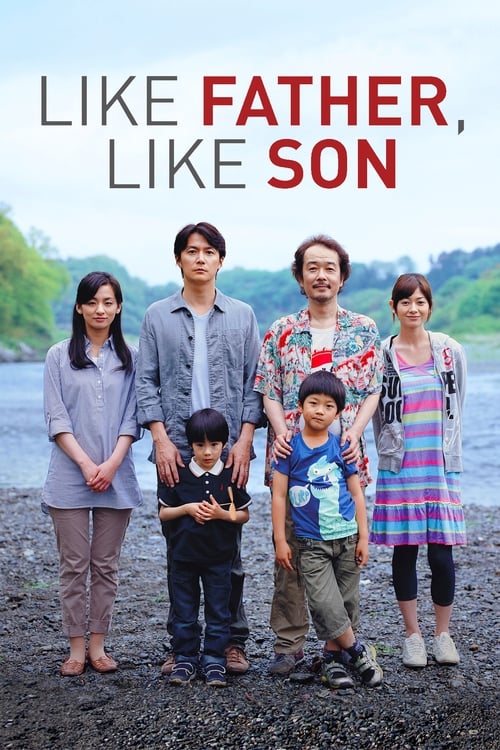
Like Father, Like Son
2013 · Hirokazu Kore-eda
For a reflective evening when you want a film to chew on for days — especially if you're a parent, or thinking about your own. Tender rather than harrowing, but it will sneak up on you.
What it's about
Ryota, a driven Tokyo architect with a glassy apartment and a son drilled at the piano, gets a phone call no parent imagines: his six-year-old was switched at birth with another baby. The other family runs a scruffy appliance shop where the father fixes toys and piles into the bathtub with his kids, and the two households must decide what to do — forcing Ryota to ask whether fatherhood is blood or accumulated hours.
The experience
Gentle on the surface and quietly devastating underneath — Kore-eda drains the melodrama out of the premise and lets the feeling gather in small gestures until it overflows. You'll come out wanting to call your family.
Performances
Masaharu Fukuyama is superb as Ryota, letting a controlled, successful man's certainties crack by degrees — much of the performance lives in how he holds himself, and a camera.
The craft
Kore-eda poses his big question almost entirely through gesture — how a man holds a camera, who a child photographs when no one is looking — and through the visual contrast of a sterile high-rise against a cluttered, happy shop. It's precise, unhurried filmmaking where every domestic detail is doing quiet work.
Why it matters
The Jury Prize at Cannes in 2013 carried Kore-eda to a global audience — Steven Spielberg, who led that jury, promptly optioned a remake — cementing his standing as Japanese cinema's great chronicler of family.
Hirokazu Kore-eda built his standing as Japanese cinema's great chronicler of improvised families, and this is the film that carried him to a global audience: the Jury Prize at Cannes 2013, with Steven Spielberg — who presided over that jury — promptly optioning a remake. The premise is an old melodramatic engine, babies switched at birth, but Kore-eda drains it of hysteria and refills it with class. Masaharu Fukuyama's Ryota is a Tokyo architect of glassy apartments and drilled pianos; the other family runs a scruffy appliance shop where the father fixes toys and shares the bathtub with his kids. The question the film keeps turning over — is fatherhood blood or accumulated hours? — is posed almost entirely through gesture: how a man holds a camera, who a child photographs when no one is looking. Kore-eda, often likened to Ozu though he claims Ken Loach, directs children better than almost anyone alive, catching performances that feel overheard rather than staged. It set the template for his run to the Palme d'Or with Shoplifters five years later.
A Deleuzian reading
The camera is a cheap compact, and the man scrolling through it is an architect who builds glass apartments for other people to live in.
The full Deleuzian reading of Like Father, Like Son →
Reception
A Jury Prize winner at Cannes 2013 and Kore-eda's biggest domestic hit to that point, it was his international breakthrough moment — though since Shoplifters swept the Palme, it's settled into 'the gateway Kore-eda' slot, warmly loved but no longer the one people lead with.
How Like Father, Like Son was received, from release to now →
Influences: the films it descends from and the films it influenced
- Tokyo Story (1953) — The tatami-level static camera and pillow-shot ellipses that let a family's generational rupture register through the arrangement of bodies in a room rather than confrontation — Kore-eda's whole grammar of domestic observation is calibrated to this.
- Late Spring (1949) — A parent-child bond in which the deepest feeling is withheld and displaced onto ordinary gesture and object (the peeled fruit, the packed bag), the exact restraint Kore-eda uses when the fathers can only express love through logistics of the swap.
- There Was a Father (1942) — Ozu's study of a dutiful father who measures paternity by provision and sacrifice rather than affection — the precise fault line Kore-eda dramatizes in the workaholic architect father.
- When a Woman Ascends the Stairs (1960) — Naruse's 'restrained melodrama' — economic and class pressure that never erupts but grinds through composed everyday scenes — models Kore-eda's refusal to let the switched-babies premise tip into weepie.
- Bicycle Thieves (1948) — Neorealism's father-and-son structure and location-shot moral dilemma of a working man, plus the practice of casting a non-professional child for unforced presence, feeding into Kore-eda's method.
- Kes (1969) — Loach's technique of drawing naturalistic child performances by shooting in sequence and withholding the full script — an explicit acknowledged influence on how Kore-eda directs Keita and Ryusei.
- The 400 Blows (1959) — The unsentimental observational gaze on a child navigating adult failure, letting the young actor's spontaneous behavior carry meaning rather than plot — the naturalistic child-performance tradition Kore-eda inherits.
- Nobody Knows (2004) — Kore-eda's own laboratory for the loose-script, chronologically-shot child-directing method and for defining family as lived caregiving rather than blood — the direct precursor to this film's central question.
- Still Walking (2008) — His most Ozu-indebted work: a single family gathering staged through cooking, meals and half-said things, perfecting the gesture-driven, kitchen-centered blocking he reuses across both households here.
- Tokyo Sonata (2008) — Kore-eda adapts Tokyo Sonata's grammar of Japanese patriarchal dissociation — a father constituted entirely by professional status and incapable of emotional disclosure — and its domestic horror structure of parallel concealment, here centered on a hospital error that destabilises the entire architecture of bourgeois family identity.
- After Life (1999) — Continues the documentary-fiction hybrid of drawing scripted scenes from real interview research, here interviews with parents, in the restrained register pioneered in After Life.
- Our Little Sister (2015) — Carries forward the found-family thesis and the Ozu-style seasonal domestic observation, resolving the blood-versus-bond tension this film raises into a chosen household of half-sisters.
- Shoplifters (2018) — The explicit culmination of the found-family inquiry begun here, again asking whether parenthood is earned or inherited, with the same restrained melodrama and gesture-driven ensemble staging.
- Capernaum (2018) — Builds a class-and-parenthood drama entirely on a non-professional child's lived presence, pushing the naturalistic child-performance and 'who deserves to raise a child' questions into a harsher register.
- Aftersun (2022) — Inherits the strategy of conveying a father-child bond almost wholly through observed gesture, framing and elision — emotion deferred to what is unsaid — the descendant of Kore-eda's restrained paternal grammar.
- Broker (2022) — Transplants the found-family and contested-parenthood framework to a Korean baby-box premise, again testing whether guardianship is defined by biology or care with the same tender, withheld tone.
- Monster (2023) — Kore-eda developed here his specific practice of using location sound — children at play, kitchen background noise, ambient domestic texture — as the film's primary affective register in place of underscore; Monster's environmental ambience method inherits this directly.
- I Wish (2011) — Made two years earlier with the same trust in improvising child actors and in the mundane textures of two contrasting family homes as the real drama — a direct methodological sibling.
- A Separation (2011) — A contemporaneous masterclass in restrained domestic melodrama where a moral impasse is refracted through class difference and procedural everyday detail rather than catharsis — the same withheld register.
- The Kid with a Bike (2011) — Extends the Loachian social-realist lineage: a child's belonging staged through handheld attentiveness to behavior, with class and fostering as the moral engine — a parallel branch of the same naturalist craft.
Similar films
- Shoplifters (2018) — influence & lineage · same viewing thread
- Nobody Knows (2004) — influence & lineage · same viewing thread
- Still Walking (2008) — influence & lineage · same viewing thread
- Our Little Sister (2015) — influence & lineage · same viewing thread
- Tokyo Story (1953) — influence & lineage · same viewing thread
- After the Storm (2016) — same viewing thread
- Tokyo Sonata (2008) — same viewing thread
- Maborosi (1995) — same viewing thread
All the films related to Like Father, Like Son →
Watch it with: curated runs of related films
- The Weight of the Unspoken — A run of quietly shattering films where the largest feelings never get said aloud — love that outlasts reason, grief that gathers over a single family dinner, a long marriage cracked open by one old letter.