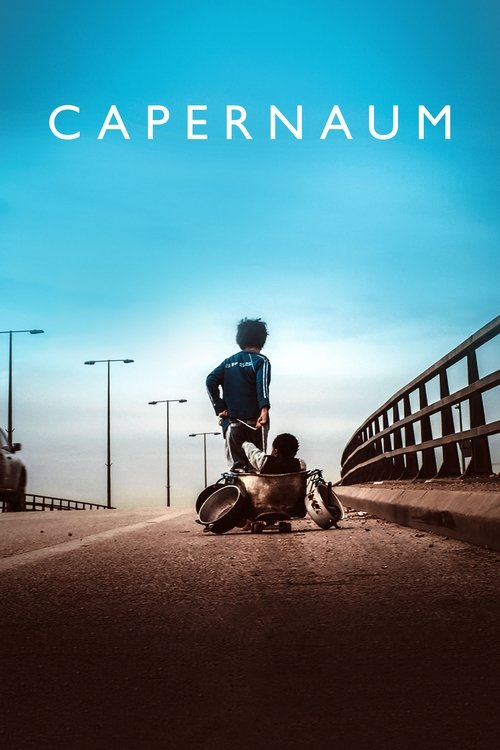
Capernaum
2018 · Nadine Labaki
For when you want to feel something real and come out shaken — a film that opens your eyes and breaks your heart in the same motion. Heavy, but there's fierce life and even humor in it.
What it's about
In a Beirut courtroom, a twelve-year-old boy sues his parents — for having brought him into the world. From that impossible charge the film flashes back through Zain's life in the city's poorest quarters: a family too overwhelmed to protect him, a little sister he can't save from being married off, and an undocumented Ethiopian mother whose baby ends up in Zain's care as he tries to survive the streets on wit alone.
The experience
Immersive, urgent, and emotionally overwhelming — it moves with documentary rawness but grips like a thriller about a child's survival. Bring tissues; it earns every tear without ever letting Zain become pitiable.
Performances
Zain Al Rafeea, a Syrian refugee discovered on the streets of Beirut, gives one of the great child performances — no cuteness, no acting-school polish, just a small, furious authority the camera never catches faking.
The craft
Nadine Labaki cast non-professionals living lives close to their characters' and shot handheld in real slums, so the line between fiction and document nearly disappears. The editing shapes years of footage into a story that feels both sprawling and inevitable, with aerial shots that suddenly show how big the chaos is around one small boy.
Why it matters
It won the Jury Prize at Cannes and an Oscar nomination, became a global arthouse phenomenon, and put Lebanese cinema — and the plight of stateless children — in front of audiences who'd never looked.
Snapshot
Capernaum opens on a paradox: a twelve-year-old boy in a Beirut courtroom, suing his parents for the crime of having given him life. The charge is impossible under any formal statute, yet director Nadine Labaki grounds it in the real precedent of Lebanese minors petitioning courts for protection from neglectful guardians. From that absurdist-realist hinge the film unfolds in extended flashback — a feverish, handheld immersion in the lives of Lebanon's poorest and most stateless inhabitants. Zain Al Rafeea, a Syrian refugee child discovered on the streets of Beirut, carries the film on a performance of startling, unvarnished authority. Capernaum won the Jury Prize at Cannes 2018 and an Academy Award nomination for Best International Feature Film; it became one of the defining humanitarian films of the late 2010s, arriving at the height of global discourse on the Syrian refugee crisis and statelessness.
The film's Arabic title, Kafarnahum, works on two registers: it names the biblical Capernaum — the Galilean city where Jesus performed miracles and was subsequently repudiated — and it exploits the word's second life in Lebanese colloquial Arabic, where kafarnahum means chaos, disorder, ungovernable mess. Both meanings are load-bearing. The film is about a city teeming with people whom the state has rendered invisible, and about the miracle of a child's conscience erupting inside that chaos.
Industry & production
Labaki and her producing partner Khaled Mouzanar developed the project over several years of embedded research in Beirut's most marginalized neighborhoods — refugee camps, slum districts, and the informal settlements of migrant workers from sub-Saharan Africa. The casting process was integral to the production methodology: rather than auditioning trained child actors, the team canvassed these communities directly, encountering Zain Al Rafeea, then approximately twelve years old, as a Syrian refugee living in Lebanon without documentation. The actor's off-screen circumstances — statelessness, poverty, family rupture — mirrored those of the character he would play, a collapse of diegetic and biographical distance that the film both exploits and, through its production process, actively addressed (Al Rafeea's family was ultimately granted asylum in Norway following the film's release).
The production was a Lebanese co-production distributed internationally by BAFTA and Cannes circuit distributors before Netflix acquired global streaming rights, giving the film a reach far beyond the arthouse audience. Budget figures have not been officially disclosed. Shooting extended over several months in actual Beirut locations, principally in the Sabra and Shatila district and surrounding informal settlements, with the crew working around resident populations rather than clearing locations for controlled filming.
Technology
Capernaum was shot digitally, with cinematographer Christopher Aoun using handheld ARRI digital cameras in a configuration suited to close, reactive work in confined spaces. The choice of digital over film was pragmatic and aesthetic: the extended observational takes, the tight pursuit of children through crowded alleys, and the improvisational rhythms of working with non-professional actors required a lightweight, fast-responding apparatus. No significant use of visual effects, processing, or digital augmentation has been reported; the images present themselves as aggressively unmediated. The digital format contributes to the impression of documentary witness even as Labaki's control over composition and staging maintains an undeniable cinematic intentionality.
Technique
Cinematography
Christopher Aoun's work is organized around proximity and instability. The camera habitually positions itself at or below Zain's eyeline — the adult world viewed from the perspective of a child who has learned to navigate it by instinct rather than privilege. Aoun favours long, unbroken handheld takes that pursue their subjects through the texture of place: markets, stairwells, drainage pipes, rooftop shelters built from scavenged corrugated iron. The depth of field is often shallow, isolating faces against the swarming, indistinct life of the background, while other shots pull back to contextualize the body within an overwhelming urban density. There is a studied refusal of beauty for its own sake; the palette is sun-bleached and harsh, the Beirut interiors dim and cluttered. Where Aoun does achieve sustained visual lyricism — occasionally at dusk, or in close study of the infant Yonas's face — it lands with disproportionate force precisely because the surrounding visual language has withheld it.
Editing
Laure Gardette, a French editor who had previously cut Labaki's Where Do We Go Now? (2011), shaped an enormous amount of documentary-adjacent material — the shoot generated an exceptional volume of footage given the improvisational working methods — into a film with a coherent dramatic arc. The courtroom framing device provides temporal anchors, cutting back to Zain's testimony to modulate pacing and maintain narrative tension in what would otherwise be a picaresque accumulation. Gardette's editing is associative rather than strictly causal, allowing scenes to breathe past the point of narrative necessity; the cuts often land on faces rather than actions, reading for emotional residue rather than propelling plot. The rhythm quickens in sequences of crisis and slows to near-stillness in sequences of provisional safety, tracking the film's emotional barometric pressure.
Mise-en-scène / staging
Labaki has spoken of working in a semi-improvisational mode with her non-professional cast, providing narrative parameters and emotional beats while allowing actors to find their own physical language within scenes. The staging reflects this: blocking is loose and responsive, objects and obstacles in the real environment allowed to disrupt and redirect action rather than cleared away. The mise-en-scène accumulates detail that reads as documentary fact — the particular texture of a mattress on a concrete floor, the mechanics of transporting an infant in a pot on a makeshift trolley — while the film's emotional architecture is rigorously constructed. Zain's improvisations with the baby Yonas, hauling him through the city's infrastructure, generate some of the film's most formally inventive images: a small body responsible for a smaller one, moving through spaces that were never built to accommodate them.
Sound
The sound design is densely layered — urban ambient noise, the overlapping Arabic, Amharic, and other languages of Beirut's polyglot underclass, children's voices, and the persistent intrusion of the city's mechanical and commercial life. Khaled Mouzanar's score, used selectively, tends toward strings and sparse melodic figures; it does not overwhelm or sentimentalize, functioning instead as emotional punctuation in a sound mix that otherwise insists on the chaos of the real. The title's colloquial meaning is, in part, achieved sonically: the film sounds like kafarnahum.
Performance
Zain Al Rafeea delivers one of the most remarkable child performances in recent cinema — not because it is technically virtuosic in the conventional sense but because it seems to operate outside the usual grammar of performed emotion. His face is guarded, watchful, and furious, with occasional eruptions of tenderness that register as biographically earned rather than directed. Yordanos Shiferaw, an Ethiopian actress playing Rahil the undocumented migrant worker, matches him in scenes together; her performance, like his, achieves its power through compression rather than release. The infant Boluwatife Treasure Bankole, who plays Yonas, was cast from Lagos; his scenes with Al Rafeea carry an absurdist tenderness that offsets the film's most unsparing passages.
Narrative & dramatic mode
The film employs a fractured chronology anchored in the courtroom present and the extended flashback of Zain's life before arrest. This structure allows Labaki to manage dramatic irony — the viewer knows from the outset that violence has occurred and that Zain is in custody — while withholding the specific sequence of events that led there. The narrative mode oscillates between social-realist case study (cataloging systems of deprivation with near-documentary precision) and something approaching picaresque: Zain moves through the city acquiring and losing companions, navigating danger with improvisational resourcefulness, the plot driven less by conventional dramatic causality than by the pressure of material scarcity. There is also a strand of the legal procedural, filtered through Kafkaesque absurdism: the lawsuit is the film's structuring conceit, its emotional logic sound even as its juridical premises are impossible.
Genre & cycle
Capernaum belongs most clearly to the tradition of social-realist cinema concerned with childhood poverty and state abandonment — a tradition extending from Italian neorealism through Iranian children's cinema to contemporary global-south poverty realism. Its closest generic contemporaries include Sean Baker's The Florida Project (2017), which maps analogous deprivation in American vernacular, and the Dardenne Brothers' sustained attention to precarious working-class bodies. It is also a film of the refugee-crisis cycle of the 2010s, alongside such works as Gianfranco Rosi's Fuocoammare (2016) and Ai Weiwei's Human Flow (2017), though Labaki works in narrative fiction rather than documentary. Some critics used the term "poverty tourism" or "misery cinema" against the film, a charge leveled also at City of God (2002) and Slumdog Millionaire (2008); defenders have argued that Labaki's embedded methodology and her attention to the structural causes of deprivation distinguish the film from exploitative precedents.
Authorship & method
Nadine Labaki is Lebanon's most internationally prominent filmmaker of her generation. Her earlier features — Caramel (2007) and Where Do We Go Now? (2011) — worked in lighter registers, examining Lebanese social life with warmth and irony, but established her characteristic interest in community, gender, and the societal forms through which ordinary lives are organized and constrained. Capernaum represents a decisive tonal and methodological shift toward harder social material. The screenplay was co-written by Labaki with Jihad Hojeily, the collaboration grounded in extensive fieldwork. Composer Khaled Mouzanar, Labaki's husband, has scored all her features, providing a consistent sonic authorship across her body of work. Cinematographer Christopher Aoun, the director's collaborator since Where Do We Go Now?, developed with her the visual grammar of proximity and handheld pursuit that Capernaum takes to its logical extreme. Editor Laure Gardette's work across Labaki's last two films gives her a significant stake in the authorial architecture.
Movement / national cinema
Lebanese cinema occupies a peculiar position in global film culture: a small national industry with intermittent international visibility, shaped by civil war, sectarian politics, and diaspora. The 1975–1990 civil war effectively dismantled whatever nascent infrastructure existed; the post-war revival produced filmmakers like Randa Chahal Sabbag, Joana Hadjithomas and Khalil Joreige, and Philippe Aractingi, who worked primarily in memory, trauma, and the war's unresolved aftermath. Labaki's work is distinct from this in its orientation toward the present social fabric — poverty, migration, sectarian coexistence — and in its consistent pursuit of international commercial distribution alongside festival prestige. Capernaum is arguably the Lebanese film most widely seen by global audiences, which is itself a comment on the structures of international film distribution: the film's humanitarian subject matter made it legible within a global-festival and NGO-adjacent discourse that Lebanon's more formally experimental filmmakers have not occupied. It is simultaneously a work of national cinema and a product of circuits that tend to render national specificity into universal-humanitarian currency.
Era / period
The film arrives at the intersection of several late 2010s convergences: the Syrian civil war and the largest refugee displacement in the region since 1948; intensifying global attention to child poverty and statelessness; and the expansion of streaming platforms as distributors of international prestige cinema. Netflix's acquisition placed the film in front of audiences who would never encounter it in theatrical release, making it one of the first international arthouse films to achieve genuine mass-streaming viewership. It also arrives in a period when the politics of humanitarianism in cinema were under renewed critical scrutiny — questions about who tells whose story, who profits from images of suffering, and what relationship documentary realism bears to advocacy were live in critical discourse when the film appeared.
Themes
The film's central subject is statelessness — not as legal abstraction but as an embodied condition: the absence of a birth certificate as the root of a cascade of deprivations, foreclosing school enrollment, medical care, legal personhood, the right to exist officially. Zain has no papers; Rahil has no papers; Yonas has no papers. The film traces how this absence compounds across generations. Alongside statelessness it addresses child labor, early marriage, the instrumentalisation of children within economies of poverty, and the ways in which parental neglect is itself produced by structural deprivation — Labaki insists, through the courtroom scenes, that the parents are victims too, caught in the same machine that crushes their children. The lawsuit is the film's moral thesis stated as action: a demand for accountability addressed to the system that makes such lives possible, displaced onto the parents as synecdoche for the state. The title's biblical resonance suggests that miracles occur in Capernaum — the capacity for moral outrage, for love between the abandoned — while the city, like its namesake, refuses to recognize them.
Reception, canon & influence
Critical reception. Capernaum received a standing ovation at its Cannes premiere and won the Jury Prize under jury president Cate Blanchett. It also won the Ecumenical Jury Prize at the same festival. International critical reception was strongly positive, with particular praise for Al Rafeea's performance and Labaki's direction; some dissent came from critics who found the film emotionally manipulative or who raised the structural "poverty tourism" critique. It received the Academy Award nomination for Best International Feature Film (2019 ceremony), losing to Roma.
Influences on the film (backward). The deepest inheritance is Italian neorealism, specifically Vittorio De Sica's attention to children in extremis (Shoeshine, 1946; Bicycle Thieves, 1948) and his method of casting non-professionals drawn from the social milieu the film depicts. Iranian children's cinema — Majid Majidi's Children of Heaven (1997), Abbas Kiarostami's early Koker films — provides a more recent precedent for lyrical social realism centered on child protagonists. The Dardenne Brothers' sustained formal project of close, mobile handheld pursuit of bodies under economic pressure is a clear stylistic influence. Fernando Meirelles and Kátia Lund's City of God (2002) established a template for kinetic poverty realism in the Global South that later filmmakers could not entirely escape. Sean Baker's work, particularly Tangerine (2015) and The Florida Project (2017), offers a near-contemporary parallel in its methods if not its geography.
Legacy / what it shaped (forward). The film's influence on subsequent production is difficult to isolate with precision given the short time elapsed, but it has demonstrably expanded the international visibility of Lebanese cinema and of films about statelessness and child rights. Its Netflix reach gave it a pedagogical life in educational and NGO contexts that theatrical distribution rarely affords. The story of Zain Al Rafeea — the Syrian child refugee whose role in the film contributed to his family's asylum claim — became a widely-reported instance of cinema intersecting with refugee advocacy, a story the film itself, in some sense, inaugurated. As a model of socially embedded, research-driven narrative fiction using non-professional actors drawn from marginalized communities, it joins a body of practice — Iranian social realism, the Dardenne tradition, Baker's work — that represents one of contemporary world cinema's most vital methodological currents.
A Deleuzian reading
Watch the boy move the baby.
The full Deleuzian reading of Capernaum →
Reception
It exploded out of Cannes 2018 with a Jury Prize and a famously tearful standing ovation, then rode an Oscar nomination — but critics split hard between 'devastating masterpiece' and 'manipulative miserablism'. Audiences settled the argument: it's now one of the most beloved non-English films of its decade, its reputation carried by viewers rather than critics.
How Capernaum was received, from release to now →
Influences: the films it descends from and the films it influenced
- Shoeshine (1946) — Casts non-professional children drawn from the depicted social stratum inside a carceral bureaucratic system incapable of serving them; the device of a child seeking justice from adult institutions that structurally exclude him is the template Labaki inherits for Zain's lawsuit against his parents.
- Bicycle Thieves (1948) — Father-child pair navigating Rome's streets on foot, filmed with a low-angle child-eyeline grammar and non-professional leads selected for social authenticity; the moral weight placed on a child witnessing adult humiliation originates the ethical device Labaki centers.
- Kes (1969) — Non-professional Yorkshire boy navigating hostile adult institutions filmed with a concealed camera to capture unguarded reactions; Loach's method of giving non-actors scripted scenarios rather than written dialogue is the direct precedent for Labaki's semi-improvisational staging with Zain Al Rafeea.
- Where Is the Friend's Home? (1987) — Child protagonist on a picaresque errand through an indifferent landscape of adult non-comprehension, built in quasi-documentary texture with a non-professional village boy; Kiarostami's practice of constructing narrative from a child's real-world navigation of obstacles anticipates Labaki's picaresque structure.
- Salaam Bombay! (1988) — Nair cast actual street children from Bombay's Chowpatty Beach after extended workshops designed to draw on lived experience, then shot their survival in the informal economy with kinetic handheld street-level grammar; this is the South Asian procedural model for Labaki's fieldwork-driven casting method.
- La Promesse (1996) — Handheld camera following a teenage male protagonist entangled in the exploitation of undocumented African migrant workers; the Dardennes establish the ethical grammar of handheld filming as moral accountability for precarious immigration status that cinematographer Christopher Aoun applies throughout Capernaum.
- Children of Heaven (1997) — Non-professional Iranian siblings navigating shared-shoe poverty in sustained close-up; Majidi's editing technique of holding on a child's face until emotional meaning arrives — the face-landing cut — is the most proximate model for Capernaum's affective editing grammar.
- Rosetta (1999) — Camera pressed close to the protagonist's back and shoulders as she moves under economic emergency, refusing wide shots that would aestheticize her poverty; this body-pursuit handheld technique is the direct formal ancestor of Aoun's chase-grammar when following Zain through Beirut's alleys.
- City of God (2002) — Non-professional cast drawn from the depicted favela community, fractured chronology with retrospective narration, and kinetic handheld shooting as the grammar of Global South poverty realism; all three devices recur structurally in Capernaum.
- Nobody Knows (2004) — Four children abandoned in a Tokyo apartment filmed over a year with a child actor who aged genuinely during production; Kore-eda's extended semi-documentary observation of children operating entirely outside adult supervision is the closest precedent for Labaki's long fieldwork period and proximity to her young cast.
- Young Mothers (2025) — Casts a non-professional child drawn from the real poverty it depicts and shoots him handheld through the city, turning a minor's claim on adult responsibility into the film's ethical spine.
- Like Father, Like Son (2013) — Builds a class-and-parenthood drama entirely on a non-professional child's lived presence, pushing the naturalistic child-performance and 'who deserves to raise a child' questions into a harsher register.
- Rocks (2019) — Cast by workshopping with actual teenage girls from the depicted East London community over months before shooting — directly extending Labaki's fieldwork-driven casting method — then filmed in close handheld proximity with semi-improvisational scenes that propagate the Capernaum model of poverty realism with non-professional child leads.
- Tori and Lokita (2022) — The Dardennes apply their handheld pursuit grammar to unaccompanied African child migrants trapped in Belgian bureaucratic and criminal systems; the film's Kafkaesque legal-institutional trap for refugee children — a subject Capernaum helped position as viable for serious art cinema — runs on formal rails continuous with Labaki's work.
- Beasts of the Southern Wild (2012) — Six-year-old non-professional girl as sole narrative focalizer in a community facing displacement, with handheld child-eyeline immersion and editing that constructs ethical argument through sustained close-up on a child's face; shares Capernaum's formal grammar even as its mythopoeic register differs from Labaki's social realism.
- The Florida Project (2017) — Near-contemporary parallel: non-professional six-year-old lead, semi-improvisational scenes built around children's unscripted behavior, child-eyeline framing of housing precarity, and a structurally complicit mother whose survival strategies harm her child — matching Capernaum's core ethical and formal architecture.
- Shoplifters (2018) — Released the same year; Kore-eda builds a found-family poverty narrative with quasi-improvisational staging and face-landing close-ups, withholds backstory through elliptical editing that is a structural sibling to Capernaum's fractured chronology, and frames institutional failure around a child's ambiguous legal status.
- Roma (2018) — Nominated in the same Oscar category; both use non-professional leads embedded in their depicted social class, sustained location shooting in working-class urban space, and position a child's experience at the center of political crisis — though Cuarón's static long takes invert Capernaum's handheld pursuit grammar, making the pairing a study in contrasting realist methods.
- The President's Cake (2026) — Casting non-professionals off the street, rewriting scripted lines into the performer's own speech and shooting largely in sequence so a child's real development registers on camera — the working method Hadi describes for his own set.
Similar films
- Salaam Bombay! (1988) — influence & lineage · same viewing thread
- Young Mothers (2025) — influence & lineage
- Children of Heaven (1997) — influence & lineage
- Shoplifters (2018) — influence & lineage
- City of God (2002) — influence & lineage · same viewing thread
- Souleymane's Story (2024) — same viewing thread
- The Voice of Hind Rajab (2025) — shared sensibility
- The President's Cake (2026) — shared sensibility
All the films related to Capernaum →
Watch it with: curated runs of related films
- Cinema of the Dispossessed — A run of slum-and-favela dramas — Rio, Mexico City, Mumbai, the Paris banlieue — where children survive by their wits and the city itself is the antagonist.