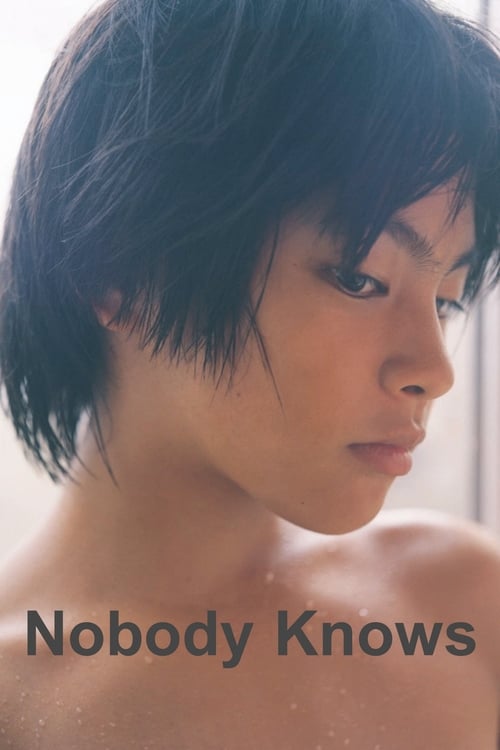
Nobody Knows
2004 · Hirokazu Kore-eda
The gentle humanist whose Monster (with a posthumous Sakamoto score and queer-childhood reveal) generated real festival argument; invoked in every conversation about family, ethics, and whether kindness can be an aesthetic.
For when you want to be moved slowly and completely — a patient, quietly heartbreaking film for a night you can give it your full attention. Bring tissues; this is the opposite of light viewing.
What it's about
In a small Tokyo apartment, twelve-year-old Akira quietly takes charge of his three younger half-siblings when their mother's absences stretch from days into months. Hidden from the landlord and unknown to the neighbors, the kids build a whole secret world of routines — cooking, allowances, small games — while the money runs down and the seasons turn. It's drawn from a true story that shocked Japan.
The experience
Gentle on the surface and devastating underneath. It never raises its voice or reaches for melodrama; catastrophe accumulates at the pace of dust settling, and the tenderness between the kids is what finally breaks you.
Performances
Fourteen-year-old Yuya Yagira became the youngest Best Actor winner in Cannes history for his turn as Akira — a performance of remarkable restraint, all responsibility held behind a boy's face.
The craft
Kore-eda came up through documentary and it shows: he shot chronologically over a full year so his young cast visibly grows, and built scenes from unscripted moments. The camera attends to small things — chipped nail polish, instant ramen, a toy piano on the balcony — and lets those details carry the story instead of dialogue.
Why it matters
The film was Kore-eda's international breakthrough and cemented his reputation as the great modern chronicler of makeshift families, a theme he'd return to for the next two decades.
Drawn from a 1988 Tokyo news story that horrified Japan, Kore-eda's breakthrough fiction feature watches twelve-year-old Akira and his three younger half-siblings keep house in a small apartment as their mother's absences stretch from days into seasons. Kore-eda came up through documentary, and it shows: he shot chronologically over a full year, letting his young cast visibly grow, and built scenes from unscripted moments rather than performances. Nothing is melodramatized. The camera attends to hands, chipped nail polish, instant ramen, a toy piano on the balcony, and lets catastrophe accumulate at the pace of dust settling. The method made fourteen-year-old Yuya Yagira the youngest Best Actor winner in the history of Cannes, chosen over the adult field of 2004. It also fixed Kore-eda's standing as the great contemporary heir to Ozu and Naruse's family cinema — though his subject here is harsher than theirs ever was: how children, left to themselves, improvise a whole civilization out of what adults abandon.
A Deleuzian reading
A hand, held in close-up.
The full Deleuzian reading of Nobody Knows →
Reception
Acclaimed from the moment it premiered at Cannes in 2004, it's never needed a reappraisal — it's simply hardened over two decades into the consensus pick for Kore-eda's masterpiece and the gateway film people hand to newcomers before Shoplifters.
How Nobody Knows was received, from release to now →
Influences: the films it descends from and the films it influenced
- Tokyo Story (1953) — Low, static tatami-height camera holding domestic apartment space in patient long takes, letting family life register through blocking and repeated household gestures rather than dramatic incident.
- When a Woman Ascends the Stairs (1960) — The anti-melodramatic method of registering a woman's/family's economic precarity through withheld emotion and undemphasized daily hardship, refusing the crescendo the material invites.
- Shoeshine (1946) — Italian-neorealist casting of untrained children as the emotional center, shooting their unpolished behavior observationally so poverty and abandonment read as documented fact, not staged pathos.
- The 400 Blows (1959) — Trailing a neglected child through an indifferent adult world with an observational, non-judging camera that follows behavior and lets small autonomous acts of survival accumulate.
- Where Is the Friend's House? (1987) — Documentary-fiction hybrid built entirely on non-professional child performers, eliciting naturalism through real tasks and locations rather than scripted line-readings.
- Kes (1969) — Social-realist direction of a child actor in near-improvised domestic scenes, shooting in sequence and on real interiors to protect the spontaneity of a working-class kid's performance.
- Maborosi (1995) — Kore-eda's own founding grammar of distant, static observational framing and slow elliptical accumulation of grief, the still-camera restraint he later brings into a cramped apartment.
- After Life (1998) — His documentary-background method of mixing real testimony and non-actors, building fiction from observed behavior and interview-derived detail rather than plotted drama.
- Sansho the Bailiff (1954) — Observes the tragedy of abandoned, separated children with patient restraint and a refusal of melodramatic catharsis, the emotional discipline and child-suffering subject Mizoguchi pioneered in Sansho.
- Kikujiro (1999) — Carries a whole film on non-professional child actors observed by a patient static camera, withholding catharsis around abandoned childhood — the observational mode Kikujiro's casting and stillness point toward.
- A Brighter Summer Day (1991) — Inherits the non-professional child cast whose real behavior is drawn over long shoots, with private catastrophe unfolding under indifferent public conditions.
- Moving (1993) — Inherits the refusal of adult framing wholesale: adults cropped at the waist or left offscreen, narration carried by hands, feet and household objects at children's eye level, with abandonment registered as accumulating domestic detail.
- Nobody Knows shares with Still Walking (2008) — Extends the Ozu-heir chamber drama, staging an entire film inside domestic space where family tension surfaces through meals, chores and offhand talk instead of confrontation.
- Like Father, Like Son (2013) — Continues the improvised-domesticity method with child non-professionals, directing kids through play and routine to capture unforced parent-child intimacy on real interiors.
- Shoplifters (2018) — Directly reworks the abandoned-children-forming-a-provisional-family premise, again from a true crime case, with a makeshift household improvising domestic ritual in a cramped apartment.
- The Florida Project (2017) — Children's-eye-view of precarity with a non-professional child cast, letting long observational stretches of unsupervised play accumulate the sense of adults' absence.
- Capernaum (2018) — Non-professional child leads and near-documentary shooting of a minor raising a younger child alone, deriving performance from lived experience rather than script.
- Monster (2023) — Kore-eda developed his withheld-script child method here — disclosing narrative information to child actors only at the moment of shooting to obtain unrehearsed behavioral responses — a practice Monster deploys with Minato and Yori throughout all three sections.
- Still Walking (2008) — Kore-eda's own prior film established his observational handling of performance inside one apartment over long stretches, trusting duration and naturalist child/ensemble behavior — the working method he refines and tightens here.
- Hope (2013) — Model for eliciting unforced naturalistic child performance and letting scene duration carry a child's suffering without melodramatic underscoring.
- Summer 1993 (2017) — Sets the standard for shooting children semi-documentarily across a real season — feeding action rather than dialogue, cutting elliptically around unspoken loss — the observational-closeness approach Simón adopts wholesale.
- System Crasher (2019) — Patient observational realism about children falling through the gaps of a welfare system, extracting unforced performances from untrained kids over a long shoot.
- My Sunshine (2024) — Builds child performances through fragmentary, largely unscripted shooting so behavior reads as observed daily texture rather than delivered lines — the documentary-of-childhood method Okuyama adopts with his young skaters.
- Room (2015) — Sustains observational child-POV realism of children sealed inside an apartment-world, treating the confined domestic space as an entire universe seen at kid level.
- Rosetta (1999) — Observational immersion in a young person's hand-to-mouth survival economy—rent, food, small hustles—filmed as procedural daily labor with no melodramatic underscoring.
- Chop Shop (2007) — Neorealist observation of a parentless child fending for himself in an adult economy, using a non-professional lead and real working locations shot with documentary patience.
- L'Enfant (2005) — Withholds moral commentary and scoring while observing young people mishandling the care of a child, trusting accumulated behavioral detail to carry the ethical weight.
- The Eel (1997) — Carries forward Imamura's location-grounded, ensemble anthropology of overlooked underclass life observed at a quiet entomological remove.
- All About Lily Chou-Chou (2001) — Digital-handheld naturalism drawing unforced performances from real children, observing abandoned kids' cruelty and tenderness without adult framing.
- Lion (2016) — Parallel method of eliciting a naturalistic, near-wordless performance from a real child navigating abandonment, privileging small sensory detail over plot exposition.
- Children of Heaven (1997) — Parallel child-centered realism that observes poverty and shame at a child's eyeline through small objects and daily errands, coaxing unaffected performances from real children over patient duration.
- Our Little Sister (2015) — The patient child-actor direction — feeding lines on the day, shooting in long chronological blocks to capture real growth — is the same method that yields the unforced sibling chemistry in this film.
- The Way Home (2002) — Observational patience with non-professional children, letting kids simply behave on camera under ambient naturalism rather than hit performed beats.
- Oasis (2002) — Observational long-scene realism on socially invisible, abandoned children that withholds sentiment and lets duration expose marginalization — the same restraint Oasis practices.
- The Son of a Thousand Men (2025) — Uses patient elliptical, observational editing to watch children assemble a self-sufficient kinship, eliding dramatic peaks to privilege accumulated small gestures.
Similar films
- Shoplifters (2018) — influence & lineage · same viewing thread
- Maborosi (1995) — influence & lineage · same viewing thread
- Like Father, Like Son (2013) — influence & lineage · same viewing thread
- Tokyo Story (1953) — influence & lineage · same viewing thread
- Our Little Sister (2015) — same viewing thread
- Still Walking (2008) — same viewing thread
- After the Storm (2016) — same viewing thread
- After Life (1999) — same viewing thread
All the films related to Nobody Knows →
Watch it with: curated runs of related films
- The Weight of the Unspoken — A run of quietly shattering films where the largest feelings never get said aloud — love that outlasts reason, grief that gathers over a single family dinner, a long marriage cracked open by one old letter.