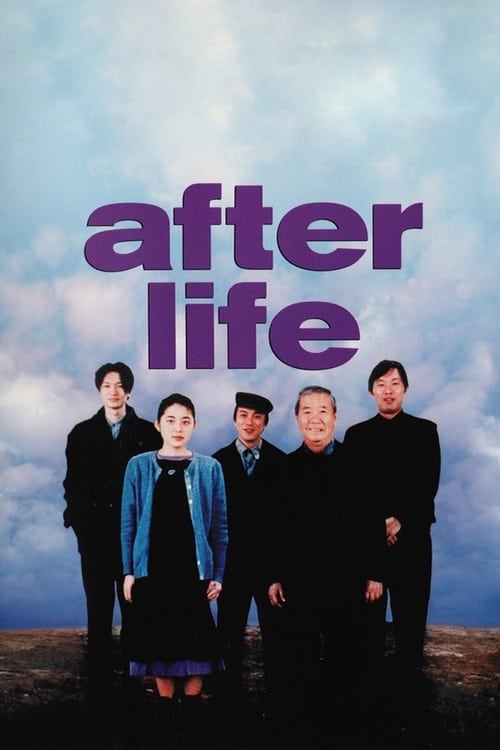
After Life
1999 · Hirokazu Kore-eda
The gentle humanist whose Monster (with a posthumous Sakamoto score and queer-childhood reveal) generated real festival argument; invoked in every conversation about family, ethics, and whether kindness can be an aesthetic.
For a reflective night when you want a film to sit with — something tender that makes you call your parents or flip through old photos afterward. Gentle in tone, profound in aftertaste.
What it's about
The recently dead arrive at a shabby way station — part social-services office, part old school building — where gentle caseworkers give them one week to choose a single memory from their lives. That memory will be recreated and filmed by the staff, and it's the only thing each person carries into eternity. The film follows one week's intake: old men, teenagers, the stubborn, the regretful, and the counselors quietly wrestling with choices of their own.
The experience
Hushed, warm, and quietly devastating — less a fantasy spectacle than a series of intimate conversations that sneak up on you. It sends you out asking the question of your own life: which moment would you keep?
The craft
Kore-eda shoots the afterlife like a documentary: drab offices, winter light, faces talking straight to camera, with real people's recollections woven in among the scripted ones, so the memories feel found rather than written. The handmade recreations of memories — cotton-wool clouds, studio breezes — are deliberately humble, and all the more moving for it.
Why it matters
It confirmed Kore-eda as one of world cinema's great humanists and became a beloved word-of-mouth classic — the film people hand each other when they want to talk about memory, mortality, and what a life adds up to.
Snapshot
After Life (Japanese title Wandafuru raifu / ワンダフルライフ — literally "Wonderful Life") is Hirokazu Kore-eda's second narrative feature, a quiet metaphysical fable built on a single, deceptively simple premise: the recently dead arrive at a shabby, half-institutional way station — somewhere between a bureaucratic office and a defunct school — where a staff of caseworkers gives them one week to choose a single memory. That memory will then be reconstructed and filmed by the staff; once the deceased watches the finished recreation, they move on into eternity carrying only that one moment, everything else dissolved away. The conceit lets Kore-eda fuse two of his abiding preoccupations — the texture of ordinary remembrance and the apparatus of cinema itself — into one structure, since the afterlife here is, quite literally, a film studio. The result is among the defining works of the international art-cinema revival of the late 1990s and the film that, after the formally austere Maborosi (1995), announced Kore-eda as a major humanist voice.
Industry & production
After Life was produced through TV Man Union, the independent Japanese production house where Kore-eda had spent his formative years as a documentary director, in association with Engine Film. The producing credits are generally attributed to Shiho Sato and Masayuki Akieda. The project grew directly out of Kore-eda's documentary practice rather than out of a conventional screenplay-financing pipeline: he and his team conducted extensive interviews — by his own account, several hundred people — asking ordinary individuals to describe the single memory they would choose to keep. Many of those interviewees appear in the finished film, recounting (or lightly reworking) their own recollections directly to camera, alongside professional actors performing scripted roles. This hybrid production model — non-professionals folded into a fiction, the casting process doubling as research — kept the film modestly budgeted and improvisatory in spirit. It belongs to the late-1990s moment when Japanese auteur cinema, long marginal in international distribution, was again finding festival traction; After Life traveled widely on the festival circuit and secured arthouse distribution in the United States and Europe, where it became one of the more visible Japanese imports of its years and a cornerstone of Kore-eda's growing overseas reputation.
Technology
The film's technology is, by design, modest and unglamorous, and its visible "technology" is partly its subject. The image carries a soft, grainy, naturalistic quality consistent with a small-gauge, available-light approach; the production embraced a rough documentary surface rather than the lacquered look of studio drama. More pointedly, the film stages its own technology of memory-making: the staff reconstruct each chosen memory using deliberately handmade, low-fi effects — cotton-wool clouds, an electric fan to simulate a breeze through a train window, painted backdrops, model trams. Kore-eda foregrounds the seams of this craft, showing the lights, the set walls, the operators. The "special effects" are intentionally artisanal and visible, so that the act of cinematic illusion becomes a theme rather than a concealment. In an era already tilting toward digital compositing, After Life makes a quiet argument for the tactile, fabricated, communal labor of pre-digital movie-making as the truest analog for how memory itself is constructed.
Technique
Cinematography
The cinematography — credited to Yutaka Yamasaki, a frequent Kore-eda collaborator, with the noted still photographer Masayoshi Sukita also associated with the film's images — divides the picture into registers. The interview and way-station scenes favor a documentary grammar: handheld or lightly mobile framing, direct-address compositions in which the dead speak across the desk to a caseworker (and, in effect, to us), available light, and a muted, wintry palette of grays, browns and institutional pallor. The look is plain, even drab, refusing prettiness. By contrast, the staged memory-recreations are lit and framed to look constructed — softer, more theatrical, their artifice acknowledged. The grain and naturalism work against sentimentality: this is an afterlife rendered in the visual idiom of a worn public building on an overcast week, which is precisely what gives the film its tenderness when warmth does break through.
Editing
Kore-eda, who came to fiction from documentary and has long been closely involved in cutting his own work, shapes the film around accretion rather than plot mechanics. The editing patiently alternates between the week's structure — intake, interviews, deliberation, construction, screening — and the digressive testimonies of the dead, allowing the catalog of remembered moments to build cumulatively into the film's emotional argument. The rhythm is unhurried, observational, willing to hold on a face hesitating over a memory. Crucially, the film withholds its central revelation (the buried link between the caseworker Mochizuki and one of his charges) until late, so that the editing reframes everything that preceded it. The pacing trusts the audience to sit inside ordinary recollection without dramatic prodding.
Mise-en-scène / staging
The production design is one of the film's quiet triumphs: the way station is a space of peeling paint, fluorescent corridors, scuffed wood and clerical clutter, suggesting a postwar municipal office that has been processing souls for a very long time. The banality is the point — eternity administered by overworked staff with clipboards and deadlines. Against this, the memory-sets erected on a soundstage are charmingly improvised and unfinished-looking. Staging favors the everyday gesture and the unforced grouping of figures in real-feeling rooms; Kore-eda places his actors in deep, lived-in spaces and lets behavior, not blocking, carry meaning.
Sound
The sound design is similarly restrained, built from the ambient hum of the institution — corridors, weather, the clatter of the workshop where memories are assembled. Dialogue, much of it drawn from or shaped by real testimony, has the hesitant cadence of genuine recollection. The musical score, composed by Yasuhiro Kasamatsu, is spare and used sparingly, entering to underline grace rather than to dictate feeling; for long stretches the film proceeds on near-silence and room tone, which heightens the impact of the rare moments when music and memory coincide.
Performance
Performance in After Life spans a deliberate spectrum from the documentary-real to the gently theatrical. The non-professional interviewees bring an unrehearsed authenticity — pauses, self-corrections, sudden emotion — that no script could counterfeit. Among the professional cast, Arata (Arata Iura) plays the young caseworker Takashi Mochizuki with a watchful, melancholy reticence, and Erika Oda plays his junior colleague Shiori with a yearning that slowly surfaces. Taketoshi Naitō is central as Ichiro Watanabe, the elderly man who can find nothing remarkable in his long life, and the veteran Kyoko Kagawa — a living link to the golden-age cinema of Ozu, Mizoguchi and Kurosawa — appears as the woman whose memory becomes the film's emotional keystone. The blend of registers is itself thematic: the film keeps asking where remembered life ends and performed life begins.
Narrative & dramatic mode
The film operates in a contemplative, episodic mode whose engine is interview rather than incident. Its dramatic spine is twofold. First is the procedural rhythm of the week — a structure that lends the metaphysical premise a grounding, almost workplace ordinariness. Second is the slowly disclosed personal drama: as caseworker Mochizuki helps the reluctant Watanabe sift a lifetime for one worthy moment, the film reveals that Watanabe had married a woman who was once Mochizuki's own fiancée, and that Mochizuki — long dead, lingering as staff precisely because he could never choose his own memory — discovers that he himself lives on inside her chosen memory. The realization that one's meaning may reside in being remembered by another, rather than in one's own remembering, resolves the film's quiet existential question. The mode throughout is humane and undidactic: the afterlife premise is a frame for an inquiry into what, in a life, is worth keeping.
Genre & cycle
Nominally fantasy and drama, After Life sits within a small but recognizable lineage of "afterlife bureaucracy" fictions — works that imagine death as administered process — of which Albert Brooks's Defending Your Life (1991) is a notable Western forerunner, and to which Powell and Pressburger's A Matter of Life and Death (1946) is sometimes compared. But Kore-eda strips the conceit of comedy and spectacle, hybridizing it with documentary realism and the Japanese tradition of the contemplative everyday-life drama. The English-language title, After Life, foregrounds the metaphysics; the original Japanese title, Wonderful Life, openly invokes Capra's It's a Wonderful Life while inverting its logic — not a life retrospectively justified by its effect on others, but a life distilled to a single irreducible image. It thus reads as both a genre piece and a meta-cinematic essay on remembrance.
Authorship & method
After Life is the pivot on which Kore-eda's authorship turns. He began at TV Man Union as a documentarian whose subjects — among them films about a bureaucrat's suicide and about living with terminal illness — circled memory, bureaucracy, grief and the ethics of representation. His fiction debut Maborosi (1995) had been rigorously composed, static and painterly, indebted to a tradition of distanced long-shot framing. With After Life he deliberately loosened that method, importing the handheld immediacy, improvisation and reliance on non-actors of his documentary work — a synthesis that would define the rest of his career. His authorial method here is collaborative and research-driven: the screenplay (his own) was developed out of real interviews, and the film's central question was first put to ordinary people before it was put to characters. Among his key collaborators, cinematographer Yutaka Yamasaki was a recurring presence in this period; composer Yasuhiro Kasamatsu supplied the restrained score; and the casting of Kyoko Kagawa consciously threaded the film into the lineage of classical Japanese cinema even as Kore-eda forged something new. Kore-eda has tended to cite Ken Loach and Hou Hsiao-hsien among his touchstones and has been wary of the reflexive comparison to Ozu, even as critics persist in it.
Movement / national cinema
The film belongs to the resurgence of Japanese auteur cinema in the 1990s, when a generation working outside the declining studio system — Kore-eda, Naomi Kawase, Shinji Aoyama, Kiyoshi Kurosawa among them — drew international festival attention and re-established Japan as a source of serious art cinema after the long shadow of its postwar golden age. Many of these filmmakers, like Kore-eda, came up through television, documentary or independent production rather than studio apprenticeship, and brought a documentary-inflected realism to fiction. After Life exemplifies that current: low-budget, independently produced, grounded in the observation of ordinary Japanese lives, and conversant with both the national tradition (the everyday-life shomin-geki sensibility) and the transnational vocabulary of the festival circuit.
Era / period
Made at the close of the 1990s, the film is marked by its moment in subtle ways. The way station's worn, analog institutional world evokes a postwar Japan of public offices and ledgers rather than the digital present, and the spread of remembered eras among the dead — including a character who recalls the war — quietly registers the long twentieth century receding into memory. The Mochizuki backstory, tied to a death in the war, anchors the film to the unresolved weight of that history. Aesthetically, it arrives just before digital tools would transform image-making, and its insistence on handcrafted, photochemical-feeling illusion reads in retrospect as a film poised on the threshold of the analog-to-digital turn, choosing the analog.
Themes
The film's governing theme is memory as the substance of a self: if a life could be reduced to one keepable moment, what would remain, and what does that choice reveal? From this flow its other concerns — the dignity and sufficiency of ordinary, unspectacular lives (Watanabe's anxiety that he accomplished nothing is the film's moral test case); the idea that meaning may lie not in being remembered but in what and whom we remember, and reciprocally in being someone else's cherished memory; and the consoling notion that to choose one memory is also to forgive or release a whole life. Threaded through all of this is the film's central metaphor: cinema as the technology of memory. By making the afterlife a film studio, Kore-eda equates the act of recollection with the act of filmmaking — selection, staging, projection, witnessing — and suggests that movies are how the ephemeral is made to last. The artisanal fakery of the recreated memories argues, gently, that the truth of a memory survives even its obvious fabrication.
Reception, canon & influence
Critically, After Life was widely and warmly received on its international release, praised for the originality of its premise, the emotional restraint of its execution, and the unexpected profundity it drew from a near-documentary surface; it consolidated Kore-eda's standing as one of the leading humanist filmmakers of his generation and remains one of his most beloved and frequently revisited works. (Specific awards and box-office figures from the film's release are not something I can document reliably here, and I won't invent them.)
Looking backward, the film's influences lie less in genre cinema than in Kore-eda's own documentary practice and in the broad tradition of Japanese everyday-life drama; the afterlife-as-bureaucracy idea has a Western antecedent in Defending Your Life, and the Japanese title's nod to It's a Wonderful Life signals an explicit, ironic dialogue with Capra. Kore-eda's stated affinities for Loach's social realism and Hou's contemplative long-take style are legible in the texture.
Looking forward, the film's legacy is twofold. Within Kore-eda's own corpus it established the documentary-fiction hybrid, the patient observational rhythm, and the preoccupations with death, memory and family that run through Nobody Knows, Still Walking, Like Father, Like Son and Shoplifters. More broadly, its image of a bureaucratic, processed afterlife and its meditation on a single defining memory have made it a touchstone repeatedly invoked in discussions of later memory-and-afterlife films — including animated features that imagine death as an administered passage — and a perennial reference in writing about cinema as a memory machine. Any claim of direct lineage to specific later productions should be made cautiously; what is clear is that After Life endures as a canonical statement of the idea that to film a memory is to keep it.
A Deleuzian reading
A man crouches beside a fake train window holding an electric fan.
The full Deleuzian reading of After Life →
Reception
A quiet arthouse hit on its 1999 US release, it steadily climbed from 'promising second feature' to consensus masterpiece — Shoplifters' Palme d'Or sent a new generation back to it, and the 2021 Criterion edition sealed the canonization.
How After Life was received, from release to now →
Influences: the films it descends from and the films it influenced
- Maborosi (1995) — Kore-eda's own debut supplies the static, painterly long-shot framing that After Life deliberately loosens — its 'composed register' survives as the second of the film's two visual registers, set against the new handheld interview footage.
- Kes (1969) — Loach's social-realist method of casting non-professionals and shooting their improvised, half-documentary behavior with unobtrusive handheld immediacy is exactly the technique Kore-eda imports into the interview sequences.
- The Puppetmaster (1993) — Hou's interleaving of a subject's spoken testimony with patiently reconstructed long-take scenes models After Life's two-register grammar of interview plus staged memory.
- Tokyo Story (1953) — The casting of Kyoko Kagawa, an Ozu/Naruse veteran, threads After Life's everyday-life domestic drama back into classical Japanese cinema as a deliberate performance lineage.
- Bicycle Thieves (1948) — Italian neorealism's foundational practice of building fiction around non-actors playing close to their own lives underwrites Kore-eda's documentary-to-fiction casting of ordinary people answering the film's central question.
- Defending Your Life (1991) — Brooks supplies the Western antecedent of the afterlife rendered as a mundane processing bureaucracy — a way-station of staff, paperwork and review of one's life — that After Life recasts in a deadpan administrative register.
- It's a Wonderful Life (1946) — The Japanese title's explicit nod to Capra signals the borrowed structural device of distilling a whole life down to its single defining, meaning-bearing memory.
- Sans Soleil (1983) — Marker's essayistic treatment of footage as a fallible memory machine — images that store and reconstruct the past — prefigures After Life's premise that to film a memory is to preserve it.
- Nobody Knows (2004) — Extends After Life's patient observational rhythm and reliance on coaxed, non-professional child performances filmed over long durations into a verité family drama.
- Still Walking (2008) — Carries forward the accretive, low-key domestic staging and the preoccupation with a single absent figure recalled through memory that After Life established as Kore-eda's house style.
- Like Father, Like Son (2013) — Continues the documentary-fiction hybrid of drawing scripted scenes from real interview research, here interviews with parents, in the restrained register pioneered in After Life.
- Shoplifters (2018) — The culmination of the After Life method: improvisation-friendly ensemble of near-non-actors, sparse scoring and delayed revelation of what binds the makeshift family.
- Rental Family (2025) — Depicts salaried workers who set-dress and stage emotional reconstructions for clients — the direct precursor to staffers paid to enact fabricated intimacies on a built set.
- Eternity (2025) — Provides the selection-of-a-single-eternity mechanic plus a documentary-realist, contained-observation staging of a modestly designed afterlife way-station, favoring caseworker interviews over spectacle.
- Departures (2008) — Shares After Life's framing of death as a procedural craft performed by quiet functionaries — the encoffiner's ritual paralleling the afterlife staff's careful reconstruction work — in a restrained Japanese register.
- A Ghost Story (2017) — Builds on the same conceit of a patient, near-silent observer suspended in a liminal way-station, distilling a life to fragments of memory through held, contemplative long takes.
- Coco (2017) — Imagines the afterlife as an administered passage with desks, clerks and processing gates — the bureaucratic-way-station image After Life made a touchstone — hinged on a single remembered self surviving death.
- Soul (2020) — Renders the threshold between life and death as a processing facility staffed by counselors who help a soul locate its defining 'spark,' directly echoing After Life's memory-selection bureaucracy.
- Our Little Sister (2015) — Kore-eda's documentary-rooted method of building fiction from interview-like elicited memory and non-professional presence establishes the naturalistic performance grammar he refines here.
Similar films
- Tokyo Story (1953) — influence & lineage · same viewing thread · often watched together
- Shoplifters (2018) — influence & lineage · same viewing thread
- Still Walking (2008) — influence & lineage · same viewing thread
- Maborosi (1995) — influence & lineage · same viewing thread
- Nobody Knows (2004) — influence & lineage · same viewing thread
- Departures (2008) — influence & lineage
- Like Father, Like Son (2013) — influence & lineage · same viewing thread
- Our Little Sister (2015) — same viewing thread
All the films related to After Life →
Watch it with: curated runs of related films
- The Weight of the Unspoken — A run of quietly shattering films where the largest feelings never get said aloud — love that outlasts reason, grief that gathers over a single family dinner, a long marriage cracked open by one old letter.