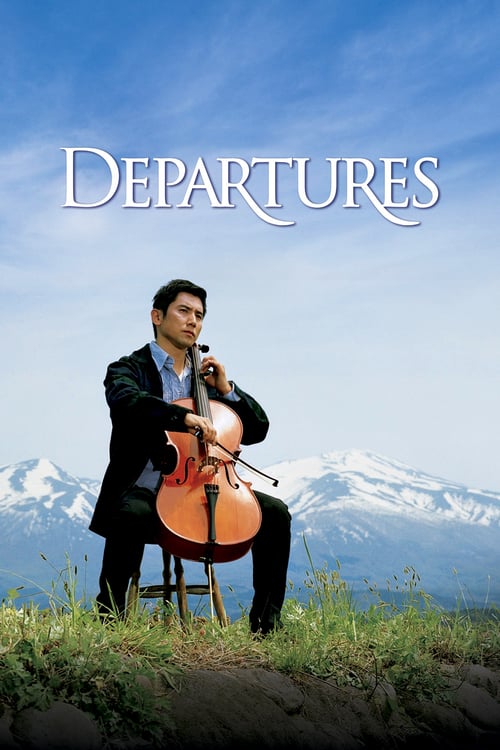
Departures
2008 · Yojiro Takita
For when you need a good cry that leaves you lighter, not heavier — a film about death that's really about tenderness. A comfort watch for a quiet evening, especially if you're grieving or thinking about someone you've lost.
What it's about
Daigo, a cellist, loses his job when his Tokyo orchestra dissolves, and moves with his wife back to his snowbound hometown in northern Japan. Answering a want-ad that promises work with 'departures,' he discovers the job is assisting an undertaker — specifically, performing the ritual cleansing and encoffining of the dead in front of grieving families. Ashamed to tell anyone what he does, he slowly finds in this taboo profession an unexpected vocation, and a way back to the father who abandoned him.
The experience
Gentle, funny, and quietly devastating by turns — it earns its tears honestly, through ritual and routine rather than manipulation. The pace is unhurried, the tone warm even when the subject is death, and it leaves you feeling consoled rather than bereft.
Performances
Masahiro Motoki carries the film as Daigo, letting revulsion melt into reverence almost entirely through his hands and posture, and Tsutomu Yamazaki is wonderfully dry as the laconic master encoffiner who teaches him the trade.
The craft
The encoffining ceremonies are filmed with the precision of choreography — folded cloth, careful hands, faces restored — and they become the film's most hypnotic passages. A cello-led score threads Daigo's old life through his new one, and the snowbound Yamagata landscapes give the whole film a hushed, wintry beauty.
Why it matters
Its Academy Award for Best Foreign Language Film was a genuine upset that made it a global word-of-mouth hit, and it brought the obscure profession of the nōkanshi into public view in Japan and beyond.
Snapshot
Departures (Japanese: Okuribito, 送りびと / お客りびと — literally "one who sends off") is a chamber drama built around a single, then-obscure Japanese profession: nōkanshi, the ritual mortician who cleans, dresses, and ceremonially encoffins the dead in front of the grieving family. Yojiro Takita's film follows Daigo Kobayashi (Masahiro Motoki), a cellist whose Tokyo orchestra dissolves, back to his snowbound hometown in Yamagata Prefecture, where he stumbles — via a euphemistic want-ad promising work with "departures" — into apprenticeship under a laconic master encoffiner (Tsutomu Yamazaki). What begins in disgust and social shame ripens into vocation, reconciliation with an absent father, and a meditation on death as a threshold rather than an ending. The film is best known for a fact of reception that outran its modest ambitions: at the 81st Academy Awards in February 2009 it won Best Foreign Language Film, the first Japanese film to take that competitive category, upsetting critical favorites and setting off a domestic re-release and reappraisal in Japan.
Industry & production
Departures originated not with its director but with its star. Masahiro Motoki has recounted that the project grew from his long-standing interest in death rituals — sharpened by travel in India and by his reading of Shinmon Aoki's memoir Coffinman (Nōkanfu Nikki), an account of a poet-turned-undertaker's spiritual life. Motoki is credited as the film's originating force, having nurtured the idea for years and taken cello and encoffinment training to embody it. The screenplay was written by Kundo Koyama, a prolific television writer here making a notable feature credit; the film is inspired by, rather than a direct adaptation of, Aoki's book, and Aoki reportedly declined a formal adaptation credit, so the screenplay dramatizes the profession freshly rather than transcribing the memoir.
The production is a mid-budget, mainstream Japanese studio drama rather than an art-house experiment — distributed domestically by Shochiku, one of the oldest Japanese majors, with a coalition of the usual production-committee partners (television and media companies) behind it, the standard financing structure for Japanese features of the period. Exact budget and Japanese box-office figures I will not assert precisely; the reliable record is that the film opened modestly at home in September 2008 and that its Oscar win triggered a substantial commercial second life in Japan and abroad. Its festival launch was decisive: it premiered at the Montreal World Film Festival in late August 2008 and won that festival's top prize, the Grand Prix des Amériques, an early signal of the international appetite for the film that culminated at the Academy Awards.
Technology
Departures is a conventionally shot 35mm-era feature that makes no claim on technological novelty; its interest lies in craft, not apparatus. It was produced at the tail end of the period before digital acquisition became standard for prestige Japanese drama, and everything about its look — naturalistic interiors, snow-country exteriors, the warm lamplight of the encoffining scenes — is achieved through traditional photochemical and lighting means rather than digital manipulation. There is no significant visual-effects component; the film's "special effect" is the meticulously choreographed physical ritual of encoffinment, performed on camera. Any claim beyond this about specific cameras or lab processes would be invented, so I leave it at the level of craft.
Technique
Cinematography
The photography (by cinematographer Takeshi Hamada) is classical, composed, and unshowy — an aesthetic of restraint appropriate to the subject. Compositions tend to the symmetrical and the frontal during the encoffining ceremonies, framing the mortician's hands and the shrouded body with a stillness that mirrors ritual formality; the camera watches rather than intrudes. The Yamagata landscape supplies the film's visual register of the seasons and of return: wide shots of the Mogami River, snowfields, and Mount Chōkai give the intimate human drama a geographic and elemental backdrop, tying the theme of death-and-continuity to the turning of the year. Interiors are lit warmly and softly, favoring a golden domesticity that stands against the cold whites of the exterior world. The overall grammar is legible, unhurried, and emotionally transparent — the film trusts the faces and the gestures.
Editing
The cutting is measured and rhythmic rather than propulsive, giving scenes room to breathe and letting the encoffining sequences play at close to their ceremonial length so that the audience experiences the ritual's tempo rather than a compressed summary of it. The film's macro-structure alternates comic and grave registers — Daigo's early humiliations and physical revulsion are edited for gentle comedy, while the ceremonies and the father plot are allowed slow, accumulating weight. I do not have a confidently sourced credit for the film's editor and will not guess one; the observable technique, however, is a deliberate, humane pacing that privileges emotional aftermath over incident.
Mise-en-scène / staging
Staging is the film's true artistry. The encoffinment ceremony is presented as choreography: the precise, unhurried unwrapping, washing, and dressing of the body performed with the body screened from the family's view by the mortician's cloth, the ritual gestures given the quality of a performance-within-the-film. This is deliberate — Daigo is a musician, and the film repeatedly rhymes the disciplined hand of the cellist with the disciplined hand of the nōkanshi, staging both as forms of practiced grace. Recurrent props carry the themes: the cello itself (from a costly professional instrument sold off to a childhood-sized one recovered from storage), the "stone-letters" (ishibumi) a river stone passed between Daigo and his father as a wordless message, and food — the eating scenes (fried chicken, blowfish milt, Christmas dinner) insist on appetite and life pressing against the constant presence of death. Domestic interiors, the old bathhouse run by a neighbor, and the mortuary office are dressed with a lived-in specificity that roots the metaphysics in ordinary Japanese small-town life.
Sound
Sound design favors quiet — the rustle of cloth, the pouring of water, the hush of the ceremony — so that Joe Hisaishi's score can enter as emotional punctuation. The film's signature is its use of the cello: Daigo playing outdoors on the levee, the instrument standing in for grief, memory, and the wordless communication the film prizes. Hisaishi's music, discussed below, is inseparable from the film's affect; the sound world otherwise is naturalistic and restrained, deploying silence as a resource around the ritual set-pieces.
Performance
Performance is the film's center of gravity. Masahiro Motoki, who trained physically for the role, gives a performance built on transformation of bearing — from flinching disgust to composed, almost priestly authority in the ceremonies — and on the cellist's physical discipline he studied to make credible. Tsutomu Yamazaki, as the mentor Sasaki, supplies the film's dry humor and its gravity, a veteran presence (long associated with Kurosawa and Itami films) who plays wisdom without sentimentality. Ryoko Hirosue as Daigo's wife Mika carries the audience's initial revulsion and its eventual conversion, the social shame of the profession dramatized through her. Supporting turns — the office manager, the bathhouse owner and her son — flesh out a community whose attitudes toward death and toward the "unclean" profession the film patiently reworks.
Narrative & dramatic mode
The film's dramatic mode is the redemptive vocation narrative crossed with the family-reconciliation melodrama, told in a register that moves fluidly between gentle comedy and elegy. Its engine is a classic ironic misunderstanding — the want-ad's "departures" — that deposits an ashamed protagonist in a stigmatized job, after which the arc is one of gradual moral and emotional conversion: revulsion to mastery, shame to pride, estrangement to reconciliation. The structure is episodic in its middle, a series of encoffinments each of which teaches Daigo (and the audience) something about grief, dignity, and the range of human death, before converging on the deferred confrontation with the father who abandoned him. The emotional design is unabashedly sentimental and cathartic; its restraint of technique offsets the frank pursuit of tears in a way many critics found earned rather than manipulative, though some found the closing father plot over-neat.
Genre & cycle
Departures sits within the durable Japanese cinematic tradition of the humanist domestic drama — the shomin-geki lineage of ordinary-life films — inflected with the "professional initiation" plot in which an outsider learns a craft and a community's values through it. It belongs to a small international cycle of films that find drama and dignity in death-work and mourning professions, and to a broader turn-of-the-2000s vein of Japanese crowd-pleasers that treat death, grief, and ritual with warmth rather than horror. It is emphatically not a genre film in the exploitation sense; its closest kin are gentle, tear-jerking humanist dramas rather than the horror or yakuza traditions for which Japanese cinema is also known internationally.
Authorship & method
Yojiro Takita's authorship is that of a versatile studio craftsman rather than an auteur with a signature worldview. Takita's career is unusually instructive: he began in the pinku eiga (softcore "pink film") industry in the 1970s and 1980s before crossing into mainstream comedy and prestige drama, a trajectory that speaks to the porousness of the Japanese industry and to Takita's fundamental professionalism. His method on Departures is self-effacing — serving the script, the performances, and the ritual, with taste and control rather than stylistic assertion.
The authorship is best understood as collaborative and star-driven. Masahiro Motoki functioned as the auteur of intention, originating and shepherding the project and training to embody it. Kundo Koyama supplied the screenplay's structure and its balance of comedy and pathos. Joe Hisaishi, Japan's most internationally celebrated film composer — long the musical voice of Hayao Miyazaki's Studio Ghibli films and of Takeshi Kitano's work — gave Departures its cello-centered score, arguably the single most memorable formal element and a major driver of its emotional reach. Cinematographer Takeshi Hamada provided the composed, seasonal photography. On the editor I decline to assert a name I cannot confirm. The film is thus a case study in Japanese studio authorship as a distributed enterprise: star-initiator, screenwriter, composer, and a reliable director converging on a well-made whole.
Movement / national cinema
The film is a product of mainstream Japanese cinema of the 2000s and its most legible export success of the decade in the drama category. It carries, at a distance, the humanist inheritance of the classical Japanese studio drama — the attention to family, seasons, ritual, and the dignity of ordinary lives associated most famously with Yasujirō Ozu and with the shomin-geki — though Departures is warmer and more overtly sentimental than that austere tradition. It also sits within a distinctly Japanese cultural framework of death: Buddhist and Shinto attitudes toward the corpse, the historical stigma attaching to those who handle the dead, and the specificity of the nōkan ceremony give the film an ethnographic dimension that partly explains its international fascination. It is not affiliated with any avant-garde or new-wave movement; it is confident, middlebrow national cinema at a high level of craft.
Era / period
Departures is a film of the late-2000s moment in which Japanese cinema was consolidating a certain kind of internationally palatable humanism, and its Oscar win arrived at a specific historical juncture — the first competitive Best Foreign Language Film win for Japan, a country that had received honorary foreign-language awards decades earlier (for films including Rashomon) but never the competitive prize. Set in a contemporary but economically pinched Japan — Daigo is unemployed by the collapse of his orchestra, part of the film's quiet backdrop of financial precarity and the return of urban strivers to the provinces — it registers the recessionary anxieties of its time even as its concerns are finally metaphysical. The period texture is contemporary-realist: small-town Yamagata, its bathhouses and offices, filmed in the present tense.
Themes
The film's governing theme is death as a departure rather than a termination — the nōkan ceremony reframed as a compassionate act of "sending off," a threshold ritual that dignifies both the dead and the living who watch. Around this cluster its major concerns: the reclamation of stigmatized labor and the confrontation of social prejudice (the "unclean" profession, the shame Daigo hides from his wife); reconciliation across estrangement, above all the absent father and the "stone-letter" motif of communication beyond words; the parallel between artistic and ritual discipline, the cellist's hands and the encoffiner's; and the insistence of appetite and the body — the film's much-noted eating scenes — as life's answer to death. Underneath runs a gentle spiritual syncretism, drawing on Buddhist attitudes toward impermanence without doctrinal insistence, offered as consolation available to secular and religious viewers alike.
Reception, canon & influence
Critically, Departures was well received internationally though not universally adored; a recurring line of praise credited its restraint, humor, and Motoki's and Yamazaki's performances, while a recurring reservation found it sentimental and its resolutions tidy. Its reception was decisively shaped by awards. It won the Grand Prix des Amériques at the Montreal World Film Festival in 2008; it swept the Japan Academy Prizes, including major awards for the film and its performers (I state the sweep as established rather than enumerating specific trophy counts I cannot verify precisely); and its Academy Award for Best Foreign Language Film in February 2009 — a genuine upset over more critically fashionable nominees — became the fact that defined its public life, prompting a domestic re-release and a global distribution push, and permanently attaching to it the historical status of Japan's first competitive winner in the category.
Influences on the film (backward): its deepest debt is to Shinmon Aoki's memoir Coffinman, the seed of both its subject and its spiritual sensibility, and beyond that to the humanist Japanese domestic-drama tradition. Its treatment of ritual, family, and seasonal landscape stands in the long shadow of that classical lineage, and its emotional address descends from mainstream Japanese melodrama.
Legacy (forward): the film's most concrete cultural effect was to bring the nōkanshi profession — previously little discussed and socially shadowed — to broad domestic and international visibility, an act of cultural dignification credited with softening the stigma around death-work in Japan. As cinema, its legacy is more that of a high-water mark for exportable Japanese humanist drama than that of a stylistic influence: it did not found a school or a technique, but it demonstrated a durable international appetite for the mode and remains the standard reference point for Japan's Oscar success in the foreign-language category. Claims of specific films directly modeled on it would be speculative, so I leave its forward influence at the level of the demonstrable: a widened cultural conversation about death, mourning, and the people who tend the dead.
Reception
It arrived as the ultimate Oscar-night shock — the gentle Japanese weepie that beat Waltz with Bashir in 2009, and Western critics initially filed it under 'safe middlebrow upset.' Years on, it's been warmly reappraised as a genuinely tender film that earned its tears, not just its trophy.
How Departures was received, from release to now →
How to watch Departures: what to notice on a first viewing
- Watch the encoffining ceremony staged like slow, exact choreography. Every wash, wrap, and dressing of the body is unhurried and precise, performed with the body screened from the family by cloth, like a performance within the film. The ritual dignifies death by treating it as a practiced, deliberate art rather than a chore.
- Notice the symmetrical, front-facing framing during each ceremony. Hamada's camera composes the encoffining scenes head-on and centered, holding still on the mortician's hands and the shrouded body rather than moving around them. The stillness of the frame mirrors the calm the ritual is trying to bring the grieving family.
- Listen for the cello whenever Daigo plays it outdoors. The instrument returns across the film as Daigo's way of working through grief and memory without words, set against Hisaishi's score. Music becomes the film's other language for feelings the characters cannot say out loud.
- Watch what people eat and how eagerly they eat it. Fried chicken, blowfish milt, and a shared Christmas dinner keep interrupting the film's grief with plain, hungry appetite. Eating becomes the film's quiet argument that life keeps insisting on itself next to death.
- Watch Daigo's posture shift from flinching to composed. Motoki plays the same man moving from disgust and embarrassment at his new job to an almost priestly calm during the ceremonies. His changing bearing is the clearest sign of the shame turning into vocation.
The whole guide to watching Departures, with the keys for a rewatch →
Influences: the films it descends from and the films it influenced
- Tokyo Story (1953) — The model for its symmetrical frontal framing, low tatami-height camera, and unhurried ceremonial cutting that lets domestic ritual and seasonal passage carry emotion without dramatic underlining.
- Late Spring (1949) — Supplies the template of parent-child reconciliation staged through seasonal markers and household ritual, where a single restrained gesture rather than confrontation resolves the emotional arc.
- Ikiru (1952) — The prototype for the vocation-as-redemption structure in which a diminished salaryman finds dignity by taking up humble work oriented toward death, the exact narrative spine Departures inherits.
- The Funeral (1984) — Establishes the ethnographic-procedural depiction of Japanese death rites played for both comedy and pathos, the tonal balancing act between reverence and awkward humor that Kundo Koyama's script reproduces.
- Tampopo (1985) — Pioneers the loving, near-ritual choreography of a craft's hand-movements as spectacle, treating a vocation's disciplined gestures with the same rhyming, close-observed attention Departures gives to the encoffining rite.
- Shall We Dance? (1996) — The mainstream-humanist template for a repressed man's professional initiation into a socially embarrassing art, dramatized as a visible transformation of physical bearing and posture — Motoki's exact performance strategy.
- Sweet Bean (2015) — Dignifies socially stigmatized labor through patient, close-observed hand-discipline — the slow craft of making sweet-bean paste filmed as transmission of a vocation — echoing Departures' rehabilitation of shadowed work.
- Perfect Days (2023) — Ennobles menial, stigmatized labor by filming its repeated daily gestures as ritual choreography with hand-discipline rhyme, extending Departures' central move of finding grace in socially-looked-down-upon work.
- Jiro Dreams of Sushi (2011) — Builds its whole grammar around the reverent close-up rhythm of a master's repeated hand-movements, the hand-discipline-rhyme that Departures uses to sacralize the encoffiner's practiced technique.
- Dear Ex (2018) — Takita manages the rituals of death as a gentle tragicomedy that never deflates the grief, the same warm-comedy-about-mortality tonal register Dear Ex sustains.
- After Life (1998) — Frames tending the dead as a gentle, bureaucratic-yet-tender profession, sharing Departures' idea of death-work as an ordinary vocation performed with quiet procedural care.
- Kikujiro (1999) — Joe Hisaishi's piano-and-strings leitmotif carries the entire emotional arc of an episodic journey, the same composer-as-emotional-engine method that makes the cello motif Departures' single most memorable formal element.
- Hana-bi (1997) — Pairs Hisaishi's mournful string scoring with composed, near-static frames about grief and death-work, the collaborator method and formal restraint Departures draws on.
- Spirited Away (2001) — Showcases Hisaishi's signature motif-driven orchestral scoring — the recurring melodic theme that swells at emotional pivots — the same authorial musical voice recruited to drive Departures' feeling.
- Still Walking (2008) — Directly extends the Ozu inheritance in the same year: a seasonal family drama built on the ceremonial tempo of a death anniversary, where meaning accrues through meals and household routine rather than plot.
- Living (2022) — A direct reworking of Ikiru's vocation-redemption-before-death in the same restrained humanist register, sharing Departures' lineage of the diminished man who finds purpose in dignified service.
- The Twilight Samurai (2002) — A modern-set shomin-geki whose dignity-of-humble-work theme, restrained melodic scoring, and observational patience mirror Twilight's method of finding tragedy and grace in ordinary provincial life.
Similar films
- Tokyo Story (1953) — influence & lineage
- Perfect Days (2023) — influence & lineage
- Ikiru (1952) — influence & lineage
- Spirited Away (2001) — influence & lineage
- Late Spring (1949) — influence & lineage
- Still Walking (2008) — influence & lineage
- Tokyo Sonata (2008) — shared sensibility
- Drive My Car (2021) — shared sensibility