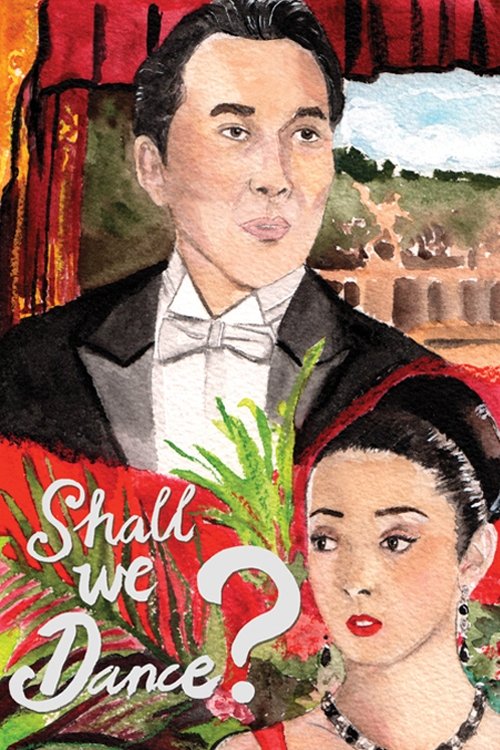
Shall We Dance?
1996 · Masayuki Suō
For when you're worn down and want a film that's kind — a comfort watch about starting over in midlife that leaves you lighter than it found you. Perfect for a quiet night when a big loud movie sounds exhausting.
What it's about
A Tokyo accountant has everything he was told to want — the house, the marriage, the steady job — and feels nothing. Then, from his commuter train, he spots a beautiful, melancholy woman standing in the window of a ballroom dance studio, and he secretly signs up for lessons just to be near her. The infatuation curdles into something better: he falls in love with dancing itself, while his wife, smelling perfume on his shirts, hires a private detective to find out what he's hiding.
The experience
Gentle, funny, and quietly moving — a slow thaw of a movie that builds real suspense out of nothing more than a shy man deciding whether to embarrass himself. By the final stretch it earns a lump in the throat honestly, without a single melodramatic move.
Performances
Kōji Yakusho is wonderful as the salaryman, playing repression so precisely that every tiny loosening of his shoulders registers as an event; real-life ballerina Tamiyo Kusakari brings a wounded gravity to the dance teacher that keeps the film from going soft.
The craft
Masayuki Suō writes an ensemble comedy where every minor student at the studio gets a full inner life, and he shoots the dancing with patience — you watch actual bodies learn actual steps, so the progress feels physical and earned. The tone control is the marvel: broad comedy and real loneliness sharing the same frame without friction.
Why it matters
A defining Japanese crowd-pleaser of the 1990s that swept its national film awards, became a major arthouse hit in America, and was remade by Hollywood — its portrait of joy as an act of quiet rebellion traveled everywhere.
Snapshot
Shall We Dance? (Shall we ダンス?) is a Japanese comedy-drama built on a deceptively slight premise: a middle-aged Tokyo accountant, outwardly successful and inwardly deadened, glimpses a melancholy woman standing in the lit window of a ballroom-dance studio from his commuter train, and — pulled by a longing he cannot name — enrolls in lessons. What begins as furtive infatuation becomes something larger and more surprising: a reawakening to pleasure, play, and physical expressiveness in a culture the film frames as constitutionally suspicious of all three. Director Masayuki Suō turns the modest materials of a mid-life crisis comedy into a widely admired study of Japanese social repression, shame, and the quiet heroism of doing something purely for joy. It was one of the defining Japanese popular films of the 1990s, a domestic phenomenon that swept the national film awards, and — via Miramax — one of the most commercially successful subtitled films in the American market of its era, later remade by Hollywood in 2004.
Industry & production
The film emerged from the mainstream commercial Japanese industry rather than the art-house or festival circuit, and its success helped demonstrate that a mid-budget, star-driven, adult-oriented Japanese film could still find a mass audience in an era when domestic exhibition was increasingly ceded to Hollywood imports and animation. Suō came to the project off the back of Sumo Do, Sumo Don't (Shiko Funjatta, 1992), a comedy about a reluctant university sumo club that had established his signature mode — the comic anatomy of an insular Japanese subculture — and had won him domestic awards and industry standing. That track record gave him the leverage to make Shall We Dance? on his own terms.
The picture's most consequential production fact is its international afterlife. Miramax, then run by Harvey Weinstein, acquired the North American rights and released the film in the United States in 1997. In keeping with Miramax's much-criticized house practice of re-cutting foreign acquisitions, the American release was trimmed substantially from the Japanese version — by roughly twenty minutes, with much of the excised material being cultural texture and slower character business that Weinstein judged would tax non-Japanese audiences. The strategy, whatever one thinks of its paternalism, worked commercially: the film became a genuine crossover success and one of the higher-grossing foreign-language releases in the U.S. of the decade. I would avoid citing a precise box-office figure here, as the widely repeated numbers vary in reliability. Domestically in Japan the film was both a hit and a prestige triumph, sweeping the Japan Academy Prizes in the categories that matter most — picture, director, and the principal acting awards — in a near-total dominance of that year's ceremony.
Technology
Technologically the film is unremarkable, and it would be false to claim otherwise. It is a conventionally shot 35mm production of the mid-1990s, using standard synchronized-sound photography with no notable optical, digital, or process innovation; its ambitions are entirely dramatic and choreographic rather than technical. What is worth noting is that the "technology" that matters to the film is human and physical — the mechanics of ballroom dance itself, which the production treats with documentary seriousness, staging real dance forms (waltz, quickstep, rumba, paso doble) performed to competition standard rather than faked through editorial trickery.
Technique
Cinematography
The visual scheme is organized around a fundamental spatial opposition: the desaturated, gray, right-angled world of the commuter city — trains, station platforms, the office, the cramped suburban home — set against the warmer, enclosed, faintly disreputable interior of the dance studio, glimpsed first as an illuminated window floating in the night. The camera is generally unshowy and observational, favoring framings that hold the body in full so that dance can register as dance; the film understands that to shoot movement in fragmentary close-up would betray it. The recurring motif of the woman framed in the lit window — a figure of yearning seen through glass, from a moving train — is the film's single strongest pictorial idea, converting a genre premise into an image of desire held at a distance. I am not confident enough in the specific director-of-photography credit to attribute the work by name here without risk of error; the record on the film's below-the-line crew is less firmly fixed in English-language sources than its above-the-line credits.
Editing
The cutting is patient and classical, built to let comic embarrassment and physical learning accumulate over time. The film's rhythm mirrors its protagonist's progress: early scenes of graceless, mortifying practice are held long enough to make the audience squirm alongside him, while the later competition and performance sequences are cut to sustain the continuity of movement. The American re-edit is itself a significant "editing" fact about the film's existence, since English-speaking viewers of the period largely encountered a version shortened and reshaped by its distributor rather than by its director — a reminder that the film has two materially different cuts in circulation.
Mise-en-scène / staging
Suō stages the film as a series of contained social arenas, each with its own etiquette: the office where feeling must be suppressed, the home where intimacy has gone quiet, and the studio where the ordinary rules of Japanese public reserve are provisionally suspended. The studio is the film's heart — a slightly shabby, generous space presided over by an older teacher, where a gallery of misfits (the flamboyant colleague hiding his passion behind a wig and a stage name, the earnest strivers, the lonely) can be more themselves than anywhere else. The staging repeatedly contrasts the rigidity of learned posture with the eventual freedom of true dancing, so that the body itself becomes the film's central expressive instrument and its map of the protagonist's inner change.
Sound
Sound and music are foundational rather than decorative, since the film is organized around dance and therefore around rhythm. The score is credited to Yoshikazu Suo, the director's brother, whose music supports the emotional register without overwhelming the diegetic dance numbers. The title itself is a direct citation of the song "Shall We Dance?" from Rodgers and Hammerstein's The King and I — a musical about cross-cultural encounter and the tentative, charged intimacy of two people learning to move together — and that borrowed melody functions as the film's thematic signature, tying its Japanese story to a Western romantic-musical lineage.
Performance
Performance is where the film's reputation truly rests. Kōji Yakusho, one of the finest Japanese screen actors of his generation, plays the accountant Sugiyama with a masterful restraint that makes the eventual physical release genuinely moving; his gift is for suggesting a large interior life behind a socially blank surface. Tamiyo Kusakari, who plays the dance teacher Mai, was a professional prima ballerina making her acting debut, and her real dance training gives the film's movement its authority; she and Suō would later marry. Naoto Takenaka's turn as the closeted-enthusiast colleague Aoki — a repressed office drone transformed into a caped, wig-wearing dance obsessive — supplies the film's broadest comedy while carrying its most direct statement of the theme, that passion suppressed in daily life must go somewhere. The supporting ensemble of studio regulars gives the film its warmth and its comic texture.
Narrative & dramatic mode
The film operates in the mode of gentle social comedy resolving into sincere emotional drama — closer to Ealing-style or Frank Capra-style humane comedy than to farce or satire. Its structure is the classic arc of secret self-transformation: a repressed man takes up a shameful pursuit in secret, is nearly exposed, risks humiliation in public competition, and is finally reconciled — crucially — not with a romantic object but with his own capacity for feeling and, ultimately, with his wife. A key narrative sophistication is that the film sets up a conventional adultery/romance plot (the beautiful teacher glimpsed in the window) and then deliberately declines to deliver it, redirecting the protagonist's awakening away from illicit desire and toward joy, self-expression, and the repair of a marriage. The wife's parallel plot — hiring a detective to explain her husband's furtive behavior — gives the film a second point of view and prevents it from being merely a male fantasy of escape.
Genre & cycle
Generically the film sits at the crossing of the musical, the romantic comedy, and the sports/competition underdog film, and it belongs to a recognizable cycle of "unlikely subculture" comedies in which ordinary people are transformed by mastering an unglamorous or faintly ridiculous discipline. Within Suō's own work it forms a clear pair with Sumo Do, Sumo Don't, both films following reluctant amateurs into a closed physical world, learning its rules and its dignity. Internationally it slots alongside a wave of feel-good, dance-and-competition crowd-pleasers of the 1990s — the Australian Strictly Ballroom (1992) is its most obvious cousin, sharing the specific milieu of competitive ballroom — and it helped consolidate the "amateurs find themselves through performance" formula that would recur across world cinema in the following decade.
Authorship & method
Suō is the film's clear author: he both wrote and directed, and the picture bears the hallmarks of his method — meticulous, affectionate research into a subculture; a comic tone that never curdles into ridicule of its characters; and a fundamentally humanist commitment to the dignity of ordinary people. His practice is to treat the subculture (sumo, then ballroom) with enough documentary respect that the comedy grows out of truth rather than caricature. Among his collaborators, the most significant creative partnerships visible in the film are with his brother Yoshikazu Suo on music and with Tamiyo Kusakari, whose professional dance expertise shaped the film's physical authenticity and whose casting was both an artistic and a personal turning point for the director. The film's ensemble — Yakusho, Takenaka, and the studio regulars — functions as a repertory of skilled character actors whose interplay Suō orchestrates with evident trust. On the specific identities of the cinematographer and editor I would rather acknowledge the thinness of my certain knowledge than risk a false attribution.
Movement / national cinema
The film is best understood as a mainstream, commercially confident work of 1990s Japanese national cinema that is nonetheless deeply about Japanese-ness itself. Its celebrated opening establishes the premise as a specifically national one: it explains, for a Japanese audience as much as a foreign one, that in Japan ballroom dancing carries a stigma of impropriety, that public physical intimacy — even a married couple dancing together — is regarded with embarrassment. The whole film is thus an argument staged against the emotional constraints of contemporary Japanese salaryman culture: the ethos of duty, self-effacement, and the suppression of individual desire. It does not belong to a formal avant-garde movement; rather it is a popular film using accessible means to examine a national condition, which is part of why it translated so readily abroad while remaining legibly Japanese.
Era / period
The film is thoroughly a product of its historical moment — Japan in the years after the collapse of the "bubble economy," when the postwar promise of endless corporate advancement had lost its certainty and the figure of the middle-aged salaryman was newly available as a subject of melancholy rather than triumph. Sugiyama has achieved everything the era's script demanded — house, family, secure white-collar job — and finds it hollow. The film reads that hollowness not as personal failure but as a generational and national ennui, and offers, as its modest answer, not economic reinvention but the recovery of pleasure and human connection. In that sense it is a quietly of-its-time film about what a life is for once the promised rewards have been achieved and found wanting.
Themes
The governing themes are repression and release; shame and the courage to be seen; the deadening of feeling under social conformity and its recovery through the body. Dance functions throughout as a metaphor for everything the culture the film depicts discourages: openness, physical joy, partnership as mutual attention, doing something for no reason but delight. A second major theme is marriage — the film is finally less about the seductive teacher than about the possibility of romance and rediscovery within a long marriage that has gone silent, and its emotional climax reunites husband and wife rather than delivering an affair. Underlying both is a theme of authenticity versus performance of social role: the office, the home, and the studio each demand a different self, and the film's arc is the protagonist's movement toward a self he need not hide.
Reception, canon & influence
Critically and popularly the film was embraced on both sides of the Pacific. In Japan it was a major hit and a near-total winner at the Japan Academy Prizes, taking the top honors across picture, direction, and acting. In the United States its Miramax release made it a signature "foreign film for people who don't watch foreign films," praised by Anglophone critics for its warmth, its comic precision, and Yakusho's performance, and it became one of the most commercially successful subtitled releases of the late 1990s — a status that itself became part of its story and its controversy, given the distributor's decision to shorten it.
Looking backward, the film's influences are legible: the humane social comedy tradition (Capra, Ealing) in its tone; the Western musical in its very title and its borrowed Rodgers and Hammerstein song; and the international ballroom-competition milieu it shares with Strictly Ballroom. Suō's own Sumo Do, Sumo Don't is its most direct antecedent within his authorship. Looking forward, its clearest legacy is the 2004 Hollywood remake directed by Peter Chelsom, which relocated the story to Chicago with Richard Gere as the accountant, Jennifer Lopez as the teacher, and Susan Sarandon as the wife — a transposition that, in stripping away the specifically Japanese cultural anxiety about public dancing, inadvertently demonstrated how load-bearing that cultural premise had been in the original. More broadly, Shall We Dance? stands as a durable model for the international feel-good film in which ordinary, repressed people are redeemed through amateur performance, and it remains a touchstone example of a national-specific popular comedy that traveled the world without losing its identity.
Reception
A phenomenon at home — it swept the Japan Academy Prizes — and then a genuine arthouse smash abroad, becoming one of the biggest Japanese-language hits ever released in the US. Today it's enjoying a quiet rediscovery as fans of Kōji Yakusho's late-career renaissance (Perfect Days) work back through his filmography.
How Shall We Dance? was received, from release to now →
How to watch Shall We Dance?: what to notice on a first viewing
- Watch the color drain from every scene outside the dance studio. Suō shoots the trains, office, and home in flat gray, right angled compositions, then lets the studio glow warmer and more enclosed each time Sugiyama enters it. The palette tells you exactly which world is alive and which one has gone numb.
- Watch for the dance teacher framed in a lit window. Sugiyama first sees her from a moving train, a small glowing rectangle in the dark, and the film returns to that framed, distant view more than once. The image holds her at a distance before the story does, longing seen through glass.
- Watch Sugiyama's face for what he doesn't let it show. Yakusho plays the accountant with a nearly blank, socially correct surface, so small slips, a held breath, a flicker, carry more weight than any speech would. You have to read him the way you would read someone in real life, off small signs.
- Notice the camera hold dancers in full, feet to head. Instead of cutting close on faces during the lessons, the film keeps whole bodies in frame, awkward footwork and all, so you watch the dancing as dancing. You see the actual work of learning to move, not just a performance of feeling it.
The whole guide to watching Shall We Dance?, with the keys for a rewatch →
Influences: the films it descends from and the films it influenced
- Shall We Dance (1937) — Supplies the borrowed English title and the Astaire-Rogers grammar of shooting couples dancing in unbroken full-body framing so the choreography reads as continuous performance rather than cut-up spectacle.
- Top Hat (1935) — Codifies the convention Suō inverts — the ballroom number as displaced courtship where dance carries the romantic subtext dialogue cannot, staged in wide takes that hold both partners' whole bodies.
- The King and I (1956) — Origin of the Rodgers and Hammerstein song 'Shall We Dance?' that Suō lifts wholesale as a borrowed title track, importing its Western-musical courtship connotation as ironic counterpoint to salaryman repression.
- Mr. Deeds Goes to Town (1936) — Models the humane social-comedy tone Suō adopts — comedy that defends rather than mocks the dignity of an ordinary, sincere man, never letting satire curdle into ridicule of its protagonist.
- Passport to Pimlico (1949) — Exemplifies the Ealing method of finding gentle comedy in a bounded community of ordinary people played by skilled character actors, a repertory-ensemble warmth Suō transplants to the dance studio.
- Tokyo Story (1953) — Source of the classical-patient editing, low full-body framing, and restrained non-emphatic performance style Suō uses to observe contained social arenas — a legibly Ozu-inflected calm underneath the comedy.
- Tampopo (1985) — Pioneers the affectionate-anthropological comedy that treats a Japanese subculture (ramen craft) with documentary respect so the humor grows from observed truth, the exact method Suō applies to ballroom.
- Sumo Do, Sumo Don't (1992) — Suō's own template film: the reluctant-recruit-into-a-researched-subculture underdog structure, the same repertory of character actors, and the comedy-from-meticulous-research method carried directly into the dance world.
- Shall We Dance (2004) — The direct Hollywood remake, replicating the secret-self-transformation structure and studio-arena staging while stripping the culturally specific shame about public dancing that had been load-bearing in Suō's original.
- Waterboys (2001) — Extends Suō's blueprint precisely: an ensemble of ordinary Japanese amateurs earnestly mastering an unlikely subculture (synchronized swimming), built on documentary-respectful research and a restrained comic tone that never demeans the strivers.
- Swing Girls (2004) — Repeats the subculture-underdog-comedy craft with real skill-acquisition at its core — cast members genuinely learning to perform (jazz band) so the climactic performance carries authentic physical competence, mirroring Suō's dancer-authenticity casting.
- Billy Elliot (2000) — Builds a whole film on Suō's central device: dance as a secret self kept hidden from a repressive social milieu that codes male dancing as shameful, released only through clandestine rehearsal.
- Departures (2008) — Carries forward the restrained-lead, documentary-respect approach to a marginalized profession-as-subculture (encoffining), finding humanist dignity and ritual grace in ordinary work exactly as Suō dignified the amateur dancer.
- Take the Lead (2006) — Recycles the ballroom-instruction-redeems-the-repressed narrative and the studio as contained social arena, using dance lessons as the vehicle for characters to transform a hidden self into public confidence.
- My Sunshine (2024) — Patiently frames untrained bodies learning a graceful discipline in a rented hall, turning rehearsal itself into drama — the template for Okuyama filming skating as tender skill-acquisition.
- Linda Linda Linda (2005) — Establishes the Japanese amateurs-rehearse-toward-one-public-performance structure whose entire emotional payoff is deferred to a single diegetic recital — the ticking-clock-defused shape the band's culture-festival climax inherits.
- Strictly Ballroom (1992) — Shares the competitive-ballroom milieu and the subverted-romance-through-dance plot, staging the competition floor as a contained arena where conformity is enforced and individual expression becomes the dramatic stake.
- The Full Monty (1997) — Independently arrives at the same feel-good engine — repressed, socially constrained men redeemed through amateur public performance — proving the international portability of the ordinary-person-through-performance formula Suō perfected.
- The Eel (1997) — Part of the Yakusho breakout trio, it shares the structure of an emotionally shut-down salaryman recovering interior life through a patient redemptive-comic arc in everyday working life.
Similar films
- Tokyo Story (1953) — influence & lineage
- Departures (2008) — influence & lineage
- Perfect Days (2023) — shared sensibility
- An Autumn Afternoon (1962) — shared sensibility
- When a Woman Ascends the Stairs (1960) — shared sensibility
- Yearning (1964) — shared sensibility
- Late Spring (1949) — shared sensibility
- Moving (1993) — shared sensibility