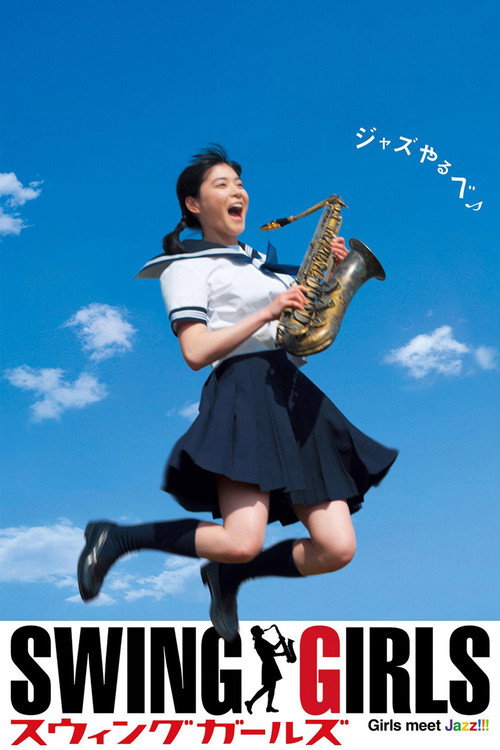
Swing Girls
2004 · Shinobu Yaguchi
For a night when you need to feel good, full stop — a zero-cynicism crowd-pleaser to watch with friends or family, or alone when the week has flattened you.
What it's about
A pack of slacker schoolgirls in rural Yamagata accidentally food-poisons their school's entire brass band — and gets drafted to replace it. That means learning, from absolute zero, to play big-band jazz: secondhand horns funded by supermarket part-time jobs, split lips, squawking reeds, and somewhere along the way, the discovery that swing is the most fun they've ever had.
The experience
Pure, engineered joy with a long fuse: it honors the unglamorous slog of practice, so when the band finally starts to cook, it lands like grace. Funny, warm, and buoyant, with a finale that will have you grinning like an idiot.
Performances
Juri Ueno became a star on the spot as Tomoko, the saxophone-toting slacker whose laziness masks real hunger — and the young cast genuinely learned their instruments, which you can feel in every scene.
The craft
Yaguchi's script is precision-built underdog comedy — every gag, wild boar chase, and setback slotted into place — but his patience is the secret weapon: he lets incompetence be truly incompetent so that competence feels miraculous. The music is played by the actors themselves, and the sound of a band clicking into swing is the whole payoff; good speakers help.
Why it matters
A beloved hit that swept Japanese awards season and cemented its director as the master of the ensemble underdog comedy, launching Juri Ueno's career in the process.
A gaggle of maths-remedial schoolgirls in rural Yamagata accidentally food-poisons the school brass band and must fill in — which means learning, from zero, to swing. Shinobu Yaguchi had already perfected the underdog-ensemble comedy with Waterboys (boys' synchronized swimming); here he refines the formula into something close to its ideal state: a zero-to-hero sports movie where the sport is big-band jazz. The pleasures are precisely engineered — wild boar chases, supermarket part-time jobs to fund secondhand horns, a timid math teacher with a secret — but the film's secret weapon is patience: Yaguchi honors the sheer unglamorous labor of practice, the squawks and split lips, so that competence, when it arrives, lands like grace. Juri Ueno's saxophone-toting slacker Tomoko became a star on the spot, and the film swept Japan Academy Prize nominations while minting a generation of jazz-band recruits in Japanese schools. Its trump card is documentary fact: the cast spent months in training and genuinely plays every note, so the climactic performance of 'Sing, Sing, Sing' is not movie magic at all — just sixteen kids, actually swinging.
Reception
A crowd-pleasing hit in Japan in 2004 that barely traveled beyond festivals abroad, it's since become a word-of-mouth comfort classic overseas — passed around by fans of Japanese feel-good cinema and rediscovered as Juri Ueno's breakout.
How Swing Girls was received, from release to now →
Influences: the films it descends from and the films it influenced
- Waterboys (2001) — Yaguchi's own prototype for the exact structure Swing Girls reuses beat-for-beat: bumbling rural high-schoolers grind an unlikely performance discipline up from zero to a single climactic public show, shot with deadpan comic patience.
- Shall We Dance? (1996) — Established the Japanese template of diffident amateurs drilling a Western performance art through humbling repetition until a recital, treating mastery-through-practice with earnest observational realism rather than gag shortcuts.
- The Full Monty (1997) — The ragtag-underdog-troupe engine: clumsy rehearsal rendered as comic montage that resolves into one nerve-wracking public performance where the amateurs finally cohere onstage.
- Brassed Off (1996) — Model for staging an ensemble of non-professionals actually playing their instruments in-frame and treating live music-making as communal labor, the same diegetic-performance authenticity Swing Girls chases with big band.
- The Commitments (1991) — The band-recruitment set piece plus casting performers who genuinely play and sing live, lending a music comedy documentary texture — the seed of Swing Girls' 'assemble the players' sequence and real-musicianship conceit.
- Tampopo (1985) — Pioneered the episodic comic set-piece structure organized around a quest for craft mastery (the perfect ramen), the training-toward-perfection gag architecture Yaguchi inherits and applies to jazz.
- Linda Linda Linda (2005) — Directly extends the method: high-school girls form a band with the cast performing the music live, sustained by low-key naturalism and patient pacing building to a festival performance.
- Hula Girls (2006) — Rural Japanese girls master a performance discipline (hula) as economic labor, with real training visible on screen and the whole arc funneling to one public recital — the labor-and-mastery theme carried forward.
- Pitch Perfect (2012) — Carries the underdog-ensemble-competition formula into a cappella: misfit group drills arrangements up to competence and delivers a climactic staged number as the payoff.
- Wood Job! (2014) — Yaguchi re-applies his own documentary-authenticity method to rural manual labor (forestry), the same rags-to-competence comedy grounded in physically observed skill acquisition and rural-Japan setting.
- Sing Street (2016) — Forms a band from scratch with the cast genuinely performing the songs, driving an underdog-to-competence arc powered by diegetic live music.
- Chihayafuru (2016) — Extends the ensemble underdog competitive-mastery template (karuta) with the patient training-montage arc and a climactic tournament as the culminating public test.
- School of Rock (2003) — Near-contemporary variant: forge musical illiterates into a real band who actually play their own instruments and build toward a single climactic gig, mirroring the rags-to-competence-to-recital arc.
- Drumline (2002) — Ensemble marching-band-as-competition with performers genuinely drumming on camera, framing showmanship and ensemble timing as an athletic underdog contest.
- Robocon (2003) — Same 2000s-Japanese underdog machine: hapless rural high-schoolers drilling a niche craft toward one competitive showcase, ensemble-cast dynamics and patient comic pacing intact.
- Whiplash (2014) — Tonal inverse but shared craft: big-band jazz mastery filmed as grueling physical labor with real playing, and the ensemble performance staged as a final-exam showcase.
Similar films
- Linda Linda Linda (2005) — influence & lineage · same viewing thread · often watched together
- Tampopo (1985) — influence & lineage
- Kamikaze Girls (2004) — same viewing thread
- One Million Yen Girl (2008) — same viewing thread
- Blue Giant (2023) — often watched together
- Liz and the Blue Bird (2018) — often watched together
- I Want to Eat Your Pancreas (2018) — often watched together
- K-ON! The Movie (2011) — shared sensibility
All the films related to Swing Girls →
Watch it with: curated runs of related films
- Learning to Play — Watch these together for the same tender charge — kids and drifters teaching themselves a song, a band, or a whole life from absolute zero, one clumsy try at a time.