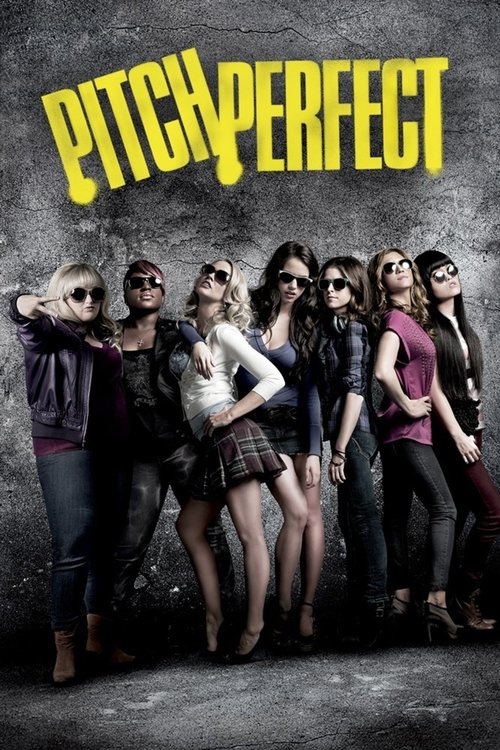
Pitch Perfect
2012 · Jason Moore
For a night when you want pure fun — a sleepover, a group hang, or a solo evening when you need a laugh and some songs stuck in your head. Total comfort food, best enjoyed loud.
What it's about
Beca arrives at college wanting nothing to do with anyone — she's an aspiring DJ just waiting to leave for LA. Instead she gets pulled into the Barden Bellas, an all-female a cappella group stuck doing the same prim, dated routines, and starts dragging their sound into the age of the mashup. What follows is an underdog sports movie where the sport is competitive collegiate singing, complete with rivals, auditions, hazing rituals, and a national championship.
The experience
Fast, quotable, and relentlessly fun — a raucous ensemble comedy stitched to genuinely catchy musical numbers, with jokes that range from sweet to happily gross. It's the kind of movie that goes down easy and gets funnier when you're watching with friends.
Performances
Anna Kendrick anchors it with dry, guarded charm, and Rebel Wilson's Fat Amy steals scene after scene with improvisational swagger — her line deliveries carried half the film's quotability into the culture.
The craft
Kay Cannon's script keeps the one-liners dense while hitting every beat of the competition-movie structure, and the a cappella arrangements — built entirely from voices, beatboxing included — are the real spectacle. The riff-offs and finale numbers reward good speakers.
Why it matters
A modest studio comedy that became a franchise and a phenomenon: it sent a song up the pop charts, mainstreamed a cappella culture, and proved a female-led ensemble comedy could mint a blockbuster series.
Snapshot
Pitch Perfect is a studio musical comedy that improbably became a cultural franchise-starter, translating the niche world of competitive collegiate a cappella into a broad, crowd-pleasing underdog picture. Adapted by screenwriter Kay Cannon from Mickey Rapkin's 2008 non-fiction book Pitch Perfect: The Quest for Collegiate A Cappella Glory, the film follows Beca (Anna Kendrick), a guarded aspiring DJ who reluctantly joins the Barden Bellas, an all-female a cappella group, and drags their fusty repertoire into the era of the mashup. Directed by Broadway veteran Jason Moore in his feature debut and produced by Elizabeth Banks and Max Handelman's Brownstone Productions, it fused the structure of a sports-competition movie, the song-and-dance appeal of the then-dominant Glee moment, and a raucous, quotable ensemble comedy. Made cheaply and released with modest expectations, it became a genuine sleeper hit through word of mouth and home viewing, spawning two sequels and a streaming spinoff, and it remains a touchstone for how a studio can build a durable brand out of an unlikely subject.
Industry & production
The project originated with Elizabeth Banks and her producing partner and husband Max Handelman, who optioned Rapkin's reported account of the collegiate a cappella circuit and developed it at Universal Pictures with producer Paul Brooks of Gold Circle Films. This is a producer-driven picture in the classic sense: the intellectual property was a work of journalism about a subculture, and the creative task was to graft a fictional, formula-friendly narrative onto that real milieu.
Kay Cannon, then a writer-producer on 30 Rock and New Girl, wrote the screenplay, importing a sitcom-honed sense of ensemble rhythm and joke density. Jason Moore, best known for directing the original Broadway production of Avenue Q (and earlier for television), was an apt choice for material built around staged musical numbers. The film is widely reported to have been made on a modest budget in the neighborhood of $17 million and shot largely in and around Baton Rouge, Louisiana, with Louisiana State University standing in for the fictional Barden University — a common cost-driven production choice of the period, when Louisiana's tax incentives drew many mid-budget studio productions.
Universal opened the film in fall 2012 to solid but unspectacular business that expanded on strong word of mouth; the widely cited outcome is a worldwide gross well in excess of $100 million against its small budget, making it one of the more profitable comedies of its year on a percentage basis. I flag that precise grosses circulate in several slightly different forms and should be checked against a box-office authority rather than taken as exact here. The commercial upside was significant enough that the sequel, Pitch Perfect 2 (2015), was directed by Banks herself and out-earned the original, followed by Pitch Perfect 3 (2017) and a Peacock spinoff series, Pitch Perfect: Bumper in Berlin (2022).
Technology
The defining technological question of Pitch Perfect is not its camera but its voice. The film's musical identity depends on contemporary a cappella production — the layering, arranging, and studio treatment of unaccompanied vocals to imitate a full pop mix, including vocal percussion (beatboxing) standing in for a drum kit and vocal bass lines standing in for low end. That aesthetic is a product of modern recording and mixing technique as much as performance, and the film leans on studio-produced tracks that were then performed to on set.
On the image side, the detailed technical record is comparatively thin in accessible sources; the film's look is unshowy studio-comedy coverage rather than a signature format, and I will not assert a specific capture format (film stock versus digital sensor) without confirmation. What is safe to say is that the production belongs to the early-2010s moment when digital capture and non-linear editing made it routine to shoot large amounts of coverage for dialogue-heavy comedies and to cut performance numbers from many angles — a workflow the film's musical set pieces plainly exploit.
Technique
Cinematography
Cinematographer Julio Macat — a veteran of studio comedies stretching back to the Home Alone films — shoots Pitch Perfect in a bright, high-key, glossy register appropriate to broad comedy and to the pageantry of stage competition. The visual grammar divides cleanly between two modes: naturalistic, brightly lit campus-and-dorm comedy, framed for ensemble legibility; and the performance numbers, which adopt the concert-stage vocabulary of spotlights, saturated color washes, crane and dolly moves, and audience reverse-angles. The camera's job in the musical sequences is to sell energy and spatial coherence — to let the viewer read choreography and group formations — rather than to impose an auteurist style.
Editing
Editing is arguably the film's most consequential craft contribution, because its two signature sequences are fundamentally editorial constructions. The "riff-off," in which rival groups trade improvised snippets across song categories, and the climactic Bellas mashup are built in the cutting room from musical logic: the humor and momentum depend on precise musical match-cuts, on timing hand-offs between soloists, and on syncing image to a pre-produced vocal track. The comedic scenes likewise rely on the reaction-shot economy of modern ensemble comedy, holding on faces (notably Rebel Wilson's) to harvest laughs. The picture's editorial pacing — brisk, joke-forward, and structured around escalating musical numbers — is what converts a competition plot into an entertainment machine.
Mise-en-scène / staging
Because the director came from the theater, the staging of the musical numbers carries particular weight. The film organizes its world around costume-and-formation signifiers: the Bellas' matching flight-attendant-style uniforms, the rival Treblemakers' collegiate-casual look, and the geometric stage blocking of a cappella performance, where singers stand in arcs and lines with a designated soloist stepping forward. Domestic and campus spaces (the a cappella "activities fair," the dorm room, the empty pool where the riff-off unfolds) are dressed for a recognizable, slightly heightened college reality. The staging consistently uses spatial arrangement to encode the drama — who stands at the center, who is pushed to the back — so that group choreography doubles as character politics.
Sound
Sound is the film's raison d'être. The musical supervision and vocal production leaned on figures from the contemporary a cappella world — notably Deke Sharon, frequently described as a leading force in modern collegiate a cappella, and Ed Boyer — who arranged and produced the vocal tracks that give the numbers their polished, mash-up-driven texture. The mashup itself is the film's central sonic idea: the recombination of familiar pop songs into new medleys, a device that both drives the plot (Beca's modernizing arrangements) and supplies the soundtrack's hooks. Diegetic performance, non-diegetic score, and pop needle-drops are braided together throughout, and the film is unusually attentive to the mechanics of vocal performance — breath, blend, the beatboxer's role — as both spectacle and subject.
Performance
The ensemble is the film's engine. Anna Kendrick anchors it with a dry, watchful comic reserve as Beca, and her rendition of "Cups" ("When I'm Gone") became a phenomenon in its own right. Rebel Wilson, as the self-christened "Fat Amy," delivers the breakout comic performance, her deadpan, improv-flavored line readings supplying much of the film's quotability. Around them the film stacks sharply drawn types: Anna Camp and Brittany Snow as the outgoing and incoming Bella leaders, Skylar Astin as the earnest love interest, Adam DeVine as a preening rival, Ben Platt (in his film debut) as a nervous newcomer, Hana Mae Lee as an unsettlingly quiet oddball, and songwriter-performer Ester Dean. Elizabeth Banks and John Michael Higgins, as a pair of grotesquely inappropriate competition commentators, function as a running comic chorus.
Narrative & dramatic mode
Dramatically, Pitch Perfect is a competition-underdog narrative fused with a coming-of-age arc and a light romantic comedy. Its skeleton is the sports movie: a ragtag team, a driven newcomer, a humiliating early defeat, a low point followed by reconciliation, and a triumphant final showdown at the national championship (the collegiate a cappella circuit's ICCA). Onto that armature the film layers Beca's personal arc — her reluctance to commit to people or places, her strained relationship with her father, her fear of vulnerability — so that learning to blend her voice into a group becomes the literalized metaphor for emotional openness. The mode is broadly comic and ironic, self-aware about its own conventions and studded with running gags, but it honors the sincerity of the underdog formula in its musical payoffs.
Genre & cycle
The film sits at the intersection of the musical, the ensemble campus comedy, and the competition picture. As a musical, it belongs to the jukebox tradition — built from pre-existing pop songs recombined rather than original numbers — and specifically to the a cappella variant of that tradition. As a comedy, it descends from the R-rated-adjacent ensemble comedies of its era, trading in gross-out beats, improv-inflected riffing, and quotable catchphrases (the film's "aca-" prefix gag — "aca-scuse me," "aca-awkward" — became a signature). As a competition film, it is a close cousin of cheerleading comedy Bring It On (2000), sharing its bright tone, its all-female team dynamics, and its escalating-to-nationals structure. Crucially, it arrived at the crest of a broader pop-culture wave for group singing driven by the television series Glee (2009–2015) and the a cappella reality competition The Sing-Off — a cycle Pitch Perfect both benefited from and helped extend into the feature-film space.
Authorship & method
Pitch Perfect is best understood as a collaborative, producer-and-writer-driven work rather than a director's personal statement. Jason Moore, directing his first feature after a theater career centered on Avenue Q, brought a stage director's fluency with musical staging and comic ensemble timing; his method here is one of orchestration — marshaling a large cast and complex numbers into a coherent crowd-pleaser — more than visual signature. Kay Cannon, the screenwriter, is arguably the decisive creative author, translating Rapkin's reportage into a joke-dense, structurally disciplined comedy and establishing the voice that carried through the franchise. Elizabeth Banks and Max Handelman, as producers, drove the property's development and its cultivation into a series (Banks stepping into the director's chair for the sequel).
Among key collaborators: cinematographer Julio Macat supplied the polished studio-comedy look; editor Lisa Zeno Churgin shaped the musical set pieces and comic pacing; composer Christophe Beck provided the underscore; and the contemporary a cappella specialists Deke Sharon and Ed Boyer designed the vocal arrangements that are, in effect, the film's true score. Where credits for the broader music team are concerned, the detailed division of labor is best confirmed against the film's official credits rather than paraphrased from memory.
Movement / national cinema
The film belongs to mainstream American studio filmmaking — specifically the Hollywood commercial-comedy and musical apparatus of Universal Pictures — and does not participate in any art-cinema movement. Its most meaningful "movement" context is industrial and cultural rather than aesthetic: it is a product of the early-2010s American ecosystem in which television-driven trends (Glee, reality singing competitions) were mined for feature properties, and in which mid-budget comedies were still viable theatrical propositions when produced cheaply, often in incentive-friendly states like Louisiana.
Era / period
Pitch Perfect is emphatically of its moment, roughly 2009–2015, when musical performance was a dominant strain of American popular entertainment and when the mashup — the recombinant pop artifact native to the streaming-and-YouTube era — was ascendant. The film's whole premise, that the way to win is to modernize stale arrangements into layered, genre-crossing medleys, is a statement about early-2010s musical taste. It is also a late example of the theatrical mid-budget comedy as a mass phenomenon, a category that would contract sharply in the years after as studios consolidated around franchises and streaming absorbed much comedy production.
Themes
The film's governing theme is belonging on one's own terms: Beca must learn that joining a group need not mean surrendering individuality, and that her instinct to remix and disrupt can serve a collective rather than isolate her. Closely tied to this is the theme of voice — both literal (finding and blending vocal parts) and figurative (self-expression, creative authorship). Female friendship and solidarity structure the narrative, with the Bellas' internal conflicts and eventual cohesion carrying more emotional weight than the romance. The film also stages a generational argument about tradition versus innovation, embodied in the clash between the rigid outgoing leader and Beca's mashup sensibility. Running beneath the comedy is a body-and-identity thread, most visibly in Rebel Wilson's character, who preempts insult by naming herself "Fat Amy" — a gag the film treats as empowerment, though later cultural conversation has complicated readings of its humor.
Reception, canon & influence
Critical reception at release was broadly positive-to-mixed: reviewers generally praised the film's energy, its musical numbers, and above all its cast — singling out Anna Kendrick and, especially, Rebel Wilson — while noting that the plot ran on familiar underdog machinery. Its more remarkable trajectory was commercial and cultural: it performed steadily in theaters and then became a genuine phenomenon through home viewing and repeat watching, the kind of film audiences quote and revisit. I flag that specific critical-aggregator scores and exact grosses vary by source and should be verified rather than cited from memory.
Looking backward, the film's influences are legible. Its DNA includes the competition-underdog comedy (with Bring It On a clear structural and tonal antecedent), the backstage musical tradition repackaged as jukebox mashup, the ensemble campus comedy, and the television-driven singing craze led by Glee and reality formats like The Sing-Off, which had already primed mass audiences for a cappella spectacle.
Looking forward, its legacy is substantial for a modest comedy. It launched a franchise (two theatrical sequels and a streaming spinoff) and helped make competitive a cappella a mainstream reference point, feeding interest in collegiate groups and vocal-arrangement culture. It was a career-defining or career-launching platform for much of its cast — consolidating Anna Kendrick's stardom, breaking out Rebel Wilson, and giving early screen exposure to performers including Ben Platt and Skylar Astin. The "Cups" song became a charting single and a widespread participatory craze, and the film's catchphrases entered the popular lexicon. Perhaps most significantly for industry history, Pitch Perfect stands as a case study in building a durable, profitable brand from cheap, unglamorous source material — proof, at the tail end of the theatrical mid-budget comedy's viability, that a well-cast musical comedy about a niche subculture could become a franchise.
A Deleuzian reading
A drained swimming pool at night.
The full Deleuzian reading of Pitch Perfect →
Reception
Opened as a modest fall sleeper in 2012 and then snowballed on home video and cable into a genuine phenomenon — by the time the sequel arrived in 2015 it was treated as a beloved comedy institution rather than the small movie it started as.
How Pitch Perfect was received, from release to now →
How to watch Pitch Perfect: what to notice on a first viewing
- Watch who stands at the center of each formation. The Bellas and Treblemakers arrange themselves in arcs and lines, with a soloist stepping forward and others pushed to the back. The blocking encodes rank and rivalry before anyone opens their mouth.
- Listen for how separate songs blend into one mashup. Beca keeps splicing familiar pop hooks together, and the vocal arrangements layer beatbox, bass line, and melody into a single texture. The mashup is the film's real subject: recombination as both plot device and sound.
- Watch Rebel Wilson hold her deadpan look after a joke. Wilson lets her flat expression sit a beat longer than expected, and the editing cuts on that beat to harvest the laugh. Comic timing here lives in the held face, not just the line.
- Notice the Bellas' matching uniforms against the Treblemakers' casual look. Costume marks the two rival groups as distinct tribes long before any competition begins. You read the rivalry through wardrobe before the plot explains it.
- Track the cuts as rival singers trade verses at the pool. The riff-off is built entirely from timed hand-offs between soloists, synced to pre-recorded vocal tracks. The sequence exists only as an edit; there is no continuous performance to film.
The whole guide to watching Pitch Perfect, with the keys for a rewatch →
Influences: the films it descends from and the films it influenced
- Bring It On (2000) — Supplies the rival-camp competition scaffold Pitch Perfect reuses wholesale — alternating showcase set-pieces, a mid-film crisis of stolen/derivative material, and a bracketed climax at a national championship.
- Drumline (2002) — Models the formation-choreography-as-battle grammar and the tradition-versus-innovation arc of a talented newcomer forcing an old-guard ensemble to update its book, shot with concert-stage coverage.
- 42nd Street (1933) — The backstage-musical template Pitch Perfect repurposes: rehearsal-drill-to-showcase structure and the understudy-replaces-the-star reversal that powers Beca stepping up to arrange and lead.
- Grease (1978) — Establishes the high-key glossy ensemble school-musical look with diegetic group numbers and paired formation dancing that Pitch Perfect's Bellas/Trebles sets echo.
- Moulin Rouge! (2001) — Pioneers the pop-mashup medley — stitching recognizable hits into a single arrangement — and the rapid on-beat musical match-cut editing that governs the riff-off and finale.
- Chicago (2002) — Its editing intercuts an imagined performance stage with narrative reality on musical accents, the concert-stage vocabulary Pitch Perfect adopts for its ICCA numbers.
- Mean Girls (2004) — Sets the joke-dense, insult-comic female-campus voice from the SNL/30 Rock writers' room that Kay Cannon shares and translates into the Bellas' clique dynamics.
- Bridesmaids (2011) — Validates the loose, improv-driven deadpan riffing inside a female ensemble comedy — the exact register Rebel Wilson's Fat Amy tags are built to exploit a year later.
- Best in Show (2000) — Its deadpan competition color-commentary duo is the direct ancestor of Higgins and Banks's absurdist play-by-play, a mockumentary device grafted onto the a cappella finals.
- Swing Girls (2004) — Carries the underdog-ensemble-competition formula into a cappella: misfit group drills arrangements up to competence and delivers a climactic staged number as the payoff.
- Pitch Perfect 2 (2015) — Directly extends the vocal-arrangement-as-score method (Deke Sharon/Ed Boyer returning) and scales the riff-off and formation-number set-pieces into a world-championship frame.
- Pitch Perfect 3 (2017) — Carries the mashup-arranging and ensemble-deadpan formula forward into a USO-tour riff-off structure, preserving Kay Cannon's joke-density and match-cut musical editing.
- Sing (2016) — Rebuilds the same singing-competition-underdog engine — audition montage, arranged pop covers, climactic showcase — with reaction-shot comedy driving the ensemble.
- The Greatest Showman (2017) — Extends the contemporary pop-vocal-arrangement spectacle with formation choreography and concert-stage lighting, chasing the same participatory, repeat-listen anthem culture Pitch Perfect's soundtrack proved.
- Blockers (2018) — Kay Cannon's directorial debut extends her Pitch Perfect authorial voice — structurally disciplined, joke-dense ensemble comedy built on deadpan-improv reaction beats.
- Glee: The 3D Concert Movie (2011) — The theatrical arm of the same TV-driven mashup-cover craze that primed audiences for arranged pop medleys and reaction-shot musical spectacle.
- Rock of Ages (2012) — A contemporary jukebox-mashup musical released the same year, arranging recognizable hits into medley showcases with the same crowd-pleasing high-gloss staging.
- Anna Kendrick's 'Cups' craze / Pitch Perfect soundtrack culture (2013) — The 'Cups' cup-percussion number spun the film's arranging aesthetic into a standalone participatory craze, a diegetic-rhythm device other vocal comedies subsequently imitated.
Similar films
- Mean Girls (2004) — influence & lineage
- The Greatest Showman (2017) — influence & lineage
- KPop Demon Hunters (2025) — shared sensibility
- Finding Emily (2026) — shared sensibility
- Bottoms (2023) — shared sensibility
- The Breakfast Club (1985) — shared sensibility
- The Perks of Being a Wallflower (2012) — shared sensibility
- Wicked (2024) — shared sensibility