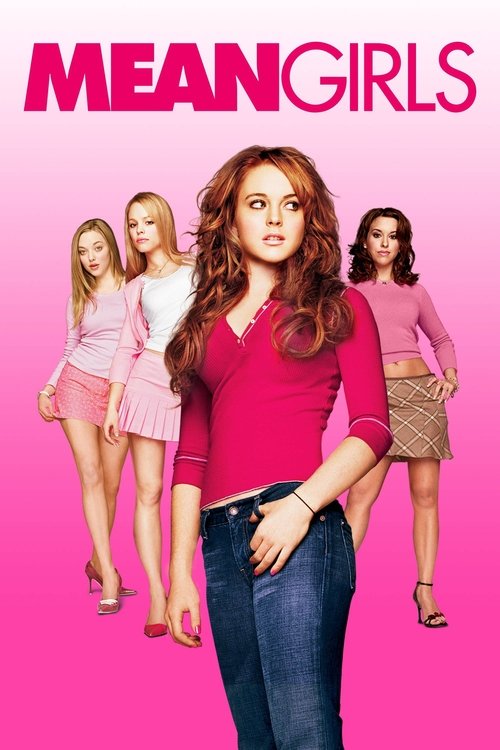
Mean Girls
2004 · Mark Waters
The perfect group-watch or comfort rewatch — for when you want to laugh hard, quote along, and still feel like the movie respects your intelligence. Zero-risk fun that has aged into pure pleasure.
What it's about
Cady Heron, raised in Africa by zoologist parents and home-schooled her whole life, lands in a suburban Illinois high school and gets adopted by The Plastics, the school's ruling clique led by the terrifyingly poised Regina George. What starts as an undercover mission to study and sabotage them from the inside gets complicated when Cady falls for Regina's ex — and starts turning into a Plastic herself.
The experience
Fast, vicious, and endlessly quotable — a comedy that lands a joke every thirty seconds while sneaking in a genuinely sharp anatomy of how teenage girls learn to wound each other. It's a riot with teeth.
Performances
Rachel McAdams's Regina George is one of the great comic villains — sweetness and menace in the same breath — Lindsay Lohan anchors it all with real warmth, and Tina Fey and Amy Poehler steal their scenes among a murderers' row of future comedy stars.
The craft
Tina Fey's screenplay is the star: she adapted a non-fiction parenting book into razor-wire satire, and nearly every line has entered the vernacular. Mark Waters keeps the tone in a tricky sweet spot — cartoonish enough to be hilarious, grounded enough that the cruelty stings — with playful cutaways that visualize the school as a wildlife documentary.
Why it matters
It became the defining teen comedy of the 2000s and one of the most quoted American films of its generation, spawning a Broadway musical and an ongoing life in memes ('It's October 3rd'). It launched Fey's screenwriting career and cemented an entire cast of stars.
Snapshot
Mean Girls is a high-school satire that took a piece of parenting non-fiction and turned it into one of the most quotable American comedies of its generation. Written by Tina Fey and directed by Mark Waters, it follows Cady Heron, a teenager raised by zoologist parents in Africa and home-schooled until age sixteen, who lands in a suburban Illinois public school and is absorbed into "The Plastics," a ruling clique headed by the imperious Regina George. What begins as an anthropological infiltration — Cady studying the social order as if observing wildlife — curdles into complicity, as she becomes the thing she set out to expose. The film's durable achievement is tonal: it is broad and cruel and cartoonish, yet organized around a genuinely rigorous idea about how girls are trained to weaponize social exclusion. Its cultural half-life has vastly outstripped its origins as a modest studio comedy; two decades on it functions less as a movie than as a shared vocabulary.
Industry & production
Mean Girls was a Paramount release produced under the SNL Studios banner, with Saturday Night Live impresario Lorne Michaels as producer — a lineage that shaped nearly everything about the film's personnel and sensibility. Its unusual origin point was Rosalind Wiseman's 2002 non-fiction guide Queen Bees and Wannabes, a book aimed at parents about adolescent female social hierarchies, cliques, and relational aggression. Michaels acquired it and brought in Tina Fey, then the head writer and "Weekend Update" co-anchor at SNL, to adapt it. Fey's task was inventive rather than conventional: the source had no plot, no protagonist, and no characters, only a taxonomy of teenage behavior. She built the narrative scaffolding — the outsider heroine, the revenge scheme, the moral reckoning — around Wiseman's sociological observations.
The picture was mounted on a relatively modest budget by studio-comedy standards and shot in and around Toronto, standing in for suburban Illinois. It became a substantial commercial success on release in the spring of 2004, comfortably outgrossing its cost; I'd flag that precise figures are best checked against a box-office database rather than trusted from memory. Casting drew heavily on both the SNL orbit and a rising cohort of young performers: Lindsay Lohan, already a Disney-era star from Freaky Friday (also directed by Waters) and The Parent Trap, took the lead, while Rachel McAdams, Lacey Chabert, and Amanda Seyfried filled out the Plastics. The adult ensemble — Fey herself as math teacher Ms. Norbury, Tim Meadows as Principal Duvall, Amy Poehler and Ana Gasteyer as parents — reads as a direct transplant from Studio 8H.
Technology
Technologically, Mean Girls is a conventional early-2000s studio comedy, and honesty requires saying that its interest lies elsewhere. It was photographed on 35mm film and finished for standard theatrical release; it predates the industry's wholesale migration to digital capture and does not participate in any technical vanguard. What modest formal ambition it has is achieved through staging, montage, and a handful of stylized fantasy inserts rather than through any novel imaging or post-production tool. The film's "special effects" are essentially comedic visualizations — the cafeteria imagined as an African watering hole, or Cady's angry impulses literalized — accomplished through editing and simple compositing rather than showcase technology. This is a movie whose innovations are entirely at the level of writing and performance.
Technique
Cinematography
Cinematographer Daryn Okada — a seasoned studio DP whose credits include Waters's Freaky Friday — gives the film a bright, glossy, high-key look appropriate to its satirical register. The photography is clean and legible rather than expressive; it flatters its young cast and keeps the visual field uncluttered so that gags and reaction shots land cleanly. The most notable cinematographic gestures are the stylized departures from this baseline realism: the aforementioned nature-documentary fantasy of the cafeteria, shot and cut to evoke a wildlife film, and other subjective inserts that break naturalism for a joke. The camera work is otherwise unobtrusive, prioritizing coverage and comic clarity over authorial signature — a deliberate choice for material driven by dialogue and ensemble timing.
Editing
Editor Wendy Greene Bricmont's work is central to the film's effect, because Mean Girls is fundamentally a picture about comic rhythm and information control. The cutting is brisk, favoring quick reaction shots that let the ensemble's faces carry punchlines, and it deploys montage repeatedly as a structural device — Cady's induction into Plastic protocol, the escalating war of sabotage, the viral spread of the Burn Book's contents through the school. Voiceover narration by Cady is threaded throughout, and the edit is built to accommodate it, moving fluidly between observed scene and internal commentary. The pacing is tight enough that the film never lingers on its own cruelty long enough to become genuinely bleak; the tempo keeps it buoyant.
Mise-en-scène / staging
The film's production design and costuming do enormous characterizing work, and this is where its craft is most visible. The Plastics are defined visually before they are defined dramatically: coordinated pink, exposed midriffs, the ritualized dress codes ("On Wednesdays we wear pink") that render conformity as literal uniform. Regina's home, with its trophy-wife mother and MTV-cribs excess, stages class and entitlement as spectacle. Cafeteria geography — the elaborately mapped seating chart of cliques that Janis draws for Cady — turns the lunchroom into a diagram of the whole social order, and the staging repeatedly returns to it as a battlefield. The Burn Book itself is a designed object, a physical MacGuffin whose materiality matters to the plot's climax.
Sound
Composer Rolfe Kent supplies a light, propulsive comedic score that supports the film's satirical energy without editorializing heavily. The more memorable sonic elements are the needle-drops and, above all, the diegetic musical set pieces — the Plastics' talent-show performance to "Jingle Bell Rock," which pivots from polished routine to chaos, is staged and cut as a comic showpiece. Detailed documentation of the film's sound design and mix is thin in the public record, and I won't manufacture specifics; what is clear is that the soundtrack functions in the pop-scored idiom standard to the teen-comedy cycle, using music to punctuate rather than to deepen.
Performance
Performance is the film's true medium. Rachel McAdams's Regina George is the anchor — a portrait of charisma as predation, played with a control that keeps the character magnetic rather than merely monstrous; it is arguably the definitive screen mean-girl performance. Lohan gives Cady a plausible arc from wide-eyed naïf to corrupted insider and back, functioning as the audience's shifting moral center. Lacey Chabert's Gretchen (anxious, status-desperate, forever trying to make "fetch" happen) and Amanda Seyfried's Karen (sublimely oblivious) round out a trio calibrated to distinct comic frequencies. Lizzy Caplan and Daniel Franzese, as outsiders Janis and Damian, provide the film's counter-voice. Among the adults, Fey and Tim Meadows model a dry, deadpan comedy that plays against the teenagers' heightened register. The ensemble's cohesion — much of it SNL-trained — is the reason the film's rapid-fire lines land.
Narrative & dramatic mode
Structurally the film is a satirical coming-of-age story built on the bones of a revenge comedy. Its dominant mode is ironic first-person narration: Cady's voiceover frames the action as fieldwork, importing the language of animal behavior into the high-school jungle, a conceit that gives the satire its analytic edge. The plot follows a clear moral geometry — infiltration, corruption, exposure, and contrition — closer to a fable than to naturalism. Fey's script is unusually disciplined about consequence: the Burn Book's release triggers a genuine social collapse, and the resolution requires Cady to publicly account for her cruelty rather than simply be forgiven. The dramatic irony is sustained throughout, since the audience watches the anthropologist become her own specimen. Beneath the joke density is a tidy three-act architecture that rarely calls attention to itself.
Genre & cycle
Mean Girls sits squarely in the American high-school comedy, and more specifically in its meaner, satirical wing. Its most obvious ancestors are Michael Lehmann's Heathers (1989), the pitch-black progenitor of the killer-clique movie, and Amy Heckerling's Clueless (1995), which supplied the template of a bright, fashion-literate teen comedy adapted from a pre-existing text (Austen's Emma, in that case). Behind both stands the John Hughes cycle of the 1980s — The Breakfast Club, Sixteen Candles, Pretty in Pink — which established the high-school social strata as a subject worthy of sustained dramatic attention. Mean Girls arrived amid an early-2000s revival of the teen film and quickly became the cycle's new reference point, the film against which subsequent entries were measured. Its particular contribution to the genre was to fuse Hughesian earnestness about adolescent pain with a sociological framework and SNL-honed joke construction.
Authorship & method
The controlling authorial intelligence here is Tina Fey's, and Mean Girls is best understood as a writer's film. Fey brought the sketch comedian's ear for the compressed, quotable line and the satirist's structural discipline, translating Wiseman's taxonomy into character and plot. Her method — adapting non-fiction sociology into narrative comedy — is genuinely unusual and accounts for the film's odd blend of belly laughs and thesis.
Mark Waters directs with an unshowy competence well suited to the material; having already guided Lohan through Freaky Friday, he manages a large young ensemble and keeps the comic machine running without imposing a heavy stylistic signature. His authorship is that of the skilled facilitator rather than the auteur. Cinematographer Daryn Okada, a Waters collaborator, supplies the clean commercial gloss; editor Wendy Greene Bricmont shapes the comic timing; composer Rolfe Kent provides the connective musical tissue. Overseeing all of it was producer Lorne Michaels, whose SNL apparatus furnished the writer, much of the cast, and the house comedic sensibility. The film is a genuinely collaborative product of that ecosystem, but its voice is Fey's.
Movement / national cinema
Mean Girls belongs to no art-cinema movement; it is mainstream American studio comedy, a product of the Hollywood-adjacent SNL/Paramount pipeline. Its only "national cinema" dimension is a production one — like many American films of the period, it was shot in Toronto for economic reasons while depicting the U.S. Midwest. Situating it culturally is more useful than situating it geographically: it is a document of American suburban adolescence at the turn of the millennium, and its relevant tradition is the commercial genre lineage described above rather than any regional or auteurist school.
Era / period
The film is deeply of its moment — the early-to-mid-2000s, post-Clueless and pre-smartphone. Its social world runs on landlines, three-way calls, printed photographs, and the physical Burn Book; the mechanics of its central catastrophe depend on the absence of the always-on digital surveillance that would define the following decade. This is worth naming because the film's later remakes and stage adaptations had to reckon explicitly with the arrival of social media, which fundamentally altered the ecology of teenage cruelty the original depicts. Mean Girls thus captures a specific, narrow window: relational aggression at its most analog, just before the internet industrialized it. It is also a late artifact of the star-driven teen-comedy economy that the subsequent shift toward franchise filmmaking would erode.
Themes
The film's governing subject is relational aggression — the specifically social, non-physical warfare (exclusion, rumor, manipulation, the withdrawal of approval) through which adolescent girls are taught to compete. Wiseman's book supplied the framework, and Fey's script dramatizes it with unusual clarity: the currency of this world is status, and its weapon is language. A second, linked theme is the performance and policing of femininity — the way the Plastics enforce rules of dress, diet, and speech that render conformity mandatory and self-regulating. Third, the film examines complicity and self-deception: Cady's belief that she can play the game ironically, without becoming corrupted, is the movie's central moral fiction, and its collapse is the point. Underneath the satire runs a genuinely humane argument, delivered most directly through Fey's teacher character, that the cruelty is learned, contagious, and reversible — that girls are not naturally each other's enemies but are trained into it.
Reception, canon & influence
Critically, Mean Girls was well received on release, praised in particular for the sharpness of Fey's screenplay and McAdams's performance, and it was a solid commercial hit — a rare comedy that critics and audiences agreed on. Its most remarkable trajectory, however, has been its afterlife. The film's dialogue entered the vernacular to a degree few comedies ever manage — "you can't sit with us," "stop trying to make fetch happen," "on Wednesdays we wear pink," "she doesn't even go here" — and its jokes proved extraordinarily durable as internet meme culture matured, giving the film a second, ongoing life it could not have anticipated in 2004. October 3rd, a throwaway date from a single scene, became an annually observed "Mean Girls Day," a striking index of the film's saturation of the culture.
Looking backward, its influences are clear: the Hughes teen canon for its emotional stakes, Heathers for its satirical cruelty, and Clueless for its adapted-text wit and glossy surface. Looking forward, it became the new lodestar of the teen comedy, cited and imitated across the genre, and it consolidated the careers of nearly its entire young cast — McAdams, Seyfried, Caplan, and Poehler among them went on to substantial work. Its institutional canonization arrived through adaptation: Fey developed a Broadway musical version (opening in 2018), which was in turn adapted into a 2024 feature musical, making Mean Girls one of the few 2000s comedies to be formally re-canonized for a new generation. Within the study of the American teen film, it is now a fixed reference point — the movie that took the genre's sociology seriously enough to be quoted for twenty years and counting.
A Deleuzian reading
Field note, first week.
The full Deleuzian reading of Mean Girls →
Reception
A solid hit with warm reviews in 2004, it has since climbed from 'good teen comedy' to full generational canon — spawning a Broadway musical, a 2024 movie musical, and its own unofficial holiday (October 3rd, Mean Girls Day).
How Mean Girls was received, from release to now →
How to watch Mean Girls: what to notice on a first viewing
- Watch what color the Plastics wear on which day. Regina enforces a strict, unspoken dress code: pink on Wednesdays, exposed midriffs, matching looks that make conformity into a literal uniform. The costume shows you the rules of the group before anyone explains them out loud.
- Listen for Cady comparing her classmates to wild animals. Her voiceover frames the school as a nature documentary, narrating social behavior like an anthropologist watching a foreign tribe. The animal framing gives you a lens for reading every scene as a study of status and survival.
- Look at the seating chart Janis draws of the cafeteria. The chart turns the lunchroom into a diagram of the whole social order, and the film keeps returning to that room as a battlefield. Once you have the map, every lunch scene becomes a scene about where each person is allowed to sit.
- Watch how fast the film cuts during Cady's induction into the Plastics. Bricmont's editing uses montage repeatedly, compressing sabotage, makeovers, and the spread of gossip into quick bursts that never slow down to let the cruelty sit. The brisk pace keeps the film buoyant, so it never lingers long enough to feel as bleak as its events actually are.
- Watch how little Regina raises her voice when she attacks someone. McAdams keeps Regina's cruelty controlled and almost pleasant on the surface, which is what makes her charisma and her menace the same thing. Her calm delivery is what makes her more frightening than a villain who yells.
The whole guide to watching Mean Girls, with the keys for a rewatch →
Influences: the films it descends from and the films it influenced
- Heathers (1988) — Supplies the template of color-coded clique costuming and invented teen argot ('very') wrapped around a revenge structure aimed at a tyrannical alpha-girl, the satirical-cruelty register Fey inherits and softens.
- Clueless (1995) — Establishes the ironic first-person female voiceover guiding the viewer through a glossy, high-key social ecosystem adapted from a canonical text (Austen), with costume read as a status taxonomy.
- Fast Times at Ridgemont High (1982) — Pioneers Fey's exact method — converting immersive nonfiction reportage (Cameron Crowe's undercover year) into an ensemble teen comedy, as Fey converted Wiseman's sociology.
- The Breakfast Club (1985) — Codifies the high-school clique taxonomy and the emotional stakes beneath the labels that the cafeteria 'social map' scene literalizes into a diagram.
- Election (1999) — Braids competing ironic voiceovers and freeze-frames to dissect high-school power politics and self-deception, the same tonal blend of belly-laugh and thesis.
- 10 Things I Hate About You (1999) — Builds a teen comedy on covert canonical-text adaptation (Shakespeare's Shrew), the strategy of smuggling a structural argument inside genre pleasure.
- Legally Blonde (2001) — Weaponizes pink costume-as-uniform and high-key commercial gloss to stage performed femininity as deliberate strategy rather than decoration.
- Easy A (2010) — Extends the ironic female voiceover (here a webcam confessional) narrating a high-school reputation economy, framed by a literary text (The Scarlet Letter) under high-key gloss.
- Juno (2007) — Carries forward the writer-as-auteur teen comedy in which densely coined, instantly quotable dialect is the film's authorial signature, as Fey's lines were hers.
- The DUFF (2015) — Explicitly names and satirizes the clique taxonomy (the 'designated ugly fat friend') in direct Mean Girls idiom, treating labels as a diagrammable social system.
- Booksmart (2019) — Inherits the hyperarticulate female-ensemble comedy that maps a school's clique sociology and punctures the protagonists' own smug self-deception.
- Lady Bird (2017) — Extends the ambition of taking teen-girl social sociology seriously as observed anthropology — the genre-as-thesis stance Mean Girls legitimized.
- Do Revenge (2022) — Explicitly revives the revenge-comedy structure and pastel clique social-map, styling itself as the direct Heathers-to-Mean-Girls heir with an infiltration plot and coded costuming.
- Bottoms (2023) — Escalates female relational aggression and femininity-policing into absurdist violence, heir to the Heathers/Mean Girls satirical register of the in-group's cruelty.
- Pitch Perfect (2012) — Sets the joke-dense, insult-comic female-campus voice from the SNL/30 Rock writers' room that Kay Cannon shares and translates into the Bellas' clique dynamics.
- Bring It On (2000) — Renders competitive female social hierarchy through snappy coined argot and choreographed set-pieces, the diegetic-performance engine Mean Girls echoes in the Jingle Bell Rock number.
- Saved! (2004) — Runs the same year's parallel experiment — satirizing a policed female in-group and its femininity codes through a mean-alpha antagonist and quotable moral hypocrisy.
- Jennifer's Body (2009) — Pushes coined-slang screenwriting and the poison-female-friendship of relational aggression into horror, sharing Amanda Seyfried and the toxic-best-friend core.
Similar films
- Lady Bird (2017) — influence & lineage
- Fast Times at Ridgemont High (1982) — influence & lineage
- Juno (2007) — influence & lineage
- Election (1999) — influence & lineage
- The Breakfast Club (1985) — influence & lineage
- Heathers (1989) — shared sensibility
- Superbad (2007) — shared sensibility
- The Perks of Being a Wallflower (2012) — shared sensibility