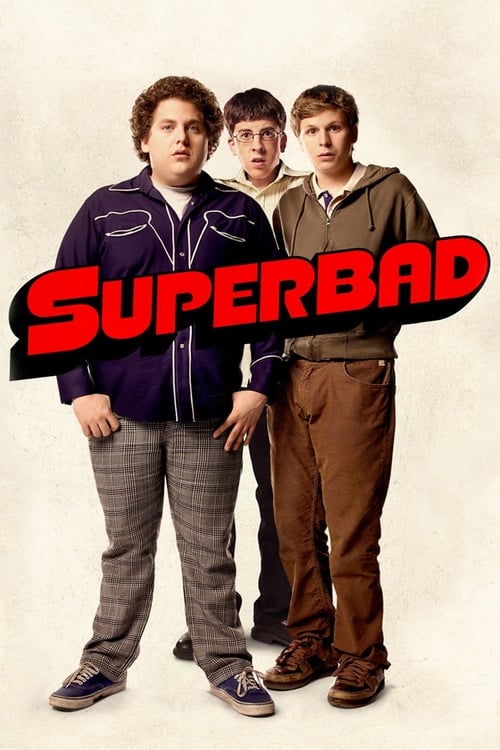
Superbad
2007 · Greg Mottola
For a night when you need to laugh hard with zero prestige guilt — perfect with friends, pizza, and nostalgia for your own worst teenage decisions.
What it's about
Two co-dependent best friends — anxious Evan and loudmouthed Seth — have weeks left before graduation splits them up, and one mission for tonight: score alcohol for a party and finally impress the girls they like. The plan hinges on their friend Fogell's gloriously bad fake ID, and it derails within minutes into a long, chaotic night involving two of the least responsible cops in movie history. Underneath the filth, it's about the terror of losing your best friend to adulthood.
The experience
Riotously, quotably funny — the dialogue has the messy rhythm of how teenagers actually talk — and then unexpectedly tender in its final stretch. It's crude enough to make you wince and sweet enough that the crudeness never curdles.
Performances
Jonah Hill and Michael Cera are a perfect comic organism — bluster and mumble, id and anxiety — and Christopher Mintz-Plasse's McLovin is one of the great one-scene-steals-the-movie debuts that just keeps stealing scenes.
The craft
The Seth Rogen–Evan Goldberg script (started when they were teenagers themselves) is the engine: profane, structurally tight, and secretly a love story between two straight boys who can't say goodbye. Greg Mottola directs with a loose, improv-friendly 70s-comedy warmth, and the funk-driven score gives the whole night a strut.
Why it matters
A defining film of the Apatow-era comedy wave that launched Jonah Hill and Emma Stone and minted McLovin as a permanent piece of pop vocabulary; nearly every raunchy-but-sincere teen comedy since sits in its shadow.
Snapshot
Superbad is a raunchy, tender coming-of-age comedy about the last stretch of a co-dependent friendship. Over a single day and night, two socially marginal high-school seniors — anxious Evan (Michael Cera) and blustery Seth (Jonah Hill) — attempt to buy alcohol and lose their virginities before graduation scatters them to different colleges, while their hapless friend Fogell (Christopher Mintz-Plasse) acquires a fake ID that identifies him only as "McLovin." The film belongs to the Judd Apatow–produced wave of mid-2000s American comedy that fused explicit, improvisation-heavy vulgarity with unusual emotional sincerity. Its lasting reputation rests less on plot than on texture: the rhythm of teenage male conversation, the ache of an impending separation the boys can barely name, and a handful of performances and lines that entered the culture wholesale. Directed by Greg Mottola from a screenplay Seth Rogen and Evan Goldberg had been writing since their own adolescence, it functions simultaneously as a gross-out party movie and a surprisingly melancholy portrait of friendship on its last night.
Industry & production
Superbad was produced by Columbia Pictures (Sony) in partnership with Judd Apatow's production banner and released in North America in August 2007. Its genesis is unusually long and well documented: Rogen and Goldberg, childhood friends from Vancouver, began drafting the script as teenagers in the 1990s, naming the two leads after themselves. The project matured over years as Rogen's profile rose through Apatow's orbit — Freaks and Geeks, The 40-Year-Old Virgin, and, the same year as Superbad, Knocked Up. Apatow's producing clout, fresh off the commercial success of those films, was central to getting a hard-R, star-light teen comedy financed and marketed.
The casting reflected the Apatow ensemble's preference for then-unknown or rising comic talent over established stars. Jonah Hill and Michael Cera anchored the film; Cera arrived from Arrested Development, Hill from small Apatow-adjacent roles. Christopher Mintz-Plasse, cast as Fogell/McLovin, was a teenage first-timer. The film is also notable as the feature debut of Emma Stone, cast as Seth's crush Jules. Rogen himself appears as one of two irresponsible police officers alongside Bill Hader — a subplot that gave the film's co-writer a comic showcase while keeping him from playing a high-schooler he had by then aged out of.
The film was a substantial commercial success, opening strongly and comfortably outgrossing its modest budget, and it consolidated the commercial viability of the R-rated Apatow comedy as a studio product. I would avoid citing precise grosses from memory, but the record is unambiguous that it was a hit and a launching pad for several careers.
Technology
Superbad is a photochemical production of its moment: shot on 35mm film, before the digital-capture transition had fully overtaken mid-budget American comedy. The technological choices are essentially conservative and in service of an unfussy, naturalistic look — the "technology" of the film is less its camera package than its production method, which prioritized coverage and long takes to accommodate heavy on-set improvisation. The Apatow model of the period leaned on shooting substantial quantities of alternate takes and improvised "riffs," a practice that presupposes ample film stock and an editorial process built to sift large amounts of material. In that sense the film's most consequential "technology" is procedural: an assembly-line of improvisation and selection rather than any distinctive optical or post-production innovation.
Technique
Cinematography
Russ Alsobrook, a frequent Apatow-camp collaborator, shot the film in a deliberately plain, unglamorous register. The visual grammar favors legibility and performance over stylization: medium and medium-wide framings that keep two actors in frame during dialogue, handheld looseness that follows improvisation rather than dictating it, and available-feeling suburban light — daytime flatness giving way to the sodium-and-fluorescent palette of a night spent walking, driving, and crashing parties. The camera rarely calls attention to itself; its job is to stay out of the way of the talk. The one recurring visual signature is a warm, slightly nostalgic tone that gestures at 1970s American film without pastiche, reinforced far more by the music than the image.
Editing
William Kerr edited the film, and the cut is where the Apatow method is most decisive. Improvisation-driven comedy lives or dies in assembly: the editor must construct scenes and comic timing from disparate takes, choosing which riffs land and pacing the back-and-forth of overlapping teenage speech. The film sustains a loose, conversational tempo that lets jokes breathe and digress, then tightens for its set pieces. The structural achievement is the interweaving of three strands — Seth and Evan's odyssey, McLovin's night with the cops, and the ticking pressure of the party — so that they converge without feeling mechanical.
Mise-en-scène / staging
The production design is aggressively ordinary: generic suburban houses, a supermarket, fluorescent school corridors, cluttered teenage bedrooms, and the anonymous sprawl of party interiors. This ordinariness is the point — it grounds the escalating absurdity (a car accident, a bar full of adults, a menstrual-blood gag) in a recognizably banal world. Staging repeatedly isolates the two leads within crowds, physically dramatizing their social marginality, and the recurrent image of the boys walking and talking side by side is the film's basic visual unit, a mobile two-shot of a friendship in motion.
Sound
Sound design is naturalistic and unshowy, but the film's most distinctive sonic decision is its score (discussed below), which does heavy tonal work. The soundtrack's period funk and soul cues do double duty: they lend the movie a retro warmth at odds with its contemporary setting and comment ironically on the characters' fumbling attempts at cool. Diegetic party noise, crowd murmur, and the specific cadence of overlapping adolescent dialogue matter more than any effects work.
Performance
Performance is the film's true medium. Cera and Hill embody a precisely observed dynamic: Cera's recessive, apologetic quiet against Hill's loud, profane overcompensation, each a defense mechanism the film gradually exposes as fear of the coming separation. Mintz-Plasse's deadpan, oblivious McLovin became the breakout, a comic creation the film treats with real affection. Rogen and Hader improvise a strand of arrested-adolescent authority as the two cops, and Emma Stone's Jules provides a grounding warmth. The performances feel improvised in the best sense — reactive, halting, full of dead ends and repetitions that mimic how teenagers actually talk.
Narrative & dramatic mode
The film uses the classical "one crazy night" structure — a compressed timeframe, a clear external goal (alcohol, the party, sex), and a series of escalating obstacles. But its dramatic mode is comic-elegiac. Beneath the picaresque quest lies a two-hander about attachment and loss: Evan and Seth's friendship is the real romance, and the plot's machinery of parties and fake IDs is a vehicle for staging their unspoken grief about parting for different colleges. The film repeatedly undercuts its own crudeness with sincerity, culminating in an emotionally direct nighttime confession of mutual love between the two boys — a scene that reframes everything preceding it. The dramatic engine is thus displacement: the characters pursue sex and status while the film is actually about the terror of being separated from the person who has defined you.
Genre & cycle
Superbad sits at the intersection of two lineages. The first is the American teen sex comedy — Porky's, Fast Times at Ridgemont High, American Pie — with its rituals of virginity, humiliation, and the mythic party. The second is the "one long night" ensemble film descending from American Graffiti and Dazed and Confused, in which a single night stands in for the end of an era. What distinguishes Superbad within its immediate cycle — the mid-2000s Apatow comedies — is the fusion of hard-R raunch with earnest emotional stakes, the mode critics of the period began calling the "bromance": a comedy centered on the intimacy and fragility of male friendship. It is arguably the purest teen-oriented example of that cycle.
Authorship & method
Authorship here is genuinely distributed. Greg Mottola directs with a light, actor-forward hand, orchestrating improvisation and locating the emotional undertow beneath the vulgarity — a sensibility he would extend in his subsequent film Adventureland (2009). Seth Rogen and Evan Goldberg, the screenwriters, supply the film's autobiographical DNA; the script's authenticity of voice derives from its long incubation in the writers' own adolescence. Judd Apatow, as producer, imposes the house method — permissive, improvisation-heavy shooting and star-making casting of comic unknowns. Cinematographer Russ Alsobrook provides the unobtrusive naturalism the comedy requires. Editor William Kerr shapes the improvised material into comic and emotional coherence. Composer Lyle Workman contributes the film's boldest authorial signature: an original score steeped in 1970s funk and soul, recorded with veteran session and funk musicians associated with that era's recordings, which lends the movie its distinctive anachronistic warmth. This division of labor is characteristic of the Apatow ecosystem, where a recognizable collective style can override individual directorial signature.
Movement / national cinema
The film is a product of mainstream American studio comedy, specifically the Los Angeles–centered Apatow "movement" — less a formal school than a repertory company of writers, actors, and producers who cycled through one another's projects in the mid-to-late 2000s. Its sensibility is distinctly North American suburban, though it is worth noting the Canadian roots of its writers, whose outsider-teen perspective feeds the material. It has no meaningful relationship to art-cinema movements; its innovations are tonal and industrial rather than formal, and it should be read within the commercial history of the Hollywood comedy rather than any national-cinema avant-garde.
Era / period
Superbad is emphatically a film of the mid-2000s, released in 2007 alongside Knocked Up at the crest of the Apatow wave. It captures a specific pre-smartphone-saturated moment of adolescence — the plot depends on landlines, in-person logistics, and physical fake IDs in ways that already read as period-specific. Culturally it belongs to the brief window when the hard-R comedy was a dependable studio proposition, before that model's commercial decline in the following decade. Aesthetically, its retro-funk scoring deliberately reaches back to the 1970s, layering a nostalgic register over a contemporary story and situating the film in a lineage of American youth pictures about endings.
Themes
The film's governing theme is separation anxiety — literalized in the boys' impending departure for different colleges and displaced onto their frantic quest for alcohol and sex. Around this it develops several related concerns: the performance of masculinity, in which bravado, profanity, and sexual boasting are exposed as compensations for fear and inexperience; the gap between adolescent fantasy and reality, as every imagined conquest curdles into awkwardness or accident; and friendship as the primary love story of the film, more fully realized and more genuinely mourned than any of the romantic pursuits. There is also a persistent theme of belated, arrested adolescence in the adult figures — the cops who behave like the teenagers they police — suggesting that the anxieties of this one night never entirely resolve. Underneath the raunch, the film argues that growing up means learning to survive the loss of the people who made you.
Reception, canon & influence
Superbad was received warmly by critics and enthusiastically by audiences, widely praised for the authenticity of its dialogue, the chemistry of its leads, and the surprising emotional depth beneath its crudeness. It made stars: Jonah Hill and Michael Cera became defining comic faces of the era, Christopher Mintz-Plasse's McLovin became an instant pop-culture reference, and the film marked Emma Stone's screen debut ahead of a major career.
Influences on the film (backward): it draws directly on the teen-sex-comedy tradition (Porky's, Fast Times at Ridgemont High, American Pie) and the "one night" youth ensemble film (American Graffiti, Dazed and Confused), while its retro-funk scoring consciously evokes 1970s American soundtrack traditions. Its improvisational method and tonal blend of vulgarity and sincerity descend from the broader Apatow project, itself rooted in the earlier Freaks and Geeks.
Legacy (forward): Superbad helped codify the "bromance" as a durable comic mode and cemented the template of the emotionally earnest R-rated buddy comedy that studios pursued for years afterward. Its central creative partnership — Rogen and Goldberg — extended into a run of subsequent collaborations that carried its sensibility forward. The film endures as a canonical teen comedy of its decade, frequently cited in retrospectives of 2000s comedy and as a career origin point for its ensemble. Its lines and characters, McLovin foremost, have retained a cultural half-life well beyond the film's release, a marker of the rare comedy that both defined its moment and outlasted it.
Reception
A hit and a critical darling right out of the gate in summer 2007, it's since settled into 'last great R-rated teen comedy' status — the raunch has aged in places, but the sweetness at its core is what people keep coming back for.
How Superbad was received, from release to now →
How to watch Superbad: what to notice on a first viewing
- Watch Seth and Evan walk side by side, talking. Mottola returns again and again to this mobile two-shot: the boys moving through streets, hallways, and parking lots, always next to each other. This walking-and-talking shot is the film's real subject: the friendship, not the party they're chasing.
- Notice Cera's quiet apology against Hill's loud bravado. Cera plays Evan recessive and hesitant while Hill plays Seth loud and profane; the film keeps setting these two registers against each other in the same frame. Both styles are cover: the film slowly reveals bravado and shyness as two ways of hiding the same fear.
- Listen for the 1970s funk and soul score. Lyle Workman's period cues, played by veteran funk musicians, keep entering scenes set in an obviously present-day suburb. The mismatch between old-sounding music and new-looking kids underlines how badly they're faking cool they don't feel.
- Notice how ordinary the houses, school, and stores look. Generic suburban homes, fluorescent hallways, and a plain supermarket recur as the backdrop for every escalating disaster of the night. The banal setting makes each absurd turn feel like it could happen to anyone, not just movie characters.
The whole guide to watching Superbad, with the keys for a rewatch →
Influences: the films it descends from and the films it influenced
- American Graffiti (1973) — Establishes the one-night youth ensemble braided from mobile, car-bound vignettes and scored wall-to-wall with period jukebox tracks — the exact structural-and-sonic template Superbad inherits.
- Dazed and Confused (1993) — Models the roaming last-night-of-something hangout built from overlapping, improv-loose teen dialogue and period needle-drops, prizing texture and behavior over plot.
- Fast Times at Ridgemont High (1982) — Pioneers non-judgmental, naturalistic suburban-teen observation in ensemble vignettes, with frank sexual candor delivered deadpan rather than for shock.
- American Pie (1999) — Supplies the R-rated 'lose your virginity before a deadline' quest engine fused to unexpected sweetness — the precise narrative spine Superbad runs on.
- Porky's (1981) — Codifies the raunchy teen-sex-comedy of horny boys scheming toward sex, the crude gross-out tradition Superbad both honors and refines.
- Freaks and Geeks (1999) — Origin of the Apatow method: emotionally observant teen realism plus the casting of comic unknowns (Rogen, Franco, Segel) that later staffs the whole repertory.
- The 40-Year-Old Virgin (2005) — Establishes the house shooting method — long alt-take improvisation assembled in the edit into both comic and emotional coherence — that Superbad applies wholesale.
- Diner (1982) — The elegiac male-friendship hangout constructed almost entirely from digressive dialogue on the eve of separation — the melancholy blueprint beneath Superbad's bromance.
- Super Fly (1972) — Curtis Mayfield's warm 1970s funk-soul score cut by real session players is the anachronistic sound Lyle Workman consciously revives, recording Superbad's score with era funk veterans.
- Animal House (1978) — Sets the R-rated ensemble raunch-comedy of institutional misbehavior, making escalating gross-out set-pieces a structuring device rather than mere interludes.
- Pineapple Express (2008) — Rogen and Goldberg's next screenplay carries their co-dependent buddy-duo dynamic and profane-tender banter directly forward into stoner-action.
- Adventureland (2009) — Mottola extends his actor-forward hand and the emotional undertow-beneath-comedy sensibility, again scored with period needle-drops as memory-texture.
- I Love You, Man (2009) — Codifies the 'bromance' as an explicit courtship structure — the durable earnest R-rated buddy mode Superbad helped name and popularize.
- 21 Jump Street (2012) — Jonah Hill co-writes and stars, extending the R-rated buddy comedy of male co-dependency built on improv riffing and self-aware crudeness.
- Booksmart (2019) — A deliberate gender-flipped reprise of the one-crazy-night-before-graduation structure and the separation anxiety of two co-dependent best friends.
- Good Boys (2019) — A Rogen/Goldberg Point Grey production transposing Superbad's profane-quest-plus-tenderness formula and improv-driven casting onto pre-teens.
- Bottoms (2023) — Supplies the horny-teen-quest structure and the rapid, profane, overlapping best-friend banter that Bottoms gender-flips and queers.
- Project X (2012) — Supplies the losers-seeking-legend quest and the two-plus-a-wildcard trio dynamic chasing social immortality through a single legendary party — Bacall-adjacent youth-comedy DNA.
- Teenage Mutant Ninja Turtles: Mutant Mayhem (2023) — The Rogen-Goldberg producing method arrives here: improvisational, joke-dense ensemble riffing and the recurring subject of tender, arrested adolescence, both imported wholesale into the Turtles' banter.
- Knocked Up (2007) — Same-year Apatow production with Rogen leading, using the identical improv-assembly method and the vulgar-yet-earnest register Superbad shares.
- Juno (2007) — Sibling teen comedy sharing Michael Cera's stammering deadpan naturalism and a frank, articulate treatment of teen sexuality released the same summer.
Similar films
- Dazed and Confused (1993) — influence & lineage
- Fast Times at Ridgemont High (1982) — influence & lineage
- Rap World (2024) — often watched together
- Harold and Maude (1971) — often watched together
- mid90s (2018) — shared sensibility
- Juno (2007) — shared sensibility
- Lady Bird (2017) — shared sensibility
- Project X (2012) — shared sensibility