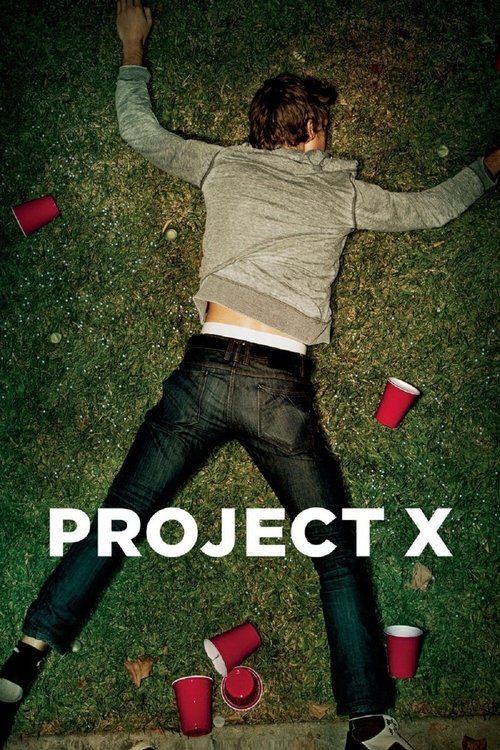
Project X
2012 · Nima Nourizadeh
For a rowdy night with friends when you want chaos with zero homework — pregame energy in movie form. Not the pick if secondhand embarrassment or bad decisions on screen stress you out.
What it's about
Three anonymous Pasadena high-school seniors — a birthday boy with an empty house, a motormouth promoter, and their gentle third wheel — throw a party to buy themselves a reputation. Word spreads, and the film simply documents, camcorder-style, a suburban backyard bash escalating past every conceivable limit.
The experience
Loud, obnoxious, and gleefully irresponsible — it plays like watching a rumor become a riot in real time, shot from inside the crowd. You laugh, you wince, and the sheer escalation becomes its own spectacle.
The craft
The found-footage format, borrowed from horror and pointed at a teen comedy, is the whole trick: amateur video texture makes every escalation feel like leaked evidence rather than a staged setpiece. The party's build from awkward to apocalyptic is a real feat of escalating construction, and the wall-to-wall soundtrack begs for good speakers.
Why it matters
A cheap production turned box-office phenomenon under Todd Phillips's producing banner, it became notorious for allegedly inspiring real copycat parties and stands as the definitive party-gone-wrong movie of its era.
Snapshot
Project X is a found-footage teen comedy that stages one suburban house party as a controlled demolition. Three unremarkable high-school seniors in Pasadena — Thomas, whose parents are away for the weekend; Costa, the loudmouth strategist; and JB, the soft anchor of the trio — set out to buy themselves a reputation, and the film simply documents the night the plan works far too well. Directed by first-time feature filmmaker Nima Nourizadeh and produced under the aegis of Todd Phillips at the crest of his Hangover success, the picture belongs to a lineage of adolescent wish-fulfillment comedies (Risky Business, Can't Hardly Wait, Superbad) but detonates that tradition through the amateur-video aesthetic then dominant after Cloverfield and Paranormal Activity. Made cheaply and marketed as an event, it became a conspicuous commercial success and, more durably, a cultural flashpoint — its title entering the lexicon as shorthand for the destructive teenage rager and, notoriously, inspiring real-world imitations. It is a minor film with an outsized footprint: aesthetically thin by design, sociologically loud, and unusually honest about the mechanics of its own excess.
Industry & production
Project X was a Warner Bros. release developed through Todd Phillips's production banner (Green Hat Films / Silver Pictures involvement is part of the record; Phillips took a "presented by" and producing role). Its commercial logic was that of the high-margin genre bet: a modest budget — widely reported in the low eight figures, on the order of roughly a dozen million dollars — deployed against a young cast of near-unknowns and a soundtrack-driven marketing campaign aimed at teenagers and college audiences. That arithmetic is the point of the project. By hiring a music-video director, casting actors without name recognition, and adopting a found-footage conceit that licenses rough, handheld imagery, the production kept costs low while promising spectacle. The film opened in early March 2012 and substantially outgrossed its production cost, becoming profitable well before ancillary revenue. I won't cite a precise worldwide gross, as I can't verify the figure with confidence, but the picture is consistently characterized as a strong earner relative to outlay.
The casting is central to the industrial story: Thomas Mann (Thomas), Oliver Cooper (Costa), and Jonathan Daniel Brown (JB) anchored the trio, with Kirby Bliss Blanton as Thomas's friend Kirby and Dax Flame as the wallflower charged with filming the night. The strategy of using unfamiliar faces reinforced the documentary illusion — audiences had no star personae to puncture the sense that they were watching real teenagers — and kept fees down. Warner Bros.'s campaign leaned hard on the promise of transgression, effectively selling the party itself as the attraction.
Technology
The film is a product of a specific technological moment: the mainstreaming of found footage as a commercial form and the ubiquity of consumer and prosumer video capture. Diegetically, the movie is presented as footage shot by the characters — principally by Dax, the deadpan chronicler hired to record the party — supplemented by other cameras, phones, and later, as the night escalates, aerial and news-style coverage. This premise let the production shoot on smaller, more mobile rigs and integrate lower-resolution, "found" imagery without breaking its contract with the viewer. The proliferation of smartphones and social platforms is also the film's engine at the level of plot: the party spirals because word spreads virally, an anxiety about networked amplification that dates the film precisely to the early-2010s. In production terms, the found-footage conceit is a technological alibi for economy — it converts the limitations of a cheap shoot into the texture of authenticity.
Technique
Cinematography
The cinematography, by Ken Seng, is organized around the found-footage rulebook while quietly cheating it toward legibility. Nominally the images come from characters' cameras, so the visual grammar is handheld, reactive, and often motivated by an in-world operator; yet the film routinely delivers coverage — crane-like elevations over the packed backyard, coherent crowd geography, cutaways — that a single amateur could not have captured, and it does not agonize over the discrepancy. Seng's work leans on available and practical light: daylight for the anxious build-up, then the saturated artificial palette of night, pool lights, glow sticks, and eventually fire. As the party swells, the camerawork grows more kinetic and the frame more crowded, translating scale into a rising density of bodies. The look is deliberately unpolished, but it is unpolished with intent — the roughness sells the reality while the underlying staging keeps the spectacle readable.
Editing
Editing is where the film's real construction lies, and it is more sophisticated than the shaggy surface implies. The picture is built as an accelerating montage: a slow, almost mundane first act (the errand-running, the nervous invitations) gives way to a middle stretch that compresses the party into a propulsive collage of vignettes cut to music, and finally a chaotic third act in which the montage tips into disaster. The rhythm is essentially musical — sequences are timed to drops and beats, so that the edit functions less like continuity storytelling than like an extended music video, which is consistent with the director's background. I can't confidently attribute the cut to a specific editor from memory, so I'll flag that the credited editing personnel are a point where I don't want to guess. What is clear is the strategy: the film uses tempo, not plot, to generate its arc.
Mise-en-scène / staging
The production design is a study in the ordinary made apocalyptic. It begins in a generic, comfortable suburban home — the kind of anonymous Southern California house whose very blankness marks it as a stage awaiting violation — and the film's central pleasure is watching that space progressively destroyed. Staging escalates in discrete, legible steps: a manageable gathering, then an overflow, then set-piece transgressions (the pool, the inflatable, the neighbor, a bouncing dwarf gag, a flamethrower, a riot). Each beat raises the ceiling on what the space can contain until the house and finally the neighborhood are consumed. The mise-en-scène is essentially additive — the frame keeps accumulating people, debris, and hazard — so that the environment itself charts the narrative's loss of control.
Sound
Sound is arguably the film's true authorship. Project X is soundtrack cinema: its identity is carried by a wall-to-wall bed of hip-hop and electronic dance music, and the party's energy is manufactured in the mix as much as on screen. The sound design toggles between the muffled, in-world audio of the found-footage premise and a fuller, non-diegetic musical scoring that abandons realism whenever the film wants euphoria. The record on an original score is thin, and the film's musical character is defined far more by licensed tracks than by composed cues; I won't attribute a score to a composer I can't verify. The important critical point is that the movie treats music not as accompaniment but as the primary instrument of feeling — it is the closest thing the film has to a nervous system.
Performance
The performances are pitched to the amateur-video conceit: naturalistic, improvisational-feeling, and calibrated to read as non-acting. Oliver Cooper's Costa is the engine — an aggressive, profane hype-man whose relentlessness supplies most of the film's motor and much of its abrasiveness. Thomas Mann plays the ostensible protagonist as a passive, faintly decent everyman, the audience surrogate carried along by events; his relative restraint is what gives the chaos a center. Jonathan Daniel Brown's JB is comic ballast, and Dax Flame, as the on-camera cameraman, functions almost as a formal device — his flatness reinforces the documentary frame. Kirby Bliss Blanton supplies the film's gesture toward emotional stakes as Thomas's friend and would-be love interest, though the screenplay gives her little room. The ensemble's effectiveness is inseparable from its anonymity: because we don't know these faces, we half-believe them.
Narrative & dramatic mode
The dramatic mode is escalation for its own sake — a comedy of runaway consequences structured as a single night's crescendo. The narrative spine is minimal and openly borrowed: three losers throw a party to become somebody, and the party exceeds every boundary until it becomes a catastrophe. Within that arc the film hangs a thin thread of conventional teen-movie feeling — Thomas's guilt over the wreckage of his parents' house, his fumbled romance with Kirby, a token movement toward consequence and reconciliation — but these beats function less as genuine drama than as the minimum scaffolding required to keep a spectacle of excess from being pure spectacle. The found-footage frame reinforces the mode: because everything is "recorded," the film adopts a documentary fatalism, presenting the escalation as something that simply happened rather than something authored. The result is a comedy whose engine is not jokes but momentum — a machine for amplification.
Genre & cycle
Project X sits at the intersection of two cycles. The first is the American teen party comedy, the wish-fulfillment tradition running from Risky Business through Weird Science, Can't Hardly Wait, American Pie, and, most proximately, Superbad — films built on the fantasy of the transformative night in which the marginal boy is validated. The second is the found-footage boom of the late 2000s and early 2010s, popularized across horror (The Blair Witch Project, Paranormal Activity) and event cinema (Cloverfield), and here transposed onto comedy. The film's originality, such as it is, lies in the collision: it applies the pseudo-documentary apparatus of the disaster/horror cycle to the party-movie fantasy, so that the genre's usual aspirational glow is shot through with the ambient dread of surveillance and viral exposure. It is a hybrid, and its cultural moment was precisely the point where those two cycles overlapped.
Authorship & method
The film is best understood as a producer's concept executed by a music-video craftsman. Nima Nourizadeh, making his feature debut, brought the sensibility of commercials and music promos — rhythm, surface energy, spectacle over character — and that sensibility is the film's dominant authorial signature; the movie is edited and scored like an extended promo. The controlling commercial vision, however, belongs to Todd Phillips, whose post-Hangover brand of raucous, boundary-testing male comedy the film clearly extends. The screenplay is credited to Matt Drake and Michael Bacall, with Bacall (a writer associated with youth-oriented material such as 21 Jump Street and Scott Pilgrim) attached to the story; their contribution is the film's schematic escalation structure and its trio dynamic. On the craft side, cinematographer Ken Seng shaped the deliberately rough look. For other key collaborators — the editor and any credited composer — the reliable record as I hold it is thin, and I'll decline to name individuals I can't verify rather than risk misattribution. The method throughout is subtractive on story and additive on sensation: strip the narrative to a premise, then pile on incident, music, and destruction.
Movement / national cinema
Project X is thoroughly American studio product with no meaningful attachment to an art-cinema movement; its "movement," if it has one, is the commercial found-footage wave rather than any national school. It is worth noting the film's Southern California specificity — the anonymous Pasadena suburb, the pool-and-patio geography, the car culture — which situates it in a very particular register of American middle-class adolescence. The director's own background lends the film a faint transatlantic inflection (Nourizadeh worked in the British and international music-video and commercial worlds before Hollywood), but the finished picture reads as unambiguously American teen-comedy mainstream. This is Hollywood genre filmmaking operating in a low-cost, high-yield mode, not a cinema of place or nation.
Era / period
The film is almost a time capsule of the early 2010s. Everything about it — the smartphone-driven virality that powers the plot, the found-footage aesthetic at its commercial peak, the EDM-and-hip-hop soundtrack culture, the anxiety about content spreading beyond control — locates it precisely in 2012. It captures a transitional moment in youth media: the party is publicized and amplified by networked communication, and the entire film is premised on the assumption that teenagers document and broadcast their own lives. Watched later, its period markers are its most vivid feature; the movie inadvertently preserves the texture of a particular pre-Instagram-maturity, post-YouTube adolescence, when the capacity to record and disseminate had arrived but the norms around it had not.
Themes
Beneath the noise, the film circles a few consistent preoccupations. The most obvious is validation through spectacle — the belief that identity and status are conferred by a single legendary event, and that becoming "somebody" means being witnessed. Closely tied is the theme of amplification and loss of control: every mechanism designed to spread the party's fame is also the mechanism of its destruction, a fable about virality in which desire for visibility becomes self-annihilating. The film is also, more troublingly, a document of a particular strain of male adolescent fantasy, and here it has been widely and fairly criticized: women function largely as scenery and reward, and the movie's celebratory framing of its own excess sits uneasily with any critical distance. Whether the film critiques or merely indulges that fantasy is a genuine interpretive fault line — the found-footage frame invites a reading of detached observation, but the exuberant editing and scoring plainly want the viewer to cheer. Finally there is a thread of consequence and destruction, the wreckage of the house standing as the literal cost of the fantasy, though the film treats that cost lightly.
Reception, canon & influence
Critical reception was predominantly negative to mixed. Reviewers frequently found the film loud, hollow, and morally incurious — praising its kinetic energy and technical propulsion while objecting to its thin characters, its treatment of women, and what many read as an uncritical celebration of destruction and excess. It was, in the critical consensus, more phenomenon than achievement. Commercially it was a clear success relative to its small budget, and it performed strongly with the young audience it targeted.
Looking backward, the influences ON the film are legible and openly worn: the teen-party wish-fulfillment tradition of Risky Business, Can't Hardly Wait, and above all the recent Superbad (with which it shares a producer-adjacent comedic milieu and a losers-seeking-legend structure); the found-footage grammar of The Blair Witch Project, Cloverfield, and Paranormal Activity; and Todd Phillips's own Hangover-era brand of escalating male misadventure. Its formal DNA is essentially a splice of the party comedy and the pseudo-documentary disaster film.
Looking forward, the film's most significant legacy is cultural rather than aesthetic. "Project X" became genuine slang for a wild, destructive party, and — most notoriously — the film was repeatedly cited in connection with real-world copycat parties, some of which resulted in serious property damage and public-safety incidents. This gives the picture an unusual afterlife: its influence is measured less in the movies it inspired than in behavior it appeared to license, making it a recurring case study in debates about media and imitation. Aesthetically, it stands as a high-water mark of the comedy found-footage experiment, a mode that did not sustain a long cycle; few successful successors followed the exact template. Its durable place in the record is therefore double-edged — a modestly regarded film that nonetheless named a phenomenon, exemplified a technological-cultural moment, and became shorthand for the very excess it depicted.
Reception
Critics trashed it in 2012 as found-footage nihilism, but it made over $100M on a ~$12M budget; today it's less reappraised than fossilized — a time capsule of early-2010s party culture that people revisit with equal parts nostalgia and horror.
How Project X was received, from release to now →
How to watch Project X: what to notice on a first viewing
- Watch the cutting speed up as the party grows. The film builds an accelerating montage: a slow first act of errands and nervous invitations, then a propulsive collage cut to music, then a chaotic rush of vignettes. The rising edit speed, not the jokes, is what actually manufactures the film's excitement.
- Listen for scenes cut exactly to the beat of a song. Cuts are timed to drops and beats in a wall-to-wall hip-hop and electronic soundtrack, so the editing behaves like an extended music video. The soundtrack is doing most of the emotional work here, more than any line of dialogue.
- Notice camera angles no single partygoer could film. Though the footage claims to come from characters' own cameras, the film delivers crane-like views over the backyard and clean crowd geography no handheld phone could capture. The found-footage premise bends whenever the film needs a bigger picture of the chaos.
- Watch the house fill with more people at every stage. Staging escalates in visible steps, a small gathering, then overflow, then set pieces like the pool and a flamethrower, each stage raising what the space can hold. The environment itself charts the story's loss of control more than any character's choices do.
- Watch how unpolished and off-the-cuff the performances feel. The mostly unknown cast plays the escalation as naturalistic and improvised, with Oliver Cooper's hype-man energy driving most scenes forward. Not recognizing the actors makes the chaos read as a real party rather than a movie.
The whole guide to watching Project X, with the keys for a rewatch →
Influences: the films it descends from and the films it influenced
- Risky Business (1983) — Established the suburban-house-as-stage template — parents away, the home converted into a site of transgressive commerce and spectacle — with pop cues doing the emotional lifting that dialogue doesn't.
- Can't Hardly Wait (1998) — Structures a whole film as one night in a single party location, built from escalating interwoven vignettes rather than plot, the additive-incident architecture Project X strips down to a premise.
- Superbad (2007) — Supplies the losers-seeking-legend quest and the two-plus-a-wildcard trio dynamic chasing social immortality through a single legendary party — Bacall-adjacent youth-comedy DNA.
- Cannibal Holocaust (1980) — Originated the recovered-amateur-footage conceit, presenting diegetically shot material as a found document — the root grammar of the whole found-footage mode.
- The Blair Witch Project (1999) — Sold authenticity through non-professional-feeling improvised performance and jittery handheld verité, the anonymity-and-realism playbook Project X reuses with a camcorder POV.
- Paranormal Activity (2007) — Modeled the cheap consumer-camera look and the patient slow-build-to-crescendo using only available and practical light, proving found footage could crescendo on a tiny budget.
- Cloverfield (2008) — Filters a large-scale disaster through a single partygoer's handheld camcorder, pivoting from a house party into escalating chaos — the exact party-then-catastrophe swing Project X inherits.
- The Hangover (2009) — Phillips's own template of escalating male misadventure, piling incident onto incident as a night spirals out of control — the producer's brand this film is engineered to extend.
- [REC] (2007) — Drives a single continuous handheld camera toward an accelerating crescendo lit only by diegetic sources, the propulsive one-camera escalation Project X apes for its climax.
- Neighbors (2014) — Extends the Phillips-brand escalating party-comedy into one-upmanship warfare, additive destruction staged as comic set-piece crescendo.
- Project Almanac (2015) — Lifts Project X's found-footage party-montage grammar wholesale — music-video crescendo, handheld amateur POV — grafting it onto a teen time-travel plot.
- Nerve (2016) — From the Paranormal Activity producing lineage, it makes smartphone-virality and validation-through-spectacle the literal plot engine, escalating dares for an online crowd.
- Assassination Nation (2018) — Converts social-media exposure into additive real-world destruction via hyperkinetic, music-video-styled staging and soundtrack-driven escalation for its own sake.
- Chronicle (2012) — Same-year found-footage teen film that motivates its camera diegetically and builds toward additive destruction as its protagonists' power/appetite escalates for its own sake.
- Spring Breakers (2012) — A music-video craftsman's youth-excess film built as soundtrack-driven montage that privileges surface, rhythm and spectacle over character — the same commercial-director sensibility, art-house end of it.
- The Bling Ring (2013) — Dramatizes validation-through-spectacle and status-hunger among teens chasing viral notoriety, the same amplification-loss-of-control theme without the found-footage frame.
Similar films
- Superbad (2007) — influence & lineage
- Cloverfield (2008) — influence & lineage
- House Party (1990) — shared sensibility
- The Cabin in the Woods (2012) — shared sensibility
- Nowhere (1997) — shared sensibility
- Buddy (2026) — shared sensibility
- Happyend (2024) — shared sensibility
- The Slumber Party Massacre (1982) — shared sensibility