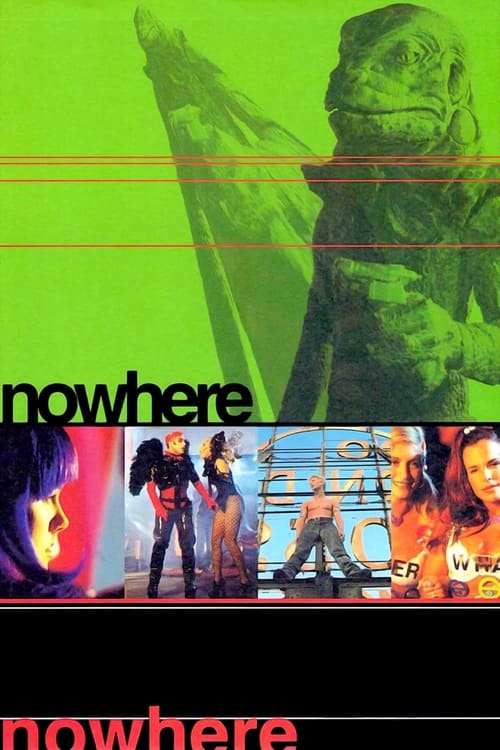
Nowhere
1997 · Gregg Araki
For a late night when you want something weird, queer, and neon — a party movie with a broken heart. This is challenge dressed up as comfort: fun to watch, harder to shake.
What it's about
One surreal day in a candy-colored Los Angeles, where a moody teenager named Dark Smith and his tangled circle of friends — girlfriends, lovers, crushes of every orientation — drift toward the biggest party of the year. Along the way there are bad drug trips, televangelists, heartbreak, sudden violence, and quite possibly an alien abduction. It's a teen soap opera pushed past the edge of reality, the last chapter of Gregg Araki's Teen Apocalypse Trilogy.
The experience
Loud, horny, funny, and then suddenly devastating — it swings from campy sketch comedy to genuine dread in a single scene. The pop-art excess keeps you grinning while a real ache about being young and doomed builds underneath, and it leaves a bruise.
Performances
James Duval carries the film as Dark, all mopey tenderness under the chaos, and the supporting cast is a startling time capsule of soon-to-be-famous 90s faces committing fully to the madness.
The craft
Every set is a pop-art installation — production designer Patti Podesta paints bedrooms and diners in colors that don't exist in nature — and the shoegaze soundtrack, thick with Slowdive and Cocteau Twins, wraps the whole thing in gorgeous melancholy. It's a film built from surfaces that turn out to have feelings. Good speakers matter as much as the screen.
Why it matters
A defining artifact of the New Queer Cinema and a cult touchstone whose DNA shows up everywhere teen stories go surreal and sincere at once; its long unavailability only deepened the legend.
The final panel of Gregg Araki's Teen Apocalypse Trilogy, after Totally F***ed Up and The Doom Generation: one day in a Los Angeles of candy-painted bedrooms and existential dread, where the mopey Dark Smith and his polymorphous circle of friends drift through hookups, bad drugs, televangelists, and the possibility of alien abduction on their way to the year's biggest party. Araki, a central figure of the New Queer Cinema, pitched it as 90210 on acid, and the film's genius is that it means both halves — the teen-soap surface (the cast is a delirious time capsule of soon-to-be-famous faces) and the genuine ache underneath, a generation raised on apocalypse looking for someone to hold. Production designer Patti Podesta turns every set into a pop-art installation; the shoegaze-heavy soundtrack, thick with Slowdive and Cocteau Twins, kept the film out of circulation for years over music rights until its 2023 restoration. Beneath the neon nihilism it is, disarmingly, a film about wanting to be loved before the world ends.
Reception
Dismissed by many 1997 critics as shock-value excess, it's since been fully reclaimed as the crown jewel of Araki's Teen Apocalypse Trilogy — a reappraisal sealed when the long-hard-to-see film got a 25th-anniversary 4K restoration and theatrical re-release in 2023.
How Nowhere was received, from release to now →
Influences: the films it descends from and the films it influenced
- Totally F***ed Up (1993) — Opened Araki's Teenage Apocalypse Trilogy with a numbered-fragment structure and camcorder confessionals charting a queer teen ensemble's aimless drift — the narrative template Nowhere restyles into pop-art.
- The Doom Generation (1995) — The immediate prior trilogy entry that fixed the deadpan neon road-movie palette, flat affect delivered over pop needle-drops, and recurring lead James Duval that Nowhere inherits wholesale.
- Rebel Without a Cause (1955) — Compressed adolescent crisis into a single tumultuous day and used expressionist color blocks (Dean's red jacket) as emotional signage — the melodramatic architecture under Araki's candy-neon.
- Pierrot le Fou (1965) — Established pop-art primary-color production design and doomed-lovers antinaturalism with deadpan direct-to-camera address, the Godardian color-and-artifice grammar Araki lifts.
- Scorpio Rising (1963) — Cut queer underground montage to a jukebox of pop singles, pioneering needle-drop-as-structure that Araki's wall-to-wall shoegaze soundtrack extends.
- A Clockwork Orange (1971) — Aestheticized ultra-violence inside fetishized pop-design interiors (the mannequin milk bar), the installation-like set staging Araki quotes in his tableau interiors.
- Liquid Sky (1982) — Neon new-wave club scene invaded by aliens feeding on drug-and-sex highs, androgynous polymorphous desire rendered in cold synthetic color — a near-direct blueprint for Nowhere's sci-fi apocalypse.
- Repo Man (1984) — Deadpan punk absurdism in which alien/nuclear apocalypse erupts into a comic subcultural drift, the tonal collision of banal youth and cosmic dread Araki reruns.
- Twin Peaks (1990) — Warped teen-soap satire with supernatural dread and hyper-saturated tableau staging, modeling the soap-opera-meets-surreal register Nowhere satirizes.
- But I'm a Cheerleader (1999) — Deploys candy-colored pop-art production design and hyper-saturated primary sets for queer teen satire — a palette and staging directly indebted to Araki.
- Donnie Darko (2001) — Places a suburban teen ensemble under an apocalyptic countdown, fusing high-school soap with surreal-sci-fi dread and structuring feeling through pop needle-drops.
- Mysterious Skin (2004) — Araki's own maturation, trading pop-art satire for Robin Guthrie/Harold Budd shoegaze-scored emotional realism while keeping the queer-teen-trauma core.
- Spring Breakers (2012) — Neon-drenched hedonist drift built on a candy-color hyperreal palette and looping pop-song hypnosis, extending Araki's saturated-surface aesthetic into the digital age.
- Euphoria (2019) — Stages polymorphous teen sexuality and drug culture as glitter-and-neon pop-art tableaux with a curated dream-pop needle-drop score — Araki's most direct television heir.
- Laurence Anyways (2012) — New Queer Cinema built on saturated stylization and a curated shoegaze/pop needle-drop soundtrack, an antecedent for Dolan's use of music cues as the emotional engine.
- I Want Your Sex (2026) — Jim Fealy's oversaturated fluorescent palette with wide deep-focus lenses and flat frontal blocking turns LA interiors into primary-colored stage boxes; the absurdist non-sequitur interruptions here prefigure the animated interpolations.
- Kids (1995) — The same mid-90s move of compressing an entire teen sex-and-drug subculture into one drifting day — the realist inverse of Araki's pop-art single-day structure.
- Gummo (1997) — Contemporaneous plotless ensemble drift through an apocalyptic teen wasteland, sharing the fragmented antinarrative and dead-affect grotesquerie.
- Velvet Goldmine (1998) — New Queer Cinema glam maximalism staging pop-art musical tableaux around polymorphous sexuality, a parallel deployment of saturated artifice and queer desire.
Similar films
- Donnie Darko (2001) — influence & lineage · often watched together
- Gummo (1997) — influence & lineage
- Kids (1995) — influence & lineage
- Mysterious Skin (2005) — shared sensibility
- Enter the Void (2010) — shared sensibility
- I Saw the TV Glow (2024) — shared sensibility
- Happyend (2024) — shared sensibility
- House (1977) — shared sensibility
All the films related to Nowhere →
Watch it with: curated runs of related films
- The Grotesque Sublime — Watch these when you want cinema that pushes the body to hallucinatory, grotesque extremes — each a lurid transformation, half ecstasy and half horror, that dares you to keep looking.