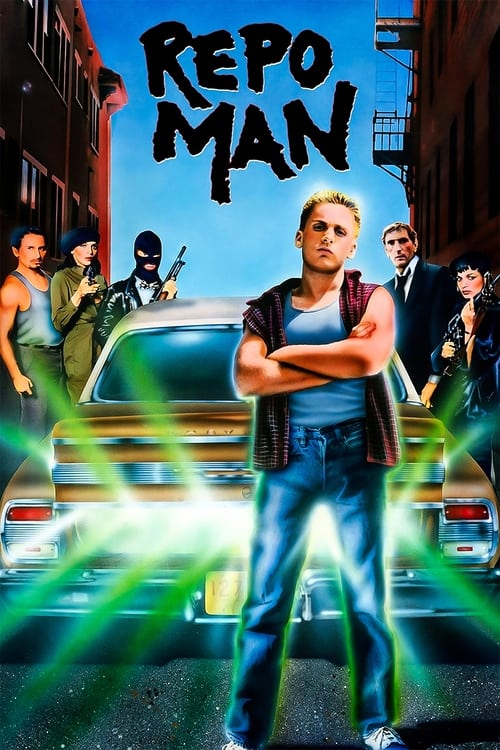
Repo Man
1984 · Alex Cox
For when you're in the mood for something gleefully weird — a midnight movie with attitude, best watched late with people who like their comedy strange. Pure cult-film comfort food, seasoned with nihilism.
What it's about
Otto, a disaffected L.A. punk who's just lost his supermarket job and his girlfriend, drifts into car repossession under the wing of Bud, a wired, speed-fueled veteran with a personal code. Their scuzzy trade collides with a bigger mystery: a battered '64 Chevy Malibu with a bounty on it and something lethal glowing in the trunk, pursued by government agents, UFO cultists, and every repo man in town.
The experience
Deadpan, anarchic, and endlessly quotable — it treats cosmic conspiracy and minimum-wage tedium with the same wry shrug, so you're never sure whether to laugh or check over your shoulder. It's fast, weird, and scored to a hardcore-punk soundtrack that keeps the whole thing buzzing.
Performances
Harry Dean Stanton is the reason to watch: his Bud delivers repo-man philosophy with such conviction it approaches scripture, while a young Emilio Estevez plays Otto's blank punk apathy perfectly against him.
The craft
Alex Cox's debut runs on tone — an absurdist flatness where generic-brand groceries, televangelists, and radioactive cargo all share the same bleached L.A. wasteland. The landmark punk soundtrack isn't decoration; it's the film's nervous system.
Why it matters
Barely released by its studio, it survived on word of mouth and its soundtrack to become one of the defining cult films of the 1980s and a touchstone of American punk cinema.
Snapshot
Repo Man is the debut feature of the British-born, UCLA-trained director Alex Cox: a deadpan collision of punk nihilism, consumer satire, and drive-in science fiction set in a stripped-down, deindustrialized Los Angeles. Otto (Emilio Estevez), a disaffected suburban punk, drifts into the automobile-repossession trade under the tutelage of the wired veteran Bud (Harry Dean Stanton), and the picaresque that follows folds a most-wanted 1964 Chevy Malibu — its trunk carrying something lethal and glowing — into a swirl of government agents, UFO cultists, televangelists, and philosophizing gutter mystics. The film's tone is its signature: an absurdist flatness that treats cosmic conspiracy and minimum-wage tedium with exactly the same wry detachment. Barely released by its studio, it survived on the strength of a landmark hardcore-punk soundtrack, midnight and repertory screenings, and home video to become one of the defining American cult films of the 1980s and an origin point for the low-budget, genre-scrambling sensibility that fed the coming independent boom.
Industry & production
Repo Man emerged from the margins of the Hollywood system rather than its center. It was produced by Peter McCarthy and Jonathan Wacks, with the crucial patronage of executive producer Michael Nesmith — the former Monkee turned music-video and film entrepreneur, whose involvement through his Pacific Arts orbit helped a first-time director's unlikely script find financing and, eventually, a studio home at Universal. The budget was small by studio standards; while various figures circulate in the trade literature, the operative fact is that this was a lean, independently minded production absorbed into a major's distribution apparatus rather than a conventional studio development.
That arrangement produced the film's notorious release history. Universal, uncertain what to do with a punk-inflected absurdist comedy, gave it a minimal theatrical push, and the picture initially struggled to find an audience. Its rescue is one of the better-documented cases of a soundtrack driving a film: the accompanying album — anchored by Iggy Pop's title theme and stacked with Los Angeles hardcore acts — sold and circulated, drawing curious listeners back to the movie, which found its true life in revival houses, on cable, and on home video. The gap between the film's negligible first-run performance and its enduring cult standing is central to how Repo Man is remembered.
Technology
Made in 1984, Repo Man is a conventional 35mm production of its moment, and it makes no claim to technical novelty at the level of format or apparatus. Its interest lies instead in how modestly it deploys ordinary tools: available and practical light, real Los Angeles locations, and a resourceful approach to its few effects. The film's science-fiction payload — the vaporizing glow that pours from the Malibu's trunk, the incandescent car of the finale — is achieved through in-camera and optical means and simple lighting tricks rather than elaborate visual effects, and the low-tech, slightly handmade quality of these moments is part of the film's charm and its punk economy. Where the record is thin on the precise technical particulars of specific effects setups, it is better to say so than to reconstruct them speculatively.
Technique
Cinematography
The single most consequential craft credit is the cinematography of Robby Müller, the Dutch master then at the height of his powers — the same year he shot Wim Wenders's Paris, Texas, and before his long association with Jim Jarmusch. Müller brings an unglamorous, observational clarity to Los Angeles: flat industrial daylight, sodium-lit night streets, wide vacant lots and generic interiors rendered without romance. His compositional calm is essential to the film's comedy, framing outlandish events with the same even, unhurried eye it gives to a convenience-store aisle or a repo lot. The look is naturalistic but never slack; Müller's feeling for the specific color and emptiness of the American urban periphery gives the absurdist material a grounded, almost documentary weight, so that the aliens and agents seem to intrude on a real city rather than a set.
Editing
The film is cut in an episodic, elliptical mode that mirrors its picaresque structure, moving between the repossession trade, Otto's punk milieu, the conspiracy plot, and stray vignettes with a deadpan willingness to let scenes end on a flat or anticlimactic beat. The editing favors comic understatement and non-sequitur juxtaposition over momentum, allowing the "lattice of coincidence" theme to register formally as much as verbally. The editing is credited to Dennis Dolan; beyond the credit itself the detailed record of the cutting-room process is comparatively thin, and it is more honest to note that than to embellish it.
Mise-en-scène / staging
Production design is where Repo Man's satire lives most visibly. The film's celebrated running gag is its generic packaging — plain white cans and boxes labeled simply FOOD, DRINK, BEER, and the like — a production-design conceit that turns consumer culture into blank, interchangeable product and doubles as a low-budget solution to brand clearances. The staging throughout favors the anonymous and the depleted: bare apartments, fluorescent-lit stores, dusty repo yards, the eroded stretches of an L.A. that looks post-industrial and slightly abandoned. This deadpan, deglamorized environment — art directed by a design team including J. Rae Fox and Lynda Burbank — is the visual argument of the film, a world of disposable objects and disposable people through which the glowing Malibu moves like a rumor.
Sound
Sound and music are inseparable from the film's identity. Iggy Pop wrote and performed the title theme, and the incidental score was supplied by the Chicano punk band The Plugz — Tito Larriva and Steven Hufsteter — whose surf-inflected, twangy cues give the picture a restless, garage-band pulse. The larger soundtrack functions as a curated map of the early-'80s Los Angeles hardcore scene, and its aggressive, ironic energy is the tonal engine of the movie. Beyond the music, the film's sound design leans on the flat naturalism of its dialogue and ambience, letting the mordant one-liners land without underscoring.
Performance
The acting style is a controlled deadpan that treats the ridiculous as routine. Harry Dean Stanton's Bud is the film's soul — a jittery, code-bound repo veteran whose contempt for "ordinary fucking people" and speeches about the repo man's life give the movie its philosophical spine and its bitter comedy. Emilio Estevez plays Otto with a sullen blankness that reads as authentically adolescent and lets him function as the audience's bewildered surrogate. Around them, a gallery of character actors sharpen the tone: Tracey Walter's Miller, the yard's soft-spoken visionary; Sy Richardson's swaggering Lite; Olivia Barash's conspiracy-smitten Leila; Vonetta McGee, Del Zamora, Zander Schloss, and Fox Harris as the ruined, lobotomized driver J. Frank Parnell. The ensemble's shared commitment to underplaying the surreal is what makes the film's humor cohere.
Narrative & dramatic mode
Repo Man is structured as a picaresque rather than a tightly plotted thriller. Otto's episodic education in the repo trade provides a loose spine onto which the film hangs a proliferating set of subplots — the hunt for the Malibu and its bounty, the CIA's pursuit, UFO true-believers, warring repo crews, punk stick-up artists — that converge more by absurdist coincidence than by mechanical causation. The dramatic mode is deadpan absurdism laced with satire: it withholds conventional emotional catharsis, undercuts its own suspense, and treats plot as a delivery system for tone and idea. Miller's monologue about a "lattice of coincidence" that lies on top of everything — his "plate of shrimp" theory that seemingly unconnected events secretly rhyme — is effectively the film's aesthetic thesis, a comic cosmology in which the scattered incidents are meant to feel obscurely, hilariously connected. The ending abandons realism entirely for a note of transcendence, an image of ascension that seals the film's refusal of ordinary narrative resolution.
Genre & cycle
The film is a deliberate genre hybrid: a punk comedy welded to a B-movie science-fiction premise, with strands of conspiracy thriller, teen-alienation drama, and workplace picaresque running through it. It belongs to the early-1980s cycle of American punk and youth-subculture films — kin to the milieu of Suburbia and the wider new-wave/hardcore moment — but it is unusual in fusing that subcultural specificity with a knowing pastiche of atomic-age and flying-saucer sci-fi. That collision, in which the tropes of 1950s paranoia cinema are replayed as Reagan-era irony, places Repo Man at the leading edge of the postmodern genre-blending that would define a strain of American cult filmmaking. It is at once a movie about a subculture and a satirical anthology of exhausted American genres.
Authorship & method
Repo Man is unmistakably an authored film, its voice traceable to Alex Cox as both writer and director. Cox drew on his own experience and the punk culture around him to fashion a sensibility that is simultaneously anarchic and morally pointed — anti-consumerist, anti-authoritarian, and fascinated by ritualized codes of conduct (the repo man's creed most of all). His method here is that of a first-time director marshaling a strong collaborative team into a coherent world: the working relationship with cinematographer Robby Müller gave the satire its grounded visual realism; the score by The Plugz (Larriva and Hufsteter) and the curated hardcore soundtrack supplied its rhythm and attitude; the editing by Dennis Dolan shaped its elliptical comic timing; and the generic-product production design translated Cox's ideas about consumer culture into instantly legible images. The executive producer Michael Nesmith's support was the enabling condition that let this idiosyncratic vision reach the screen. Cox would extend this authorial persona across subsequent, increasingly uncompromising work.
Movement / national cinema
Though financed and distributed within the American industry and shot by a European cinematographer, Repo Man is best understood as a document of American independent and subcultural cinema in transition. It sits at the hinge between the punk/no-wave underground of the late 1970s and early 1980s and the commercial independent movement that would flower later in the decade and into the 1990s. Its DNA is Los Angeles: the hardcore music scene, the sprawl and industrial decay of the city's periphery, and a specifically Southern Californian strain of apocalyptic irony. As the work of a British émigré operating inside Hollywood's margins, it also carries an outsider's estranged view of American consumer life, giving its national-cinema identity a productive doubleness.
Era / period
The film is thoroughly a product of the early-to-mid 1980s and of the Reagan era's cultural contradictions. Its satire targets the period's consumerism, televangelism, and Cold War paranoia — the born-again TV preacher siphoning money from Otto's zonked-out parents; the nuclear anxiety encoded in the Malibu's cargo; the generic-brand economy of interchangeable goods. It captures a particular moment of American deindustrialization and youth disaffection, when punk had curdled from novelty into a subculture of exhaustion. The neutron-bomb undertones and the atmosphere of low-grade dread are inseparable from the nuclear imagination of the decade. In this sense Repo Man is both a comedy and a period record of Reagan-era unease.
Themes
At its core the film is an anti-consumerist satire: a portrait of a society reduced to generic products and disposable relationships, where advertising, credit, and television have flattened experience into blank labels. Layered over that is a study of alienation and the search for meaning — Otto's drift from suburban nullity into the repo trade is a quest for something, anything, to belong to, and the film offers competing frameworks (punk rebellion, the repo code, UFO faith, Miller's cosmic coincidence) as rival religions of the disaffected. The "lattice of coincidence" motif expresses a yearning for hidden order in a chaotic world, played simultaneously as stoned comedy and genuine metaphysics. Running beneath it all is a Cold War strain of nuclear dread and conspiracy, and a persistent skepticism toward every institution — government, church, family, commerce — that claims authority. The film's contempt is democratic and its sympathies lie with the marginal.
Reception, canon & influence
Critical reception, once the film found viewers, was substantially warm; Repo Man was embraced as a fresh, genuinely original voice, and it accrued the kind of enthusiastic critical defense that helps build a cult reputation. Its commercial arc — negligible in first run, then steadily rising through the soundtrack, cable, home video, and repertory play — is the classic shape of cult canonization, and the film is now routinely cited among the definitive punk films and among the most distinctive American independent debuts of its decade; its later admission to prestige home-video canonization reflects that consolidated standing.
Its backward influences are legible: the atomic-age science fiction and flying-saucer paranoia of 1950s B-movies, replayed ironically; the anarchic energy and DIY ethos of punk itself; and a lineage of deadpan American absurdist comedy. Looking forward, Repo Man helped license a whole sensibility — the low-budget, genre-mixing, ironically detached indie film — that would proliferate in the following years. Its philosophizing drifters and its faith in meaningful coincidence prefigure the slacker cinema of the early 1990s, and its blend of the mundane and the surreal anticipates later cult and Coen-adjacent comedy. For Alex Cox it was a career-defining calling card that led directly to his subsequent work (Sid and Nancy among it), and he would later return to the material's world in a loosely related follow-up. More than a curiosity, Repo Man endures as a touchstone: the rare studio-distributed film that captured a subculture from the inside and, in doing so, sketched the outlines of the independent cinema to come.
Reception
Universal barely released it in 1984 and it died fast — then the Iggy Pop–fronted punk soundtrack started selling, word of mouth built, and a theatrical re-release turned it into the definitive 80s cult movie, later canonized with a Criterion edition.
How Repo Man was received, from release to now →
Influences: the films it descends from and the films it influenced
- Kiss Me Deadly (1955) — The incandescent, radioactive Chevy Malibu trunk is a direct transposition of the glowing 'great whatsit' briefcase MacGuffin, the same atomic-dread lure that kills whoever opens it.
- Two-Lane Blacktop (1971) — Establishes the deadpan, existential car-culture picaresque built on flatly underplayed non-actor performances and elliptical narrative drift that Repo Man inherits wholesale.
- The American Friend (1977) — Robby Müller's desaturated, available-light rendering of a grubby Americana is the exact naturalistic-flat-daylight grammar he carries into Repo Man.
- The Harder They Come (1972) — Pioneers the model of a curated subculture soundtrack acting as the film's narrative engine and the primary driver of its slow cult canonization through the record rather than the box office.
- The Atomic Cafe (1982) — Weaponizes recycled 1950s civil-defense and duck-and-cover footage into ironic atomic-age pastiche, the same nuclear-kitsch register Cox mines for satire.
- Eraserhead (1977) — Demonstrates rendering mundane industrial America as deadpan surrealism on a micro-budget using practical in-camera effects rather than optical trickery.
- Down by Law (1986) — Extends the Müller-shot deadpan-drifter aesthetic, pairing his monochrome naturalism with picaresque losers who philosophize their way through dead time.
- Raising Arizona (1987) — Carries forward the deadpan-absurdist tone and the cartoon-flat generic-product Americana into a fully realized comic vernacular.
- Slacker (1990) — Literalizes Repo Man's philosophizing-drifter monologues and 'lattice of coincidence' into a whole structure of chained, aimless encounters.
- Sid and Nancy (1986) — Cox's immediate follow-up that extends his punk-insider authorial persona and morally pointed anti-authoritarian gaze onto real subcultural figures.
- Pulp Fiction (1994) — Inherits the glowing-briefcase MacGuffin (via Kiss Me Deadly through Repo Man) plus the lattice-of-coincidence structure and needle-drop-as-attitude soundtracking.
- Dead Man (1995) — Robby Müller shoots a deadpan American picaresque again, translating Repo Man's flat naturalism into monochrome and its drift into a spiritual-absurdist road structure.
- Nowhere (1997) — Deadpan punk absurdism in which alien/nuclear apocalypse erupts into a comic subcultural drift, the tonal collision of banal youth and cosmic dread Araki reruns.
- I Love Boosters (2026) — Punk lo-fi sci-fi that welds labor and economic satire onto a genre skeleton with cheap surreal effects and deadpan class rage.
- Good Luck, Have Fun, Don't Die (2026) — The named model for stating one absurd proposition aloud in flat deadpan and then following it with total literalism, plus the anti-glamour night-LA location shooting and the recruitment-by-a-lecturing-crank scene that opens both films; also the commercial template Verbinski's picture is now repeating — theatrical failure, cult recuperation.
- The Return of the Living Dead (1985) — Shares the exact premise engine — a sealed government container that destroys whoever opens it, loose in a working-class Los Angeles — plus the practice of casting punk-subcultural performers as location texture rather than as a subject, which Return's warehouse-and-cemetery tableaux copy.
- Liquid Sky (1982) — Contemporaneous no-budget punk-scifi hybrid that fuses subcultural fashion and flying-saucer conceit with the same DIY genre-blending impulse.
- Buckaroo Banzai Across the 8th Dimension (1984) — Same-year deadpan-absurdist genre collage that plays atomic-age B-movie alien-invasion tropes with a straight face and cult-comic timing.
- Paris, Texas (1984) — Müller's same-year, sun-bleached flat-daylight palette of the American Southwest is the prestige counterpart to the identical lighting language he lends Repo Man's L.A.
- Stranger Than Paradise (1984) — Shares the contemporaneous invention of a minimalist American indie built on deadpan underplaying and elliptical, blackout-structured comic drift.
- Blood Simple (1984) — A fellow 1984 regional-American indie debut that proves genre-mixing (noir here, punk-scifi there) can be an authored calling-card off tiny money.
- Dinner in America (2020) — Punk not as subject but as structuring aesthetic — deadpan suburban/LA absurdism scored to an authentic hardcore idiom, the template for treating scene culture as the film's native grammar rather than costume.
Similar films
- Sid and Nancy (1986) — influence & lineage
- Pulp Fiction (1994) — influence & lineage
- Eraserhead (1977) — influence & lineage
- Kiss Me Deadly (1955) — influence & lineage
- RoboCop (1987) — shared sensibility
- Ghostbusters (1984) — shared sensibility
- Inherent Vice (2014) — shared sensibility
- Good Luck, Have Fun, Don't Die (2026) — shared sensibility