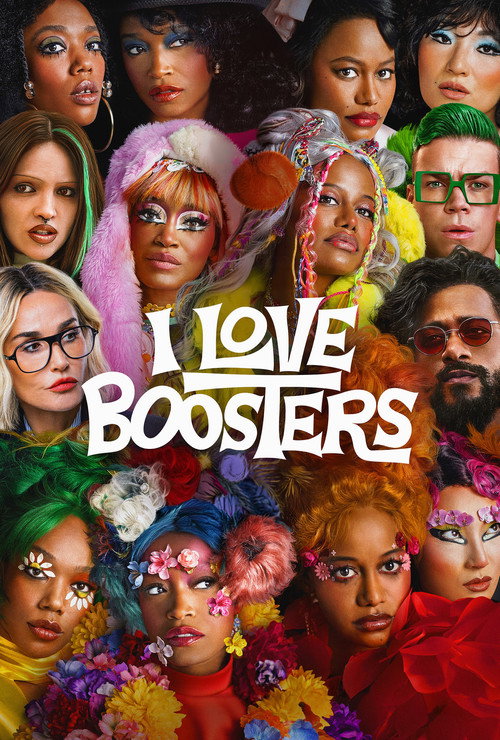
I Love Boosters
2026 · Boots Riley
For when you want your comedy weird, loud, and on the side of the little guy — a rowdy watch that doubles as a conversation starter. More party than homework, but it'll leave you chewing.
What it's about
A crew of shoplifters declares war on a cutthroat fashion maven, boosting merchandise from her stores and reselling it cheap — 'fashion-forward philanthropy,' as they call it. It's a heist comedy set in the temples of retail, where the crime is redistribution and the getaway is a markdown. Boots Riley's third feature keeps his running argument with capitalism going, this time in couture.
The experience
Exuberant, absurd, and fast on its feet — jokes stacked on jokes, with a genuine political snarl underneath the silliness. You laugh first and realize what it was arguing afterward.
The craft
Riley's signature is the practical, handmade surreal: in-camera gags and visible seams instead of digital polish, so the absurdity feels built rather than rendered. The wildest conceits are load-bearing — every sight gag is also an argument about labor, price tags, and who gets to own style, delivered with a comic's timing and an organizer's conviction.
Why it matters
It extends one of the most uncompromised runs in contemporary American cinema and cements Riley's place at the center of a Black American absurdist wave he helped will into being.
Boots Riley's third feature continues one of the most uncompromised runs in contemporary American cinema. The Coup frontman turned filmmaker arrived with Sorry to Bother You (2018), a telemarketing satire that detonated into full-blown surrealism, then went further out with the seven-part I'm a Virgo; here he brings his Oakland-honed agitprop to the heist comedy, following a crew of shoplifters who target a ruthless fashion empire and resell the goods cheap — redistribution as retail. Riley belongs to no movement but has helped will one into being: a Black American absurdist cinema where the wildest genre conceits are load-bearing arguments about labor and capital, delivered with the timing of a great comic and the conviction of an organizer. His craft signature is the practical, handmade surreal — visible seams, in-camera gags, production design doing the ideological work — a deliberate refusal of digital slickness. That a science-fiction shoplifting comedy doubles as a treatise on price, value, and theft from below is not a bug; with Riley it is always the entire point.
Reception
Riley's first feature in the eight years since Sorry to Bother You, it premiered at SXSW 2026 to strong buzz, then split critics on release that May — hailed as audacious by some, called 'an unequivocal mess' by others. Too new for a reappraisal arc; the first-impressions fight is still happening.
How I Love Boosters was received, from release to now →
Influences: the films it descends from and the films it influenced
- Sorry to Bother You (2018) — Riley's own debut supplies the template: literalizing a capitalist metaphor (the 'white voice' dub, the equisapien reveal) via code-switching audio tricks and practical body-horror rather than CGI.
- Putney Swope (1969) — Deadpan advertising-world agitprop that satirizes commerce through non-sequitur sketch logic and cheap in-camera gags, the direct grammar Riley's absurdist satire inherits.
- Bamboozled (2000) — Media satire that escalates into grotesque literalization, using production design (the minstrel-show set) as an explicit polemical argument.
- Brazil (1985) — Handmade retro-futurist sets and practical ductwork build a world where the production design itself is the anti-bureaucratic, anti-capital argument.
- Playtime (1967) — An entire modernist city built as a set so that choreographed comic staging within the frame becomes a critique of consumer society.
- Repo Man (1984) — Punk lo-fi sci-fi that welds labor and economic satire onto a genre skeleton with cheap surreal effects and deadpan class rage.
- Big Deal on Madonna Street (1958) — The bungling-crew heist-comedy blueprint, where process comedy and mistimed incompetence, not slick execution, drive the caper.
- The Ladykillers (1955) — Ealing ensemble heist farce whose meticulously mistimed comic beats and grotesque character-actors model the crew-comedy timing.
- The Science of Sleep (2006) — Cardboard-and-tape in-camera surrealism that stages dream logic with visibly handmade practical effects, refusing digital slickness.
- Bedazzled (1967) — A wish-economy satire built as escalating comic vignettes, using genre conceit to literalize a Faustian bargain over value and desire.
- Get Out (2017) — Genre cinema as Black social allegory, literalizing extraction and bodily commodification through a controlled high-concept conceit.
- They Cloned Tyrone (2023) — Blaxploitation-inflected conspiracy sci-fi comedy that fuses genre pastiche with anti-corporate, redistribution-minded satire of a manipulated neighborhood economy.
- Everything Everywhere All at Once (2022) — Maximalist absurdist sci-fi assembled from DIY practical gags and prop-based surrealism, rooted in working-class debt and labor anxiety.
- Swiss Army Man (2016) — Deploys practical-handmade, in-camera surreal effects as the comic and emotional engine, sharing Riley's commitment to visible physical craft over VFX.
- Attack the Block (2011) — Stages working-class estate politics inside a creature-feature, using practical monster effects and genre thrills to carry class critique.
- Blindspotting (2018) — Same Oakland vernacular and code-switching, heightening verbal performance and rhythmic comic timing into satire of race, value, and gentrification.
Similar films
- Blindspotting (2018) — influence & lineage · same viewing thread
- Sorry to Bother You (2018) — influence & lineage · often watched together
- They Cloned Tyrone (2023) — influence & lineage
- Bamboozled (2000) — influence & lineage
- Kneecap (2024) — same viewing thread
- Zootopia 2 (2025) — same viewing thread
- Zootopia (2016) — same viewing thread
- PlayTime (1967) — influence & lineage · often watched together
All the films related to I Love Boosters →
Watch it with: curated runs of related films
- Genre as Trojan Horse — Watch these together when you want the pleasures of a genre picture — a buddy-cop case, a heist crew, a monster in the sky — that turns out to be secretly arguing about who America polices, prices, and erases.