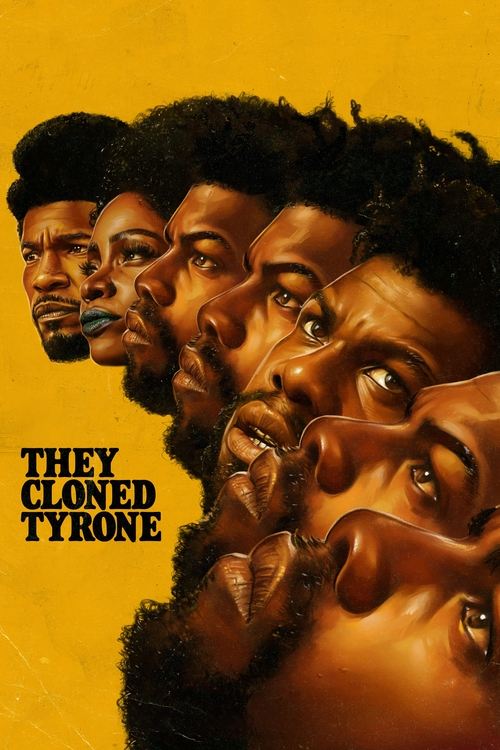
They Cloned Tyrone
2023 · Juel Taylor
For a night when you want entertainment with teeth: laughs, a mystery to pull apart, and something real to argue about afterward. Easy to watch, harder to shake.
What it's about
In a neighborhood called the Glen, a dope dealer, a pimp, and a sex worker keep noticing things that shouldn't be possible — eerie repetitions, people who aren't quite themselves. Following the weirdness leads the reluctant trio toward a vast, clinical operation running beneath their streets, and the suspicion that the everyday textures of their world are instruments of control.
The experience
A conspiracy thriller that's genuinely funny and genuinely unsettling at once — the jokes land fast while a low hum of paranoia keeps building. It moves like a caper but leaves a bruise.
Performances
John Boyega works in a low, wounded register while Jamie Foxx and Teyonah Parris play the comedy at full wattage — the friction between those temperatures is the movie's signature pleasure.
The craft
Juel Taylor and cinematographer Ken Seng shoot digital but grade it like degraded 70s film stock — grain, halation, colors gone slightly rancid — so the whole thing feels beamed in from the blaxploitation era it's riffing on. The retro-funk texture rewards a good screen and speakers.
Why it matters
A standout of the recent wave of Black genre filmmaking that treats conspiracy as metaphor made literal, and a bold calling card for first-time director Juel Taylor.
A dope dealer, a pimp, and a sex worker in a neighborhood called the Glen stumble onto evidence that something vast and clinical is operating beneath their streets — and that the everyday textures of their world may be instruments of control. Juel Taylor's debut feature runs blaxploitation iconography through a paranoid sci-fi engine, joining Sorry to Bother You and Us in a modern wave of Black genre filmmaking that treats conspiracy not as fantasy but as metaphor made literal. John Boyega works in a low, wounded register while Jamie Foxx and Teyonah Parris play the comedy at full wattage; the friction between those tones is the film's signature. Taylor and cinematographer Ken Seng shoot digital but grade it to look like degraded 70s film stock — halation, grain, colors gone slightly rancid — so the movie seems beamed in from the era whose politics it's interrogating. Beneath the caper mechanics sits a pointed argument about assimilation, respectability, and who profits when a community is kept asleep.
Reception
Landed in July 2023 to strong reviews and real buzz for its Boyega–Foxx–Parris trio, then did the classic Netflix vanishing act within weeks. Since then it's become a go-to exhibit in the 'great movies the algorithm swallowed' conversation — the film people keep telling each other they missed.
How They Cloned Tyrone was received, from release to now →
Influences: the films it descends from and the films it influenced
- Putney Swope (1969) — Establishes the absurdist Black corporate-satire register where a boardroom conspiracy is played deadpan-comic, the tonal-friction mode Taylor uses to make 'The Company' both funny and sinister.
- Cotton Comes to Harlem (1970) — Codifies the comedic Harlem-detective blaxploitation template — street-level sleuthing, neighborhood vernacular, buried loot — that Tyrone reactivates as its investigative spine.
- Super Fly (1972) — Supplies the dealer-milieu iconography (the coke-block flat, the pusher's swagger, the funk-scored block) that Fontaine's world reproduces then reveals as an engineered set-dressing.
- Coffy (1973) — Provides the exact character grammar Tyrone recasts as archetypes-under-glass: Hill's dealer/pimp/sex-worker triad maps directly onto Fontaine, Slick Charles, and Yo-Yo.
- The Spook Who Sat by the Door (1973) — Pioneers the Black paranoid-conspiracy thriller in which systemic control of the community is the covert antagonist, the political engine Tyrone literalizes as underground cloning.
- The Stepford Wives (1975) — Gives the 'replacement to enforce conformity' plot machine — a controlled populace swapped for compliant duplicates, discovered through creeping wrongness in familiar faces.
- Invasion of the Body Snatchers (1978) — Models the your-neighbor-is-a-copy dread and the paranoid escalation from personal unease to citywide conspiracy that Tyrone's clone reveal runs on.
- They Live (1988) — The blueprint for consumer products as instruments of mass mind-control unmasked by a device — Carpenter's sunglasses become Tyrone's tainted perm cream, grape drink, and fried chicken.
- Undercover Brother (2002) — Directly precedes Tyrone's move of literalizing 'The Man' as an actual clandestine organization while staging the whole thing as blaxploitation pastiche comedy.
- Get Out (2017) — Supplies the social-thriller mechanics — a benign surface concealing a systematized bodily-appropriation scheme against Black people, revealed via a slow procedural of clues.
- Sorry to Bother You (2018) — Named influence: the magic-realist Black satire that hard-swerves mid-film into sci-fi body-horror to unmask corporate dehumanization, sharing Tyrone's comedy-to-horror tonal friction.
- Us (2019) — Named influence: doubles and a hidden underground infrastructure deployed as metaphor for a deliberately engineered underclass — the literal-clones-below-the-streets device Tyrone inherits.
- Atlanta (2016) — Runs the same surreal Black-genre register, letting naturalistic street comedy tip without warning into uncanny horror — the deadpan-into-dread tonal control Taylor deploys scene to scene.
- Bad Hair (2020) — Shares the period-styled Black horror-satire approach, mining a culturally specific beauty ritual (weaves / perm cream) as the vector for a supernatural-systemic threat.
- Vampires vs. the Bronx (2020) — Deploys a genre-monster (vampires ≈ clones) as the metaphor for an organized, hidden erasure of a Black-and-brown neighborhood, uncovered by wisecracking local kids.
- Nope (2022) — Extends the same craft-forward Black-authored genre spectacle, using a digitally-shot image finished for a filmic, period-textured grain rather than clean gloss — kin to Ken Seng's graded-to-film halation look.
- Black Dynamite (2009) — Inherits the blaxploitation styling wedded to a genocidal-conspiracy-against-the-Black-community plot, played with the same deadpan sincerity Black Dynamite pioneered for the revival.
- I Love Boosters (2026) — Blaxploitation-inflected conspiracy sci-fi comedy that fuses genre pastiche with anti-corporate, redistribution-minded satire of a manipulated neighborhood economy.
Similar films
- Sorry to Bother You (2018) — influence & lineage
- Nope (2022) — influence & lineage
- Get Out (2017) — influence & lineage
- Coherence (2014) — shared sensibility
- American Fiction (2023) — shared sensibility
- Colony (2026) — shared sensibility
- Bugonia (2025) — shared sensibility
- A Thousand and One (2023) — shared sensibility
All the films related to They Cloned Tyrone →
Watch it with: curated runs of related films
- Comedies That Torch the Genre — A run of comedies that each grab a familiar genre — the teen sex romp, silent slapstick, the blaxploitation conspiracy thriller, queer sci-fi satire — and cheerfully detonate it from the inside.