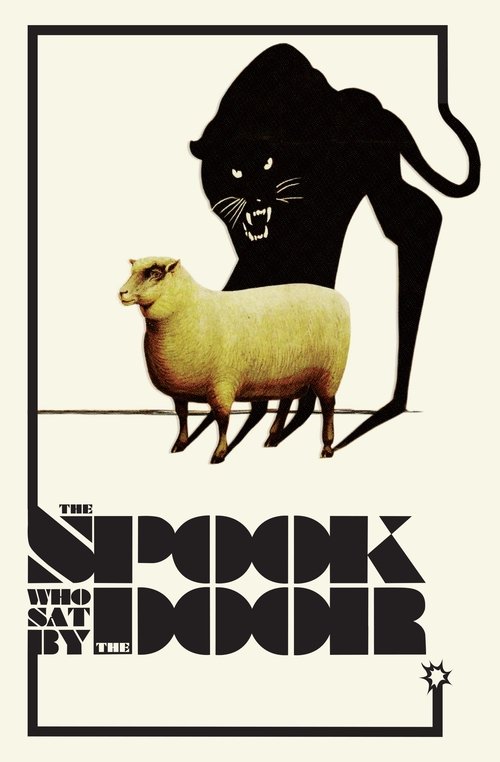
The Spook Who Sat by the Door
1973 · Ivan Dixon
When you want a film with teeth — something radical and confrontational to argue about afterward, not a switch-your-brain-off thriller. Firmly on the challenge end of the dial, and worth it.
What it's about
A Black man becomes the CIA's first African American officer by playing exactly the harmless token the Agency wants to see — then quietly absorbs everything it teaches him about insurgency and takes that training home to Chicago's South Side, where he starts building a revolution. It's a spy thriller turned inside out: the surveillance state's own playbook aimed back at it.
The experience
Cold-blooded, methodical, and still startling — it plays like a procedural but lands like a provocation, and its anger hasn't dated a day. You watch half-thrilled, half-uneasy at how coolly it commits to its premise.
The craft
Ivan Dixon directs with lean, no-nonsense control, and Herbie Hancock's score gives the whole thing a tense, prowling pulse. Financed partly by Black investors after Hollywood balked, and shot largely in Gary, Indiana when Chicago wouldn't cooperate — the scrappiness reads on screen as urgency, not cheapness.
Why it matters
It did strong business for a few weeks in 1973, then vanished from theaters with a speed its makers always attributed to FBI pressure, surviving for decades on bootleg tapes passed hand to hand — one of American cinema's true suppressed films, now recognized as the most politically radical work of its era.
The most dangerous film of the Blaxploitation era wasn't exploitation at all. Ivan Dixon — the actor from 'Nothing But a Man,' better known then for 'Hogan's Heroes' — adapted Sam Greenlee's novel about the CIA's first Black officer, a man who weaponizes white assumptions of his invisibility, absorbs the Agency's training in insurgency, and takes it home to Chicago's South Side. Financed in part by Black investors after Hollywood balked, shot largely in Gary, Indiana because Mayor Daley's Chicago wouldn't cooperate, and scored by Herbie Hancock, the film played to strong business for a few weeks in 1973 — then vanished from theaters with a speed Greenlee and Dixon always attributed to FBI pressure. For decades it survived on bootleg tapes passed hand to hand, a genuine samizdat object in American cinema. Its jolt hasn't dulled: this is still the rare studio-distributed film to treat armed Black revolution not as nightmare or fantasy but as strategy, laid out step by methodical step. The Library of Congress added it to the National Film Registry in 2012.
Reception
Pulled from theaters within weeks of its 1973 release — reportedly under FBI pressure — and effectively suppressed for decades, it survived because a negative was quietly stashed under a different title; it was restored in the 2000s and entered the National Film Registry in 2012, now hailed as a landmark of Black radical cinema.
How The Spook Who Sat by the Door was received, from release to now →
Influences: the films it descends from and the films it influenced
- The Battle of Algiers (1966) — Its cell-structure insurgency procedural — clandestine recruitment, cutouts, weapons logistics and urban guerrilla actions shown as step-by-step tradecraft — is the template Spook adopts wholesale for the Cobras' training and operational sequences.
- Nothing But a Man (1964) — Ivan Dixon's own understated lead performance in this location-shot, anti-melodramatic Black-life drama grounded the naturalist actor's-eye direction he carried into Spook — the actor-turned-director lineage made concrete.
- Uptight (1968) — Transposed The Informer to a militant Black revolutionary cell in Cleveland, modeling the betrayal-within-the-organization structure and on-location Black-radical milieu Spook reworks.
- Sweet Sweetback's Baadasssss Song (1971) — Established the self-financed Black-independent model of a Black protagonist outmaneuvering white authority, proving a militant political feature could be produced and distributed entirely outside the studios.
- Cotton Comes to Harlem (1970) — First-wave Black-directed adaptation of a Black novelist (Chester Himes) that established the Black-authored literary-crime film Spook extends, with Greenlee adapting his own novel.
- Ascenseur pour l'échafaud (1958) — Miles Davis's improvised modal-jazz score for a crime thriller set the idiom of loose, atmospheric jazz underscore that Herbie Hancock works within on Spook.
- Blow-Up (1966) — An earlier Herbie Hancock film score — the same composer's jazz-funk sensibility and instrumentation carried directly into his Spook cues, a collaborator debt rather than a stylistic echo.
- Z (1969) — Codified the docudrama political-thriller pace — investigative procedure and state repression cut with newsreel urgency — that Spook borrows to render its insurgency in a plausible, reportorial register.
- Killer of Sheep (1977) — LA Rebellion location shooting with a non-professional cast in a working industrial neighborhood, extending Spook's Gary, Indiana on-location Black realism.
- Bush Mama (1979) — A militant LA Rebellion film of radicalizing Black consciousness, continuing Spook's project of a politically insurrectionary narrative produced outside the studio system.
- Night Catches Us (2010) — Dramatizes surveillance, informants and betrayal inside a post-Panther Black revolutionary community — the state-suppression-of-the-cell thread Spook fictionalized, played as aftermath.
- BlacKkKlansman (2018) — Built on the literal 'spook by the door' device — a Black man who infiltrates a white power institution and turns its own machinery against it from the inside.
- Sorry to Bother You (2018) — A Bay Area Black-radical satire of subversion-from-within a white corporate system whose insurrectionary climax Riley has explicitly tied to Spook's infiltrate-then-detonate structure.
- Judas and the Black Messiah (2021) — Dramatizes the informant-and-infiltration-versus-state-suppression procedural of the actual Panther era that Spook had fictionalized as tradecraft.
- Born in Flames (1983) — Diagrams organized clandestine insurrectionary cells staging armed uprising in American cities, the operational how-to-organize-a-revolt narrative logic behind Borden's Women's Army.
- They Cloned Tyrone (2023) — Pioneers the Black paranoid-conspiracy thriller in which systemic control of the community is the covert antagonist, the political engine Tyrone literalizes as underground cloning.
- Gordon's War (1973) — A Vietnam vet drills a disciplined paramilitary cell to reclaim Harlem — the same insurgency-procedural of trained, militarized Black collective action arriving the same year.
- Ganja & Hess (1973) — A same-year Black-independent auteur film that was likewise recut/suppressed by its distributor and only later restored, sharing Spook's samizdat-survival exhibition history.
- Death Wish (1974) — Herbie Hancock scored this vigilante thriller the very next year, extending the same funk-inflected jazz scoring of urban violence he brought to Spook.
Similar films
- BlacKkKlansman (2018) — influence & lineage
- Judas and the Black Messiah (2021) — influence & lineage
- Soundtrack to a Coup d'Etat (2024) — shared sensibility
- Point Blank (1967) — shared sensibility
- Bamboozled (2000) — shared sensibility
- State of Siege (1972) — shared sensibility
- Seven Days in May (1964) — shared sensibility
- Pickup on South Street (1953) — shared sensibility