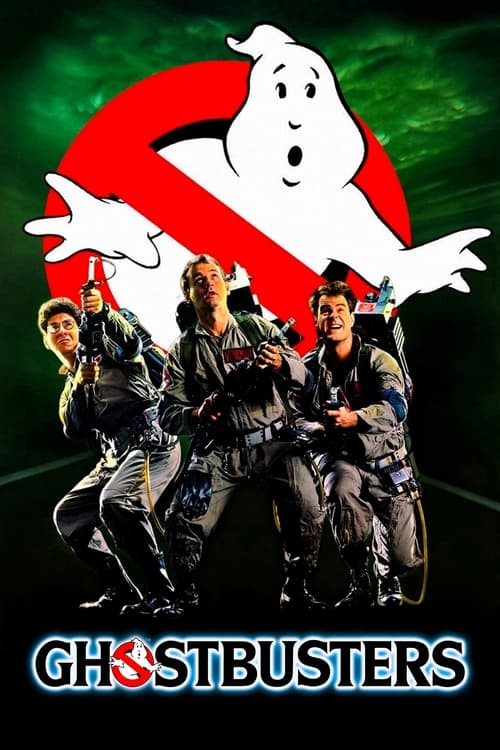
Ghostbusters
1984 · Ivan Reitman
For when you want pure comfort-food fun — a rewatchable crowd-pleaser for a Friday night, a hangover, or introducing a kid to the movies you grew up on. Zero challenge, maximum charm.
What it's about
Three parapsychologists get bounced from their cushy university jobs and do the only sensible thing: open a ghost-catching business out of a run-down Manhattan firehouse. Business is slow until it very much isn't — hauntings multiply across New York, a skeptical cellist's apartment building turns out to be at the center of something ancient and hungry, and the guys in the jumpsuits become the city's only line of defense against an honest-to-god apocalypse.
The experience
It plays the end of the world at the temperature of a bad day at work — deadpan wisecracks bouncing off genuinely eerie spook-show set pieces, so the jokes land harder because the ghosts are real. Fast, endlessly quotable, and somehow both laid-back and enormous.
Performances
Bill Murray's slouching, insolent Peter Venkman is one of the great comic star turns — a man visibly improvising his way through the supernatural. Dan Aykroyd's true-believer enthusiasm and Harold Ramis's dry precision give him perfect foils, Sigourney Weaver plays it straight and sultry, and Rick Moranis steals scenes as the world's most pathetic accountant.
The craft
It fused the loose, improv-bred comedy of the Saturday Night Live generation with genuine effects-blockbuster spectacle — practical ghosts, proton streams, and a finale of towering scale, all shot with real New York locations grounding the mayhem. Ray Parker Jr.'s theme song became inescapable, and the creature work still has a handmade charm digital effects can't fake.
Why it matters
One of the biggest hits of 1984 and the template for the effects-comedy blockbuster — it proved a special-effects movie could run on jokes, spawned a franchise, and turned 'Who you gonna call?' into permanent pop-culture vocabulary.
Snapshot
Ghostbusters is the film in which the American comedy of deadpan insolence collided with the effects-driven blockbuster and produced something neither form had quite managed alone: an apocalypse played at the temperature of a bad day at work. Three parapsychologists lose their university sinecure, hang out a shingle in a derelict Tribeca firehouse, and discover that a Manhattan apartment building has been engineered as a receiver for a Sumerian destroyer-god. What distinguishes the picture is not the premise but the register. Where Spielberg's supernatural films of the period asked for awe, Reitman's asks for a shrug and a wisecrack, and then — crucially — takes the threat seriously enough that the wisecrack has something to push against.
Released by Columbia on 8 June 1984, the same day as Joe Dante's Gremlins, it became the top-grossing comedy released to that point and one of the defining commercial events of the decade. Its afterlife — logo, theme song, four subsequent features, two animated series, a merchandising apparatus that has never really switched off — has partly obscured how odd the film is as an object: a $30-million-class studio production built around improvising club comedians, shot by one of the New Hollywood's great cinematographers, scored by the composer of To Kill a Mockingbird, and finished by an optical effects house founded expressly to complete it.
Industry & production
The project originated with Dan Aykroyd, whose interest in parapsychology was familial rather than affected: the Aykroyd family had a documented involvement with spiritualist inquiry across generations, and his father later published on the subject. His first treatment was vastly larger than the finished film — a chronicle of competing ghost-catching teams operating across time and dimensions, written with John Belushi in mind for the role that became Peter Venkman. Belushi's death in March 1982 removed that anchor, and Ivan Reitman's contribution was, in the first instance, an act of compression: bring the story to present-day New York, make it a small business, and bring in Harold Ramis to co-write. The precise division of labor between Aykroyd and Ramis is described in interviews in broad strokes rather than page-by-page, and the record there is genuinely soft; what is clear is that Ramis supplied the structural discipline and the recognizable comic idiom of Animal House and Caddyshack, while Aykroyd supplied the technical argot that gives the film its peculiar credibility.
Casting was a chain of substitutions. Eddie Murphy was pursued for Winston Zeddemore and John Candy for Louis Tully; both declined, and the roles passed to Ernie Hudson and Rick Moranis, the latter recasting Louis as a nasal, dogged accountant rather than the accented eccentric first conceived. Winston's late entry into the narrative — a hired fourth man rather than a founding partner, and the film's only Black principal — is the most persistent structural criticism leveled at the picture, and it is a fair one: the script gives Hudson the audience's-eye skepticism and then declines to develop it.
Columbia had to negotiate rights to the title itself, which had been used by a Filmation live-action children's series in the 1970s — an entanglement that later forced the 1986 animated spin-off to be branded The Real Ghostbusters. Production ran on a compressed schedule to hit a summer 1984 date, with New York location work (the Hook & Ladder 8 firehouse in Tribeca, 55 Central Park West standing in for Dana's building, Columbus Circle) and interiors and stage work in Los Angeles. The film carried a PG; the PG-13 category, created in the wake of Indiana Jones and the Temple of Doom and Gremlins, took effect only weeks after its release.
Technology
Ghostbusters sits at the last high plateau of purely photochemical effects work. Richard Edlund, coming off the original Star Wars trilogy at Industrial Light & Magic, left to found what became Boss Film Corporation specifically to service Ghostbusters and 2010 simultaneously — building optical printers, a stage, and an animation department more or less from scratch against a delivery date. Nearly every supernatural element in the film is an optical composite: blue-screen elements, rotoscoped and hand-animated energy for the proton streams, matte paintings (Matthew Yuricich among the artists) extending the rooftop temple and the Manhattan skyline, miniature architecture for the Shandor building's crown, and full-scale mechanical creature work.
The creatures divide by technique. The terror dogs, Zuul and Vinz Clortho, were realized under Randy Cook as a combination of stop-motion armatures for full-body movement and large-scale articulated puppets for close work — a hybrid strategy that betrays its seams in the stop-motion cuts but pays off in the tactile menace of the puppet heads. Slimer, developed with makeup-effects work by Steve Johnson, is a rod-and-cable puppet shot against blue screen and composited. The Stay Puft Marshmallow Man is a suit, performed by Bill Bryan, filmed at high speed against blue screen and matted into miniature and live-action New York — an old-fashioned solution that is arguably the film's most enduring image precisely because of its plush, absurd materiality.
The relevant historical point is that this arsenal is pre-digital in every particular. Ghostbusters achieves its scale through layering, matting, and craft labor, and the softness, edge fringing, and slight density mismatch endemic to heavy optical compositing are visible throughout. The film survives them because the comedy does not require photographic seamlessness — a tolerance that would evaporate within a decade.
Technique
Cinematography
László Kovács, whose credits include Easy Rider, Five Easy Pieces, and Paper Moon, brings a New Hollywood naturalism that is the film's least remarked-upon asset. Shot for a 1.85:1 frame, the picture is lit for plausibility rather than spectacle: fluorescent institutional flatness at the university, grimy available-light-feeling New York exteriors, an apartment interior of ordinary warm domesticity. When the supernatural arrives, it arrives into a world that has been photographed as though it were a mildly depressed 1984 city — which is exactly why the arrival lands. Kovács reserves stylization for the Gozer sequences, where the temple is lit in hard, saturated key with heavy atmospherics, and the shift reads as an eruption rather than an escalation.
Editing
Sheldon Kahn and David E. Blewitt cut a film with two incompatible clocks. Comic scenes are held long, allowing Bill Murray's improvisations to breathe and the reaction beats to accumulate; effects and action sequences are cut with conventional blockbuster propulsion. The montage that turns the Ghostbusters into a media phenomenon — magazine covers, talk shows, a working business — is a compression device of almost 1930s vintage, and it does an enormous amount of narrative labor cheaply. The editors' most consequential decision is a matter of restraint: reaction shots of the human characters are given roughly equal weight to the effects they are reacting to, so the film never becomes a demo reel.
Mise-en-scène / staging
John DeCuir's production design supplies the film's governing joke: institutional shabbiness weaponized. The firehouse is a wreck with a fireman's pole and a containment unit in the basement; the equipment is unlicensed nuclear hardware carried in canvas straps; the Ecto-1 is a converted 1959 Cadillac ambulance-hearse. Against this, DeCuir sets the Shandor building's Art Deco monumentality and the rooftop temple, a genuine piece of designed architecture-as-menace. The staging repeatedly frames the four men as small, encumbered figures inside grand spaces — the New York Public Library, the ballroom of the Sedgewick Hotel, the temple stair — which is the visual argument of the whole film: municipal-scale bureaucratic absurdity confronting cosmic-scale threat.
Sound
Elmer Bernstein's score is the film's secret weapon and its most sophisticated formal gesture. Bernstein had by 1984 built a second career scoring comedies (Animal House, Airplane!, Stripes, Trading Places) with full orchestral seriousness, and here he writes a main theme of genuine heroic swagger while deploying the ondes Martenot — the electronic keyboard instrument with a wavering, vocal glide — for the supernatural material. The instrument's uncanny quality does the work that the optical effects sometimes cannot: it makes the ghosts feel wrong. Against this sits the pop soundtrack, dominated by Ray Parker Jr.'s chart-topping title song (later the subject of a settled infringement suit brought by Huey Lewis over similarity to "I Want a New Drug") and Mick Smiley's "Magic," used to extraordinary effect over the walk to the temple. Detailed credits for the film's effects-sound design are less well documented in the standard literature than its music, and I will not guess at attributions.
Performance
Bill Murray's Venkman is a landmark in American screen comedy: a performance built almost entirely on withheld affect, delivering scientific and romantic dialogue with the same bored insincerity, and improvising extensively within Ramis and Aykroyd's structure. The film works because the other three refuse to match him. Aykroyd's Ray is guileless enthusiasm; Ramis's Egon is affectless precision; Hudson's Winston is plain sense. Sigourney Weaver, cast against her Alien register, plays Dana's exasperation with Venkman straight, which makes her possession genuinely unsettling; the frequently recounted story that she proposed the animal transformation in her audition is part of the film's oral history rather than its documentary record. Moranis and Annie Potts supply a parallel comedy of ordinary New York loneliness, and William Atherton's Walter Peck established a durable type: the officious functionary as the film's only human antagonist.
Narrative & dramatic mode
The film's structure is a disaster movie — escalating incidents, institutional denial, a shutdown that unleashes catastrophe, a final ascent to confront the source — inhabited by characters who never adopt disaster-movie diction. Its comic mode is deflationary: every sublime event is met with a procedural or commercial response. The three-act spine is unusually clean for a comedy of this improvisational looseness, and Ramis's craftsmanship shows in how efficiently the first act converts academic humiliation into a business plan.
The dramatic risk is real. The film asks an audience to accept, in the same ninety minutes, a running gag about a receptionist's dating life and the end of the world. It manages this by keeping the stakes literal and the tone consistent: no character ever winks. Venkman's insincerity is a trait, not an authorial position.
Genre & cycle
Ghostbusters belongs to at least three cycles at once. It descends from the comedian-meets-monster tradition — Bob Hope's The Ghost Breakers, Abbott and Costello Meet Frankenstein, and the drawing-room supernatural comedy of Topper — and from the early-1980s horror-comedy revival that produced An American Werewolf in London and, that same week, Gremlins. It belongs equally to the post-Animal House cycle of studio comedies staffed from Second City, SNL, and SCTV, of which Reitman's own Meatballs and Stripes are direct antecedents. And it belongs to the high-concept effects blockbuster established by Star Wars, Close Encounters, and Raiders.
Its historical significance is the fusion: before 1984, effects budgets went to awe and comedy went to talk. Ghostbusters demonstrated that a comedy could carry blockbuster infrastructure and that improvisational performers could headline a tentpole — a lesson the industry has applied continuously since.
Authorship & method
Reitman's authorship is producerial rather than expressive. His method, visible across Meatballs, Stripes, and Ghostbusters, is to build a stable, well-crafted classical frame and then let gifted comic performers destabilise it from within — hiring first-rank technicians (Kovács, Bernstein, DeCuir, Edlund) precisely so the surface can absorb the chaos. He is not a stylist, and the film's visual signature belongs more to Kovács and DeCuir than to him; what is unmistakably his is the calibration between improvisation and structure.
Ramis is the pivotal collaborator — co-writer, performer, and the sensibility that connects Animal War — the National Lampoon lineage — to a workable three-act architecture. Aykroyd supplies the cosmology and the vocabulary. Michael C. Gross, a National Lampoon art director who worked on the film in a production capacity, designed the "no-ghost" logo, one of the most reproduced commercial marks of the century and an early instance of a film's graphic identity outliving its marketing campaign.
Movement / national cinema
The film is American studio product with a strong and under-discussed Canadian axis. Reitman (born in Czechoslovakia, raised in Toronto), Aykroyd (Ottawa), and Moranis (Toronto) all emerged from the Toronto comedy ecology of Second City and SCTV; Murray and Ramis came through Second City Chicago. Ghostbusters is thus a product of a transnational North American improvisational theater pipeline that ran through The National Lampoon Radio Hour and Saturday Night Live into Hollywood — arguably the most consequential comic movement in late-twentieth-century American film, and one that had no manifesto and left no name.
Era / period
Made in the third year of the Reagan administration, the film is legible as a fable of deregulated enterprise: the scientists are expelled from a publicly funded university, prosper as an unlicensed private venture, and are nearly destroyed by an EPA officer whose intervention is procedurally reasonable and dramatically catastrophic. Ray's "the franchise rights alone will make us rich" and Venkman's "I've worked in the private sector — they expect results" are the period's economics rendered as one-liners. Whether the film endorses or merely observes this is genuinely ambiguous; the Ghostbusters are entrepreneurs, but they are also broke, indebted, and reckless.
It is also a New York film of a specific moment — a city photographed as grubby and depleted, in which the arrival of a marshmallow colossus is only a difference of degree. The gendered dimension has aged least well: Venkman's pursuit of a sedated Dana and the film's framing of possession as sexual availability are read very differently now than in 1984, and the discomfort is not anachronistic projection but an available reading of what is on screen.
Themes
Professional precarity and the dignity of expertise; the transposition of the sacred into the commercial (an ancient god defeated by men with a business license and an accountant); the city as a body with something wrong in its plumbing; and bureaucracy as the true antagonist of both science and the supernatural. Underneath runs a persistent joke about belief: the film's scientists are frauds until the moment the universe validates them, and their vindication changes nothing about their character.
Reception, canon & influence
Contemporary notices were broadly favourable, with particular praise for Murray's performance and for the unlikely marriage of effects spectacle to deadpan; a minority of critics found the two halves imperfectly fused and the effects sequences a drag on the comedy. Commercially it was a phenomenon — the top-grossing comedy to that date and one of the highest-grossing releases of 1984 — and it received Academy Award nominations for Visual Effects and Original Song, losing both.
Backward, its lines run to the comedian-versus-ghost tradition; to H. P. Lovecraft and the pulp cosmology of ancient entities breaching modernity, filtered through Aykroyd's genuine reading in parapsychology; to Poltergeist's domestic haunting; and to the anarchic Lampoon comedy Ramis had helped codify. Forward, its influence is structural rather than stylistic. It established the template of the wisecracking professional service confronting the uncanny — visible in Men in Black, in Reitman's own Evolution, and in the procedural-supernatural mode of much later television — and it proved the commercial viability of comedy at blockbuster scale.
Its franchise history is a case study in the difficulty of repeating the accident: Ghostbusters II (1989), The Real Ghostbusters animated series, a 2009 video game written with Aykroyd and Ramis's participation and treated by many as a de facto third installment, Paul Feig's 2016 reboot with an all-woman principal cast, and Jason Reitman's legacy sequels Afterlife (2021) and Frozen Empire (2024). Ramis's death in 2014 ended decades of intermittent development on a direct third film with the original cast; Ivan Reitman died in 2022. The original remains one of the very few American studio comedies of its era whose iconography — the logo, the theme, the packs, the car — circulates independently of anyone having seen the picture, which is both the measure of its success and the reason its actual formal intelligence is so easily overlooked.
A Deleuzian reading
The cut that makes the movie isn't a special effect.
The full Deleuzian reading of Ghostbusters →
Reception
No flop-to-classic story here — it was a genuine phenomenon in summer 1984, out-grossing nearly everything and becoming the biggest comedy of its era. What's changed is that it's now a nostalgia monument, endlessly re-litigated through sequels and reboots that never quite recapture it.
How Ghostbusters was received, from release to now →
How to watch Ghostbusters: what to notice on a first viewing
- Watch Murray's face right after something horrible appears. He does nothing. No fear, no comic mugging, no wink. Venkman delivers scientific talk and flirtation in the same bored voice, and the other three refuse to match him. The monster is not the joke. The delay before Murray responds is the joke, and the film is built on it.
- Look at how ordinary the lighting is before Gozer. Laszlo Kovacs shoots fluorescent flatness at the university, grimy daylight on the street, plain warm lamps in an apartment. It looks like a 1970s character drama about people whose lives are stuck. The supernatural arrives into a city photographed as mildly depressing. That plainness is why the arrival lands.
- Listen for the wavering electronic voice under the ghosts. Elmer Bernstein writes a genuinely heroic main theme for the men, then brings in the ondes Martenot, a keyboard with a gliding vocal tone, whenever the supernatural shows up. It has no throat behind it. The instrument makes the ghosts feel wrong in a way the optical effects cannot. Sound is carrying the horror.
- Look at the equipment they carry on canvas straps. John DeCuir builds the joke into the props: a wrecked firehouse with a pole, unlicensed nuclear hardware in packs, a 1959 Cadillac ambulance turned into a work vehicle. Everything is secondhand and slightly broken. The apocalypse is being handled by a small business with a lease and an accountant. The props make that argument.
- Watch how small the men look inside big rooms. The library, the hotel ballroom, the lobby of the Shandor building, the temple stair. DeCuir keeps setting four encumbered figures against Art Deco monumentality. They are always outsized by the architecture. Municipal-scale men against cosmic-scale threat. The staging says it before any line of dialogue does.
The whole guide to watching Ghostbusters, with the keys for a rewatch →
Influences: the films it descends from and the films it influenced
- King Kong (1933) — Establishes the grammar Boss Film restages for Stay Puft — an outsized figure ascending a New York landmark, matted over live-action crowds and forced-perspective miniature streets so that human scale is legible only by comparison to architecture.
- Abbott and Costello Meet Frankenstein (1948) — Codifies the rule Ghostbusters obeys absolutely: the monsters are photographed and scored entirely straight, never as gags, and all comedy is generated in the reaction shot — which is why the film can cut between a terror dog and Murray's flat delivery without changing register.
- The Day the Earth Stood Still (1951) — Herrmann's theremins as the numinous voice riding on top of an otherwise conventional orchestra is the exact structural move Elmer Bernstein makes with the ondes Martenot — an electronic timbre reserved for the supernatural inside a symphonic comedy score.
- Cleopatra (1963) — Same production designer, John DeCuir, deploying the same monumental-architecture-versus-small-figure staging: the Shandor rooftop temple is DeCuir's epic-scale processional set logic, with the firehouse and Columbia's corridors as his opposing register of institutional shabbiness.
- Jason and the Argonauts (1963) — Harryhausen's Dynamation — stop-motion armature puppets matted into plates with live actors playing to nothing — is the technique Randy Cook inherits directly for the terror dogs, alternating animated miniatures with full-scale hydraulic heads in the same scene.
- Five Easy Pieces (1970) — László Kovács brings his New Hollywood practice — practical sources, smoky low-contrast interiors, muted desaturated palette, long-lens observation — so the first two acts look like a 1970s character drama, which is what makes the hard saturated key of the Gozer climax register as rupture.
- The Exorcist (1973) — Supplies the procedural-clinical approach to possession: exhaustive institutional verification before any supernatural payoff, and the specific bedroom staging — levitation, altered voice, restrained subject — that Dana Barrett's sequence restages with the register flipped.
- Close Encounters of the Third Kind (1977) — Trumbull's cloud-tank atmospherics and, crucially, interactive on-set lighting played across performers' faces to marry them to elements added optically later — the technique that lets Ghostbusters' proton streams and ectoplasmic glow read as present in the room rather than pasted on.
- Animal House (1978) — Ramis's own template: ensemble anarchy contained by a rigid three-act frame with a bureaucratic authority-figure antagonist — Dean Wormer's shutdown of the house is structurally Walter Peck's shutdown of the containment grid.
- The Blues Brothers (1980) — Proves the Second City/SNL pipeline survives blockbuster apparatus — Aykroyd's deadpan sustained inside enormous practical spectacle, with a soundtrack single engineered as a marketing object, the model Ghostbusters repeats with optical effects in place of car stunts.
- Raiders of the Lost Ark (1981) — Richard Edlund's ark-opening climax — rotoscoped translucent spirit figures, cloud-tank vapor, and quad-printer light beams over a stone-altar set — is the direct technical rehearsal for the Gozer sequence he supervised at Boss Film three years later.
- Stripes (1981) — The Reitman method in prototype: a stable, classically shot institutional frame built specifically so Murray and Ramis can improvise against it, with Murray's withheld affect calibrated as the film's tonal governor rather than its punchline delivery system.
- Big Trouble in Little China (1986) — Boss Film again — Edlund's storm-of-light optical vocabulary reused wholesale — married to a deflationary protagonist whose incompetence is the comedy while the supernatural spectacle is played with total sincerity.
- Beetlejuice (1988) — Extends the institutionalization of the afterlife into full bureaucracy — caseworkers, waiting rooms, a handbook — and pushes the stop-motion/puppet hybrid further by making the effects grotesque-comic in themselves, the one line Ghostbusters refused to cross.
- Groundhog Day (1993) — The Ramis–Murray craft distilled: a metaphysical premise treated with unbroken procedural literalism, never explained, with Murray's flattened line readings doing the tonal regulation that effects and score do in Ghostbusters.
- Men in Black (1997) — Lifts the structural template whole — licensed professionals in uniform with proprietary hardware, a containment facility, and an unglamorous service-industry attitude toward the uncanny — and keeps the reaction-shot parity where the human deadpan is cut at equal weight to the creature effect.
- Gremlins (1984) — Same-summer solution to the same problem: creature performance built from puppets and cable rigs shot in full horror grammar, with tonal whiplash produced by the cut rather than by any softening of the effects work itself.
Similar films
- Beetlejuice (1988) — influence & lineage
- Groundhog Day (1993) — influence & lineage
- Gremlins (1984) — influence & lineage
- King Kong (1933) — influence & lineage
- Monsters, Inc. (2001) — shared sensibility
- Independence Day (1996) — shared sensibility
- Minions & Monsters (2026) — shared sensibility
- Galaxy Quest (1999) — shared sensibility