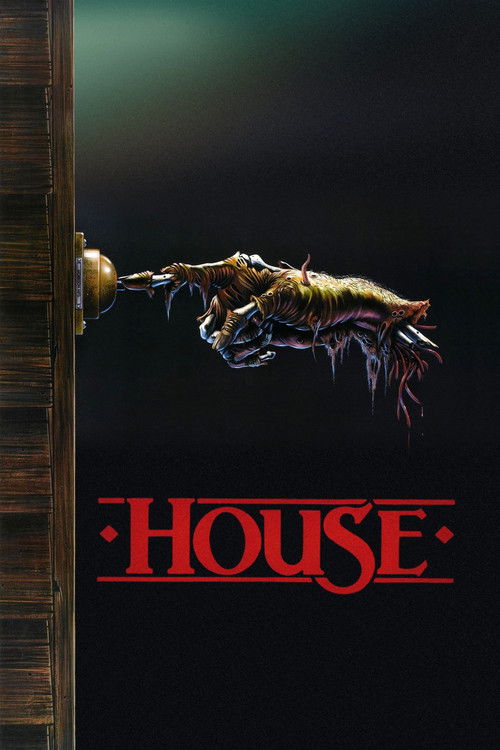
House
1985 · Steve Miner
Perfect for a nostalgic Friday night with pizza when you want Halloween vibes without actual trauma — cozy horror-comedy from the VHS era, pure comfort.
What it's about
Roger Cobb is a horror novelist and Vietnam veteran whose life has come apart: his young son vanished, his marriage collapsed, and now his aunt has died in the old Victorian house where the boy disappeared. Roger moves in to write a memoir of the war and instead finds the house fighting back — with monsters in the closets, rooms that open onto somewhere else, and visions that drag his buried guilt into the open.
The experience
A goofy-spooky ride that swings between rubber-monster comedy and genuine melancholy, moving fast and never taking itself too seriously. It's funhouse horror with an unexpectedly sad heart underneath the gags.
Performances
William Katt carries it with likable, haunted everyman energy, and George Wendt — Norm from Cheers — steals scenes as the nosy neighbor who can't resist Roger's weird house.
The craft
From the Friday the 13th team of Sean S. Cunningham and Steve Miner, it trades slasher grimness for practical creature effects: puppets, prosthetics, and closet-dwelling monsters with real handmade charm. The house itself is a great set, its doors and mirrors hiding spatial tricks.
Why it matters
A hit that helped define the mid-80s horror-comedy boom and spawned a franchise, it's remembered fondly as a gateway horror film — and as an early mainstream genre film to make Vietnam trauma its emotional engine.
Snapshot
House is a mid-1980s American horror-comedy about Roger Cobb (William Katt), a horror novelist and Vietnam veteran. His young son has vanished, his marriage has ended, and his career has stalled. When his elderly aunt hangs herself, Roger moves into her Victorian house, the place where his son disappeared, meaning to write a memoir of his war service instead of another genre potboiler. The house answers with a series of monsters, illusions and spatial distortions. These pull him toward two traumas he has not dealt with: the loss of his child and the death of a comrade, Big Ben (Richard Moll), whom he could not save in Vietnam.
Produced by Sean S. Cunningham, directed by his Friday the 13th collaborator Steve Miner, and released by New World Pictures (the American theatrical release came in early 1986), House swaps the slasher's stalk-and-kill pattern for a fairground funhouse: rubber creatures, gags, and a hero who is as often exasperated as terrified. It belongs to the horror-comedy wave set off by Ghostbusters and Gremlins (both 1984). Under the gags sits an unexpectedly sincere story about grief and veterans' guilt, and that tension between pratfall and pathos is what makes it distinctive. It made money, it started a loosely connected franchise, and it has kept a steady cult following as a definitive piece of 1980s practical-effects entertainment.
Industry & production
House came out of the independent genre economy that grew up in the wake of Halloween (1978) and Friday the 13th (1980). Sean S. Cunningham, who had produced and directed the first Friday the 13th, produced. Steve Miner, who had been an associate producer on that film and then directed Friday the 13th Part 2 (1981) and Part III (1982, in 3-D), directed. The film is usually seen as both men's deliberate step away from the slasher formula they had helped make lucrative and that was, by the mid-1980s, critically disreputable and running into censorship and ratings pressure.
The story is credited to Fred Dekker, who would soon make Night of the Creeps (1986) and The Monster Squad (1987). The screenplay is credited to Ethan Wiley. New World Pictures distributed. Under Roger Corman the company had been a byword for exploitation; after Corman sold it in the early 1980s, New World became an aggressive independent distributor of genre product. The house exteriors were shot at a Victorian residence in Monrovia, California, and much of the interior action was built on sets that could be opened, rigged and reconfigured for effects.
The film was made on a modest budget by studio standards. It is widely remembered as a clear commercial success relative to its cost, enough to justify sequels quickly. Exact budget and gross figures vary across secondary sources, so they are not given here.
Technology
House is a showcase for analogue, pre-digital effects. Its monsters are latex suits, foam-rubber puppets, animatronic heads and prosthetic makeup. They include:
- the bloated, grotesque creature that emerges from the closet;
- the transformed "Aunt Elizabeth";
- the decayed, skeletal revenant of Big Ben in combat fatigues;
- a mounted swordfish that comes to life;
- small gremlin-like creatures and animated garden tools.
The film's pleasures depend on these effects being palpably physical. Creatures occupy real space, take blows and come apart in tactile ways. This was the same craft culture that sustained The Thing (1982), Gremlins and Re-Animator (1985) in the same years, though at a lower budget and in a deliberately cartoonish register.
Some sequences use optical compositing and matte work to open impossible spaces inside the house: the medicine cabinet that leads to another dimension, and the dark void beneath the bathroom through which Roger descends. The Vietnam flashbacks were staged on studio jungle sets with smoke and practical pyrotechnics, a production economy typical of the period's mid-budget genre films.
Technique
Cinematography
Swedish-born cinematographer Mac Ahlberg shot the film. He was also central to the look of Empire International's genre films of the period, including Re-Animator. His work here is bright and clean rather than shadow-drenched. The house is often lit in ordinary daylight or warm domestic interior light, which deliberately undercuts Gothic expectation and makes each intrusion of the uncanny land as a comic shock. The camera favours clear, legible framing of the effects, so the audience gets a good look at each creature, and moves into deeper shadow and saturated colour mainly for the otherworldly passages and the Vietnam material.
Editing
The editing (credited to Michael N. Knue) runs on a rhythm of setup and payoff more often found in comedy than in horror. Scares are frequently built as gags: the build-up to a jump is followed by a beat of Roger's incredulity, or by a cut to a neighbour seeing him do something absurd. Cross-cutting between present-day Roger and his Vietnam memories steadily brings the two timelines together, until the climax collapses them into a single space.
Mise-en-scène / staging
The house is the central set-piece. Its Victorian exterior evokes the American haunted-house tradition descending from The Old Dark House and from Shirley Jackson's The Haunting of Hill House (filmed as The Haunting, 1963), but the interior is treated as an unstable architecture, a set that obeys dream logic rather than physics. Doors open onto other places, a bathroom becomes an abyss, and the closet is a recurring site of threat.
Staging leans heavily on physical comedy. Roger's struggle to dispose of a dismembered monster by burying its parts in the garden, while the parts keep moving and his neighbour peers over the fence, is the best-known example. The film also stages domestic spaces as spaces of memory: the study where Roger tries to write his war memoir becomes the threshold through which the past breaks in.
Sound
Harry Manfredini, whose stabbing strings and whispered vocal motif defined the Friday the 13th films, composed the score. Here he writes in a lighter, more playful mode, giving cues a mock-ominous quality that matches the film's tone. The sound design trades in creature growls, squelches and the hyperbolic crunch of 1980s effects films. The Vietnam sequences are marked by a contrasting layer of gunfire, helicopters and jungle ambience.
Performance
The film rests on William Katt, then best known for the television series The Greatest American Hero and for his role in Carrie (1976). He plays Roger with a likeable, put-upon earnestness, as a man more harried than heroic, and his reactions do much of the comic work. George Wendt, then famous as Norm on Cheers, plays the nosy neighbour Harold Gorton, a sitcom presence carried directly into the horror film; his scenes with Katt are pure two-hander comedy. Richard Moll, known from Night Court, gives Big Ben a hulking menace that turns, in the undead form, into vengeful mockery. Kay Lenz plays Roger's ex-wife Sandy, an actress whose doubling by a monstrous impersonator is among the film's more unsettling gags. Susan French plays Aunt Elizabeth.
Narrative & dramatic mode
The narrative follows a trauma-and-return pattern disguised as a haunted-house romp. The house does not just harbour arbitrary spirits; it seems to know Roger's specific wounds. The missing son and the dead comrade are the film's two structural secrets. The climax reveals that Big Ben, embittered at being left to be captured in Vietnam, is behind the haunting and has taken Jimmy. Roger rescues his son and confronts and destroys Ben's revenant, which resolves both traumas in one act.
The dramatic mode is mixed. Episodic set-pieces (monster attacks, comic misunderstandings, surreal journeys) alternate with a melodramatic throughline of guilt and reconciliation. The tone moves sharply between slapstick and sincerity, and contemporary critics were divided over whether that was a strength or an incoherence. The ending restores the nuclear family in a reunion that reads as both genre convention and emotional catharsis.
Genre & cycle
House sits where three strands meet:
1. The haunted-house film. It inherits the old dark house, the inherited property, the suicide of a previous occupant and the protagonist isolated inside. 2. The 1980s horror-comedy. Its immediate context includes An American Werewolf in London (1981), Ghostbusters, Gremlins, Fright Night (1985), The Return of the Living Dead (1985) and Re-Animator. All of them mixed genuine gore or monster effects with self-aware humour. 3. The Vietnam trauma narrative. In the mid-1980s Vietnam was returning to American popular culture in films such as First Blood (1982), Rambo: First Blood Part II (1985) and, shortly afterwards, Platoon (1986). House folds the figure of the haunted veteran into supernatural genre form.
Within its producers' own careers, House was a self-conscious pivot away from the slasher cycle toward a more PG-13-friendly funhouse register, though it was released with an R rating. It anticipates the more elaborate effects comedies that followed, including Evil Dead II (1987) and Beetlejuice (1988).
Authorship & method
Steve Miner (director). Miner came up through Cunningham's low-budget operation and became one of the period's dependable genre craftsmen. House shows his preference for clean, efficient staging and his facility with effects-driven set-pieces. His later career covered Warlock (1989), Forever Young (1992), Halloween H20: 20 Years Later (1998) and Lake Placid (1999), all marked by a similar professionalism across genres rather than a strongly personal style.
Sean S. Cunningham (producer). Cunningham's producing hand is visible in the film's commercial calculation: a recognisable genre hook, a television-familiar cast, and effects as the main attraction.
Fred Dekker (story) and Ethan Wiley (screenplay). Dekker, a devoted fan of monster movies, was on the verge of his own directing career. His affection for creature features and 1950s horror shows in the film's monster-of-the-week structure. Wiley, who wrote the screenplay, later wrote and directed House II: The Second Story (1987).
Mac Ahlberg (cinematography), Harry Manfredini (music), Michael N. Knue (editing). Each brought experience from the independent genre circuit. Ahlberg and Manfredini in particular link House to the wider ecosystem of 1980s American exploitation and horror production.
The record on the film's internal creative process, such as how much Dekker's original story was reshaped in development, is fairly thin in reliable published sources.
Movement / national cinema
House is American independent genre cinema of the Reagan era: commercially driven, distributed outside the major-studio system, and aimed at the expanding theatrical and home-video market for horror. It was not part of an aesthetic movement in the art-cinema sense. It belongs to the industrial movement in which independent producers and distributors (New World, Empire, Cannon, Troma and others) supplied a large share of the decade's horror, using the VHS boom as a secondary revenue stream that made modest budgets low-risk.
Era / period
The film is shaped by its moment. Television stars were crossing into features, and the casting of Katt, Wendt and Moll leveraged audiences' familiarity with prime-time sitcoms and action shows. The PG-13 rating, introduced in 1984, had reshaped the commercial calculus for effects-heavy fantasy, though House itself went out as an R. Practical makeup effects were at their creative height before computer-generated imagery arrived. And Vietnam was being re-examined in popular culture roughly a decade after the war's end.
Themes
- Grief and the lost child. The disappearance of Roger's son is the film's emotional core. The house is the place of loss, and returning to it is a form of mourning that the genre turns into a literal descent and rescue.
- War trauma and survivor's guilt. Roger's inability to write his Vietnam memoir, and the return of Big Ben as a vengeful corpse, dramatise a veteran haunted by a moment of failure. The film is notable for bringing this subject into a comic horror vehicle.
- The writer's block and the haunted imagination. Roger is a horror novelist whose own genre seems to come alive around him, a self-reflexive joke about fiction and its sources.
- Domestic space as psyche. The house's impossible geography maps onto Roger's mind: closets, mirrors and hidden depths become places where repressed material emerges.
- Masculinity and repair. Roger has to reclaim the roles of father and soldier he feels he failed at. The reunited family at the end resolves that in conventional terms.
Reception, canon & influence
Critical reception. On release House drew mixed notices. Some reviewers enjoyed its energy, effects and good humour. Others found the mix of slapstick, horror and Vietnam melodrama tonally confused. Its commercial success mattered more to its immediate fate than its critical standing. Over the following decades, home video and cable built it a durable audience, and it is now generally remembered with affection as an emblematic 1980s horror-comedy rather than as a canonical work.
Influences on the film. The film draws on the classical haunted-house tradition (The Haunting, The Amityville Horror), the slapstick-horror line running back to the Abbott and Costello monster comedies, and 1950s creature features. Its most immediate context is the commercial success of Ghostbusters and Gremlins. Its Vietnam material echoes the wider early-1980s cultural reckoning with the war and its veterans.
Legacy and influence. House launched a loose franchise:
- House II: The Second Story (1987), written and directed by Ethan Wiley, kept the comic-fantasy tone with a largely unrelated story.
- The Horror Show (1989), released in some territories as House III, was a more conventional supernatural slasher.
- House IV (1992) returned William Katt in a different role.
More broadly, House is a reference point for the "funhouse" horror-comedy that sets effects-driven spectacle against a grounded emotional story. It also shows how a slasher producer and director could move into a lighter, more broadly marketable form. Discussions of horror films about veterans' trauma and grief in the domestic Gothic sometimes mention it as an early, if offhand, example of the haunted house turned into a map of personal guilt, a mode later horror would explore with much greater seriousness. Its reputation today rests chiefly on its practical creature work, its cast's comic timing and its sincere core, and on its role as a period artefact of American genre filmmaking in the mid-1980s.
Influences: the films it descends from and the films it influenced
- Abbott and Costello Meet Frankenstein (1948) — Sets up the slapstick-horror shot pattern House depends on: a comic lead's double-take reaction cut directly against a monster played completely straight, so the scare and the laugh land in the same edit.
- The Haunting (1963) — Its house responds to one protagonist's inner state, through doors, corridors and sounds that seem aimed at that one person. House takes this idea of architecture as a psychological projection and uses it for comedy.
- The Amityville Horror (1979) — Gives House its basic setup of an ordinary homeowner whose domestic routines (repairs, chores, a sense of ownership) are turned against him by the building itself.
- Friday the 13th (1980) — The Cunningham–Miner–Manfredini production model comes from here: Manfredini's stinger-cue scoring, cheap jump-scare timing and a producer-driven genre hook, which House reuses as gag-and-scare timing.
- Poltergeist (1982) — Supplies the brightly lit suburban haunting and the plot device of a child pulled through a portal in the house into another dimension, which House copies directly in Jimmy's disappearance and rescue.
- The Evil Dead (1981) — Treats the dwelling itself as the malevolent agent, with practical-effects transformations pushed far enough to become grotesque comedy. House cleans this up into PG-13-adjacent funhouse set-pieces.
- Ghostbusters (1984) — Pairs a television-comedy star's deadpan with bright, unspooky lighting and optically composited apparitions. This is the commercial formula House borrows when it casts sitcom actors William Katt and George Wendt.
- Gremlins (1984) — Uses puppeteered practical creatures as engines for gags inside domestic interiors, such as kitchen appliances and furniture fights. House's closet monster and its scuttling garden-tool creatures follow the same approach.
- House II: The Second Story (1987) — Wiley takes House's dream-logic architecture, where rooms open onto impossible spaces, and stretches it into doors leading to other eras and worlds, keeping the comic-fantasy tone and puppet creatures.
- The Monster Squad (1987) — Dekker widens the creature-feature affection he wrote into House's story into a full Universal-monster pastiche, with Stan Winston practical makeup and the same mix of kid-friendly comedy and horror.
- Beetlejuice (1988) — Turns the haunted-house comedy into a lit-up, anti-gothic set where stop-motion and replacement-animation creatures appear within the house's own architecture as sight gags.
- Jacob's Ladder (1990) — Develops House's device of crosscutting a Vietnam veteran's jungle flashbacks with present-day supernatural attacks until the two timelines meet, here played with complete seriousness.
- The Frighteners (1996) — Repeats House's tonal whiplash of slapstick ghost set-pieces (here largely digital rather than practical) around a hero frozen by grief over a lost family member, so pathos and gags alternate scene by scene.
- Lake Placid (1999) — Miner returns to House's formula of sitcom-familiar casting (Betty White, Oliver Platt) set against a practical creature effect (Stan Winston's animatronic crocodile), with scares timed as punchlines.
- Fright Night (1985) — A 1985 suburban horror-comedy that likewise balances practical creature transformations against a sincere emotional story and a winking love of old monster movies, made with the same latex and animatronic toolkit.
- Night of the Creeps (1986) — Dekker's own directing debut, built on the same monster-of-the-week, 1950s-creature-feature fandom that shaped House's story structure, with practical slug effects played for both gross-out and gags.
- Critters (1986) — A low-budget Gremlins-wave film in which the Chiodo Brothers' practical puppets attack a family house. Like House, it shows independent producers turning creature effects into the main attraction in a domestic setting.
- Evil Dead II (1987) — Its mounted deer head comes alive and taunts the hero, the same gag as House's animated swordfish trophy. Both films stage a lone man fighting his own possessed house as physical slapstick.
Similar films
- Fright Night (1985) — influence & lineage
- The Haunting (1963) — influence & lineage
- Beetlejuice (1988) — influence & lineage
- House (1977) — shared sensibility
- Hokum (2026) — shared sensibility
- The House by the Cemetery (1981) — shared sensibility
- The Conjuring: Last Rites (2025) — shared sensibility
- Ghost Stories (2018) — shared sensibility