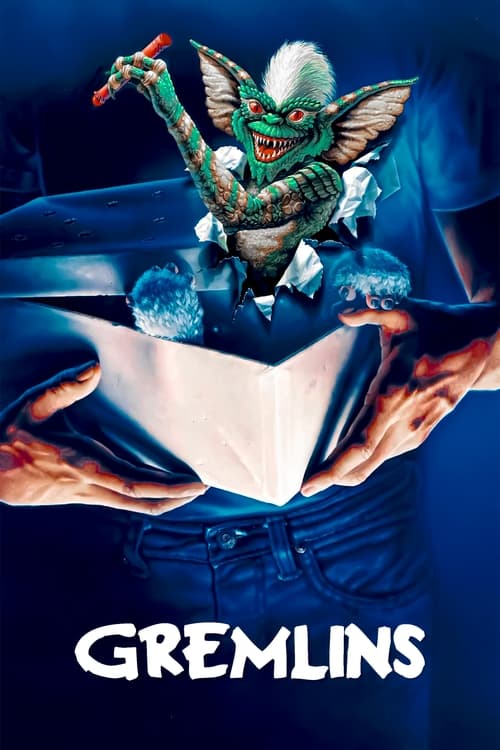
Gremlins
1984 · Joe Dante
For when you want a Christmas movie with fangs — a rowdy, nostalgic night in for anyone whose holiday spirit runs more mischievous than sentimental. Great with a crowd.
What it's about
For Christmas, a small-town young man receives an adorable exotic pet that comes with three strict rules: no bright light, no water, and never feed it after midnight. The rules get broken, and by Christmas Eve his snow-globe town is overrun by a horde of scaly, cackling little monsters with a genius for mayhem. What starts as a family comedy becomes an all-night siege on Main Street.
The experience
Gleefully mean fun — it swings from cozy holiday warmth to slapstick carnage and back without warning, and the whiplash is the joke. It's funny, a little cruel, and just scary enough to feel like you're getting away with something.
The craft
The gremlins themselves are a triumph of puppetry and practical effects — dozens of expressive, anarchic creatures doing musical numbers and bar brawls, all built by hand. Joe Dante stages the town like a classic Christmas picture and then lets cartoon logic loose inside it, with sly satirical jabs at consumer culture tucked into the chaos.
Why it matters
One of the biggest hits of 1984, it helped push the creation of the PG-13 rating and spawned an entire subgenre of little-monster movies — the definitive proof that horror and comedy could share a family film.
Snapshot
Gremlins is a Christmas fable that turns into a small-town siege, and a family comedy that keeps sliding, without warning, into cruelty. A hapless inventor buys his son an "exotic" pet from a Chinatown antique shop; three rules govern its care — no bright light, no water, no food after midnight — and once broken, they release a population of scaly, cackling saboteurs who dismantle Kingston Falls over a single Christmas Eve. Joe Dante, working for Steven Spielberg's Amblin Entertainment from a spec script by the then-unknown Chris Columbus, built the film as a collision: Frank Capra's Bedford Falls invaded by Warner Bros. cartoon logic, with 1950s creature-feature mechanics underneath and a satirist's contempt for the consumer economy running through it. The film was one of the largest hits of the summer of 1984 and, with Indiana Jones and the Temple of Doom, the proximate cause of the MPAA's creation of the PG-13 rating weeks after its release. Its afterlife is enormous and slightly disreputable: it defined the "small monsters" cycle of the mid-1980s, gave Amblin's suburban fantastic its dark twin, and remains the model for every subsequent attempt to make a Christmas movie that bites.
Industry & production
The project began as a calling-card screenplay. Chris Columbus, a recent NYU film school graduate with no produced features, wrote Gremlins on spec; it reached Spielberg, who was then consolidating Amblin Entertainment into a producing operation capable of generating hits he did not personally direct. Spielberg took it as an executive producer and installed Joe Dante — whose Piranha (1978) and The Howling (1981) had made him the most inventive graduate of Roger Corman's New World Pictures — as director, with Michael Finnell, Dante's regular producer, running the production.
The industrial arrangement is worth noting because it is characteristic of the period: Amblin's production base was at Universal, and Gremlins was shot largely on the Universal backlot, but the film was distributed by Warner Bros. Kingston Falls is Universal's standing Courthouse Square — the same New England-ish town square used for decades of studio product and, the following year, for Back to the Future — redressed with snow and Christmas lights. The economics of a backlot town, a contained cast, and creature effects rather than star salaries meant Gremlins was made for a modest sum by 1984 blockbuster standards and returned many times over; precise figures vary between sources, so it is enough to say it was among the top-grossing releases of a crowded summer. It opened on June 8, 1984, the same day as Ghostbusters, and the two films between them established that horror-comedy could be mainstream family-adjacent business.
Columbus's original draft was substantially harsher than the finished film: it contained set pieces of a viciousness that would have been unreleasable at a PG, and, most consequentially, it had Gizmo himself mutate into the villain. Spielberg's intervention — that Gizmo remain Gizmo, a stable object of audience affection, with Stripe split off as a separate antagonist — is the single most commercially decisive change to the material, and it is what made Gizmo a merchandising property rather than a plot device. Dante and Spielberg reportedly disagreed over how much of the darkness to retain; the surviving film keeps a great deal of it, including Kate's monologue about how her father died in the chimney on Christmas Eve, a scene widely reported to have been contested and which Dante defended.
The film's most durable industrial consequence was the rating. Complaints from parents about the violence in a PG-rated picture marketed heavily to children — the microwaved gremlin, the kitchen sequence, Mrs. Deagle's stairlift launch — combined with the equivalent outcry over Temple of Doom to push the MPAA to introduce PG-13 in the summer of 1984. Red Dawn was the first film released under the new rating. Gremlins, in effect, helped create the category it would have belonged to.
Technology
Gremlins is a fully practical effects film made at the last moment when that was the only option. Chris Walas designed and supervised the mogwai and gremlin effects, leading a shop that produced hundreds of puppet units across the two creature species. Gizmo and the mogwai are primarily hand and rod puppets with cable-actuated faces; the gremlins range from simple glove puppets for background chatter to elaborate multi-operator animatronics for close work, with scaled-up sets and forced perspective used to sell the size relationship between creatures and humans. The production is well documented as having been technically punishing — the Gizmo units in particular were fragile and slow, and the schedule absorbed the cost of puppets that failed to perform.
The technological argument the film makes is inseparable from the technology used to make it. Because the gremlins are physical objects sharing real light and real space with the actors, they have weight and contact: they knock over lamps, they get into blenders and microwaves, they occupy the room. The film's comedy depends on that materiality; a digital gremlin two decades later would have been more mobile and less funny, because the gag is that these things are in the kitchen. Dante and Walas also exploit the limitation — many gremlins are staged in mid-shot clutter, in shadow, in fast cutaways, so that the eye assembles a crowd from a handful of working units.
The other technology in the film is diegetic and satirical. Randall Peltzer is an inventor of failed consumer gadgets, and the film's opening at an inventors' convention (where Spielberg appears in a brief cameo) establishes a world already choked with malfunctioning machines. The gremlins do not introduce chaos into a functioning technological order; they simply accelerate one that is already breaking down.
Technique
Cinematography
John Hora, Dante's regular cinematographer, shoots the film in two registers that are allowed to contaminate each other. Kingston Falls by day is warm, wide, and slightly storybook — the studio-backlot lighting of American small-town cinema, deliberately quoting the look it will later destroy. The night material is closer to a creature feature: hard sources, colored practicals from Christmas lights and neon, deep pools of black that conceal puppet rigs and let a gremlin resolve out of the dark. Hora also does a great deal of quiet functional work in service of the effects — low camera positions that put the creatures in the foreground plane, careful frame lines that hide puppeteers, and framings that keep human and creature in the same shot rather than cutting between them, which is what makes the illusion hold.
Editing
Tina Hirsch, another Corman alumna, cuts the film with the density of a trailer — which is the idiom Dante himself came up out of, having cut trailers at New World. The second half in particular runs on a gag-per-beat rhythm: a gremlin appears, does a thing, is answered by a reaction, and the film moves on before the puppet can be examined. Hirsch also handles the film's most distinctive structural move, the tonal cut — the abrupt juxtaposition of slapstick and injury with no transitional beat, so that the audience's laugh is still in the air when something genuinely nasty happens. (Hirsch would go on to direct Munchies in 1987, one of the Corman-produced imitations Gremlins itself spawned — a small, perfect piece of industrial circularity.)
Mise-en-scène / staging
The film is staged as a set of nested enclosures: the Chinatown shop, the Peltzer house, Dorry's Tavern, the movie theater, the department store. Each is a container that the gremlins fill and wreck. Dante's staging is fundamentally cartoon staging — objects are planted so they can later be weaponized, and the geography of a room is established precisely so it can be violated. The production design keeps Kingston Falls dressed in maximal Christmas: garlands, lights, a bank about to foreclose on the town, an iconography of American civic warmth that is quoted from It's a Wonderful Life (which plays on a television in the film, as does Invasion of the Body Snatchers) and then set on fire. Mrs. Deagle is a straightforward Mr. Potter analog, and her cartoon death is the film's declaration that it will not honor the Capra contract.
Sound
Jerry Goldsmith's score is one of the great pieces of tonal engineering in 1980s studio film. The main theme — a lurching, ragtime-inflected march, scored with percussion, plucked and rattling textures, and a queasy carnival brightness — is neither comic nor frightening but permanently unstable, and it does most of the work of telling the audience how to sit in the film. Goldsmith, a long-term Dante collaborator (Twilight Zone: The Movie, Explorers, Innerspace, The 'burbs, Small Soldiers), threads Christmas music through the score as ironic material rather than sentiment. The sound design layers the creatures out of chattering, giggling, screeching vocalizations — Howie Mandel's Gizmo as a small, sung, almost infantile presence against Frank Welker's Stripe and the general gremlin din — so that the aural difference between the cute and the malevolent is established before the visual one.
Performance
Zach Galligan plays Billy as a genuinely ordinary young man, which the film needs: he is a reactive center in a picture where the spectacle belongs to puppets. Phoebe Cates, coming off Fast Times at Ridgemont High, supplies the film's one moment of unbroken seriousness in the chimney monologue, played straight into a comedy. Hoyt Axton's Randall is warm, feckless, and slightly sad. The most Dante-ish performances are the character actors: Dick Miller, the Corman institution, as Murray Futterman, a xenophobe who blames foreign machinery for everything and who explicitly names the World War II airman's folklore the film draws its title from; Polly Holliday as Mrs. Deagle; Keye Luke, veteran of the Charlie Chan pictures, as Mr. Wing. Casting genre history in supporting roles is Dante's signature, and it functions as a kind of continuous footnote.
Narrative & dramatic mode
The film runs on an explicitly stated rule set — a fairy-tale device, delivered early and repeated — which converts the first act into a suspense mechanism: the audience knows what must not happen and watches it happen anyway, through accident and negligence rather than malice. This is the structure of a cautionary tale, and Gremlins keeps the moral frame (Mr. Wing's closing judgment that the Peltzers were not ready for the responsibility) even as it plays the consequences for laughs.
Structurally the film is bifurcated. The first half is a domestic comedy with a creature in it; the second is a siege, in which the town is overrun and the protagonists retreat, improvise, and counterattack. The dramatic mode is comic-grotesque: characters die, but in the register of cartoon violence, and the film refuses to fully commit to either the pathos or the punchline. That refusal is the point. Gremlins is a film about the impossibility of keeping the nice version and the nasty version of the same object separate — which is also, precisely, its plot.
Genre & cycle
Gremlins sits at the intersection of three cycles. It is a creature feature in the 1950s tradition Dante grew up on, with a monster population, an ineffectual local authority, and a besieged town. It is a Christmas film, and specifically an anti-Christmas film, joining a small tradition that includes the seasonal horror pictures of the early 1980s but doing it inside a major-studio family release. And it is an Amblin suburban-fantastic film — the cycle of E.T., Poltergeist, Back to the Future, The Goonies, Explorers, Innerspace, Honey, I Shrunk the Kids — in which the extraordinary arrives in a recognizably ordinary American town, filtered through a child or adolescent point of view. Gremlins is the cycle's shadow: the same arrival, the same town, but the visitor is not benign and the town does not survive intact.
Authorship & method
Dante's method is bricolage by a fan. He came up writing for the monster-movie press, cutting trailers at New World, and co-directing Hollywood Boulevard (1976) out of stock footage; his films are built from the debris of film history and are unembarrassed about it. In Gremlins this shows as continuous quotation — Chuck Jones appears as a character, Robby the Robot turns up, genre veterans fill the supporting cast, and the town's cinema shows Snow White and the Seven Dwarfs to an audience of gremlins before Billy and Kate blow the building up. That last gag is Dante's authorial thesis in one image: an audience of anarchic creatures adoring a Disney classic, destroyed by the film's own protagonists. Cinephilia here is not reverence; it is raw material.
The collaborators are the same ones across Dante's career, which is why his films have a consistent texture despite wildly varying budgets: Hora on camera, Goldsmith on score, Finnell producing, Miller in the cast, Walas (and later Rick Baker, on Gremlins 2) building the monsters. Columbus's screenplay supplies the machinery — the rules, the escalation, the seasonal setting — and Dante supplies the tone, which is where the film's identity actually lives. Columbus went on to write The Goonies and Young Sherlock Holmes and to direct Home Alone, a film whose booby-trap slapstick descends fairly directly from the Peltzer kitchen.
Movement / national cinema
This is American commercial cinema of the post-classical studio era, but it belongs to a specific American formation: the Corman school, the low-budget genre apprenticeship system that produced Dante, Hirsch, Allan Arkush, Jonathan Demme and many others, meeting the Spielberg-era blockbuster apparatus. Where the European new waves produced critic-directors who wrote about cinema before making it, the Corman-Amblin generation produced fan-directors who consumed cinema in revival houses and monster magazines and made films out of that consumption. Gremlins is one of the purest artifacts of that lineage — a studio blockbuster whose formal grammar is borrowed equally from Universal horror, Warner Bros. animation, and drive-in exploitation.
Era / period
1984 is the film's subject as much as its date. Kingston Falls is a town in economic trouble — a bank threatening foreclosures, a plot detail that sits oddly in a Christmas comedy and is meant to. The gremlins arrive as an imported novelty, bought cheaply from an old man in Chinatown by a father looking for a gift, and they proceed to destroy American Main Street from the inside; Futterman's running complaint about foreign-made machinery makes the reading explicit, and it lands squarely on mid-1980s anxiety about Japanese imports and American manufacturing decline. Critics have also noted, fairly, that the film's Chinatown framing trades in Orientalist convention — the inscrutable elder, the cursed object from the East — even as it gives Mr. Wing the film's moral last word.
Alongside that runs a straightforward satire of consumption: Christmas as an orgy of acquisition, the gremlins as appetite with no off switch, feeding after midnight as the original sin. The film's climax takes place in a department store. This is a Reagan-era picture that keeps noticing what the era's imagery is covering up.
Themes
The governing theme is responsibility to what you have acquired — the film states it, and then spends ninety minutes showing that ordinary human carelessness is sufficient to cause catastrophe. No one in Gremlins is evil; Billy is decent, his father is loving, the rules are broken by a leaking pipe and a misread clock. Second, and inseparable, is appetite: the mogwai reproduce through water and transform through food, and the gremlins are pure consuming id, watching television, drinking, gambling, and destroying. Third is the doubleness of the cute — Gizmo and Stripe are the same creature at different stages, and the film insists that adorability and malevolence are not opposites but phases. Fourth is the counterfeit of nostalgia: Kingston Falls is a Capra town that turns out to be foreclosing on its own residents, and Kate's chimney story is the film's flat statement that the Christmas myth conceals real deaths.
Reception, canon & influence
Contemporary reception was divided, and the division was about tone rather than craft. Reviewers who responded to the film praised its anarchic wit, its cartoon invention, and Goldsmith's score; those who did not found the mixture of slapstick and cruelty incoherent, and objected specifically to a picture pitched to children that contained a woman fighting monsters in her kitchen with knives and a microwave. The parental complaints were serious enough to move the industry, and the PG-13 rating is the concrete result. Commercially the film was a major success and Gizmo became one of the decade's substantial licensed characters — the film's own satire of merchandising notwithstanding.
Backward, the film's debts are worn openly: the RAF folklore of gremlins as aircraft saboteurs (a mythology Roald Dahl had used in a wartime children's book developed at Disney and never filmed); the 1950s small-town invasion picture, above all Invasion of the Body Snatchers, which the film literally screens; Capra's It's a Wonderful Life as the template being defaced; and Chuck Jones's Warner Bros. cartoons as the physics engine. The Disney Snow White sequence acknowledges the animated feature tradition the gremlins are a corruption of.
Forward, its influence is immediate and broad. It launched a full cycle of small-monster pictures — Ghoulies (1985), Critters (1986), Troll (1986), Munchies (1987), Hobgoblins (1988) and their many relatives — most of them cheaper and none of them as formally controlled. It gave Amblin's house style its permission to be mean, and its DNA is legible in The Goonies, Innerspace, and Honey, I Shrunk the Kids. Dante's own Gremlins 2: The New Batch (1990), made with unusual creative freedom, turned the property into a metafictional demolition of itself — relocating to a Manhattan smart building, breaking the film strip on screen, and satirizing the sequel economy that produced it; it underperformed on release and has since been substantially reclaimed as the more radical of the two.
Longer term, Gremlins is the reference point for the entire "Christmas horror-comedy" register — Michael Dougherty's Krampus (2015) is the most direct descendant — and for the wider 1980s-nostalgia revival of the 2010s, where its lighting, its small-town geography, and its kids-versus-creatures structure are cited constantly (Super 8, Stranger Things). Its most useful legacy, though, is formal: it demonstrated that a mainstream studio film could hold two incompatible tones in the same frame without resolving them, and that audiences would follow. That instability, not the puppets, is what has kept it alive.
Reception
A monster hit in the summer of 1984 — released the same day as Ghostbusters — but its cheerful nastiness genuinely alarmed parents who'd walked in expecting cuddly Spielberg. Four decades on it's settled into beloved-classic status as the gold standard of the Christmas horror-comedy.
How Gremlins was received, from release to now →
How to watch Gremlins: what to notice on a first viewing
- Listen to the main theme lurch like a carnival march. Jerry Goldsmith writes a ragtime-inflected march full of rattling percussion and plucked textures. It is not funny and it is not scary. It sits between, and it never settles. The score tells you how to sit in the film. You are cued to laugh and to brace at the same time.
- Watch the Christmas lights become the only light at night. John Hora shoots Kingston Falls by day warm, wide and storybook, the backlot look of American small-town movies. After dark he switches to hard sources, colored practicals and deep black. The film quotes the look it is about to wreck, then hides its puppets in the shadows that quoting creates.
- Notice how often a creature and a person share one shot. Hora drops the camera low so the creatures sit in the foreground plane, with scaled-up sets and forced perspective selling the size difference. He holds both in frame instead of cutting between them. The trick holds because the film refuses to separate them. You keep seeing the contact, which is what convinces you.
- Look at what is playing on the televisions. It's a Wonderful Life runs in one room, Invasion of the Body Snatchers in another. Chuck Jones turns up as a character. Robby the Robot walks through. Dante builds the town out of other movies. Kingston Falls is assembled from film history on purpose, so wrecking it means wrecking something borrowed.
- Count the three rules and watch each one get broken. No bright light, no water, no food after midnight. The film states them early and repeats them, then breaks each through a leaking pipe, a misread clock, ordinary carelessness. Nobody here means harm. Knowing the rules in advance is the suspense. You wait for the mistake instead of being surprised by a villain.
The whole guide to watching Gremlins, with the keys for a rewatch →
Influences: the films it descends from and the films it influenced
- Snow White and the Seven Dwarfs (1937) — The seven individuated dwarfs — one gag-personality each, staged as a chorus reacting in unison — is the exact template the gremlin horde inverts, which is why Dante screens this specific film to an audience of gremlins before blowing the theater up.
- It's a Wonderful Life (1946) — Kingston Falls is Bedford Falls re-dressed: the same snowbound Main Street backlot geography, the same bank/bar/town-square circuit walked repeatedly to build spatial familiarity, and the same Christmas Eve compression — Dante keeps Capra's blocking and defaces the sentiment.
- Fast and Furry-ous (1949) — Jones's written rulebook for Coyote/Road Runner — a short list of inviolable laws that generate escalation, plus damage physics where bodies deform rather than die — is the engine of both the three-rules structure and the gag-per-beat kitchen sequence.
- Invasion of the Body Snatchers (1956) — Literally screened on Billy's TV; supplies the small-town-infiltration blocking where the threat propagates through ordinary domestic interiors — cellars, kitchens, garages — and the casting of Kevin McCarthy in Dante's stock company as the payoff of that debt.
- The Incredible Shrinking Man (1957) — Arnold's oversized-prop and forced-perspective grammar — building a scaled-up set so a small performer reads as tiny against real furniture, with low camera placement selling the size differential — is the same technique Gremlins uses to put Gizmo and the mogwai into human rooms.
- The Blob (1958) — The movie-theater siege set piece — creature invades the auditorium mid-screening, audience becomes the monster's audience — is the direct structural precedent for the Snow White massacre, down to the nested enclosure of a screen inside the screen.
- Piranha (1978) — Dante and Sayles's New World method of undercutting each attack set piece with a satiric joke on the beat after the kill — plus Corman-school economies of shooting creature action in cramped practical locations — is rehearsed here and industrialized in Gremlins.
- An American Werewolf in London (1981) — Proved a studio release could hold slapstick and genuine body-horror in adjacent shots without a reconciling tone, and normalized the tonal cut — laugh line straight into a practical-effects atrocity — that Dante uses as his primary editing figure.
- The Howling (1981) — Establishes the crew and the in-joke apparatus: Dick Miller and genre veterans in supporting roles, characters named for horror directors, background signage carrying gags, and a full-body practical transformation staged in a single confined interior.
- E.T. the Extra-Terrestrial (1982) — Rambaldi's committee-operated animatronic — multiple puppeteers driving eyes, mouth and limbs from beneath a built-up floor so a creature can hold a sustained emotional close-up — is the performance technology Gizmo runs on, and the suburban-house concealment blocking is reused wholesale.
- Ghoulies (1985) — The first of the cheap cycle: rod-and-glove puppets shot tight in single confined rooms with low-angle framing to hide the operator, replicating the Gremlins creature grammar at a fraction of Walas's articulation budget.
- The Goonies (1985) — Chris Columbus's screenplay machinery carried over intact — an explicit rule/map system, kid ensemble with assigned comic functions, and escalation staged through a chain of nested enclosures — with the meanness Gremlins licensed left in.
- Critters (1986) — Takes the creature-vocalization design directly — chittering non-human speech treated as a comic performance track, here subtitled — and repeats the small-town-house-under-siege staging where puppets are shot from floor level moving through furniture.
- The Monster Squad (1987) — Reproduces the kids-versus-creatures rulebook structure (monsters defeated by researched, stated conditions) and the cinephile casting logic, with Stan Winston's suit-and-appliance work standing in for Walas's puppets.
- Honey, I Shrunk the Kids (1989) — Builds an entire feature out of the Gremlins scale technique — giant physical props and forced-perspective compositing rather than optical reduction — so small performers interact with practically-built oversized environments in-camera.
- Gremlins 2: The New Batch (1990) — Turns the original's quotation habit into metafiction: the film strip appears to burn and jam mid-projection, gremlins seize the projector, and Rick Baker's expanded animatronic range lets creatures speak and sing — the cartoon logic escalated until it breaks the apparatus.
- Krampus (2015) — The most literal inheritance of the register: Weta practical puppets and suits (no CG creatures) attacking a single decorated house, Christmas-light practicals as the key source, and carols scored ironically against the violence.
- Tremors (1990) — Establishes the monster through explicitly stated rules the film then obeys without cheating, and proves a single puppet can carry menace and comedy in the same shot without either register canceling the other.
- Child's Play (1988) — Chris Walas's fleet of interchangeable rigs — cable-controlled faces, rod puppets, suit performers — matched to forced-perspective sets so knee-high creatures could share frame with actors, is the multi-rig methodology Kevin Yagher rebuilt for Chucky.
- Poltergeist (1982) — Goldsmith's paired-score method — a lullaby theme in the strings set against atonal brass clusters for the same house — is the identical device he applies to Gizmo's motif versus the gremlin march, and the Amblin production line supplies the same suburban-interior-as-battlefield staging.
- Innerspace (1987) — Same unit — Hora shooting, Goldsmith scoring, Finnell producing, Miller cast — applying the forced-perspective and oversized-set toolkit to scale comedy again, with the gag-per-beat cutting rhythm intact.
- The Little Shop of Horrors (1960) — The practical-puppet creature as comic-horror engine, executed by Corman alum Dante with stock-company face Dick Miller — the Audrey Junior puppet idea scaled up to a studio budget.
- Back to the Future (1985) — Spielberg-produced Amblin piece that stages the Reagan-era small-town main street as its canvas, the idealized-then-upended suburban Americana BTTF shares as sibling product of the same shingle.
- Ghostbusters (1984) — Same-summer solution to the same problem: creature performance built from puppets and cable rigs shot in full horror grammar, with tonal whiplash produced by the cut rather than by any softening of the effects work itself.
- Indiana Jones and the Temple of Doom (1984) — Released weeks apart under the same Spielberg production banner and calibrated on the same wager — comic tone as the carrier for genuine horror imagery aimed at children — the two films' complaints jointly forced the MPAA to invent PG-13 that summer.
- Little Shop of Horrors (1986) — Chris Walas's cable-and-rod creature ensemble is asked to carry comic timing and menace as acting beats on a studio backlot street, solving the same horror-comedy tonal problem by keeping the puppets on screen long enough to perform.
Similar films
- Gremlins 2: The New Batch (1990) — influence & lineage
- The Nightmare Before Christmas (1993) — shared sensibility
- Monsters, Inc. (2001) — shared sensibility
- When Evil Lurks (2023) — shared sensibility
- Buddy (2026) — shared sensibility
- A Bug's Life (1998) — shared sensibility
- Five Nights at Freddy's (2023) — shared sensibility
- The Muppet Christmas Carol (1992) — shared sensibility