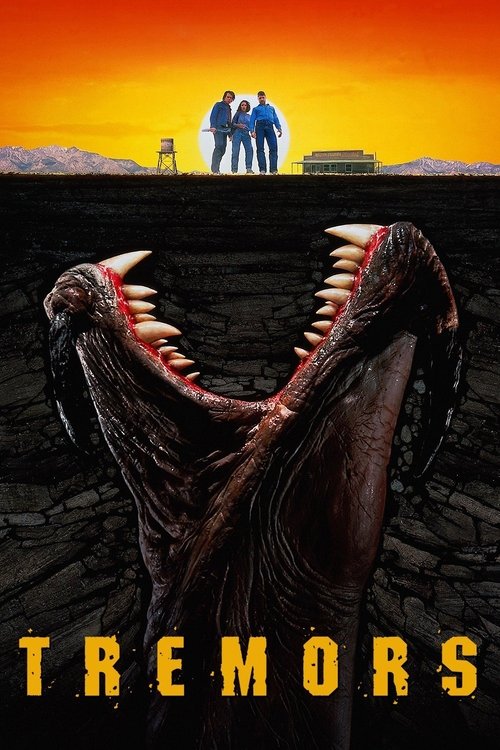
Tremors
1990 · Ron Underwood
For a pizza-and-friends night when you want thrills without dread — the rare creature feature the whole room enjoys, whether they love horror or not. Comfort food of the highest order.
What it's about
In Perfection, Nevada — population fourteen, one road out — two handymen are finally quitting town when they discover something enormous is moving under the ground and eating people. With phone lines down and the desert floor itself now deadly, the whole town scrambles onto rooftops and boulders to figure out what these things are and how to get past them. The only safe place is up.
The experience
Pure fun — a monster movie that's genuinely suspenseful and genuinely funny at the same time, with jokes that come from the characters instead of at their expense. It moves like a mechanical toy: tight, clever, and over before it wears out a single idea.
Performances
Kevin Bacon and Fred Ward have real buddy-movie chemistry as the bickering handymen, and Michael Gross steals scenes as a gun-hoarding survivalist whose paranoia finally pays off.
The craft
The script by S.S. Wilson and Brent Maddock is a small marvel of construction — every escape plan fails logically, every solution is set up before it's needed. The practical creature effects still hold up, and the wide desert photography turns open ground into a threat you can feel.
Why it matters
A modest theatrical run turned into one of the great video-era cult successes, spawning a decades-long franchise and becoming the modern benchmark for the horror-comedy creature feature.
Snapshot
Tremors is a monster picture built with the precision of a mechanical toy. In the fictional Nevada hamlet of Perfection — population fourteen, one road in, no road out — two itinerant handymen discover that something enormous is moving beneath the soil. The film's premise is elegant enough to state in a sentence and rich enough to sustain ninety-six minutes: the ground is hostile, and the only safe place is up.
What distinguishes it is tonal control. Released in January 1990 by Universal, from a script by S.S. Wilson and Brent Maddock and directed by Ron Underwood in his feature debut, Tremors is simultaneously a creature feature, a buddy comedy, a siege thriller and a late Western, and it never lets any one of those registers cannibalize the others. The jokes arise from character rather than from parody; the monsters remain frightening after the audience has laughed. It underperformed theatrically, then became one of the definitive cases of a film discovering its audience on videocassette and cable — a cult that eventually produced six sequels and a television series, and a reputation, now largely uncontested, as one of the most durable American genre films of its decade.
Industry & production
Tremors was produced independently by No Frills Film Production — the company formed by Wilson, Maddock and producer Nancy Roberts — and released through Universal Pictures. The reported production budget sits in the neighborhood of eleven million dollars, with a domestic theatrical gross of roughly sixteen million by standard trade tallies; figures for a film of this vintage should be treated as approximate.
The project's gestation is unusually well documented because its authors have told the story often: by Wilson's account, the idea dates to the mid-1970s, when he was working on a desert location and found himself imagining what it would be like to be trapped on a rock by something in the earth below. Wilson and Maddock spent the 1980s establishing themselves as reliable writers of high-concept studio entertainment — Short Circuit (1986), \batteries not included* (1987) — and used that standing to get their long-nursed desert monster script made, with Underwood, a collaborator from their earlier work in educational and industrial filmmaking, attached to direct.
The working title, by the filmmakers' own repeated account, was Land Shark. Universal's difficulty in marketing the finished film is part of its lore and is consistent with the release pattern: a January berth, historically a dumping ground, and campaign materials that had to sell a horror-comedy-Western hybrid with no stars of the first magnitude and a monster that could not be shown without spoiling the film's central withholding strategy. The picture's real commercial life began afterward, in the ancillary market that had by 1990 become the genuine economy of mid-budget genre production.
Technology
Tremors arrived at the last possible moment for a film of its kind to be made entirely by hand. James Cameron's The Abyss (1989) had just demonstrated photorealistic digital character animation; Terminator 2 and Jurassic Park would follow within three years and reorganize the field permanently. Tremors belongs to the era immediately preceding that break, and it is among the most accomplished demonstrations of what that era's craft could achieve.
The Graboids were created by Amalgamated Dynamics Inc. — the shop founded in 1988 by Tom Woodruff Jr. and Alec Gillis, both alumni of Stan Winston's studio. Tremors was effectively ADI's calling card, and the work is a compendium of practical technique: large-scale hydraulically actuated head and jaw units for the close encounters, cable-operated appendages for the three prehensile "tongues," and miniature and rigged-earth effects for the burrowing. The furrow of displaced soil racing toward a victim — the film's signature image, and its equivalent of the shark fin — was achieved with mechanical rigs dragging shaped forms beneath prepared ground, supplemented by miniature landscape work.
The consequence is a monster with weight. Because the creature had to physically exist, it had to obey physics, and because it obeyed physics the actors could play against something real. There is no digital compositing of note in the film. Its texture — dust, hydraulic hesitation, the slight resistance of matter — is inseparable from its credibility, and is precisely what the subsequent decade of computer-generated creatures had to learn to simulate.
Technique
Cinematography
Alexander Gruszynski's photography organizes the film around a single compositional idea: the horizon line as a threat. The Alabama Hills near Lone Pine, California — the granite country that served American B-Westerns for half a century — provide a landscape of enormous lateral emptiness punctuated by boulder outcrops, and Gruszynski shoots it so that the flat ground reads as danger and the rock reads as sanctuary. Cameras sit low, often at or near soil level, so that the earth occupies the bottom third of the frame as an active surface rather than a neutral floor. The film's crucial spatial relationship is vertical, not lateral, and the coverage keeps reminding us of it: characters are shot from below when they are safe on rock, and from a slight elevation when they are exposed on open ground.
The daylight palette is bleached and unromantic — dust, sagebrush, sun-faded paint — which does two useful things. It withholds the atmospheric cover horror films normally rely on, forcing the picture to generate dread in full sun, and it grounds the fantastical premise in a recognizably depleted American landscape.
Editing
The cutting, credited to O. Nicholas Brown, performs a difficult double duty: comic timing and suspense timing are governed by opposite instincts, and the film alternates between them without whiplash. The strategy is to let comic exchanges play in sustained two-shots — Bacon and Ward's dialogue is rarely chopped up — and to reserve rapid cutting for the attack sequences, where the geography of who is standing where becomes the entire content of the scene. The film is scrupulous about spatial legibility during set pieces; the audience always knows the distance between a character's feet and the nearest rock, because the suspense depends on it. At roughly ninety-six minutes, the picture has almost no slack.
Mise-en-scène / staging
Tremors is staged as a series of escalating spatial problems, and this is the most frequently noted feature of its construction — critics have long observed that it anticipates the level design of video games. Each sequence establishes a fresh configuration of safe and unsafe surfaces and then solves it: the rock outcrop overnight; the pole-vault across open ground; the bulldozer towing a trailer; the pipe; the concrete foundations; the cliff. The staging is legible because the rules are legible. The creatures hunt by vibration, cannot penetrate solid rock, and move faster in loose soil, and once those three facts are established the film simply plays out permutations with rigorous fairness.
Production design gives Perfection just enough specificity to be worth defending: Chang's Market, the half-built houses, the cinderblock rec room, the survivalists' arsenal-lined basement. Nothing is dressed for whimsy.
Sound
Sound is thematized as well as designed. The Graboids hunt by vibration, which makes noise a plot mechanism, and the mix accordingly foregrounds the low end — subsonic rumble, displaced gravel, the groan of shifting earth — as the primary index of threat. Long stretches depend on the audience listening for the same cues as the characters. The score is credited principally to Ernest Troost, with additional music by Robert Folk, and it makes the film's generic hybridity audible: slide guitar and harmonica figures out of the Western tradition set against orchestral horror gestures, with the two idioms sharing the same cues rather than alternating.
Performance
Kevin Bacon and Fred Ward play Val and Earl as a genuinely worn-in partnership — men who have argued the same arguments for years and no longer need to finish sentences. Bacon, who at the time was in a career trough between his early-eighties visibility and his nineties resurgence, plays Val's vanity and laziness without softening them; Ward's Earl is the film's exhausted conscience. Their rapport supplies the film's emotional continuity and most of its comedy.
Michael Gross's Burt Gummer is the picture's masterstroke of casting: Gross was nationally known as the liberal father on Family Ties, and here plays a heavily armed survivalist as competent, unironic and correct. Paired with Reba McEntire, in her feature debut as his wife Heather, the Gummers could easily have been a sketch; instead the film treats their preparedness as a virtue and gives them its most cathartic set piece. Finn Carter's Rhonda LeBeck, a graduate seismology student, is written and played as useful rather than decorative. Victor Wong, Charlotte Stewart, Tony Genaro, Robert Jayne and Ariana Richards fill out an ensemble notable for containing no villains at all — a structural choice with real consequences for the film's warmth.
Narrative & dramatic mode
The film's dramatic mode is investigative escalation followed by siege. The first act is a mystery of effects without visible causes: a man dead on an electrical tower, a slaughtered flock, a severed head in the dirt, a road blocked by rockslide, the phone lines down. The monster is withheld through partial revelation — a tentacle, a shape, a wake in the soil — in the manner Jaws had codified fifteen years earlier. Once the creature is fully seen, the film converts from mystery to problem-solving: the humans must reason their way out using the rules they have inferred.
Crucially, the characters are smart. They observe, hypothesize, test and revise, and the film's pleasure is substantially the pleasure of watching competent people improvise under pressure. There is no idiot plot, no character who wanders off for no reason. Deaths follow from bad luck or defensible errors, not from stupidity, and the film's comedy never requires a character to be a fool.
Genre & cycle
Tremors sits at the intersection of three lineages. From the 1950s American giant-monster cycle — Them! (1954) above all, with its desert Southwest and its burrowing colony — it takes the premise, the arid setting and the scientific-explanation scene. From Jaws it takes the unseen predator, the graduated reveal, and the structure of a small community whose economy and geography trap it. From the Western it takes the location itself, the dying frontier town, the sense of a landscape that will not sustain the people on it, and the armed climax.
Within the horror-comedy cycle of the late 1980s — Evil Dead II, Return of the Living Dead, Killer Klowns from Outer Space, Gremlins and its imitators — Tremors is unusual for refusing camp. It is affectionate toward the 1950s monster movie without condescending to it, and it declines the winking self-reference that would dominate genre filmmaking after Scream (1996). Its comedy is observational and character-based; its horror is played straight.
Authorship & method
Authorship here is best located in the Wilson–Maddock–Underwood partnership rather than in a single director. Wilson and Maddock wrote and produced, and their fingerprints — the high-concept premise stated with mechanical clarity, the affection for working-class competence, the machinery that behaves consistently — are visible across their filmography. Wilson's background in effects and animation is legible in a creature conceived from the start around what could physically be built.
Underwood's contribution is tonal and spatial: the modulation between registers, the patient establishment of geography, the refusal to hurry the character scenes. His subsequent career — City Slickers (1991), Heart and Souls (1993), Speechless (1994), the Mighty Joe Young remake (1998), and the notorious commercial failure of The Adventures of Pluto Nash (2002), after which he worked largely in television — suggests a filmmaker at his best with ensemble comedy grounded in landscape, which is exactly what Tremors is.
Among department heads, Gruszynski's low-horizon photography and Troost's genre-blending score are the most consequential authorial signatures. Documentation of the editorial and design process is comparatively thin in the published record; the account above rests on the evidence of the film itself.
Movement / national cinema
Tremors belongs to no movement, and that is part of its interest. It is a specimen of a now largely vanished American production category: the mid-budget studio genre film, made by journeymen without stars, released without event-picture support, and expected to earn out across theatrical, video and television windows. Its national character is emphatically American — the desert West, the survivalist, the trailer and the pickup, the self-employed handyman — and its politics are unusually generous toward a rural working population that studio cinema of the period more often treated as backdrop or joke.
Era / period
Made at the hinge between the 1980s and 1990s, the film registers several transitions at once. Technologically, it is a late masterwork of practical creature effects on the eve of digital displacement. Industrially, it marks the maturity of home video as the medium through which mid-budget genre films actually found audiences. Culturally, it is a post-Reagan portrait of economic dead-end: Perfection has fourteen residents, no work, and half-built houses, and Val and Earl's entire dramatic motivation before the monsters arrive is the wish to leave. The film makes that wish literal — the monsters are, among other things, the reason the road out is blocked.
Themes
Three concerns run through the picture. The first is the ground as antagonist: a landscape that has already failed its inhabitants economically now attacks them physically, and the film's governing image is of people stranded above a surface they can no longer trust.
The second is competence as virtue. Nobody in Perfection is educated in the way the film's genre forebears would require, but everyone knows how to use what they have — a bulldozer, a pipe bomb assembled from ranch supplies, a basement of firearms. The film's moral economy rewards resourcefulness and mutual reliance over expertise, while treating Rhonda's science as genuinely useful rather than as an obstacle.
The third is community without villains. The ensemble contains no traitor, no coward punished for cowardice, no rich antagonist. The Gummers' survivalism, which a 1990 studio film could easily have satirized, is instead vindicated. The result is a horror film whose emotional register is unusually affectionate — a siege picture about people who like each other.
Reception, canon & influence
Backward. The film's declared inheritances are the 1950s desert monster cycle, above all Them!; Jaws, for its withholding and its trapped-community structure; and the B-Western tradition materially present in the Alabama Hills locations. The siege architecture descends from Night of the Living Dead and the Hawksian professional group; the buddy-comedy chassis from the 1980s two-hander.
Contemporary reception. Reviews on release were broadly favorable but not extensive; the film's genre-hybrid identity and January release limited its critical footprint. It was generally praised for craft, pace and the Bacon–Ward chemistry, and its practical creature work was singled out. The commercial disappointment was real, and the standard account attributes it substantially to marketing that could not articulate what the film was.
Forward. Tremors became a home-video and cable perennial through the 1990s, and that afterlife generated an unusually long franchise: Tremors 2: Aftershocks (1996, directed by S.S. Wilson), Tremors 3: Back to Perfection (2001), a Syfy television series (2003), the Western prequel Tremors 4: The Legend Begins (2004), Tremors 5: Bloodlines (2015), Tremors: A Cold Day in Hell (2018) and Tremors: Shrieker Island (2020). Michael Gross appears in all seven features, making Burt Gummer — a supporting character in the original — the series' sole continuous presence, an outcome few films have produced. A revival pilot with Kevin Bacon was produced for Syfy in the late 2010s but not picked up.
Its critical standing has risen steadily. The film is now routinely cited as a model of the rules-based creature feature: a subgenre in which a monster's constraints are established with legal clarity and the plot consists of exploiting them. That template is visible across subsequent horror — the sound-hunted survival of A Quiet Place (2018) is the most frequently drawn comparison, and the comic-practical creature pictures Slither (2006), Grabbers (2012) and Love and Monsters (2020) all work recognizably in its idiom, whether or not direct influence can be documented. Equally durable is its tonal lesson, absorbed by a generation of genre filmmakers: that comedy and terror can occupy the same scene without either one being a defense against the other.
Reception
A modest theatrical performer in January 1990, it exploded on video and cable into one of the great word-of-mouth cults — now routinely called the perfect creature feature and the seed of a seven-film (plus TV) franchise.
How Tremors was received, from release to now →
How to watch Tremors: what to notice on a first viewing
- Watch the camera stay low, near the dirt. Gruszynski keeps shots near soil level so the ground fills the bottom of the frame, an active surface rather than a neutral floor, in bleached Nevada daylight. The land itself becomes the threat before you ever see a monster.
- Notice which surfaces the characters choose to stand on. Each set piece is a fresh configuration of safe rock and unsafe open ground: an overnight outcrop, a pole vault, a bulldozer and trailer, a pipe. The film plays fair: once you know the rules, you can solve each problem right alongside the characters.
- Listen for the mix's low end under quiet scenes. Because the Graboids hunt by vibration, the sound design foregrounds subsonic rumble, displaced gravel, and the groan of shifting earth as the primary sign of danger. You end up listening for the same cues the characters are listening for.
- Watch how Bacon and Ward finish each other's sentences. Val and Earl bicker like men who have had the same arguments for years, a worn-in partnership that carries most of the film's comedy. Their rapport is what keeps the film warm even while everyone is in danger.
The whole guide to watching Tremors, with the keys for a rewatch →
Influences: the films it descends from and the films it influenced
- Them! (1954) — Introduces the monster as an off-screen sound cue — the chirping heard long before anything is seen — and builds it as full-scale hydraulic puppets photographed in hard desert daylight rather than miniatures, the exact two-part method Tremors reproduces for the graboids.
- Tarantula (1955) — Arnold's desert grammar of a very low horizon line with the flats occupying the bottom third of frame, so open ground reads as a crossable void the creature can traverse unseen — the compositional rule Gruszynski applies to the Perfection valley floor.
- Bad Day at Black Rock (1955) — Establishes a one-street Owens Valley desert town in widescreen as a fully legible map — every doorway, distance and sightline fixed in the first reel — so later violence can be followed without re-establishing geography; Perfection is staged on the same spatial contract.
- Ride Lonesome (1959) — Treats the Alabama Hills granite piles as tactical furniture — cover, high ground, chokepoints — rather than scenery, shot low and hard by Lucien Ballard; Tremors inherits both the literal location and this reading of rock formations as strategy.
- Rio Bravo (1959) — The Hawksian professional group in which overlapping comic banter never suspends competence: characters are ranked by what they can do, and the joke and the job occupy the same line of dialogue — the template for the Valentine–Earl two-hander.
- The Birds (1963) — Stages attacks in flat rural daylight with no score to cushion them and no causal explanation offered, escalating in discrete set-pieces that each expose a new failure of the community's shelters.
- Night of the Living Dead (1968) — Codifies the siege procedure — inventory the structure's weak points, board them up as visible on-screen labor, argue about the plan — so that solving the building precedes solving the monster.
- Jaws (1975) — Signifies the creature by its displacement of a medium — barrels dragging across water, a dirt mound wake in Tremors — allowing the monster to be tracked, feared and fought while withheld, plus the working-class trio who bicker their way through the engineering problem.
- Piranha (1978) — The Sayles–Dante economy of the comic creature feature: a rigorously cheap practical monster, jokes delivered straight by actors who never wink, and a real body count that keeps the comedy from becoming a defense.
- The Thing (1982) — The apex of pre-CGI on-set creature construction — full-scale articulated puppets with jaw and tentacle mechanisms operated in camera — married to a plot whose engine is a small group empirically deducing the organism's biology.
- Gremlins (1984) — Establishes the monster through explicitly stated rules the film then obeys without cheating, and proves a single puppet can carry menace and comedy in the same shot without either register canceling the other.
- Predator (1987) — Attrition by an unseen, sensory-specialized predator whose rules the survivors must decode mid-hunt — the 'learn the monster's perception to beat it' structure Predator crystallized.
- Tremors 4: The Legend Begins (2004) — Wilson makes the original's B-Western substrate literal, transposing the established graboid rule-set into 1889 and rebuilding the puzzle around period-limited ordnance, proving the creature logic was portable independent of the cast.
- Slither (2006) — Small-town practical-creature comedy in the Tremors idiom: animatronic and latex gags engineered to produce revulsion and laughter within a single shot, with local competence rather than arriving authorities executing the solution.
- Attack the Block (2011) — Designs its creature around what the budget could physically build — a black-furred silhouette with bioluminescent teeth, no interior detail required — inside one vertically legible geography mapped early so every chase remains followable.
- Grabbers (2012) — The rules-based creature feature in pure form: a single exploitable weakness (alcohol in the bloodstream) is discovered at the midpoint, and the entire third act is the community engineering and executing that exploit.
- A Quiet Place (2018) — Keys predation to one sensory channel and then organizes every prop, blocking choice and sound edit around that constraint — the most direct extension of the Tremors contract that the audience must always be able to compute the danger themselves.
- Nope (2022) — Daylight horror in an open Western basin with a withheld creature that is redefined mid-film by a discovered rule (don't look at it), solved by ranch-hand practical competence, and framed on a low horizon that makes the empty sky the threat's medium.
- The Host (2006) — Models the daylight comedy-creature hybrid in which a subterranean monster is hunted across precisely mapped real terrain, mixing slapstick with dread—the tonal-switch architecture and ground-level geography The Host scales up to Seoul.
- Hope (2026) — The daylight creature-hunt staged as amateur community problem-solving, with dread and rube comedy held inside the same wide desert frame rather than alternated between scenes — the tonal-mixing licence Na's provincial hunting party runs on.
- Jurassic Park (1993) — The other major creature picture built on the practical/CGI threshold, and one that states an animal's sensory limitation as a rule before dramatizing it; its water-glass tremor cue literalizes the seismic-vibration-as-warning device Tremors made its plot mechanism.
Similar films
- Jurassic Park (1993) — influence & lineage
- The Thing (1982) — influence & lineage
- Night of the Living Dead (1968) — influence & lineage
- Beetlejuice (1988) — shared sensibility
- The Texas Chain Saw Massacre (1974) — shared sensibility
- When Evil Lurks (2023) — shared sensibility
- The End of Oak Street (2026) — shared sensibility
- Scooby-Doo on Zombie Island (1998) — shared sensibility