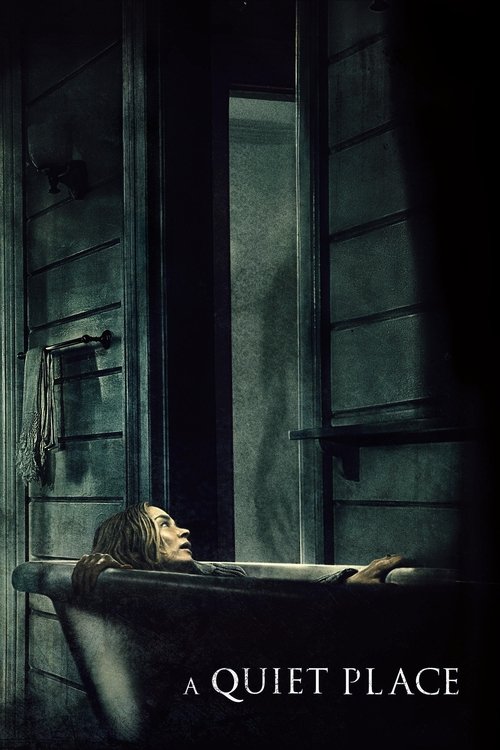
A Quiet Place
2018 · John Krasinski
When you're craving a real scare with your heart in it — a white-knuckle watch that's intense but not cruel, great with a crowd brave enough to stay quiet.
What it's about
The world has been overrun by blind creatures that hunt by sound, and the Abbott family survives on their rural farm by living in near-total silence — sign language, bare feet, sand-lined paths. The parents are trying to raise, protect, and teach their kids under a rule where one dropped plate can be fatal, and the mother is pregnant, which means a countdown to the loudest thing a human being can go through.
The experience
Ninety minutes of held breath. The silence makes you hyper-aware of every creak — in the film and in your own room — and it wrings real emotion out of the family story between the scares. Tense from the first minutes and it never lets go.
Performances
Emily Blunt is remarkable, carrying whole scenes with no dialogue at all, and deaf actress Millicent Simmonds gives the film its emotional spine as the daughter.
The craft
The sound design is the star — the film teaches you to listen the way the family does, dropping in and out of a deaf character's hearing, making silence itself feel loud. Watch it with good speakers or headphones and don't eat anything crunchy; it rewards the best sound system you can find.
Why it matters
A modest-budget original that became one of 2018's biggest hits, it reinvented John Krasinski from sitcom everyman to horror director and proved a high-concept, near-silent studio film could pack theaters.
Snapshot
A Quiet Place is a horror-thriller built on a single, ruthlessly elegant constraint: in a world overrun by blind predators that hunt by sound, a family survives by living in near-total silence. The conceit collapses the genre's usual mechanics — dialogue, score, the comfort of ambient noise — into a sustained exercise in dread, where the smallest acoustic accident carries mortal stakes. Directed by John Krasinski, an actor best known to American audiences as the affable Jim Halpert of the television comedy The Office, the film marked an unexpected and decisive reinvention; Krasinski also co-wrote it and stars opposite his wife, Emily Blunt, as the parents of the Abbott family. Released by Paramount in the spring of 2018, it became one of the year's signal commercial and critical successes, a low-budget original that outperformed expectations and revived industry confidence in the theatrical horror feature as a venue for formal experiment. Its real achievement is less the monster premise than the way that premise reorganizes filmmaking itself: A Quiet Place is a movie about listening that compels its audience to listen, turning the cinema's own sound system into an instrument of suspense and making silence — and the threat of breaking it — the engine of nearly every scene.
Industry & production
A Quiet Place originated as a spec screenplay by Bryan Woods and Scott Beck, two filmmakers who had worked together since childhood and conceived the project as a near-silent creature feature. Their script attracted the attention of Paramount Pictures and the producing apparatus around Michael Bay's Platinum Dunes — the genre-focused label, run with partners Andrew Form and Brad Fuller, that had spent the 2000s and 2010s producing horror remakes and original thrillers. John Krasinski came aboard initially as a hired director and undertook a substantial rewrite of the Woods-and-Beck screenplay, deepening the family drama and the emotional architecture around the premise; the three share screenplay credit, with Woods and Beck additionally credited for the story. Krasinski has spoken in interviews about being drawn to the material as an allegory for parenthood and protection, and that personal investment reshaped the project from a high-concept genre exercise into a family melodrama wearing horror's skin.
The casting of Emily Blunt, Krasinski's wife, was reportedly not part of the original plan — by widely circulated accounts she read the script and asked to play the role herself — and the couple's real intimacy lends the film's central relationship an unusual authenticity. The production made a consequential and now much-praised decision in casting Millicent Simmonds, a deaf actress, as the Abbotts' deaf daughter Regan; her presence is not incidental but structural, since the family's fluency in American Sign Language — a survival advantage in a soundless world — is grounded in the premise itself. The budget was modest by studio-tentpole standards, reported in the range of roughly seventeen to twenty-one million dollars, and the film returned many multiples of that figure in worldwide theatrical release, though precise grosses should be verified against box-office records rather than asserted here. The film premiered at the South by Southwest festival in Austin in March 2018 before its wide release, and its festival reception helped build the word-of-mouth momentum that carried it commercially.
Technology
A Quiet Place is not a technically experimental film in the sense of new camera systems or pioneering visual-effects pipelines; it was shot digitally and finished through a conventional contemporary post-production chain. Its technological significance lies instead in sound reproduction and in the creature visual effects. The film was designed for, and is most fully experienced in, theatrical exhibition with a calibrated multichannel sound system, because its drama depends on the audience's ability to register extremely quiet sounds against near-silence and to localize noises in space — a footstep, a creak, a child's breath. The film effectively weaponizes the dynamic range of modern cinema sound, the gap between near-inaudibility and sudden loudness, in a way that home viewing can only partly reproduce.
The creatures themselves are computer-generated, the product of contemporary visual-effects work (Industrial Light & Magic is credited among the effects houses), and they are conceived around their predatory adaptation: eyeless, armored hunters with elaborate, unfurling auditory organs that open like sensory petals to locate prey. The design's restraint — the monsters are largely withheld for much of the running time and revealed fully only late — is both an aesthetic and a practical choice consistent with the long horror tradition of delayed disclosure. Beyond this, the film makes no claim to technological novelty, and it would be invention to attribute to it innovations the record does not support; its power is a matter of design and discipline rather than apparatus.
Technique
Cinematography
The cinematography is by Charlotte Bruus Christensen, a Danish-born director of photography known for her work with Thomas Vinterberg (The Hunt) and on literary dramas such as Far from the Madding Crowd and Fences. Her images for A Quiet Place favor a naturalistic, earth-toned palette suited to the Abbotts' rural farmstead and the surrounding woods and fields — autumnal browns, muted greens, the desaturated gray of overcast daylight — that grounds the fantastical premise in the texture of an ordinary American agricultural landscape. The camera is patient and observational, frequently holding on faces and on the small physical actions that, in this world, carry enormous risk. Because dialogue is largely unavailable, Christensen's framing must carry narrative and emotional information that would ordinarily be spoken: the geography of the farm, the placement of hazards, the silent exchange of looks between characters. The film uses space with unusual precision, mapping the layout of the house and grounds so that the audience understands distances and sightlines — knowledge that becomes the substance of suspense when a character must cross a room or a field without making noise.
Editing
Edited by Christopher Tellefsen, the film is structured as a series of meticulously controlled suspense set-pieces threaded onto a continuous thread of domestic survival. The editing's central problem — and triumph — is rhythm in the absence of dialogue: cuts are timed to physical action, to the proximity of threat, and to the audience's growing literacy in the rules of the world. Tellefsen builds tension through the careful alternation of stillness and sudden motion, and through cross-cutting between family members separated in space during the film's climactic crisis, when multiple simultaneous emergencies converge. The cutting also manages the film's crucial information economy, doling out the rules of survival — the sand-covered paths, the soundproofed spaces, the warning lights — early enough that later scenes can exploit the audience's understanding. Pace accelerates markedly in the final act, but the film's signature is its willingness, in its quieter stretches, to let scenes extend to nearly unbearable length, the edit refusing the relief of a cut until the tension has been wrung out.
Mise-en-scène / staging
The film's production design constructs a fully imagined survival ecology, and the staging is among its most expressive elements precisely because so much meaning must be conveyed without speech. The Abbott farm is a text in itself: paths strewn with sand to muffle footsteps, a network of strung lights that turn red to signal danger, a basement prepared as a refuge, painted board-game pieces and felt markers substituted for noisy toys, a soundproofed room built in anticipation of an infant's cries. These details are not set dressing but plot, each one a rule the staging establishes so that its later violation can generate terror. Krasinski stages action to foreground hazards — the protruding nail on the cellar stair is the film's most discussed example, planted early and paid off with excruciating tension — and the blocking continually emphasizes the physical labor of silence: the deliberate placement of feet, the careful handling of objects, the choreography of a family that has rehearsed soundlessness into second nature. The pregnancy of Blunt's character introduces the cruelest staging problem of all, a body destined to produce uncontrollable noise, and the film's design anticipates it with the soundproofed nursery and the submersion of childbirth into a set-piece of nearly silent agony.
Sound
Sound is the film's reason for being, and its sound design — the work of a team including sound designers and re-recording mixers whose contributions the film's awards recognition would later single out — is its most celebrated technical dimension. The film inverts the normal hierarchy of the soundtrack: silence is the baseline, and every audible element is therefore charged. Ambient noise, breath, the rustle of clothing, and the tiny incidental sounds of a house become potential death sentences, and the audience is trained to monitor the soundtrack with the same vigilance as the characters. The film makes pointed use of subjective sound, most powerfully in its alignment with the deaf daughter Regan: at moments the soundtrack drops to the muffled near-silence of her experience, and her cochlear implant — and the feedback it can produce — becomes a plot mechanism as well as a perceptual one. Marco Beltrami's score is used sparingly and strategically, withdrawn for long stretches so that its returns register, and careful never to fill the silence the film depends upon. The result is a work in which sound design is not support but subject, the discipline around which everything else is organized.
Performance
With dialogue largely unavailable, performance in A Quiet Place is overwhelmingly physical and facial, conducted in American Sign Language, glances, and the suppression of sound. Emily Blunt anchors the film with a performance of contained terror and maternal resolve, her childbirth sequence — endured in near-silence to avoid attracting the creatures — a tour de force of acting under constraint, expressing in breath and clenched stillness what cannot be cried out. Krasinski, as the father, plays protection curdling into desperation, and the role's deliberate distance from his comic television persona is part of the film's reinvention of him. The children carry much of the emotional weight: Millicent Simmonds, herself deaf, brings authenticity and a complex interior life to Regan, whose strained relationship with her father and whose deafness become central to the plot's resolution; Noah Jupe plays the son Marcus with a palpable, fearful fragility. Across the ensemble, the performances are notable for their reliance on the actors' faces and bodies to carry feeling that the medium ordinarily entrusts to the voice, and the family's signed communication grounds the performances in a shared physical language that the casting of a deaf actress makes genuine rather than simulated.
Narrative & dramatic mode
A Quiet Place's dramatic mode is survival horror fused with domestic melodrama, and its great formal wager is the substitution of silence for speech as the medium of storytelling. The narrative is structured around rules — the audience learns, almost wordlessly, the laws of this world and the family's adaptations to it — and around the steady accumulation of pressure toward a crisis the premise makes inevitable. Chief among these is the pregnancy: the film opens a clock the moment we understand that the mother will give birth, and that a newborn cannot be silenced, so that the entire picture proceeds under the shadow of a coming sound that cannot be prevented. This is suspense in the classical sense, generated by the audience's knowledge of dangers the characters must navigate, and the film's quietest passages are often its most agonizing because the slightest noise threatens catastrophe.
Beneath the genre machinery, the film is a drama of family, grief, and protection. An early loss — the death of the youngest child in the opening sequence — hangs over the whole, charging the parents' vigilance with guilt and the daughter's arc with the need for a father's forgiveness and trust. The film's emotional resolution is bound up with its plot resolution: the discovery that the creatures are vulnerable to a particular sound frequency, tied to Regan's cochlear implant, makes the deaf daughter — the family member most marked by difference and self-doubt — the agent of salvation, so that the melodrama of paternal reconciliation and the mechanics of monster-killing arrive at the same point. The film thus operates as allegory as much as thriller, its silence and its terrors readable as a parable of parenthood: the impossible labor of keeping children safe in a dangerous world, and the moment a parent must trust a child to save herself and others.
Genre & cycle
A Quiet Place belongs to the late-2010s wave of theatrically successful, formally ambitious studio and independent horror — the cycle often associated with the company Blumhouse and films such as Get Out (2017) and A Quiet Place's near-contemporary Hereditary (2018), as well as the critically embraced "elevated horror" discourse that surrounded these pictures — even though A Quiet Place itself was a Paramount/Platinum Dunes production rather than a Blumhouse one. What it shares with that cycle is the conviction that horror could carry serious thematic and formal weight while succeeding commercially on modest budgets, and that an original premise could outdraw franchise product. In the longer history of the genre it is a creature feature and a post-apocalyptic survival film, descending from a lineage of films about families besieged by inhuman threats and about humanity reduced to scattered survivors after a civilizational collapse. Its specific innovation — the gimmick elevated to governing principle — is the near-total constraint on sound, a high-concept conceit that recalls other films built around a single radical rule. The film's success spawned its own small cycle, most directly its sequel, A Quiet Place Part II (2020), again directed by Krasinski, and the franchise it initiated, including the later prequel A Quiet Place: Day One (2024) directed by Michael Sarnoski, extending the world's mythology to the day of the creatures' arrival.
Authorship & method
A Quiet Place is most legible as the work that established John Krasinski as a director of genre cinema, and its authorship is genuinely collaborative in ways the film foregrounds. Krasinski rewrote the originating screenplay by Bryan Woods and Scott Beck, reshaping its near-silent creature premise into a vehicle for an essentially familial and emotional story; his stated interpretation of the material as an allegory of parenthood is the organizing idea that distinguishes the finished film from a pure exercise in suspense. As director and co-star he shaped the picture from inside the family it depicts, and the casting of his own wife as his on-screen spouse folds a real marriage into the film's central relationship.
Among the key collaborators, cinematographer Charlotte Bruus Christensen supplied the naturalistic, landscape-rooted images that ground the fantastical premise; editor Christopher Tellefsen built the suspense rhythms that operate without the usual support of dialogue; and composer Marco Beltrami, a veteran of horror and action scoring, provided a score disciplined enough to honor the film's silences. The sound team's contribution rises to the level of co-authorship given the film's premise, and their work was singled out in the subsequent awards season. The casting of deaf actress Millicent Simmonds was itself a methodological choice with authorial consequences, grounding the family's signed communication and the deafness-centered resolution in lived reality rather than performance. The producing presence of Platinum Dunes — Michael Bay, Andrew Form, and Brad Fuller — situates the film within an established genre-production apparatus, even as its sensibility departs sharply from the loud spectacle associated with Bay's own directing.
Movement / national cinema
A Quiet Place is a product of the American studio system, specifically the strand of contemporary Hollywood horror that, in the 2010s, rediscovered the original, mid-budget genre feature as a reliable source of both profit and prestige. It does not belong to a national or aesthetic "movement" in the strict art-historical sense, but it is fully embedded in an industrial moment: the post-Get Out recognition that horror could be a vehicle for authorial ambition and social or emotional allegory while remaining commercially potent, and the broader studio appetite for original concepts that could be franchised. The film's cinematographer is European and its sensibility owes something to a restrained, art-cinema patience uncommon in mainstream American horror, but its idiom — the besieged American family, the rural heartland setting, the post-apocalyptic survivalism — is recognizably American. As national cinema it is a confident example of Hollywood absorbing the lessons of independent and "elevated" horror into a studio production and exporting the result to a global audience.
Era / period
The film is a precise artifact of late-2010s American culture and of its film industry. Commercially it belongs to a moment when studios, anxious about the dominance of franchise and superhero product, were rewarded for backing original horror at modest cost, and A Quiet Place became a frequently cited proof that audiences would turn out in numbers for a non-franchise concept. Thematically, readings of the film have connected its imagery of a family hunkered in fearful silence, avoiding detection by an implacable external threat, to the anxieties of its political moment — though such allegorical interpretations are inferential, and the film's own stated emphasis is on parenthood and protection rather than topical commentary. Its participation in the "elevated horror" conversation of 2017–2018 places it firmly within a specific critical period, and its near-silent design, dependent on the dynamic range of contemporary multiplex sound systems, ties it to the technological conditions of theatrical exhibition at that time. The choice to cast a deaf actress and to center deafness and sign language reflects a late-2010s sensitivity, in both the industry and its audience, to authentic representation.
Themes
The film's governing theme is parenthood as an act of protection under impossible conditions — the labor of keeping children alive in a world that punishes the smallest mistake, and the dread that no vigilance can ever be sufficient. Around this orbit several related concerns. There is grief and guilt: the early death of the youngest child shadows the parents' every choice and structures the daughter's need to be forgiven and trusted, so that the family's survival drama is also a drama of mourning. There is communication and its failures — a family that speaks in sign, a father and daughter estranged by unspoken blame, a world in which speech itself has become lethal — and the film makes its central irony out of the fact that the deaf daughter's mode of perception, marked throughout as a difference and a vulnerability, becomes the family's salvation. There is the theme of difference as strength: Regan's deafness, the source of her isolation and self-doubt, turns out to hold the key to defeating the creatures, an arc that reframes disability as capacity. And there is the persistent allegorical undertow of a family besieged, reading variously as a parable of parental fear, of protecting the vulnerable in a hostile world, or of survival itself. Beneath all of it lies the film's formal theme — the value and fragility of silence, and the terror that lives in sound.
Reception, canon & influence
A Quiet Place was met with strong critical acclaim and exceptional commercial success on its 2018 release, and the response coalesced around its formal daring — the near-silent design — and the performances, particularly Emily Blunt's and the breakthrough of Millicent Simmonds. Critics praised Krasinski's unexpected assurance as a genre director and the film's fusion of high-concept suspense with genuine emotional stakes, and it was widely cited as one of the year's most satisfying studio releases and a vindication of original horror. Its awards recognition centered, fittingly, on sound: the film was nominated for the Academy Award for Best Sound Editing, an acknowledgment of the craft that constitutes its very subject, and it gathered numerous other industry and critics' honors over the season (specific awards beyond the Oscar nomination should be confirmed against the record).
Influences on the film run backward to the long tradition of the creature feature and the post-apocalyptic survival narrative, to the besieged-family horror of films in which a household defends itself against external threat, and to the genre's enduring strategy of withholding the monster. Its emphasis on a single governing constraint links it to the lineage of high-concept thrillers organized around one radical rule, and its patient, atmosphere-first approach reflects the influence of the "elevated horror" sensibility crystallized by Get Out and the contemporary work of directors like Ari Aster. The decision to ground the premise in sign language and deafness draws on the real culture and language of the deaf community rather than on cinematic precedent.
Its influence forward is felt first within its own expanding franchise — the sequel A Quiet Place Part II (2020) and the prequel A Quiet Place: Day One (2024) — which turned a self-contained original into a durable property and confirmed the commercial logic that an inventive concept could anchor a series. More broadly, the film reinforced the late-2010s industry conviction that original, mid-budget horror with a strong formal hook could outperform expectations, encouraging studios to greenlight comparable concept-driven genre films. Its central technique — the manipulation of silence and the dynamic range of cinema sound as the primary instrument of suspense — became a widely cited reference point in discussions of film sound, and its centering of a deaf character and actress contributed to ongoing conversations about authentic representation in mainstream cinema. A Quiet Place retains a secure place in the canon of late-2010s American horror as the film that proved, with unusual purity, how much terror and tenderness can be wrung from the threat of a single sound.
A Deleuzian reading
Watch the feet.
The full Deleuzian reading of A Quiet Place →
Reception
A word-of-mouth phenomenon in spring 2018 — a $17M horror film from the guy from The Office that became a monster hit and instant franchise-starter. It's since settled in as a key title of the 2010s mainstream-horror revival, the film that proved 'quiet' high-concept horror could be a blockbuster.
How A Quiet Place was received, from release to now →
Influences: the films it descends from and the films it influenced
- Wait Until Dark (1967) — Blueprints the sensory-deprivation thriller, structuring its climax around a single perceptual constraint — a blind heroine who kills the lights to level the field — the same 'one radical sensory rule governs the suspense' architecture AQP inverts into sound.
- The Birds (1963) — Discards a conventional orchestral score for an electronically designed soundscape, making the texture and absence of sound itself the suspense instrument during a creature siege on a rural household.
- Jaws (1975) — Perfects withholding-the-monster suspense and planted-payoff mechanics — props and sounds set up early to detonate late — the grammar AQP rebuilds around the nail on the stair and the hearing aid's feedback.
- Alien (1979) — Establishes the besieged-survivors-versus-unseen-creature template with sound-led stalking in confined space, literalizing silence-as-threat in a way AQP makes its entire ruleset.
- Night of the Living Dead (1968) — Provides the besieged-household-defends-itself-against-external-threat structure with explicit survival rules and a downbeat familial sacrifice as its emotional engine.
- 2001: A Space Odyssey (1968) — Legitimizes extended dialogue-free passages and the dramatic use of near-total silence and amplified breathing as the dominant sonic texture rather than a momentary effect.
- Signs (2002) — The immediate ancestor: a rural family besieged by withheld aliens, structured as a parenthood-and-faith allegory with domestic objects planted as climactic payoffs.
- No Country for Old Men (2007) — Sustains near-scoreless, dialogue-free suspense built almost entirely from naturalistic diegetic sound and patient cross-cutting, the restraint AQP adopts wholesale.
- I Am Legend (2007) — Extends I Am Legend's sound/silence-as-primary-register formal device to its logical structural conclusion: silence becomes explicit survival rule rather than atmospheric register, with creature-triggered audio as the primary tension mechanism — completing the formal logic that I Am Legend's night-sequence soundscape had mapped through creature vocalizations independent of their CG visibility.
- Godzilla Minus One (2023) — Krasinski extends the sound-as-primary-dread grammar into a feature-length formal principle — creature defined entirely by its acoustic signature, ambient silence as survival mechanism, sound design doing the horror work before any visual — and structures the film around domestic-enclosure staging and implosive grief performance within a family unit abandoned by any functioning institution.
- The Darkest Hour (2011) — Extends the epistemological-survival design — survival governed by a strict sensory rule against a predator you must avoid being perceived by — into a fully realized horror grammar the earlier film only sketched.
- World War Z (2013) — Builds a failure-of-barriers survival procedural around emergent predators and a 'vulnerability as protection' reversal — silence as camouflage — echoing WWZ's terminal-illness masking gambit.
- Bird Box (2018) — Replicates the high-concept sensory-constraint survival rule — 'don't look' swapped for 'don't make sound' — framed identically around a parent shepherding children through a depopulated world.
- A Quiet Place Part II (2020) — Direct franchise extension of the same silence-as-baseline and dynamic-range-as-suspense craft, expanding the rules-based worldbuilding outward from the farmhouse.
- No One Will Save You (2023) — Carries AQP's dialogue-free rhythm to a near-total extreme, staging an almost wordless alien home-siege where sound design alone performs the narration.
- A Quiet Place: Day One (2024) — Transplants the franchise's silence-as-survival ruleset to dense urban space, testing the same sound-management suspense against a city's ambient noise.
- Heretic (2024) — Beck and Woods' own signature: reduce horror to one governing rule the characters must obey and navigate — the authorial method Heretic transposes from sound to theology.
- Get Out (2017) — The cited crystallizer of 'elevated horror' — atmosphere-first, allegory-driven studio genre filmmaking — establishing the commercial template AQP exploits a year later.
- Hereditary (2018) — Treats the domestic unit and parental grief as the literal engine of dread, sharing AQP's conviction that family trauma, not gore, is the horror's true subject.
- It Comes at Night (2017) — Rules-based survival horror centered on a family guarding a household against an unseen, ambiguous external threat, withholding its monster as a matter of design principle.
- Don't Breathe (2016) — Weaponizes enforced silence: characters must stay soundless to survive a blind hunter who navigates by ear — the exact sensory game of AQP run in reverse.
- Sound of Metal (2019) — Builds POV through radical subjective sound design and centers an authentic Deaf experience, the craft and representational concerns AQP foregrounds through Millicent Simmonds and its silences.
- Nope (2022) — Krasinski builds his entire horror grammar around a single sensory rule — sound triggers the creature — deriving geography, staging, and performance from that one constraint; Nope reverses the polarity exactly, making visual attention the trigger, applying the same single-rule creature-grammar to a different sensory domain.
- War of the Worlds (2005) — Descendant building on the film's restrained-silence sound design and a parent's desperate protection of children during an unstoppable creature invasion staged as intimate chamber-piece survival.
- CODA (2021) — Casts Deaf actress Millicent Simmonds and makes ASL a diegetic register while using imposed-silence sound design as a structuring device rather than an effect.
- Jurassic World Rebirth (2025) — Builds its set-pieces on creature-vocalization and sound design as the primary suspense engine, the audio-led menace Rebirth deploys in its stalking sequences.
- Deaf (2025) — Casts deaf actress Millicent Simmonds and ties its sound-drop design to her point of hearing, using ASL and selective silence as the audience's access to a deaf character's perception.
- Colony (2026) — Makes sound the governing rule and then hands the mix to the plot — the sound design is the diagnostic instrument both characters and audience use, so silence, a dropped object or a hearing aid's feedback are plot events rather than atmosphere.
Similar films
- Hereditary (2018) — influence & lineage
- Get Out (2017) — influence & lineage
- Signs (2002) — influence & lineage
- A Quiet Place Part II (2021) — same viewing thread
- Jaws (1975) — influence & lineage · same viewing thread
- Night of the Living Dead (1968) — influence & lineage · same viewing thread
- The Invisible Man (2020) — same viewing thread
- [REC] (2007) — same viewing thread
All the films related to A Quiet Place →
Watch it with: curated runs of related films
- Nowhere Left to Hide — Watch these when you want pure primal terror — ordinary people cornered by something relentless, from open water to a silent farmhouse to a stairwell in Barcelona.