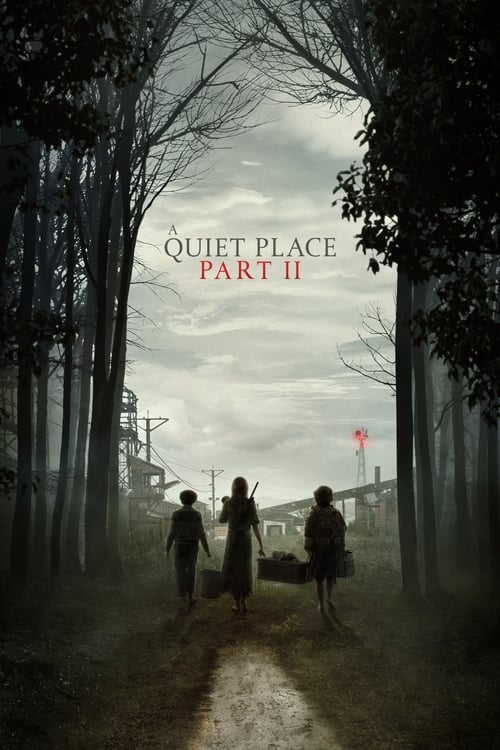
A Quiet Place Part II
2021 · John Krasinski
For when you're craving real tension — a jump-scare movie night where you want your heart rate up but a family worth rooting for underneath the terror.
What it's about
A family that survived an invasion of creatures that hunt by sound must leave the fortified farm they know and venture into the ruined world beyond, where the monsters are not the only danger. The story splits between a deaf teenage daughter following a faint radio signal toward hope, and the family she leaves behind — while flashing back to the terrifying first day it all began.
The experience
A white-knuckle exercise in held breath — long silent stretches where every footstep matters, punctuated by explosive bursts of chaos. It's relentless but emotionally grounded, and the parallel storylines braid into a genuinely nerve-shredding finale.
Performances
Millicent Simmonds, a deaf actress playing the deaf daughter Regan, carries the film with fierce, wordless conviction; Cillian Murphy brings haunted weight as a broken survivor, and Emily Blunt anchors the family's grief and grit.
The craft
The sound design is the star: the film keeps cutting into the deaf daughter's silent point of view, turning your own hearing into the source of dread. Krasinski's opening Day 1 sequence is a bravura single stretch of escalating panic. Watch it loud, in the dark, with no distractions.
Why it matters
It proved the original's silence-as-suspense premise could scale up into a franchise, and became one of the films credited with bringing audiences back to theaters in 2021.
Snapshot
A post-apocalyptic survival thriller in which the Abbott family — newly minus their patriarch — is forced off their sand-path sanctuary and into a world they have not seen since the first day of the alien invasion. The film is simultaneously a sequel, an expansion of a mythology, and a structural experiment: it opens with an extended Day 1 prologue, then splits its present-day narrative between two geographically separated parties moving in parallel toward a climax intercut in a sustained set-piece. Where the original A Quiet Place (2018) operated as a compressed domestic drama of near-theatrical intimacy, Part II trades some of that claustrophobia for scale, testing whether the franchise's core grammar — radical sound discipline, deaf perspective, biological-threat creature design — could survive and indeed energize a more classically structured action-thriller. The answer the film gives is largely yes, and the critical and commercial response on its pandemic-delayed theatrical opening in May 2021 made it one of the more closely watched theatrical events of the early post-lockdown era.
Industry & production
Paramount Pictures greenlit the sequel quickly after the original's exceptional return on a modest budget. John Krasinski, who had written and directed the first film, returned to write and direct Part II, marking a degree of creative continuity unusual in studio franchise expansion. Emily Blunt returned as Evelyn Abbott; Cillian Murphy was cast as Emmett, a neighbor survivor introduced in the film's prologue whose arc runs alongside the Abbott children's. Millicent Simmonds and Noah Jupe reprised their roles as Regan and Marcus Abbott, with Simmonds's character considerably more central to the sequel's plot architecture than she had been in the original.
Principal photography was completed in late 2019 and early 2020. The film was originally slated for a theatrical release in March 2020, a date that was overtaken by the global COVID-19 pandemic and the subsequent closure of cinema chains worldwide. The delay stretched over a year. When A Quiet Place Part II finally opened on Memorial Day weekend of 2021 — one of the first wide studio releases to test post-lockdown theatrical appetite — it was read by the industry as a genuine bellwether. Its opening weekend performance exceeded expectations for a pandemic-era release and was cited in trade reporting as evidence that audiences would return to theaters for the right film. Paramount adopted a hybrid release model under which the film became available on Paramount+ forty-five days after its theatrical debut, a window that was itself a point of negotiation and commentary in the ongoing industry conversation about streaming versus theatrical viability.
Technology
The production inherited and extended the technical infrastructure developed for the first film, with particular emphasis on the sound pipeline. The franchise's central formal conceit — that near-silence is a survival strategy — demands a sound design and mix that can articulate degrees of quiet as dramatically meaningful. Dolby Atmos theatrical presentations were used as a primary delivery format, allowing the mix to spatialize threat from specific directions and to represent the hearing world and Regan's deaf perspective within the same sequence by systematically stripping or filtering the sound field.
The Day 1 prologue, set at an exterior Little League game, presented logistical and technical challenges different from the first film's largely interior and farmland settings. Shooting the alien arrival in a public American small-town space required extensive coordination and a larger supporting cast than anything in the original, and Krasinski and his collaborators used this expanded canvas deliberately, staging the collapse of normalcy in a context designed to evoke maximum audience identification.
Camera technology followed the franchise's established preference for anamorphic lenses, which contribute to the widescreen peripheral-awareness quality that both films use to suggest that threat may enter from any edge of the frame. The widescreen format also accentuates the silence-as-danger grammar: a wide, quiet shot with nothing in the corners becomes charged with a different anxiety than a telephoto close-up.
Technique
Cinematography
Polly Morgan served as director of photography, replacing Charlotte Bruus Christensen, who had shot the original. Morgan, a British cinematographer whose prior credits spanned independent drama and genre work, adapted to the franchise's established visual language while extending it toward slightly more dynamic camera work suited to the sequel's expanded geography. The prologue sequence, shot in warm late-afternoon light at the baseball diamond, is deliberately coded as the world-before: saturated, comfortable, full of ambient crowd sound. The shift to the post-invasion present-day narrative is marked by a cooler, more depleted palette — not desaturated to the point of conventionalized post-apocalypse gray, but stripped of that suburban warmth. The use of existing location topography — industrial ruins, an island coastline, long stretches of road — allowed Morgan to build compositions that suggest both the openness of the world and the exposure that openness means for characters who require concealment to survive.
Editing
Michael P. Shawl, who edited the original, returned for Part II, and the sequel's most formally ambitious sequence — the final parallel-cut climax — rests almost entirely on his work. Krasinski's screenplay splits the narrative so that Regan and Emmett, heading toward the island radio station, and Evelyn and Marcus, facing the creature that has cornered them back on the mainland, are in genuine mortal danger simultaneously. The climax intercuts between these two locations with increasing compression, timing its cuts to the sound design in ways that recall classical parallel-editing theory from Griffith onward while using the franchise's sound-silence grammar as an additional rhythmic layer. The effect is that silence on one track punctuates action on the other, and the crescendo is managed not by a single climactic moment but by the convergence of two separate resolutions.
Mise-en-scène / staging
Krasinski's staging in Part II is notably more confident with open space than the original, which was largely organized around the farmhouse and its immediate surroundings. The decision to stage the alien attack during a baseball game — a deliberately Spielbergian choice, locating catastrophe inside American communal ritual — establishes from the prologue that the sequel will be willing to use public spaces. The industrial ruin interiors, the dock sequences, and especially the island colony location extend the world laterally. The creatures themselves appear more frequently and in better light than in the original, which had used darkness and partial framing to preserve their mystery. This is a calculated escalation: Part II allows the audience to see more of the monsters because Part II is more interested in action-thriller mechanics than in the sustained dread-from-concealment that the first film cultivated.
Sound
The sound design remains the franchise's defining technical contribution. Eric A. Norris, who worked on the first film's sound department, and the wider sound team continue the approach of treating Regan's deaf perspective as a formal resource rather than simply a narrative detail. Several sequences shift abruptly into her auditory POV — the ambient world drops out, tinnitus tones enter, and the audience is repositioned into her experiential isolation. The film also develops a plot point in which the high-frequency signal from Regan's cochlear implant, when broadcast over a radio frequency, disorients the creatures, which transforms her deafness from a vulnerability into a tactical asset. The sound design in these moments must make legible the difference between the signal as a weapon and the signal as ambient presence, which it does through directional spatialization and the creatures' behavioral responses.
The score by Marco Beltrami, returning from the original, continues his practice of integrating thematic material into a texture that supports rather than underscores the sound-design-dominant mix. Beltrami's approach throughout both films is restrained by horror-franchise standards; the music functions closer to a felt atmospheric pressure than to conventional genre signposting.
Performance
Millicent Simmonds, who is deaf in real life, carries a significantly larger portion of the film's dramatic weight than she did in the original. Her performance as Regan is physical and precise in its management of the sensory information she can and cannot access — she reads space through vibration and visual cue in ways that Krasinski frames as both dramatic tension and practical problem-solving. Cillian Murphy brings a studied withdrawal to Emmett; the character is a study in grief and complicity, and Murphy underplays him consistently, which sits in productive contrast against Simmonds's more externally active performance in their shared scenes. Emily Blunt, working with reduced screen time compared to the first film, sustains the franchise's emotional anchor in fewer sequences. Noah Jupe's Marcus is given a genuinely harrowing sequence in a bear-trap situation that demands sustained physical performance.
Narrative & dramatic mode
The film operates in two temporal registers: the Day 1 prologue, which functions as an origin sequence for the invasion mythology and which reframes certain events from the first film by showing them from a different vantage point; and the present-day survival narrative, which begins precisely where the first film ended. This dual temporality gives the sequel an expository function unusual for genre sequels — it must expand the world while maintaining the first film's discipline of conveying information through action rather than dialogue. The split-narrative structure of the present-day story is the film's most significant formal gamble: it asks the audience to carry two geographically separate storylines with their own emotional stakes, trust that the editing will bring them into productive relationship, and accept a climax that resolves both threads without fully uniting the characters. The film ends on something close to a hard cut, a strategic withholding that functions as both sequel hook and formal statement.
Genre & cycle
A Quiet Place Part II sits within a mid-2010s to early-2020s cycle of elevated horror and horror-adjacent genre films that achieved mainstream critical acceptance and awards attention. This cycle, sometimes grouped under the loose label "post-horror" or "prestige horror," includes films produced or distributed by A24, Blumhouse, and the genre divisions of larger studios. What distinguishes the A Quiet Place franchise within this cycle is its grounding in thriller mechanics rather than psychological horror — the films are closer to siege narratives and chase-survival films than to the supernatural or dread-atmospheric mode of peers like Hereditary (2018) or Midsommar (2019). Part II's expansion toward action-thriller structure moves it further from the prestige-horror cluster and closer to franchise genre filmmaking while retaining a level of formal craft that distinguishes it from rote sequel production.
The creature-feature lineage is also directly relevant. The design and behavior of the blind-but-acutely-hearing aliens situates the film in a tradition of biological-threat monster films extending from Alien (1979) through The Thing (1982) and into more recent creature work. The conceit of a specific biological vulnerability that can be exploited — a weakness fundamental to the creature's own anatomy — is classical genre structure, and Krasinski's films use it in both installments.
Authorship & method
John Krasinski's path to the A Quiet Place franchise ran through his work as an actor on the American version of The Office and through a small body of directorial work that included Brief Interviews with Hideous Men (2009) and The Big Sick-adjacent indie drama before the original A Quiet Place established him as a genre filmmaker. His stated influences have included Spielberg, and the Day 1 prologue of Part II is perhaps the most nakedly Spielbergian passage in either film — the baseball diamond, the small-town Saturday afternoon, the children in uniform, the collapse of that world by external attack. These are recognizable Spielberg grammar points, particularly from War of the Worlds (2005).
Krasinski's authorial position in Part II is complicated by his reduction to a brief prologue appearance as Lee Abbott, the father who died at the end of the first film. He is present as director and writer but absent as performer beyond that prologue, which changes the film's internal emotional dynamics: Part II belongs more fully to Blunt and Simmonds than the first film did.
Polly Morgan as cinematographer and Michael P. Shawl as editor are the key technical collaborators. Marco Beltrami's work across both films as composer creates musical continuity. The screenwriting credit rests solely with Krasinski, who has spoken in production materials about building the sequel's structure around parallel editing as a formal response to the original's more linear survival logic, though detailed public discussion of his writing process on Part II is limited.
Movement / national cinema
The film is unambiguously an American genre product, produced within and for the Hollywood mainstream. Its thematic preoccupations — family survival, the protection of children, the rural American landscape as simultaneously sanctuary and vulnerability — are continuous with a long tradition of American disaster and invasion narrative. The baseball game prologue is almost programmatically American in its iconography. There is no meaningful transnational production dimension; the film's influences are drawn from the canon of American genre cinema and from the specific creature-feature tradition that runs through both Hollywood and its British and European parallels.
Era / period
The film is a product of two overlapping temporal pressures: the creative context of mid-2010s elevated horror and the industrial context of pandemic cinema. Its delayed release made it, involuntarily, a document of a specific historical moment — the first wide studio horror release to test whether theatrical audiences would return. That context is now inseparable from the film's reception history, even though the film itself makes no reference to pandemic conditions and was conceived entirely before them.
Themes
The franchise's central thematic preoccupation is the relationship between vulnerability and adaptation: what appears to be a disability or a weakness — Regan's deafness, the family's imposed silence — turns out to be a resource or a weapon. Part II extends this by making the island colony's radio signal and Regan's implant frequency the mechanism of creature defeat. The theme is not subtle, but the films are consistent in their refusal to sentimentalize it; Regan's deafness is dramatized as a practical and perceptual condition, not a symbol.
Parenthood and the transfer of survival knowledge from parent to child runs through both films. Lee's death in the original transfers the burden of protection to Evelyn and, increasingly, to Regan herself, who by Part II's end has effectively become the action protagonist of her own storyline. The question of who protects whom — and whether protection can be a collaborative rather than hierarchical function — underlies the split narrative.
Community versus isolation is a theme the sequel introduces that the first film, confined to a single family, could not fully address. The island colony raises the question of whether survival is viable in solitude or requires social structure, and the film's answer is tentative but affirmative toward community.
Reception, canon & influence
Critical reception was positive, with most reviewers acknowledging that Part II accomplished the difficult task of extending the franchise without simply reproducing its first entry. Commentary tended to note that the sequel was somewhat more conventional in its genre mechanics than the original, trading some of the first film's formal severity for thriller momentum, but that the formal discipline — particularly in sound — remained high. Millicent Simmonds's expanded role was widely identified as a creative success.
Influences on the film (backward): The A Quiet Place franchise as a whole draws on the creature-feature tradition (Alien, The Thing); on post-apocalyptic survival cinema (The Road [2009], 28 Days Later [2002]); on Spielberg's disaster and family-in-peril grammar (War of the Worlds, Jurassic Park); and on the classical parallel-editing tradition running from D.W. Griffith through The Godfather (1972). The sound-design centrality has antecedents in films that use silence as a formal resource, including Bresson's work and, more proximately, the thriller tradition's use of audio absence as a tension mechanism.
Legacy / what it shaped (forward): A Quiet Place Part II consolidated the franchise as a viable studio property and led directly to A Quiet Place: Day One (2024), a prequel spinoff directed by Michael Sarnoski. The film's pandemic-era theatrical performance became a data point in industry arguments about the survival of theatrical exhibition, referenced repeatedly in trade analysis of the 2021-2022 theatrical recovery period. Its influence on the creature-feature revival of the early 2020s is real but difficult to isolate precisely; the success of the franchise as a whole contributed to studio appetite for high-concept creature and survival horror that retained a craft premium. The formal use of deaf perspective and sound-design-as-narrative-structure has been discussed in film sound scholarship as a model for integrating disability representation into formal filmmaking choices rather than treating disability as purely a narrative attribute.
A Deleuzian reading
A boy hits a pop fly into a gold Saturday afternoon.
The full Deleuzian reading of A Quiet Place Part II →
Reception
Landed in May 2021 as the movie that reopened cinemas — its premiere had happened in March 2020 literally days before lockdown, and after a 14-month wait it became the first film of the pandemic era to cross $100M domestic. It's now remembered as much as a 'movies are back' milestone as a horror sequel.
How A Quiet Place Part II was received, from release to now →
Influences: the films it descends from and the films it influenced
- A Quiet Place (2018) — Part II inherits the complete silence-grammar system established here without reinvention: the same deaf POV audio conventions (intermittent silence wash to signal Regan's perspective as zero-point), Polly Morgan's anamorphic widescreen framing, and the survival-through-silence mechanics are carried forward as the franchise's foundational formal architecture.
- War of the Worlds (2005) — The Day 1 prologue sequences Spielberg's family-in-peril grammar almost literally — small-town Saturday-afternoon normality (baseball diamond, families in bleachers) catastrophically ruptured by alien attack — with Krasinski's camera blocking and crowd choreography citing Spielberg's mise-en-scène for the New Jersey ferry sequences directly, an acknowledged homage Krasinski has named in production materials.
- Signs (2002) — Signs establishes the creature-feature grammar AQP II most directly extends: sound as the primary threat indicator (alien clicks on the baby monitor), rural family under siege in an isolated house, and the technique of withholding creature visibility while foregrounding audio presence — the television news reflection as partial revelation is the same logic as the furnace-room glimpse.
- Alien (1979) — The creature-feature axiom that a monster's threat is primarily established through audio cues — crew listening, the sound of movement before any visual confirmation, the use of breathing and ambient sound as dread architecture — is the proximate ancestor of AQP's creature grammar; Scott's rule that the creature is heard before it is seen is the template Krasinski systematizes.
- The Thing (1982) — Carpenter's siege-survival model — isolated group in confined space, threat defined by its unpredictable movement through rooms, editing that withholds visual confirmation of creature location — directly shapes the structural approach to creature fear in both AQP films; the farmhouse and bunker sequences inherit Carpenter's rhythm of silence, sound, and sudden violence.
- Hush (2016) — Flanagan's deaf-protagonist survival film is the proximate craft precursor for AQP's deaf-POV sound design: the technique of rendering hearing loss through sudden silence washes and the foregrounding of the protagonist's sonic world as the audience's primary information channel directly anticipate the conventions Krasinski and sound designer Erik Aadahl use for Regan's perspective sequences.
- Don't Breathe (2016) — Álvarez inverts the premise (the antagonist is blind; intruders must stay silent) to develop the silence-as-survival-grammar that AQP II extends: every edit is sound-synchronized to the silence threshold, the audience learns to listen as tactically as the characters, and the spatial logic of threat is organized around sound rather than sight — the specific editing discipline AQP systematizes.
- The Godfather (1972) — The baptism sequence's parallel crosscutting — intercutting between Michael in the church and the simultaneous family executions across multiple locations — is the structural template for AQP II's split-geography crosscutting between Evelyn's route and Regan's island storyline; both films use the intercut to generate ironic counterpoint rather than mere simultaneity.
- Jurassic Park (1993) — Spielberg's use of the anamorphic frame to build suspense through negative space — the T-Rex's presence announced by the water-glass vibration audio cue before visual confirmation, children concealed in the back of frame — is the direct model for AQP's creature sequences; Krasinski inherits the grammar of sound-before-sight as the creature's primary formal signature.
- 28 Days Later (2002) — Boyle establishes the post-apocalyptic small-group survival grammar AQP II works within — the emptied landscape as horror setting, the tight family unit navigating a transformed world by avoiding attention — and the editing rhythm that alternates between prolonged tense traversal and explosive close-range violence that drives both films' pacing architecture.
- A Quiet Place: Day One (2024) — Sarnoski inherits AQP II's complete silence-grammar system as the franchise's transferable formal architecture — the deaf POV sound design conventions, the creature-presence audio signatures, the silence-threshold editing discipline — demonstrating that the formal system Krasinski built is detachable from his direction and can be operated by another filmmaker across a new protagonist and urban setting.
- Dunkirk (2017) — Both films structure narrative through parallel crosscutting across split geography and dual temporal registers, and both use Dolby Atmos spatial sound design as a formal storytelling layer rather than atmospheric supplement — Nolan's use of Hans Zimmer's ticking-clock sound architecture to externalize dread through the audio channel runs directly parallel to AQP II's survival-grammar approach to sound-synchronized editing.
- Sound of Metal (2019) — Marder's film develops the deaf-POV sound design approach most rigorously in contemporary cinema: the audience's subjective audio experience shifts to match Ruben's progressive hearing loss, with silence rendered as a specific textured sound state distinct from mere quiet — the formal technique AQP uses for Regan's perspective sequences, here given full systematic treatment.
- Children of Men (2006) — Cuarón and cinematographer Emmanuel Lubezki's warm-cool palette contrast — degraded amber for the collapsed world, cool blue-gray for moments of hope and open space — is the cinematographic grammar Polly Morgan works within for AQP II; both films use color temperature as an externalization of the emotional state of survival rather than as location-motivated naturalism.
- It Comes at Night (2017) — Shults's prestige horror siege film shares AQP II's formal discipline — family unit under external threat rendered through spatial and sonic constraint rather than spectacle, performance calibrated to naturalistic register interrupted by extreme events, and the sustained withholding of information about the outside world as a technique for claustrophobic dread.
- Hereditary (2018) — Aster's debut demonstrates the contrast-register performance architecture AQP II uses: naturalistic family interaction — grief, resentment, ordinary domestic friction — suddenly interrupted by extreme events, with actors modulated to different emotional registers within the same scene; Krasinski uses the same technique to calibrate Blunt and Murphy's performances against each other across tonal shifts.
Similar films
- A Quiet Place (2018) — influence & lineage · same viewing thread
- Hereditary (2018) — influence & lineage
- The Thing (1982) — influence & lineage
- Jurassic Park (1993) — influence & lineage
- Signs (2002) — influence & lineage
- Insidious (2011) — shared sensibility
- The End of Oak Street (2026) — shared sensibility
- Alien: Romulus (2024) — shared sensibility
All the films related to A Quiet Place Part II →
Watch it with: curated runs of related films
- Nowhere Left to Hide — Watch these when you want pure primal terror — ordinary people cornered by something relentless, from open water to a silent farmhouse to a stairwell in Barcelona.