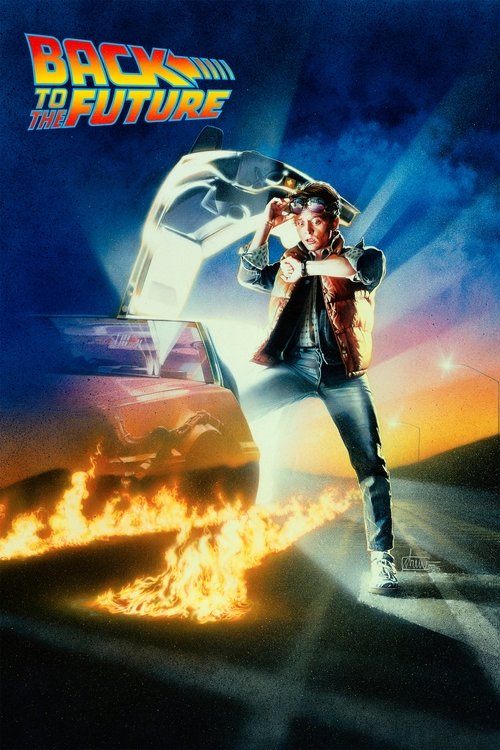
Back to the Future
1985 · Robert Zemeckis
The definitive comfort classic: family movie night, a sick day, or anytime you want guaranteed joy. Zero risk, maximum payoff.
What it's about
An eighties teenager gets accidentally stranded in 1955 by his friend Doc Brown's time machine, disrupts his own parents' first meeting, and attracts his mother's romantic attention instead. Now he has to engineer their romance and find a way back to 1985 before he's erased from the family photos.
The experience
Pure propulsion — funny, warm, and wound like a watch, with every scene paying off something you didn't realize was a setup. It's the kind of movie that makes two hours feel like twenty minutes, no matter how many times you've seen it.
Performances
Michael J. Fox — famously brought in six weeks into shooting while filming a sitcom by day — gives Marty a live-wire charm that carries the whole machine, and Christopher Lloyd's wild-eyed Doc Brown became an instant archetype.
The craft
The screenplay, rejected more than forty times before Spielberg's Amblin took it on, is still taught as the model of setup and payoff — nearly every object and line in the opening reel returns transformed. Zemeckis directs it with clockwork precision that never feels mechanical, and the score and soundtrack are stitched into the memory of a generation.
Why it matters
One of the defining blockbusters of the 1980s, it launched a beloved franchise and remains the reference point whenever anyone talks about airtight screenwriting.
The screenplay Robert Zemeckis and Bob Gale hawked around Hollywood for four years — rejected more than forty times, deemed too tame for the raunchy teen-comedy market — became, once Spielberg's Amblin took it on, the most rigorously constructed crowd-pleaser of its decade. A teenager stranded in 1955 must engineer his own parents' romance while his inventor friend works out how to send him home: a premise that lets the film be simultaneously a time-travel caper, a small-town American pastoral, and a gently Oedipal farce. Screenwriting courses still teach it as the model of setup and payoff — nearly every object and line in the opening reel returns transformed. Its production history contains one of Hollywood's great gambles: Eric Stoltz was replaced six weeks into shooting by Michael J. Fox, then filming a sitcom by day and this by night, and it is impossible now to imagine the film without his coiled, comic panic. Alan Silvestri's surging orchestral score and one gull-winged DeLorean did the rest; the clock tower alone is a masterclass in cross-cut suspense.
A Deleuzian reading
Doc Brown leans into the DeLorean and types a date into the dashboard.
The full Deleuzian reading of Back to the Future →
Reception
No reappraisal needed — it was the biggest box-office hit of 1985 and has never really left the pantheon, one of the rare blockbusters critics and audiences agreed on from day one.
How Back to the Future was received, from release to now →
Influences: the films it descends from and the films it influenced
- It's a Wonderful Life (1946) — Supplies the alternate-timeline-town template — Pottersville's nightmare version of Bedford Falls is the direct structural model for the biff-ruled 'Hell Valley,' one changed life rewriting a whole small town's face.
- The Time Machine (1960) — Establishes the time machine as a physically designed, dashboard-piloted vehicle steered by a lone inventor, with the spectacle-of-passing-time (spinning dials, blurring surroundings) that Zemeckis restages via the DeLorean's flux-capacitor readout.
- The Absent-Minded Professor (1961) — The garage-tinkerer comedy whose Flubber-inventing MacMurray is Doc Brown's ancestor: eccentric-scientist gadget mishaps staged as the film's comic engine, invention-gone-awry as set-piece.
- I Wanna Hold Your Hand (1978) — Zemeckis-Gale's debut established their method of obsessive period reconstruction of a single pop-cultural moment (Beatles 1964) with multiple ensemble lines converging on one event — the machinery reused for 1955 Hill Valley.
- Used Cars (1980) — The Zemeckis-Gale farce where every planted detail detonates later; the ruthless setup-payoff clockwork ('every gag is a Chekhov's gun') is perfected here before being applied to time-travel causality.
- Close Encounters of the Third Kind (1977) — Defines the Amblin suburban-everyman-meets-the-impossible tonal register — wonder rendered through an ordinary man's awestruck reaction shots — the emotional grammar Spielberg brought as executive producer.
- Raiders of the Lost Ark (1981) — Model for serial-cliffhanger momentum and escalating-clock set-piece construction; the clocktower-lightning climax is engineered with the same beat-by-beat kinetic pacing Spielberg codified.
- Who Framed Roger Rabbit (1988) — Zemeckis's next film extends his maniacally-timed technical-precision crowd-pleasing — where a controlled formal gimmick (toon/live compositing) serves relentlessly engineered gag timing.
- Bill & Ted's Excellent Adventure (1989) — Downstream teen-slacker time-travel caper built on a piloted vehicle-machine (the phone booth) and the same low-stakes, buddy-comedy treatment of history-as-playground.
- Groundhog Day (1993) — Inherits the setup-payoff clockwork wholesale — every replayed detail is a planted gag engineered to detonate on a later loop — applying BTTF's precision-farce architecture to a time loop.
- Donnie Darko (2001) — Reworks the teen-protagonist-plus-time-paradox-plus-1980s-suburb formula into tragedy, using predestination and self-correcting timelines with the same escalating-clock countdown structure.
- Hot Tub Time Machine (2010) — Explicit BTTF homage — a group piloting a machine back to their own 1980s past, obsessing over not disrupting the events that produce their present — the butterfly-effect causality played as R-rated farce.
- About Time (2013) — Extends the oedipal/generational thread — time-travel deployed to repair one's own family and parentage — foregrounding the father-son and courtship-of-parents anxieties BTTF turned into comic engine.
- Ready Player One (2018) — Spielberg-produced source of the DeLorean licensed-prop citation, and the home of Alan Silvestri's brass-fanfare idiom that he transplants here to cover John Williams's absence.
- Forrest Gump (1994) — Established the Zemeckis–Silvestri–Schmidt repertory and his signature method of wedding meticulous period reconstruction to the era's most advanced effects technology.
- The Man from the Future (2011) — Supplies the template the film openly runs on — time travel motored by intimate romantic/familial anxiety rather than cosmic stakes, with the comic engine of a hero maneuvering unseen through a meticulously reconstructed version of his own recent past.
- The Girl Who Leapt Through Time (2006) — Models the causal-bookkeeping of consequence-driven time travel where each jump silently rewrites the present — a mechanic the film externalizes through the depleting count-tattoo on Makoto's forearm.
- Back to the Future Part II (1989) — Part II literally re-photographs and re-lights this film's footage and inserts new performances into it, making the original's editing the physical substrate of the sequel's intercutting-into-predecessor device.
- Sing Street (2016) — Its 1955 'Enchantment Under the Sea' prom is directly pastiched by the 'Drive It Like You Stole It' gym fantasy — the wish-fulfilment production number that breaks cleanly from the film's surrounding naturalism.
- The Terminator (1984) — Same-era time-travel-causality plotting built on the bootstrap paradox — a traveler whose actions must secure his own existence — the rigorous cause-and-effect engineering BTTF plays for comedy rather than dread.
- Gremlins (1984) — Spielberg-produced Amblin piece that stages the Reagan-era small-town main street as its canvas, the idealized-then-upended suburban Americana BTTF shares as sibling product of the same shingle.
- The Goonies (1985) — Spielberg-story Amblin crowd-pleaser from the same year built on the same audience-engineering — kids/underdogs against a ticking obstacle course, momentum-over-plausibility construction.
- Peggy Sue Got Married (1986) — The melancholy inverse of BTTF's mechanics — an adult thrown into her own teenage past who must navigate courting her future spouse — the same generational-collision device played wistful instead of farcical.
- Star Trek IV: The Voyage Home (1986) — Extends the crowd-pleasing fish-out-of-water time-travel comedy — travelers baffled by an unfamiliar era mined for laughs — the same tonal pivot from SF premise to broad comedy.
- Ivan Vasilyevich Changes His Profession (1973) — Parallel time-travel comedy whose engine is a malfunctioning contraption and the fish-out-of-water gag of a present-day sensibility stranded in another era.
Similar films
- About Time (2013) — influence & lineage · same viewing thread
- The Terminator (1984) — influence & lineage · same viewing thread
- Groundhog Day (1993) — influence & lineage
- Who Framed Roger Rabbit (1988) — influence & lineage
- Back to the Future Part II (1989) — same viewing thread
- The Man from the Future (2011) — same viewing thread
- Looper (2012) — same viewing thread
- Toy Story (1995) — shared sensibility
All the films related to Back to the Future →
Watch it with: curated runs of related films
- Tampering With the Timeline — A run of films that all reach for the undo button — meddling with the past, outrunning the future, and living with the paradoxes that snap back.