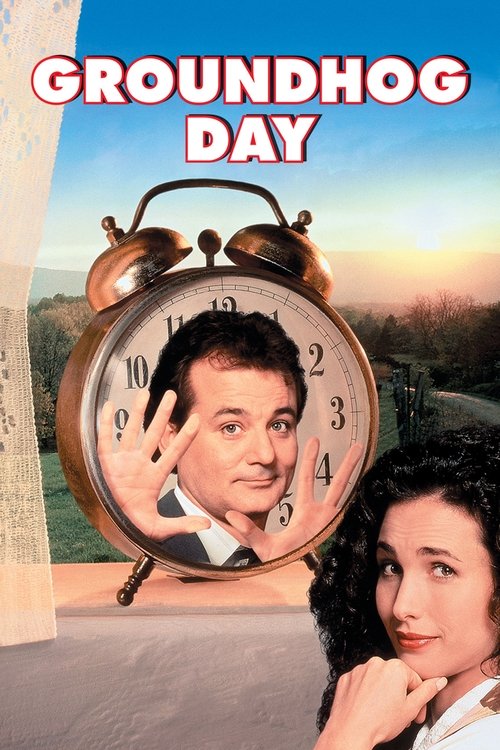
Groundhog Day
1993 · Harold Ramis
For when you want comfort viewing that still gives you something to chew on for days — the rare feel-good movie that's also quietly about how to live. Perfect for a winter night, a rewatch, or showing someone who's somehow never seen it.
What it's about
A cynical Pittsburgh weatherman is sent, resentfully, to cover the Groundhog Day festivities in tiny Punxsutawney — and wakes the next morning to find it's Groundhog Day again. And again. Trapped in a town he despises with a producer he's just starting to see clearly, he has infinite time and no consequences, and the film follows what a man actually does with that.
The experience
Endlessly rewatchable — a comedy that starts as a snarky lark, gets darker and stranger than you remember, and lands somewhere genuinely moving. It's funny the whole way through, and it sneaks real wisdom in under the jokes.
Performances
Bill Murray gives the performance of his career: the deadpan sarcasm is peak Murray, but it's the gradual, unshowy thaw underneath that makes the film land. Andie MacDowell's warmth gives him something worth changing for.
The craft
The screenplay by Danny Rubin and Harold Ramis is a marvel of structure — it never explains the loop, and it uses repetition as a comic engine, teaching you the day's rhythms so every variation pays off. Ramis directs it with such a light touch that the machinery never shows.
Why it matters
It became the template for an entire subgenre — 'a Groundhog Day situation' entered the language — and grew from hit studio comedy into a genuine modern parable, embraced by philosophers and theologians alike.
Snapshot
Groundhog Day is a studio comedy that became, almost against the intentions of its own marketing, one of the most durable philosophical parables in American cinema. Its premise is a single sentence: a Pittsburgh television weatherman, sent on an assignment he despises to Punxsutawney, Pennsylvania, wakes on February 2nd and finds that February 2nd will not end. The film never explains the loop. It offers no curse, no device, no antagonist, no scientific rationale. What it offers instead is a moral and formal experiment — a comic engine that runs on repetition and is redeemed only when its protagonist stops trying to escape and starts trying to become good at being alive.
Released by Columbia Pictures in February 1993, directed by Harold Ramis from a screenplay credited to Danny Rubin and Ramis, and starring Bill Murray, Andie MacDowell, and Chris Elliott, the film was a solid commercial success and drew warm reviews, but its stature grew steadily in the decades that followed. Its title entered English as a common noun for numbing recurrence. It has been claimed as scripture by Buddhists, Christians, psychoanalysts, Stoics, and economists; it was selected for the United States National Film Registry in 2006. Within genre history it is the founding text of what would become an entire cycle — the time-loop film — whose subsequent entries (Edge of Tomorrow, Happy Death Day, Palm Springs, Russian Doll) cite it not as an influence but as a shared grammar.
What holds the film together is a paradox of tone. It is a comedy of cruelty and despair — a man's suicides are played as a montage gag — wrapped in the softest genre packaging available, the small-town romantic comedy. That tension between the sweetness of the surface and the bleakness of the machinery is the film's real subject and the source of its long afterlife.
Industry & production
Groundhog Day emerged from the last stretch of a particular Hollywood comedy formation: the National Lampoon / Second City / Saturday Night Live pipeline that had, through the late 1970s and 1980s, supplied the studios with a durable house style. Harold Ramis was central to that formation as writer (Animal House, Meatballs, Stripes, Ghostbusters) and then director (Caddyshack, National Lampoon's Vacation, Club Paradise). Bill Murray was its most valuable performer. The two had collaborated repeatedly since Meatballs (1979), and their partnership — Ramis as the structuring intelligence, Murray as the destabilizing one — had produced much of the era's most commercially reliable comedy.
The screenplay originated with Danny Rubin, then a relatively unestablished writer. Rubin's spec script circulated and drew interest, and the project came to Ramis, who worked substantially on the material with Rubin before production. Rubin has since discussed his original conception at length — including in his book on the script's development — and the well-attested broad outline is that Rubin's version was structurally bolder and darker in places, beginning deeper into the loop, while the produced film front-loads a conventional setup so the audience meets Phil Connors before the trap closes. The finished screenplay is credited to Rubin and Ramis; Rubin received sole story credit.
Production was based in Woodstock, Illinois, standing in for Punxsutawney, with additional Pennsylvania-set exteriors handled there and the square dressed to serve as the town's civic center. The choice was practical — Woodstock's intact town square offered a repeatable, controllable set of geographies — and it turned out to be a decisive one aesthetically. A time-loop film requires an environment the audience can memorize. The square, the bed-and-breakfast, the diner, the insurance man's corner, the puddle, the alley: these become a mental map, and the film's comedy depends on the viewer knowing that map as well as Phil does.
The most persistently discussed production fact is the deterioration of the Ramis–Murray relationship during the shoot. Both men, and multiple collaborators, acknowledged in later interviews that the making of the film was difficult and that the two did not speak for many years afterward; the widely reported account is that the friction concerned the film's tone, with Murray pressing for a more austere, philosophically weighted picture and Ramis holding to a broader comic register. They reconciled shortly before Ramis's death in 2014. The specific texture of the disagreement is documented mostly through retrospective interviews rather than contemporaneous record, and it should be treated as such — but the fact of the rupture is not in dispute, and it is worth noting that the finished film contains, unresolved, exactly the tension the two men were arguing about.
The picture was a commercial success on release and performed strongly in subsequent home-video and television life, where its structure — endlessly re-enterable, legible from any point — made it a cable perennial. That afterlife on television arguably did more for its canonization than its theatrical run.
Technology
Technologically, Groundhog Day is deliberately unremarkable, and this is a substantive artistic decision rather than a limitation. Made at the exact moment when digital effects were being announced as the future of American cinema — Terminator 2 was two years old, Jurassic Park would open four months later — the film contains essentially no effects work in the modern sense. The most fantastic event in the story, the loop itself, is rendered entirely by editing, sound, and set dressing.
Its one recurring "effect" is a clock radio flipping to 6:00 and playing Sonny & Cher's "I Got You Babe." That is the whole apparatus. The film's supernatural premise is enforced by continuity and repetition — the same coverage, the same blocking, the same alarm — which places the burden on production design, script supervision, and cutting rather than on optical or digital intervention.
This anti-technological posture matters historically. Groundhog Day demonstrates that a high-concept fantasy premise can be executed with the toolkit of a 1950s romantic comedy, and that the audience will accept an unexplained metaphysical rupture provided the rules are administered consistently. The film's technical demands were, in practice, logistical: matching props, wardrobe, weather, snow continuity, and crowd blocking across dozens of near-identical setups so that intentional variations register as meaningful rather than as errors.
Technique
Cinematography
John Bailey shot the film. Bailey's résumé — American Gigolo, Ordinary People, The Big Chill, Mishima, and later In the Line of Fire — is notably weighted toward dramatic and stylized work rather than broad comedy, and his presence here is legible in the image. The film is lit and composed with more restraint and more atmosphere than the era's studio comedies generally received: cold blue-gray winter exteriors, warm practical-driven interiors in the bed-and-breakfast and diner, a palette that reads as small-town Pennsylvania in February rather than as comedy-bright.
The governing formal strategy is repetition with controlled variation. Recurring beats — the alarm clock, the stairs, the encounter with Ned Ryerson, the puddle — are often returned to with familiar framing, so the audience recognizes the setup instantly and the film can then vary one element: Phil's line reading, his route, his posture, whether he steps around the puddle. Because the frame is stable, small changes read loudly. This is a comic engine built out of camera discipline; it works because the cinematography refuses to editorialize.
Bailey's other significant contribution is the film's handling of Phil's psychological arc through light and weather. The early loops are shot with a certain flat competence appropriate to a man executing a hated assignment; the despair sequences are colder and emptier; the final day, once Phil has become genuinely useful to the town, is warmer and more populated, and the eventual arrival of snowfall as a chosen rather than imposed condition is given real visual weight. The change is gradual enough that most viewers experience it as tonal rather than photographic.
Editing
Editing is where Groundhog Day does its most inventive work, and the credit belongs to Pembroke J. Herring. The film has to solve a problem no conventional comedy faces: how to depict an indeterminate span of subjective time — plausibly years, possibly far longer — inside a hundred-minute running time, without the audience losing track of where Phil is in his development.
The solution is a shifting compression ratio. Early loops are given nearly in full, so the audience learns the day's geography and rhythm. Once the map is established, the film moves to elision: a loop may be one shot, or one line, or simply a cut back to the alarm clock. Montage sequences handle the largest spans — the seduction attempts, the suicides, the piano lessons, the ice sculpting — each compressing dozens or hundreds of iterations into a few seconds. Crucially, the film varies how much it shows according to what phase Phil is in, so the pacing itself communicates his psychology: dense and grinding during the hedonism, staccato and brutal during the despair, fluid and almost musical during the mastery phase.
The alarm-clock cut becomes the film's punctuation mark, functioning something like a chapter break, a joke, and a death knell simultaneously. Its meaning inverts across the film: first an irritation, then a horror, finally — in the last reel — a genuine question the audience wants answered.
Mise-en-scène / staging
The film's staging is organized around a fixed inventory of places and people. Punxsutawney as presented is small enough to be held entirely in the mind: the boarding house staircase, the bathroom, the sidewalk, Ned's corner, the diner, the Gobbler's Knob ceremony site, the alley, the bowling alley bar, the church basement dance. Each is introduced early and then returned to under altered conditions.
The design logic is accumulation. A minor figure glimpsed in an early loop — an old man on the sidewalk, a boy falling from a tree, a man choking in a restaurant — is later revealed to have been present all along, which retroactively converts background dressing into moral obligation. This is the film's most elegant structural idea: the world does not change, only Phil's attention to it. The staging makes attention itself visible.
Production design and the town square's fixed geography also enable the film's spatial comedy. Phil's mastery is demonstrated through movement: by the final act he crosses the town on a timetable, arriving at each emergency at the required second. The sequence works because the audience has been taught the map well enough to feel the choreography.
Sound
The sound design carries the film's supernatural premise almost single-handedly. "I Got You Babe" on the clock radio, followed by the same DJ patter, is the mechanism by which the loop is announced; the audience learns to dread a pop song. The repetition of an identical audio cue against slightly varied images is the film's most economical fusion of comedy and horror.
George Fenton's score is comparatively restrained for a 1990s studio comedy, avoiding wall-to-wall jauntiness and giving the despair sequences room to sit. The needle-drops are used structurally rather than decoratively — Sonny & Cher as the loop's signature, and Delbert McClinton's "Weather Man" among the diegetic-feeling selections that root the film in a specific pop-cultural small-town register. The final morning's variation in the radio audio is the film's payoff, delivered in sound before it is delivered in image.
Performance
Bill Murray's performance is the film's central technical achievement and one of the defining pieces of screen acting of the 1990s. The role requires a single character to pass through contempt, disbelief, opportunism, hedonism, predation, despair, suicidal exhaustion, resignation, curiosity, competence, and finally something like grace — while remaining recognizably one man and while remaining funny.
Murray plays it by keeping the same instrument and changing only the pressure. The sardonic detachment that made him a star is present in the first scene and the last; what alters is what it is pointed at. In the early loops the irony is a weapon; by the end it has become a form of gentleness. Murray also does something unusual for a comic lead: he permits Phil to be genuinely unpleasant — the manipulation of Rita, the exploitation of the town — without cushioning it, which is what makes the final act legible as change rather than as reward.
Andie MacDowell's Rita has the harder and less appreciated task. She must be a real person while functioning as the film's moral measure, and she plays most of her scenes as if for the first time, because for her they are. MacDowell's warmth grounds the film's thesis that Phil's transformation cannot be performed or faked — Rita catches every false note, and the film requires an actor whose sincerity makes that credible.
Chris Elliott's Larry supplies a sardonic counterweight that keeps the film from tipping into sentiment. Stephen Tobolowsky's Ned Ryerson is a small-part masterclass: an insurance salesman deployed as recurring assault, whose eventual absorption into Phil's affections marks the moral turn as clearly as any line of dialogue.
Narrative & dramatic mode
Groundhog Day belongs to a rare narrative category: the film whose structure is its argument. It uses repetition not as a device within a story but as the story's fundamental grammar, which places it alongside works like Rashomon or Last Year at Marienbad in formal ambition while operating in a wholly commercial register.
The dramatic mode is closest to the moral fable, or to what an older criticism would call an exemplum. Phil moves through recognizable stages, and the film's structure is essentially a stations-of-the-cross progression: denial, experimentation, hedonism, seduction, despair, and finally disinterested service. It is worth noting that the film does not present the last stage as a solution Phil discovers in order to escape. Escape comes only after he stops seeking it — the loop breaks when he has ceased to treat the day as a problem. This is the film's most philosophically serious move and the reason it resists reduction to self-help.
Structurally, the film also solves an unusually difficult problem of information management. The audience must remain oriented across an unknown number of iterations. The film handles this by making Phil's knowledge the visible index of elapsed time: what he knows about Rita, the townspeople, the piano, French poetry, the falling boy. Time is measured in competence.
The romantic-comedy scaffolding is real but subordinate. Rita is less a romantic object than a criterion — the one person who cannot be gamed. The film's romance plot is therefore structurally identical to its moral plot, which is why the ending lands: winning Rita and becoming a decent person are, by construction, the same achievement.
Genre & cycle
At release, Groundhog Day was positioned as a high-concept romantic comedy, and it functions as one. But its genre position is genuinely hybrid: fantasy premise, romantic-comedy plot, small-town Americana setting, and a substantial current of existential horror that the film never fully domesticates.
It sits within a lineage of American fantasy-moral comedies — It's a Wonderful Life is the most-cited ancestor, along with A Christmas Carol adaptations and the "second chance" pictures of the 1940s. It also draws on the Twilight Zone tradition of the unexplained premise administered with rigorous internal logic, a debt the film's own writing has been openly associated with.
Its more important genre role is generative. Before 1993, time loops existed in prose science fiction and in television, but there was no established cinematic form. Groundhog Day created one, and did so completely enough that later films inherit not just the premise but the rule-set: the loop is unexplained, the protagonist retains memory, physical resets are total, the reset trigger is fixed, mastery accumulates, and escape is conditional on internal rather than external change. Subsequent entries largely define themselves by which of these rules they break.
Authorship & method
Harold Ramis's authorship is best understood as structural rather than visual. Across his career he specialized in taking an anarchic comic energy — Murray's, chiefly — and building a frame sturdy enough to hold it. Groundhog Day is the fullest expression of that method: an extremely disciplined architecture wrapped around a performance that is permitted considerable freedom inside it. Ramis's direction is unshowy to the point of self-effacement, and the film's reputation has, over time, made a virtue of that restraint. He was also a serious reader in comparative religion and philosophy, and he spoke in later interviews about the film's reception among religious communities with evident interest; the film's moral seriousness is not accidental to his sensibility.
Danny Rubin's contribution is the conceptual architecture — the loop, the refusal to explain it, and the insight that the interesting question is not how to escape but what to do. Rubin has written and taught extensively about the script since, and it is one of the more thoroughly documented screenplays of its era from the writer's side.
John Bailey's cinematography supplies the atmospheric ballast that keeps the film from playing as sketch comedy. Pembroke J. Herring's editing supplies the temporal engine. George Fenton's score supplies restraint. Production design and the Woodstock location supply the memorizable world.
The collaboration that defines the film, however, is Ramis–Murray, and its documented breakdown is inseparable from the result. The finished picture holds a comic register and a genuinely bleak one in unresolved suspension — which is precisely the argument the two were having. Attributing specific scenes to that conflict would be speculation; the record supports the general characterization and not much more.
Movement / national cinema
The film belongs to no movement in the art-historical sense. It is a mainstream American studio production, and its national-cinema significance lies in its relationship to a specific American comic institution: the Chicago improvisational tradition (Second City) as it flowed through Saturday Night Live and National Lampoon into Hollywood from the late 1970s onward. Ramis, Murray, and Elliott are all products of that ecology in one form or another.
Its Americanness is also substantive at the level of setting. The film is set in a real Pennsylvania town during a real folk ritual — a genuinely eccentric piece of American vernacular culture — and treats that ritual with a blend of condescension and eventual affection that mirrors Phil's own arc. The small-town square, the church basement dance, the bachelor auction, the local news apparatus: these are specific to a mid-century American self-image that the film both mocks and, finally, endorses.
Era / period
Groundhog Day arrives at a hinge in Hollywood history. The comedy formation that produced it was ending; Ramis and Murray would both move, over the following decade, toward more melancholic and more idiosyncratic work — Murray most conspicuously, in the run through Rushmore and Lost in Translation that reframed him as a dramatic actor. Retrospectively, Groundhog Day looks like the pivot: the film where Murray's detachment stopped being purely a comic weapon and became a subject.
It also sits at the end of the pre-digital studio picture and just before the internet era that would make it a canonical text. The film's rise in stature tracks closely with the rise of online film discussion, cable repetition, and the recommendation cultures of the 2000s — environments in which a film that rewards re-viewing and invites interpretive argument thrives. Its appeal to religious and philosophical readers, which became a minor cottage industry of essays and sermons, is a genuinely unusual reception history for a studio comedy.
Contextually, the early 1990s American mainstream was hospitable to fantasy premises played straight in ordinary settings, and the film's success helped confirm that a metaphysical conceit needed no explanation to satisfy a mass audience.
Themes
Repetition and meaning. The film's central question is what makes a day worth living when consequence has been removed. It arrives at an answer that is neither hedonistic nor stoic exactly: meaning is generated by attention and by usefulness to others, and it survives the removal of permanence.
The refusal of the reward structure. Phil's transformation only completes when he stops instrumentalizing it. Every attempt to be good in order to escape fails; the escape follows only from goodness pursued for its own sake. This is why the film has been claimed simultaneously by Buddhist readers (the loop as samsara, escape via the extinction of craving), Christian readers (grace unearned by works performed for reward), and Aristotelian and Stoic readers (virtue as habituated practice). The film accommodates all these readings without endorsing any, in part because it never explains the loop.
Mastery and time. Phil's acquisitions — piano, French, ice sculpting, medicine — dramatize the mundane truth that skill requires duration. The film gives him the one resource no one has, and shows him doing with it what any of us might, badly, and then well.
Attention as ethics. The film's most quietly radical claim is that the townspeople were always there, always in need, always interesting; only Phil's contempt made them scenery. His redemption consists precisely in noticing.
Mortality. The homeless man's death is the film's hardest sequence and the one that keeps it from sentimentality. Phil, having mastered the day, cannot save him. The film insists that some things are not fixable by competence, and it does not resolve this.
Authenticity and its impossibility to fake. Rita's function as the film's lie detector encodes an argument about character: performance can be perfected across infinite attempts, but sincerity cannot be simulated to someone paying attention.
Reception, canon & influence
Critical reception on release was broadly positive, with reviewers noting the ingenuity of the premise and the quality of Murray's performance; the film was well liked rather than heralded, and its initial critical framing treated it as an unusually smart mainstream comedy rather than as a major work. Its reputation grew substantially over the following two decades — through television repetition, home video, and a sustained secondary literature of philosophical and theological commentary. It was selected for the National Film Registry by the Library of Congress in 2006, an unusually rapid canonization for a comedy of its era.
Influences on the film (backward). The clearest ancestors are the American moral-fantasy tradition — A Christmas Carol and its descendants, It's a Wonderful Life — in which a protagonist is granted a supernatural intervention that forces moral reassessment. The Twilight Zone tradition supplies the unexplained-premise-with-strict-rules methodology. Prose science fiction had explored time loops well before 1993, and the concept was not novel; what was novel was the decision to treat it as a comedy of character rather than as a puzzle to be solved. Behind all of it sits the Second City / SNL comic idiom that shaped Ramis's and Murray's instincts, and the screwball tradition's model of romance as adversarial verbal contest, which the Phil–Rita scenes repeatedly invoke.
Legacy (forward). Groundhog Day's influence operates on three levels.
At the level of language, the title became an ordinary English idiom for repetitive futility, used routinely in political, military, and workplace contexts by speakers with no particular film literacy. Very few films have entered the general vocabulary this completely.
At the level of genre, it founded the cinematic time loop as a form. Edge of Tomorrow (2014) applies the structure to military science fiction and makes the accumulation-of-mastery theme literal; Happy Death Day (2017) applies it to slasher horror; Palm Springs (2020) adds a second looper and shifts the question from redemption to companionship; Russian Doll (2019) extends it into serial television and interlocks two loops; Boss Level, The Map of Tiny Perfect Things, and many others follow. The pattern is consistent: these works assume the audience already knows the rules, which is the strongest possible evidence of a founding text. Video game design, where death-and-retry is native, absorbed the structure so thoroughly that the film is frequently invoked as a reference point for roguelike and retry-loop design.
At the level of interpretation, the film generated a body of commentary disproportionate to its origins as a studio comedy — essays, sermons, philosophy-course syllabi, and religious readings across multiple traditions. Ramis himself remarked on the diversity of communities claiming it. A stage musical adaptation with music and lyrics by Tim Minchin and a book by Danny Rubin, directed by Matthew Warchus, premiered in London in 2016 and reached Broadway in 2017, returning the material to its author two decades on.
Its deepest influence may be tonal. Groundhog Day demonstrated that a mainstream comedy could contain genuine despair — suicide played for laughs, a death that cannot be prevented, an unexplained cosmology — without breaking, and that audiences would follow. The strain of American comedy that runs through Rushmore, Eternal Sunshine of the Spotless Mind, and the later Murray filmography operates in the space this film proved was habitable.
Reception
A hit comedy in 1993 that critics liked but nobody called profound — then philosophers, Buddhists, and theologians spent the next two decades claiming it, and by its National Film Registry induction in 2006 it had quietly become one of the most respected American comedies ever made.
How Groundhog Day was received, from release to now →
How to watch Groundhog Day: what to notice on a first viewing
- Listen for the clock radio hitting 6:00 and the same DJ patter. Sonny & Cher and the identical morning chatter announce every reset. The image varies; the audio cue does not. You learn to dread a pop song. Sound, not effects, carries the whole supernatural premise, and it turns a cheerful hit into an alarm bell.
- Watch whether Phil steps around the puddle each time he passes. Bailey returns to recurring beats with the same framing, so the only thing that shifts is Murray: his route, his posture, his line reading. The stable frame makes tiny changes read loudly. The camera refuses to comment, which is exactly why you can measure Phil's change down to a single footstep.
- Notice the cold blue-gray streets against the warm lamplight indoors. Bailey lights Punxsutawney like February in Pennsylvania, not like a studio comedy. Interiors run on warm practical sources, exteriors stay drained. The balance shifts across the film. The photography quietly tracks Phil's mood, so you feel the arc as weather before you name it as change.
- Watch the people in the background of the town square. An old man on the sidewalk, a boy in a tree, a man at a restaurant table. Ramis plants them early as scenery and lets them sit there, unhelped, loop after loop. The town never changes. Only Phil's noticing does, and the staging makes noticing something you can literally see.
- Notice Murray's voice: same dry delivery, different pressure each loop. Murray keeps one instrument from first scene to last. The sardonic tone that starts as a weapon against the assignment slowly gets pointed somewhere else. Because the manner never softens artificially, the change reads as a man actually changing rather than a script rewarding him.
The whole guide to watching Groundhog Day, with the keys for a rewatch →
Influences: the films it descends from and the films it influenced
- Scrooge (A Christmas Carol) (1951) — Supplies the moral-audit architecture Rubin and Ramis rebuilt as a loop: the same social scenes are re-staged with the protagonist demoted from participant to spectator, so character change is measured against a fixed, memorized tableau rather than narrated.
- It's a Wonderful Life (1946) — Establishes the fixed-town-geography method Punxsutawney inherits — a small set of named streets, storefronts and recurring bit players drilled into the audience early so that later alterations to that geography read instantly as moral information.
- His Girl Friday (1940) — The screwball model of courtship as adversarial overlapping-dialogue contest, which the Phil–Rita diner and bar scenes replay verbatim across loops — Murray's rewriting of his own lines between takes is a repetition device only legible because the screwball tempo makes each variant land as a new attempt.
- Rashomon (1950) — Codifies repetition-with-variation as an editing and blocking discipline: identical camera setups and entrance marks are reused so the audience reads the delta in performance rather than plot, exactly the grammar John Bailey uses for the recurring alarm-clock, staircase and puddle beats.
- Je t'aime, je t'aime (1968) — The prior art for re-entering one fixed minute at variable durations — Resnais cuts the same interval at wildly different lengths as the mechanism degrades, which is the variable-compression-ratio principle Ramis later scales from full days to two-second gags.
- Caddyshack (1980) — Ramis's first demonstration of his core method — a rigid location-bound comic frame (one country club, fixed cast positions) built specifically to license Murray's unscripted monologue without the film losing shape.
- Ghostbusters (1984) — The Ramis-scripted rule that a supernatural premise is stated once, obeyed absolutely, and never explained; it also fixes Murray's deadpan-sarcasm-as-protagonist register, the ironic distance Groundhog Day spends two acts dismantling.
- Back to the Future (1985) — The accumulative-background-detail technique — the same town square dressed in successive states, with signage, extras and props altered so returning viewers can index change — is Hill Valley's method applied by Ramis to a single square block across a single day.
- Eternal Sunshine of the Spotless Mind (2004) — Inherits the tonal permission slip: a broad comic star cast against type inside an unexplained metaphysical premise with strict internal rules and no cosmology offered, where the same relationship is replayed in variant states and repaired by attention rather than by solving the mechanism.
- Source Code (2011) — Adopts the post-Groundhog assumption that no rule exposition is needed — the eight-minute reset is running before it's explained — and reuses the fixed-set inventory method, mapping one train carriage's passengers as the loop's searchable object grid.
- Edge of Tomorrow (2014) — Lifts the variable-compression-ratio edit wholesale: early loops play at full length, mid-film loops collapse into a rapid montage of failures cut on repeated sound cues, and late loops are elided entirely — the piano-lesson and card-flip montage structure transposed to combat mastery.
- Happy Death Day (2017) — Ports the structure to slasher by reusing the diegetic-alarm motif as its reset stinger (the birthday-song ringtone standing in for 'I Got You Babe') and converting the moral-transformation arc into a whodunnit checklist of suspects on a fixed campus map.
- Timecrimes (2007) — Proves the loop is a production-design economy rather than an effects problem — a single house, hill and lab shot practically, with continuity between iterations enforced by wardrobe and prop damage exactly as Ramis enforced it with weather, coats and the pothole.
- Russian Doll (2019) — Serializes the form and doubles it: two loopers whose deaths interlock, with the bathroom-door reset and Harry Nilsson's 'Gotta Get Up' functioning as the diegetic alarm cue, and decaying background objects (fruit, mirrors, people) used as the loop's accumulative ledger.
- Palm Springs (2020) — Argues directly with the seed's thesis by adding a second looper mid-film, which converts the solitary self-improvement montage into a two-hander and shifts the exit condition from moral worthiness to mutual choice.
- The Map of Tiny Perfect Things (2021) — Takes the seed's accumulative-background-detail staging as its entire subject — the loop is spent cataloging and choreographing incidental town events into a curated sequence, the ambulance-catch and falling-boy beats expanded into the film's central formal project.
- Dream Scenario (2023) — Metaphysical-comedy architecture in which an unexplained supernatural rule reshapes an ordinary man's social standing through an escalating-vignette rhythm.
- Liar Liar (1997) — The model comedy-of-constraint: a self-centered man imprisoned by a single supernatural rule whose airtight mechanical logic forces moral growth — Liar Liar's exact narrative engine.
- About Time (2013) — Domesticates a fantastical time conceit into a moral-growth engine — a day (or moment) replayed to rehearse and perfect an emotional beat — and refuses to explain its rules, exactly the mechanism-agnostic approach About Time adopts.
- The Man from the Future (2011) — Codifies the do-over romantic fantasy in which a protagonist repeatedly re-confronts a fixed slice of the past to earn moral growth and win the woman, prioritizing character redemption over time-mechanics.
- Run Lola Run (1998) — Three passes over an identical twenty-minute route, with micro-changes in Lola's timing rippling into wholly different outcomes for background figures — the same 'butterfly bookkeeping' Ramis runs on the Punxsutawney bit players, staged as kinetic thriller rather than comedy.
- Rushmore (1998) — Extends the depressive Murray unlocked here — the flattened affect, the suicide gag played straight, the comedian used as a repository of unspoken grief — into a register that becomes the actor's second career.
- Defending Your Life (1991) — Metaphysical comedy that never explains its mechanism — the cosmology is asserted once and played dead straight, so release arrives from a single changed act rather than from an unveiling.
Similar films
- Palm Springs (2020) — influence & lineage
- Rushmore (1998) — influence & lineage
- Back to the Future (1985) — influence & lineage
- Ghostbusters (1984) — influence & lineage
- It's a Wonderful Life (1946) — influence & lineage · same viewing thread
- The Graduate (1967) — often watched together
- The Truman Show (1998) — shared sensibility
- It's Such a Beautiful Day (2012) — shared sensibility
All the films related to Groundhog Day →
Watch it with: curated runs of related films
- Grace in the Dead of Winter — A run of cold-season films where a lonely or cynical soul, snowbound and nearly out of hope, stumbles into connection — watch them across one dark week.