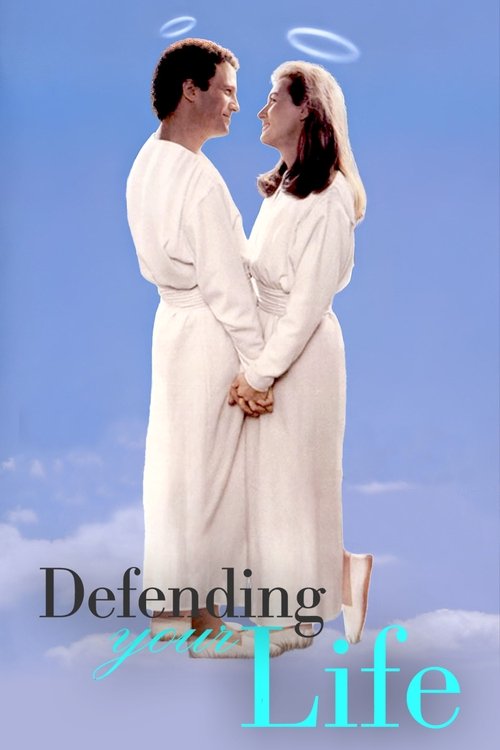
Defending Your Life
1991 · Albert Brooks
For a cozy night when you want a comedy with an actual soul — something that makes you laugh about death and then makes you want to be braver on Monday. Comfort viewing that sneaks in a life audit.
What it's about
An anxious Los Angeles advertising executive dies suddenly and wakes up in Judgment City, a pleasant, climate-controlled way station where the newly dead must stand trial — not for their sins, but for their fear. Over several days, a defender and a prosecutor screen episodes from his life on courtroom monitors, arguing over whether he ever acted with real courage. Between sessions he falls for Julia, a warm, unguarded woman whose case is going conspicuously better than his.
The experience
Gentle, funny, and quietly devastating in the way only a comedy about your own worst habits can be — it plays like a hangout movie in the afterlife, all-you-can-eat buffets and hotel rooms, while slipping in the question of whether you've actually been brave with your one life. You laugh the whole way through and then find it sitting with you for days.
Performances
Albert Brooks is the definitive version of his own neurotic everyman, and Meryl Streep is so relaxed and radiant as Julia that the romance feels effortless; Rip Torn is a riot as Daniel's booming, carnivorously confident defense attorney.
The craft
Brooks writes and directs with a satirist's precision, imagining the afterlife as a mid-tier corporate campus — tram tours, comedy clubs, performance reviews — and mining every detail for laughs. The courtroom device, replaying moments of the hero's life as evidence, gives the comedy a structure that keeps tightening. It's a film built on writing and timing rather than spectacle, and every joke lands where it's aimed.
Why it matters
Widely considered Albert Brooks's masterpiece and one of the great American comedies about self-sabotage, its vision of the afterlife as a bureaucratic resort has been borrowed by decades of high-concept comedy since. It's the film people cite when they argue Brooks belongs alongside the major American comic filmmakers.
Snapshot
Albert Brooks's fourth feature takes the oldest question in the fantasy-romance repertoire — is there love after death? — and answers it with a performance review. Daniel Miller, a Los Angeles advertising executive, dies on his birthday in a head-on collision with a bus, distracted by compact discs he has dropped in his new BMW. He wakes in Judgment City, a climate-controlled way station where the recently dead are housed in mid-range hotels, fed unlimited food without consequence, and then tried. The charge is not sin. It is fear. Over several days a defender and a prosecutor screen episodes from Daniel's life on courtroom monitors and argue about whether he ever acted without flinching. Meanwhile he falls for Julia, a woman whose case is going conspicuously better than his.
The film's radical move is tonal rather than metaphysical: it renders eternity as a competently run conference resort and treats cosmic advancement as a promotion track. What results is one of the most precise American comedies about self-doubt ever made, and the closest Brooks ever came to a genuinely romantic picture.
Industry & production
Defending Your Life was produced by Geffen Pictures — David Geffen's company, then operating under a distribution arrangement with Warner Bros., which released the film in the spring of 1991. Geffen's slate in this period ran to idiosyncratic, director-led studio pictures (Beetlejuice, Little Shop of Horrors, Men Don't Leave), and Brooks fit that profile precisely: a filmmaker with critical prestige, a devoted following, and no history of large grosses. Michael Grillo, whose production experience ran through Lawrence Kasdan's films, produced.
Brooks wrote the screenplay alone — a departure from the pattern of his earlier features, which he had co-written with Monica Johnson. He directed and took the lead role, as he had on every film since Real Life (1979). The budget was substantial by his standards but modest by 1991 studio norms; the picture's costliest requirement was not effects but architecture, since Judgment City had to look like a real place run by real administrators rather than a special-effects heaven.
Commercially the film performed respectably without breaking out, which had been true of Brooks's work throughout the 1980s and remained the shape of his career: consistent critical standing, a cult that renewed itself with each home-video format, and grosses that never justified more frequent production. The detailed record of the shoot — schedules, location specifics, the internal history of the Geffen–Warner relationship on this title — is comparatively thin in the published literature, and claims about it should be treated cautiously.
Technology
The film's most quietly contemporary idea is that the afterlife runs on video. Daniel's life is not weighed by an omniscient intelligence; it is played back on screens, cued and paused by attorneys, argued over as footage. In 1991 this was an idea with immediate cultural traction: the camcorder had domesticated the moving image, VHS had made rewatching ordinary, and the courtroom video exhibit was about to become a national fixture. Brooks turns the surveillance premise into a joke about self-consciousness — the horror is not that you were watched, but that the tape is unflattering and the edit is not yours.
Otherwise the picture is deliberately effects-light. Judgment City is achieved through production design, location architecture, and lighting rather than optical work; there are no clouds, no gates, no ascending figures. The one showpiece, the Past Lives Pavilion — where visitors view their previous incarnations in individual booths, hosted by Shirley MacLaine as herself — is staged as a theme-park attraction, an EPCOT-grade interactive exhibit. That is the film's technological argument in miniature: the infinite has been productized, and it comes with a docent.
Technique
Cinematography
Allen Daviau shot the film, bringing the warm, generous, high-key sensibility he had developed with Spielberg on E.T. and Empire of the Sun. The choice is a joke played straight. Judgment City is bright, even, and shadowless — an anti-noir afterlife, lit like a hotel brochure or a pharmaceutical advertisement. Nothing lurks. The light offers no mystery to hide in, which is exactly Daniel's problem: he is a man who has spent a lifetime managing impressions, dropped into a place with no dark corners.
The Earth material recovered on the courtroom monitors is handled more plainly, in the flatter register of ordinary domestic and office life, so the flashbacks feel like evidence rather than memory — unglamorized, close to the drab truth. Daviau's coverage of the trial itself is conventional courtroom grammar, and the conventionality is load-bearing: the more procedurally normal the framing, the funnier the metaphysical stakes.
Editing
David Finfer's cutting serves Brooks's fundamental comic rhythm, which is patience. Brooks builds humiliation in long units and resists rescuing a scene early; the laugh usually arrives a beat after the audience expects release. The trial structure gives the film an unusual engine — a series of self-contained vignettes from Daniel's life, each essentially a short sketch, framed and interrupted by legal commentary. This lets Brooks fold his stand-up and short-film instincts into a feature without the picture disintegrating into revue. The cutaways to the impassive judges and to Rip Torn's serenely confident defender do the work of a laugh track without ever conceding one.
Mise-en-scène / staging
Ida Random's production design is the film's central invention and its sharpest satirical instrument. Judgment City is rendered as a corporate conference town: atria with potted ficus, tram service, pastel and beige interiors, restaurants with unlimited portions, comedy clubs with bad comedians. Accommodation is stratified by merit — Julia's hotel is visibly nicer than Daniel's — so the afterlife arrives pre-equipped with class anxiety. The dead wear loose, shapeless robes that flatten everyone into the same undistinguished silhouette, a costume choice that strips Brooks's character of the one register he is fluent in: presentation.
Staging in the courtroom is intimate and small-scale, more arbitration hearing than tribunal. Nobody raises their voice. The universe, it turns out, is administered by professionals who are polite to you.
Sound
Michael Gore — a composer out of Fame and Terms of Endearment — scores the film with unembarrassed orchestral romanticism. Crucially, the music never winks. It plays the Daniel–Julia romance as a real love story, supplying the sincerity that Brooks's dialogue keeps deflecting, and it is this counterweight that lets the final act land as feeling rather than gag. The sound design of Judgment City is similarly deadpan: ambient hum, tram chimes, the tonal neutrality of institutional space.
Performance
Brooks plays Daniel in his established key — verbal, defended, quick to negotiate, incapable of stillness. The performance's precision lies in how little it pleads; Daniel's self-pity is dry rather than wet. Meryl Streep's Julia is the film's other pole: open, unguarded, amused, entirely without strategy. Streep, working in a period when she was actively pursuing comedy after She-Devil and Postcards from the Edge, plays warmth as a form of competence, and the asymmetry between her ease and Brooks's tension supplies the romance with its structure.
Rip Torn, as defender Bob Diamond, gives one of the great supporting turns in American comedy — a man whose absolute serenity is itself the joke, explaining that the living use only about three percent of their brains while he operates at many times that. The performance sits immediately before Torn's career-defining run as Artie on The Larry Sanders Show, and shares its DNA. Lee Grant prosecutes with brisk professional courtesy, which is more devastating than hostility. Buck Henry appears as another defender — a piece of casting that quietly salutes his authorship of the 1978 Heaven Can Wait, one of the film's direct forebears.
Narrative & dramatic mode
The film fuses two structures that ordinarily repel each other: the courtroom procedural and the romantic comedy. The trial provides retrospective narrative — a life reviewed as exhibits — while the romance provides forward motion in the present tense. The device is elegant because the two plots test the same proposition. Everything the trial says Daniel failed to do, the romance offers him a chance to do now.
Dramatically the mode is comedy of embarrassment rather than farce. There is no misunderstanding to be resolved, no obstacle to be outwitted; the antagonist is a temperament. Brooks withholds the conventional catharsis until the last possible moment, and then delivers it physically rather than verbally — Daniel abandoning his tram, in traffic, to reach Julia's. It is the first thing he does in the film without calculating the cost, and the judges reverse on the evidence of the act itself. The film's dramaturgy insists that courage cannot be argued, only demonstrated.
Genre & cycle
Defending Your Life arrives in the middle of a distinct turn-of-the-decade cycle of afterlife romances and metaphysical fantasies: Chances Are (1989), Always (1989), Ghost (1990), Truly Madly Deeply (1990), with Alan Rudolph's Made in Heaven (1987) just upstream. Where those films use the beyond to sustain love against death, Brooks uses it to audit a life. He belongs to the cycle by premise and stands outside it by tone.
The deeper generic lineage is the celestial-bureaucracy comedy: Outward Bound (1930), Here Comes Mr. Jordan (1941), Lubitsch's Heaven Can Wait (1943), Powell and Pressburger's A Matter of Life and Death (1946) with its heavenly tribunal and cross-boundary romance, and Warren Beatty and Buck Henry's 1978 Heaven Can Wait. Brooks's innovation is to update the celestial civil service from an Edwardian ministry to a late-eighties business park, and to substitute an American therapeutic vocabulary — fear, growth, potential — for moral accounting.
Authorship & method
Brooks is the central American example of a comic auteur who works from persona rather than around it. The son of the radio comedian Harry Einstein, he came up through stand-up and television, and made six short films for the first season of Saturday Night Live in 1975–76 — formally inventive pieces that established his interest in the apparatus of media itself. His features arrive at long intervals: Real Life (1979), a mockumentary that anticipated reality television by two decades; Modern Romance (1981); Lost in America (1985), the definitive satire of yuppie self-liberation; then Defending Your Life. Each proceeds from a single conceptual premise that traps the Brooks character inside a system he cannot talk his way out of.
His method is writerly and controlled rather than improvisational — the scripts are tight, the concepts fully worked before shooting — and his collaborators here are notably conventional choices deployed against type. Daviau's luminous humanism, Gore's sincere romantic scoring, Random's immaculate corporate design: none of them signal comedy. Brooks makes his films funny by surrounding an anxious man with total professionalism. Writing solo on this picture, without Monica Johnson, he produced his warmest screenplay; the corrosiveness is still there, but for the first time it is directed at fear rather than at vanity, and the ending grants a mercy his earlier films withhold.
Movement / national cinema
The film belongs to the American tradition of the writer-director-star comedian — Chaplin, Keaton, Jerry Lewis, Elaine May, Woody Allen — working inside, but not quite of, the studio system. Brooks's nearest kin is May, whose A New Leaf and Mikey and Nicky share his taste for comedy that refuses to make its protagonist likable on schedule. The Allen comparison is inevitable and partly misleading: both are verbal, neurotic, Jewish-American authors of urban self-consciousness, but Allen writes from the library and Brooks writes from the parking lot. Brooks's subject is not culture; it is the middle-class American vocabulary of self-improvement, which he reproduces so faithfully that the satire barely needs exaggeration.
Era / period
1991 is a hinge year: the Reagan–Bush expansion had ended in recession, the Gulf War had just concluded, and the language of national courage was in wide circulation. Domestically, the New Age boom was at its commercial peak — Shirley MacLaine's own bestselling accounts of past lives are the direct target of the Past Lives Pavilion gag, which she performs herself with excellent grace. The film's real period subject, though, is the therapeutic and managerial idiom of late-eighties professional life: performance evaluation, potential, personal growth. Judgment City is what eternity looks like to a generation that has learned to describe its soul in the language of human resources.
In the same year, Hollywood comedy was moving decisively toward high-concept spectacle. Defending Your Life has a high concept and spends it on a small, talky, adult film about mid-life failure — very nearly the last moment such a trade was possible at a major studio.
Reception, canon & influence
Critical reception was strong on release, with particular praise for the conceptual economy of the premise, for Streep's rare and relaxed comic work, and for Rip Torn. The film did not become a large commercial success, but it accumulated standing steadily through home video and cable, in the way most of Brooks's features have, and it is now widely regarded — alongside Lost in America — as his best work. The Criterion Collection's edition confirmed that canonical position for a later generation of viewers.
Backward. The film's declared ancestry runs through the celestial-tribunal comedies — Here Comes Mr. Jordan, A Matter of Life and Death, Heaven Can Wait in both incarnations — and through Kafka's bureaucratic-judgment tradition, filtered into a comic register where the court is not sinister, merely thorough. Within Brooks's own filmography it completes an argument begun in Real Life and Lost in America: that American self-understanding is a performance staged for an imagined evaluator.
Forward. Its influence runs in two channels. The first is the cringe-comedy lineage — Brooks's willingness to let a scene sit in discomfort without rescue is a direct antecedent for Larry David's Curb Your Enthusiasm and for the Judd Apatow generation, several of whom have named Brooks as formative. The second is the afterlife-as-institution premise, which became a durable comic structure: the bureaucratic hereafter of Mike Schur's The Good Place, with its points system, its assigned guides, and its case-file review of a life, is routinely and reasonably identified as descending from Brooks's film, and Pixar's Soul works a related seam of pre- and post-life administration.
More diffusely, Defending Your Life established a template for the metaphysical comedy that takes its metaphysics seriously enough to be moving. Its final gesture — a man doing one brave thing, badly, in public — remains the cleanest dramatization in American comedy of the idea that a life is judged not by what it understood but by what it risked.
A Deleuzian reading
He dies on his birthday, reaching for compact discs he dropped on the floor of a new BMW.
The full Deleuzian reading of Defending Your Life →
Reception
A critical darling but only a modest box-office performer in 1991, it slow-burned its way to being called Albert Brooks' masterpiece — capped by a Criterion Collection release in 2021 and a wave of pandemic-era rediscovery as the most comforting movie ever made about death.
How Defending Your Life was received, from release to now →
How to watch Defending Your Life: what to notice on a first viewing
- Notice that nothing in Judgment City casts a real shadow. Allen Daviau lights the afterlife bright, even, and shadowless, like a hotel brochure, with none of the dark corners you'd expect from an afterlife movie. This is what the reading calls lyrical abstraction: light as pure illumination instead of shadow and mystery.
- Notice the trams, the atria, and the unlimited-portion restaurants. Judgment City is designed as a corporate conference resort, complete with tram service, potted plants, and pastel hotel interiors, rather than any traditional vision of heaven. Eternity here runs like a business trip, which is the joke the whole design keeps making.
- Notice that every dead person wears the same loose robe. The robes strip away tailoring, color, and personal style, flattening Daniel and everyone around him into the same undistinguished silhouette. Take away the suit, and an advertising man loses the one language he actually speaks.
- Watch how Daniel's past is paused, rewound, and replayed on a screen. Two attorneys cue up video of specific days from Daniel's life, freeze it, back it up, and argue over what it means while he sits and watches with them. This is what the reading calls a lectosign, an image that stops being obvious and has to be argued over instead.
- Watch how differently Daniel and Julia carry themselves in a room. Streep plays Julia as open and unguarded, entirely without strategy, while Brooks keeps Daniel verbal, defended, and unable to sit still. The gap between her ease and his tension is doing the romance's real work.
The whole guide to watching Defending Your Life, with the keys for a rewatch →
Influences: the films it descends from and the films it influenced
- Here Comes Mr. Jordan (1941) — Claude Rains plays the celestial administrator as an unhurried functionary correcting a clerical error, establishing the deadpan-bureaucrat register Rip Torn's Bob Diamond inherits — the afterlife handled as casework rather than revelation.
- Heaven Can Wait (1943) — Structures an entire life as a sequence of self-selected episodes recounted to a courteous examiner in Hell's antechamber — the vignette-as-testimony architecture Brooks reuses with videotape substituted for narration.
- A Matter of Life and Death (1946) — The literal appellate trial over a man's right to go on living, with assigned defense counsel and prosecuting adversary; Brooks keeps the structure but inverts its palette, playing the beyond in flat high-key white instead of Powell's chromatic split.
- It's a Wonderful Life (1946) — Opens with supervising authorities screening a man's life as reviewable footage before ruling on him — the surveillance-as-judgment conceit Brooks literalizes into a courtroom playback monitor.
- The Trial (1962) — The accused inside an indifferent institution, staged in vast impersonal architecture; Brooks retains the procedural opacity — no one will state the rules — but rewrites the menace as customer service.
- Heaven Can Wait (1978) — Re-established the celestial-clerk comedy for a contemporary affluent audience by playing supernatural functionaries with flat administrative naturalism — the tonal permission on which Judgment City is built.
- Real Life (1979) — Brooks's own first use of recording apparatus as the instrument that convicts its subject; the documentary crew that exposes a life prefigures the courtroom deck that indicts one.
- Modern Romance (1981) — The extended unrescued embarrassment scene — Brooks holds the take past the point of relief so humiliation accrues in real time, the timing discipline the cross-examination scenes depend on.
- E.T. the Extra-Terrestrial (1982) — Allen Daviau's diffused, warm high-key humanism, a lighting grammar built for wonder, which Brooks hires against type so the afterlife photographs like a well-lit business park and comedy is denied its usual visual irony.
- Terms of Endearment (1983) — Michael Gore's unembarrassed romantic orchestral idiom, written there for melodrama and re-deployed here entirely straight beneath comic material, so the love story is scored as though it were tragedy.
- Lost in America (1985) — The long negotiation set-piece in which the Brooks persona argues with an institutional gatekeeper — the casino manager — and talks himself deeper into ruin; the same scene grammar as his examinations by the prosecutor.
- The Larry Sanders Show (1992) — Rip Torn's Artie extends the Bob Diamond function exactly: a serene institutional professional whose unflappability is the fixed point against which an anxious comic lead's panic is measured.
- After Life (1998) — The hereafter as a shabby processing facility where caseworkers interview the newly dead and then re-stage the chosen memory on film — the same recorded-memory-as-verdict device, played in documentary realism instead of comedy.
- Curb Your Enthusiasm (2000) — Serializes Brooks's delayed comic timing: the scene is allowed to sit in discomfort with no cutaway, punchline or reaction shot to rescue it, embarrassment carried by duration alone.
- The Good Place (2016) — Ports the architecture wholesale — a points-scored life, an assigned guide, case-file review of the deceased's conduct — inside a purpose-built town of pastel institutional design.
- Soul (2020) — Staffs pre- and post-life administration with counselors and literal accountants who audit an assembled life, extending the celestial-institution comedy into a fully rendered corporate design system.
- Eternity (2025) — Models the mundane-corporate afterlife — Judgment City's hotels, cafeterias and courtrooms — and lets romance bloom during a processing limbo, the deadpan admin-of-the-beyond comedy Eternity revives.
- Beetlejuice (1988) — Renders the hereafter as a waiting-room bureaucracy of handbooks, numbered tickets and assigned caseworkers three years earlier, from the grotesque direction Brooks declines in favor of immaculate corporate design.
- Groundhog Day (1993) — Metaphysical comedy that never explains its mechanism — the cosmology is asserted once and played dead straight, so release arrives from a single changed act rather than from an unveiling.
- A Dog's Will (2000) — Comic afterlife courtroom where the recently dead must argue their own worth, an independent instance of the celestial-tribunal-as-comedy device that structures the finale.
Similar films
- Lost in America (1985) — influence & lineage
- Modern Romance (1981) — influence & lineage
- Groundhog Day (1993) — influence & lineage
- Heaven Can Wait (1943) — influence & lineage
- After Life (1999) — shared sensibility
- Crimes and Misdemeanors (1989) — shared sensibility
- Harold and Maude (1971) — shared sensibility
- The Shawshank Redemption (1994) — shared sensibility