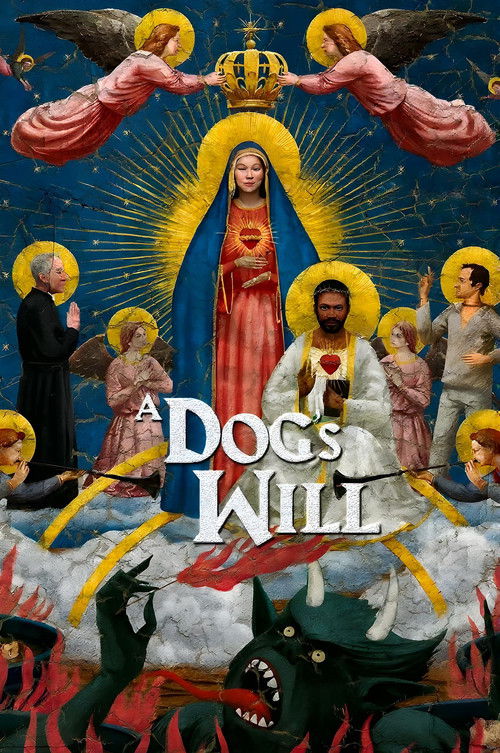
A Dog's Will
2000 · Guel Arraes
For a feel-good night with real wit underneath — when you want to laugh hard and come away lighter, or introduce someone to a comedy classic outside the Hollywood canon.
What it's about
In a dusty town in Brazil's Northeastern backlands, two broke friends — João Grilo, a fast-talking trickster, and Chicó, a coward with a tall tale for every occasion — con their way through priest, baron, and bandit. Their swindles eventually catch up with them, and the pair face a final judgment before Christ, the Devil, and the Virgin Mary herself.
The experience
Fast, warm, and genuinely funny — the jokes ride on verbal invention and escalating schemes, and just when you've settled into the farce it opens up into something surprisingly moving about mercy and who deserves it.
Performances
Matheus Nachtergaele's scrawny, scheming João Grilo and Selton Mello's sweetly cowardly Chicó are a beloved double act — the whole film runs on their chemistry and motor-mouthed timing.
The craft
Adapted from Ariano Suassuna's landmark 1955 play by way of a TV series, Guel Arraes's leaner theatrical cut moves like a shot — the compression sharpened its velocity. The singular mix of stage farce, backlands folk Catholicism, and a class consciousness worn as lightly as a straw hat gives the comedy real spine.
Why it matters
One of Brazil's most beloved films, quoted endlessly at home — it carried a cornerstone of Northeastern literature to a mass audience and made national stars of its leads.
Brazil's most beloved comedy began as Ariano Suassuna's 1955 play, a cornerstone of Northeastern letters that folded medieval morality drama into the cordel ballad tradition of the sertão. Guel Arraes filmed it first as a four-part Globo television series, then carved this leaner theatrical cut, and the compression only sharpened its velocity. Matheus Nachtergaele's João Grilo, a scrawny trickster running on pure verbal invention, and Selton Mello's Chicó, a coward with a tall tale for every occasion, con their way through a dusty town — priest, baron, bandit — until the swindles catch up with them and the film swerves into its famous celestial tribunal, where the poor finally get an advocate. The mixture is singular: commedia dell'arte farce, backlands Catholicism, and a class consciousness worn as lightly as a straw hat. In Brazil its dialogue functions as shared scripture, quoted across generations; Suassuna, founder of the Armorial movement, lived to see his play become national folklore twice over.
Reception
Never needed a rescue: it aired as a hit Globo TV miniseries in 1999, was recut for cinemas in 2000, and has only climbed since — decades of holiday reruns turned a popular comedy into an undisputed Brazilian national classic.
How A Dog's Will was received, from release to now →
Influences: the films it descends from and the films it influenced
- Black God, White Devil (1964) — Structures the sertão as a mythic space narrated by a blind cordel balladeer, establishing the cordel-de-feira sung-verse mode of storytelling that A Dog's Will's João Grilo inherits.
- O Pagador de Promessas (1962) — Stages Northeastern popular piety as a public trial of faith on the church steps, supplying the folk-Catholicism-versus-clergy confrontation that drives the film's morality-play conflict.
- Macunaíma (1969) — Builds an episodic, carnivalesque picaresque around a shapeshifting trickster anti-hero, the malandro-folk-tale template João Grilo's cons directly extend.
- The Seventh Seal (1957) — Personifies Death and dramatizes a mortal arguing his case before a supernatural power, the medieval morality-play allegory that prefigures the celestial-tribunal climax.
- A Matter of Life and Death (1946) — Invents the staged heavenly-court device in which a bureaucratic tribunal literally adjudicates a mortal's fate, the exact framing of the film's final judgment scene.
- The Gospel According to St. Matthew (1964) — Renders the sacred as popular, non-clerical folk realism among the rural poor, the plainspoken peasant-Catholic register that lets Christ and the Virgin appear without pomp.
- La Strada (1954) — Draws its leads straight from commedia dell'arte street-performer masks (the Fool, the brute), the same stock-type physical comedy grammar animating the two-conman duo.
- Il Bidone (1955) — Follows petty swindlers who disguise themselves as clergy and face a final divine reckoning, the con-artist-meets-judgment moral arc mirrored in João Grilo's fate.
- Ahí está el detalle (1940) — Turns Cantinflas's verbal quick-wittedness into a courtroom farce where the picaro talks his way out of a tribunal, the trickster-in-the-dock craft João Grilo's celestial trial reprises.
- Lisbela e o Prisioneiro (2003) — Arraes again compresses a TV microsérie of Northeastern popular theater (Osman Lins) into farce with Selton Mello, extending the same cordel-comedy method and television-origin editing.
- Caramuru: A Invenção do Brasil (2001) — Reworks another Globo microsérie into a farcical armorial-flavored national origin tale, repeating the multi-episode-to-feature compression technique that shaped A Dog's Will.
- City of God (2002) — Retomada-era feature built from TV/commercial kinetic editing and an ensemble of non-pro and stage actors including Matheus Nachtergaele, sharing the compressed televisual cutting energy.
- Central Station (1998) — Contemporary Retomada road film crossing the sertão toward a folk-Catholic pilgrimage, reviving the backlands spiritual landscape A Dog's Will inhabits.
- Me You Them (2000) — Same-year sertão comedy of manners steeped in cordel-inflected Northeastern folk texture, an adjacent take on backlands vernacular humor.
- Deus é Brasileiro (2003) — Sends God himself wandering the Northeastern backlands in search of a saint, a folk-Catholic comic allegory that plays the same earthly-celestial interplay for laughs.
- Defending Your Life (1991) — Comic afterlife courtroom where the recently dead must argue their own worth, an independent instance of the celestial-tribunal-as-comedy device that structures the finale.
Similar films
- Lisbela and the Prisoner (2003) — influence & lineage
- Black God, White Devil (1964) — influence & lineage
- The Given Word (1962) — influence & lineage
- Estômago: A Gastronomic Story (2008) — shared sensibility
- Mango Yellow (2002) — shared sensibility
- Bacurau (2019) — shared sensibility
- Antonio das Mortes (1969) — shared sensibility
- Chuck Billy and The Marvelous Guava Tree (2025) — shared sensibility