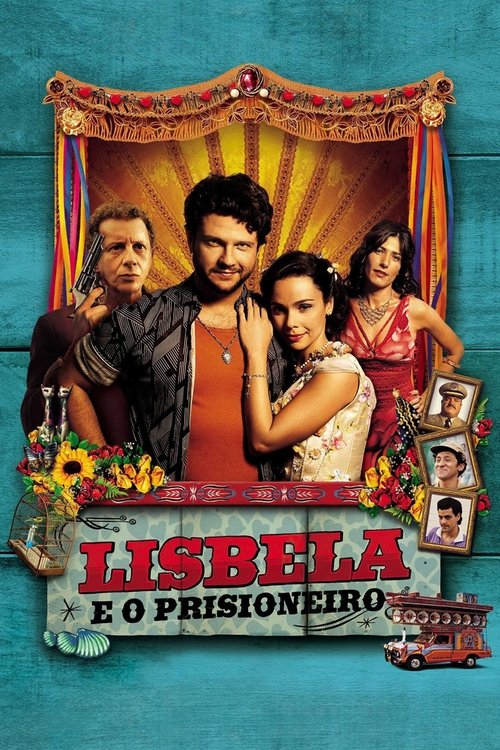
Lisbela and the Prisoner
2003 · Guel Arraes
For a light, warm night when you want to laugh and root for lovers on the run — pure comfort, best shared, no homework required.
What it's about
In a dusty town in Brazil's Northeast, Lisbela is engaged to a preening bore but hopelessly in love with the movies — she narrates her own life like a matinee. Into town rolls Leléu, a traveling con man and carnival barker, one step ahead of a legendary hitman whose beautiful wife he's just seduced. Lisbela and Leléu fall for each other on sight, and the whole town's farce of jealous husbands, hired guns, and thwarted weddings kicks into motion.
The experience
Fast, silly, and openly in love with cinema itself — characters wink at movie clichés even as they live them. It's sunny and quotable, with real romantic charge under the slapstick; the energy is closer to a stage farce than a sitcom, everything heightened and delivered with relish.
Performances
Selton Mello's Leléu is all rogue charm, and Débora Falabella makes Lisbela's movie-fed daydreaming genuinely winning rather than cute — their chemistry carries the film.
The craft
Guel Arraes adapts Osman Lins's 1964 stage play into a candy-colored, self-aware romp, translating Brazil's orally rooted comic tradition — the rhythms of popular theater and cordel storytelling — into big-screen farce. The dialogue crackles with regional flavor, and the film keeps playfully framing itself as the kind of movie Lisbela loves.
Why it matters
A major popular hit that helped define the crowd-pleasing wing of Brazil's cinematic revival in the early 2000s, and a beloved comedy Brazilians still quote.
Snapshot
Lisbela e o Prisioneiro is a Brazilian romantic comedy that adapts Osman Lins's 1964 stage play of the same name, relocating its love-triangle farce to a stylized Northeastern Brazil of dusty towns, traveling entertainers, and matinee dreams. Its engine is a collision of appetites: Leléu (Selton Mello), a small-time con man and carnival barker, and Lisbela (Débora Falabella), a young woman betrothed to the preening Douglas but hopelessly in love with the movies, fall for each other on sight — even as Leléu is being hunted by a legendary hitman whose wife he has bedded. The film belongs to director Guel Arraes's project of translating a distinctly Brazilian, orally rooted comic tradition into popular cinema, following his enormously successful O Auto da Compadecida (2000). It arrived during the mature phase of the retomada, the revival of Brazilian film production after the industry's near-collapse in the early 1990s, and became one of the year's signal domestic hits. Its abiding subject is cinema itself — how the conventions of the movies (the hero always survives the last reel) organize desire, courage, and the shape a life is willing to take.
Industry & production
The film was produced within the orbit of Globo Filmes, the cinema arm of Brazil's dominant media conglomerate, TV Globo, whose entry into feature production in the late 1990s reshaped the economics of the retomada. Guel Arraes was at that point one of Globo's most important television authors, and Lisbela — like O Auto da Compadecida before it — emerged from the porous boundary between the network's fiction unit and the theatrical market. That lineage matters: Globo's involvement brought marketing muscle, cross-promotion, and a stable of nationally famous actors, and it institutionalized a model in which a project could live as both a television property and a film. O Auto da Compadecida had in fact originated as a Globo miniseries before being recut for cinemas; Lisbela was conceived for theatrical release but carries the same production DNA.
Commercially, the film was a substantial success by the standards of Brazilian domestic cinema in 2003, ranking among the most-attended national releases of its year. I would rather not cite a specific admissions or gross figure than risk a wrong one — the precise numbers are the kind of detail that should be checked against a reliable box-office record such as ANCINE's — but the film's status as a popular hit and a staple of subsequent television rebroadcast is not in dispute. Its success reinforced a commercial thesis the retomada had been testing: that comedies rooted in regional Brazilian idiom, backed by Globo's reach and cast with familiar television faces, could reliably draw a mass audience that art-house retomada dramas often could not.
Technology
Lisbela was made in the early-2000s window when Brazilian features were still predominantly shot and finished photochemically on 35mm, before the wholesale migration to digital acquisition later in the decade. There is nothing in the film that advertises technological novelty; its "effects" are theatrical and in-camera — the carnival illusion of a woman transformed into a gorilla, the staged spectacle of Leléu's traveling show — rather than digital. Where the production's technical ambition shows is less in hardware than in the integration of a television-honed post-production sensibility (tight, musical cutting; graphic transitions) into a theatrical release. Absent a verified technical spec sheet, I will not assert a specific gauge, lab, or lens package as fact; the safe, established point is that the film sits on the film-based side of the analog-to-digital transition and treats its period-Northeastern setting through art direction and staging rather than through image-processing trickery.
Technique
Cinematography
The photography serves a heightened, storybook vision of the sertão and its small towns: warm, saturated light, picture-postcard skies, and a color palette closer to a remembered matinee than to social realism. This is consonant with the film's thesis that its world is half-dreamed through Lisbela's love of movies. Framing tends toward the frontal and legible — compositions that read instantly, in the manner of comedy and of television — so that gags and reactions land cleanly. I am not able to confirm the director of photography's name from memory with the confidence this dossier demands, and I will not guess; the credit should be verified against the film's titles or a database entry. What can be stated is the strategy: the camera is an accomplice to the comedy, prioritizing clarity, warmth, and a faintly nostalgic sheen over grit.
Editing
Editing is arguably the film's most characteristic technical dimension, and it is inseparable from Arraes's television authorship. His signature is a brisk, rhythm-forward cutting style — quick scene dispatch, playful elisions, occasional direct address and self-aware asides — that keeps the farce buoyant and foregrounds the film's metacinematic wit. The movie repeatedly reminds us that it knows it is a movie, and the cutting is where that knowingness lives: transitions that wink, comic timing built in the edit rather than only in performance. This is the same sensibility that made O Auto da Compadecida feel like a live, quick-witted telling of a folk tale, now applied to romantic comedy.
Mise-en-scène / staging
Because the source is a play, the film retains a fundamentally theatrical architecture — set-piece confrontations, entrances and exits, the comic geometry of who knows what and who is hiding from whom. Arraes stages this with a showman's front-of-house energy appropriate to a story about a traveling entertainer. The production design leans into a stylized regionalism: the market square, the cinema, the domestic interiors of a Northeastern town rendered slightly larger and brighter than life. The recurring motif of performance-within-the-film — Leléu's carnival barking, the gorilla act, the movie house itself — turns the mise-en-scène into a series of framed spectacles, nesting stages inside the stage.
Sound
The soundscape is strongly regional, drawing on the popular musical vocabulary of the Northeast — the accordion-driven idioms of forró and baião — to root the comedy in place and to drive its romantic and celebratory beats. Music functions less as underscore than as atmosphere and momentum, in keeping with a tradition where Northeastern film and Northeastern song are deeply entwined. I do not want to attribute the score to a specific composer without confirmation, so I will flag that credit as one to verify rather than name it speculatively. Dialogue carries the regional accents and cadences that are central to the film's texture; the verbal comedy — Douglas's affected attempts to pass as a cosmopolitan carioca chief among them — depends on the audience hearing the gap between how characters speak and how they wish to sound.
Performance
Performance is the film's beating heart, and it is cast from Brazil's top television and stage talent. Selton Mello's Leléu is all charm and nimble cowardice curdling into reluctant courage — a con man who must, in the end, act like the hero of the movies Lisbela loves. Débora Falabella's Lisbela is bright, willful, and unembarrassed in her desire, which gives the romance its forward drive. Marco Nanini, one of the most esteemed actors of his generation, plays the feared hitman with a comic gravity that keeps the menace both real and absurd; his pursuit is the plot's ticking clock. Virgínia Cavendish's Linaura supplies the incendiary first affair, and Bruno Garcia's Douglas is the film's richest comic caricature — the provincial pretender whose cosmopolitan airs are the movie's sharpest satire of class and cultural aspiration. The ensemble plays in a register of broad but precise farce, calibrated so that the caricatures never wholly forfeit sympathy.
Narrative & dramatic mode
The narrative mode is farce braided with romantic comedy, organized around the classic triangle (Lisbela promised to Douglas, in love with Leléu) and the pursuit plot (the hitman closing in on Leléu). Its most distinctive feature is metafiction: Lisbela reads the world through the grammar of cinema, and the film adopts her faith as its structuring principle — the conviction that the hero cannot die before the final scene, that love conquers, that the movies are true. This lets the film run its perils sincerely and ironically at once. The dramaturgy is inherited from Osman Lins's play, with the theatrical unities of the comedy of intrigue — misunderstandings, concealments, near-misses, and a converging climax — modernized by Arraes's fleet, self-aware storytelling.
Genre & cycle
The film sits at the intersection of romantic comedy and the broader tradition of Brazilian popular comedy, and specifically within a cycle of Northeastern-set literary adaptations that Arraes helped make bankable. Together with O Auto da Compadecida, it defines a recognizable strain of early-2000s Brazilian cinema: comedies drawn from canonical or regional literary sources (Ariano Suassuna, Osman Lins), steeped in nordestino culture, produced with Globo backing, and pitched to a national mass audience. This cycle stands in productive contrast to both the grittier urban dramas of the retomada (the Cidade de Deus register) and the earlier chanchada musical-comedy tradition, even as it inherits the chanchada's populism and its affection for spectacle and song.
Authorship & method
The dominant author is Guel Arraes (born 1953), a director and screenwriter whose formation was in TV Globo's fiction unit, where he became a defining figure in the network's seriado and miniseries output. Son of the Pernambuco politician Miguel Arraes, he brings a pronounced Northeastern cultural allegiance and an authorial method that treats regional literary and oral tradition as raw material for popular, self-aware entertainment. His approach is collaborative and writerly, built on adaptation, ensemble casting from the Globo/theatrical talent pool, and an editing-forward comic style migrated from television into cinema.
On the screenplay, Arraes worked — as he characteristically did — with close collaborators adapting Lins's play; the writing team is usually credited alongside Arraes, and I would point a reader to the film's own credits to confirm the exact roster rather than risk misattributing co-writers from memory. What is safe to say is that the film is a writers' comedy, dense with verbal invention, and that its screenplay is a genuine transposition rather than a filmed play, opening out Lins's stage intrigue into a mobile, cinematic Northeast. The remaining key craft credits — cinematographer, composer, editor — are precisely the ones I have declined to name speculatively above; the honest scholarly move is to mark them as verifiable from the titles rather than to invent attributions.
Movement / national cinema
Lisbela is a product of the Brazilian retomada — the resumption of national film production after the early-1990s dismantling of the state agency Embrafilme and the collapse of output that followed. By 2003 the retomada had matured from survival into a diversified industry, and Lisbela represents its commercial, Globo-anchored wing. It also belongs to a longer current of Northeastern regionalism in Brazilian culture, from Cinema Novo's sertão (Glauber Rocha, Nelson Pereira dos Santos) to the literary universes of Suassuna and Lins — though Arraes inverts Cinema Novo's political austerity into celebratory popular comedy. The film's national-cinema significance lies in demonstrating that regionally specific, literarily derived comedy could be a pillar of a self-sustaining domestic box office.
Era / period
The film is doubly period. As a 2003 production it belongs to the early-2000s consolidation of Brazilian commercial cinema and to the last years of predominantly analog filmmaking. As a fiction it evokes a nostalgic, non-specific mid-century Northeast — a world of traveling shows, small-town cinemas, and pre-television communal entertainment — filtered through the affectionate haze of memory and the movies. That temporal doubling is thematically load-bearing: the film is set in an age when the cinema was the great popular dream-machine, and it was made in an age anxious to prove that Brazilian cinema could again be a popular art.
Themes
The governing theme is the movies as a way of seeing and living — Lisbela's cinephilia as a moral and romantic worldview, and the film's own faith that reality can be bent toward the shape of a good story. Around this cluster: desire and its disruptions (the affair that sets the plot running, the engagement that must be broken); courage and cowardice, as Leléu is forced to become the kind of man the movies would make him; and class and cultural aspiration, satirized through Douglas's ludicrous performance of carioca sophistication against the authenticity of the Northeastern setting. Underneath the farce runs a warm populism — a valuing of local, embodied culture (song, storytelling, the traveling show) over borrowed metropolitan pretension.
Reception, canon & influence
Critically and popularly, Lisbela e o Prisioneiro was received as a crowd-pleasing success and consolidated Arraes's reputation as a maker of intelligent popular comedy; it remains a durable title in Brazilian television rotation and a reference point for the Globo-backed literary-comedy cycle. I will not attach specific award citations or gross figures to that reputation without a source in hand, but its standing as one of 2003's notable domestic hits is well established.
Looking backward, the film's deepest influence is its source — Osman Lins's 1964 play — and behind that the whole tradition of the Northeastern comedy of intrigue and the auto, the same folk-theatrical vein Arraes had mined with Suassuna. Its cinephile metafiction draws on the universal romantic-comedy faith in happy endings and on Brazil's own memory of the movie house as communal ritual; formally, its brisk wit is inherited from Arraes's television practice and, more distantly, from the populist energy of the chanchada.
Looking forward, Lisbela — together with O Auto da Compadecida — helped legitimate a commercially reliable formula that later Brazilian comedies would follow: regional or literary source material, Globo Filmes financing, casts of beloved television actors, and a confidently popular address. Its most concrete legacy is the demonstration that Brazilian audiences would turn out in force for their own comedies, a lesson that shaped the mainstream commercial cinema of the following decade. Arraes himself would continue adapting Northeastern and literary material in the same spirit, and the film remains a touchstone for how the retomada's populist wing understood the relationship between literature, television, and the movies.
Reception
A massive crowd-pleaser in Brazil in 2003, it arrived amid critic-side sniffing that Globo Filmes comedies were just 'TV on a big screen' — two decades of reruns and streaming later, it's settled in as one of the most beloved Brazilian romantic comedies ever made.
How Lisbela and the Prisoner was received, from release to now →
How to watch Lisbela and the Prisoner: what to notice on a first viewing
- Notice how warm and saturated every scene looks. The color leans toward postcard skies and matinee warmth rather than ordinary documentary grit, a palette that matches Lisbela's own dreamy, movie-fed view of the world. The look tells you this Northeast is half dreamed before a single plot point does.
- Notice how squarely the camera frames every gag. Compositions stay frontal and instantly readable, the way television comedy is shot, so a reaction or a punchline never gets lost in an odd angle. The camera works as the comedy's accomplice, clearing a clean line to every joke.
- Notice a transition wink at you mid scene. Arraes cuts fast and playfully, with occasional direct address and self-aware asides, so the film keeps reminding you that it knows it is a movie. The editing carries as much of the joke as the performances do, timing built right into the joins.
- Watch for a show inside the show itself. Leléu's carnival barking, the gorilla act, and the movie house all stage a spectacle within the film's own spectacle, nesting one performance inside another. You are always watching someone perform for someone else, which is the whole film in miniature.
- Listen for accordion music rooting every romantic beat. Forró and baião rhythms drive the film's celebratory and romantic moments, tying the comedy directly to the sound of the Northeast rather than to a generic score. The music keeps the film rooted in one place even as the plot chases a con man across towns.
The whole guide to watching Lisbela and the Prisoner, with the keys for a rewatch →
Influences: the films it descends from and the films it influenced
- O Auto da Compadecida (2000) — Direct ancestor and template: Arraes's own method of shooting a work first as a Globo miniseries then re-cutting it into a feature, transposing a Northeastern folk-theatrical source (Suassuna's auto/cordel) via rhythm-forward comic editing and a fixed ensemble of Globo/theatre actors.
- Caramuru: A Invenção do Brasil (2001) — Immediate sibling in Arraes's cycle: the same TV-miniseries-to-cinema pipeline and playful metafictional address, treating a historical/literary source as raw material for self-aware farce with narrator interruptions and anachronistic winks.
- Carnaval Atlântida (1952) — Chanchada ancestor: the populist musical-comedy energy, the studio-and-movie-house self-reference, and the frontal, direct-address staging of broad performers that Arraes revives as legible, theatrical framing.
- To Be or Not to Be (1942) — Ancestor of the performance-within-film farce: comedy engineered from a troupe's staged deceptions and precisely timed entrances/exits, the same 'players playing players' architecture Lisbela uses in its theatrical set-pieces.
- Sullivan's Travels (1941) — Ancestor of cinephilia-as-worldview: verbally dense screwball construction married to an explicit argument that popular comedy and the shared laugh of the movie house are a form of grace worth defending.
- The Purple Rose of Cairo (1985) — Metafiction ancestor: the screen-versus-life boundary as a comic engine, dramatizing moviegoing as an escapist faith in happy endings — the belief that organizes Leléu's cinephile hope.
- Cinema Paradiso (1988) — Ancestor of the movie house as provincial communal ritual: the small-town theater as an emotional civic center whose romance of projection and audience Lisbela inherits and localizes to the Northeast.
- The Princess Bride (1987) — Ancestor of the storybook meta-frame: an affectionately self-aware fairy-tale romance told with a saturated, illustrative palette and knowing tonal winks that flatter genre convention rather than deconstruct it.
- Amélie (2001) — Near-contemporary sibling in image-craft: the saturated storybook color, frontal legible framing, and direct-address narration that turn whimsical romance into a hand-tinted, self-narrating fable.
- O Homem Que Copiava (2003) — Retomada sibling: first-person direct address and playful graphic/editing interruptions harnessed to a class-aspiration satire, the same year and the same populist-formal wing of the revival.
- A Máquina (2005) — Nordestino descendant: a playwright adapting his own sertão stage piece into cinema with heightened theatrical staging and a saturated regional palette, extending Lisbela's stage-to-screen Northeastern romance.
- Se Eu Fosse Você (2006) — Commercial descendant: the Globo Filmes formula Lisbela helped validate — beloved TV actors, a confidently popular romantic-comedy address, and television comic timing scaled to the big screen.
- Tapete Vermelho (2006) — Descendant of the cinephile-ritual strand (sharing actor Matheus Nachtergaele): a caipira's pilgrimage to see a movie dramatizes the movie house as sacred communal event, Lisbela's theme carried into rural fable.
Similar films
- A Dog's Will (2000) — influence & lineage
- The Man Who Copied (2003) — influence & lineage
- The Princess Bride (1987) — influence & lineage
- Mango Yellow (2002) — shared sensibility
- Estômago: A Gastronomic Story (2008) — shared sensibility
- My Sweet Orange Tree (2012) — shared sensibility
- Ó Paí, Ó: Look at This (2007) — shared sensibility
- Carandiru (2003) — shared sensibility