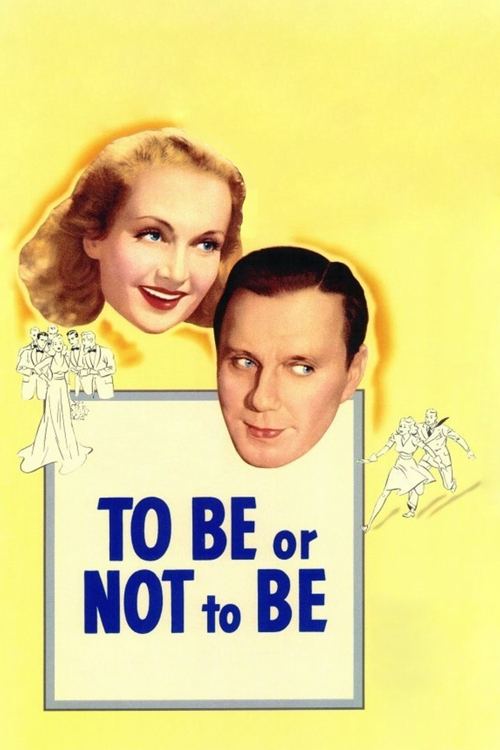
To Be or Not to Be
1942 · Ernst Lubitsch
For when you want wit with a spine — a comedy that's actually about something, perfect when modern jokes feel thin and you want to watch professionals land every line. Comfort viewing with teeth.
What it's about
Warsaw, under Nazi occupation. A troupe of Polish actors — led by the magnificently vain leading man Joseph Tura and his charming, much-admired wife Maria — gets tangled up with a spy plot that threatens the Polish resistance. Their only weapons are the ones they've always had: costumes, false beards, ham acting, and nerve, deployed against the Gestapo itself.
The experience
Fast, elegant, and shockingly funny given the stakes — it whipsaws between backstage farce and genuine danger without ever dropping a plate. You laugh, then catch your breath, then laugh again.
Performances
Jack Benny turns his radio persona of preening vanity into the performance of his film career, and Carole Lombard — luminous in her final role — matches him beat for beat with warmth and perfect timing.
The craft
Lubitsch's script is a machine of running gags and mirrored scenes where lines repeat with the meanings reversed, and the direction makes theater itself — entrances, cues, costumes — the engine of the suspense. It's a masterclass in how structure can be funny.
Why it matters
Released weeks after Pearl Harbor and Lombard's death in a plane crash, it was attacked as tasteless for daring to make farce out of occupied Poland — and is now regarded as one of the greatest comedies ever made, the proof that satire can meet tyranny head-on.
Snapshot
To Be or Not to Be is Ernst Lubitsch's audacious comedy about a Warsaw theatrical troupe that improvises its way through the Nazi occupation, turning greasepaint, ham acting, and stagecraft into instruments of resistance. Built around the vanity of a self-regarding leading man (Jack Benny's Joseph Tura), the charm of his wife and co-star (Carole Lombard's Maria Tura), and a chain of impersonations that pit actors against the Gestapo, the film fuses screwball timing with wartime peril in a way few American pictures of the period dared. It arrived in early 1942 shadowed by two disasters: the United States had just entered the war after Pearl Harbor, and Lombard—the film's luminous center—had died in a plane crash weeks before release while returning from a war-bond tour. The combination of a Nazi-occupation farce and that offscreen tragedy produced a fraught, often hostile initial reception. Time has decisively reversed the verdict: the film is now regarded as one of the supreme achievements of Hollywood comedy and the fullest expression of the "Lubitsch touch" applied to the gravest possible subject.
Industry & production
The film was an independent production released through United Artists, made outside the major-studio system by Lubitsch in partnership with the Korda organization—Alexander Korda produced, and his brother Vincent Korda supplied the art direction. This independent footing mattered: it gave Lubitsch, one of Hollywood's most prestigious directors, latitude to pursue a premise that a risk-averse major might have softened or refused outright in the anxious months after December 1941.
Casting shaped the picture's identity. Jack Benny, primarily a radio comedian, was cast against the grain of his film reputation in what became his signature screen role; Carole Lombard, a reigning star of screwball comedy, took the female lead. The supporting ensemble drew heavily on German and Central European émigrés whose own displacement gave the anti-Nazi satire a lived edge—Sig Ruman as the bombastic Colonel "Concentration Camp" Ehrhardt, Felix Bressart as the bit-player Greenberg, and others. Robert Stack, then early in his career, played the young flyer Lieutenant Sobinski.
The production is inseparable from Lombard's death. On January 16, 1942, her plane crashed near Las Vegas as she returned from a war-bond rally, making To Be or Not to Be her final film. It reached theaters weeks later. Studio and creative principals reportedly weighed how to handle a line in which Maria's fate is discussed—concern centered on a dark joke about a plane—and the picture went out into a public mood freshly bereaved of one of its favorite stars and freshly at war. The specific internal deliberations are recounted variously in later histories; the essential fact is that release occurred under a double weight of grief and national emergency.
Technology
Technologically the film is a product of mature classical Hollywood practice rather than innovation. It was shot in black-and-white on 35mm in the standard Academy ratio, with a single-channel optical soundtrack. There is no evidence of novel camera, lens, or process work; the picture's ambitions are entirely dramaturgical and comedic rather than technical. Its "effects" are effects of performance and construction—the illusion that a stage set is Gestapo headquarters, that an actor is a colonel—achieved through costume, makeup, art direction, and editing rather than any laboratory or optical apparatus. In this sense the film is thematically about the oldest illusion technology of all, the theater, even as it is realized through the studio soundstage.
Technique
Cinematography
The camerawork is by Rudolph Maté, a cinematographer of unusual pedigree—he had shot for Carl Theodor Dreyer (The Passion of Joan of Arc, Vampyr) in Europe before establishing a distinguished Hollywood career. His work here is polished, mobile studio photography that serves the comedy without calling attention to itself: clean, glamorous lighting for Lombard, and a legibility of space essential to farce, where the audience must always understand who is where, who can be seen, and who is about to be caught. The visual style is deliberately unshowy; its discipline is that it never lets technique upstage timing.
Editing
Dorothy Spencer, a first-rank Hollywood editor (she cut Stagecoach and would later work on major productions through the 1960s), handled the cutting. The film's comedy is fundamentally an editing comedy of reveals and reversals: the celebrated opening is constructed so that a scene we take for a real confrontation with Hitler is revealed to be a rehearsal, a cut and a pullback re-framing everything we thought we saw. Throughout, the pacing depends on precisely timed cuts between deception and its near-exposure—the rhythm of a door about to open, a lie about to collapse.
Mise-en-scène / staging
Staging is the film's deepest subject and its greatest strength. Lubitsch, himself a man of the theater in his German youth, builds nearly the entire picture on the logic of performance-within-performance: actors playing Nazis, a husband impersonating a Gestapo colonel, a colonel impersonated in turn. Sets double as stages and stages double as sets, so that the boundary between "playing" and "being" is continually blurred. Blocking is engineered around sightlines and entrances—who occupies the theater box, who leaves a seat on a cue, who walks through which door at the wrong moment. The famous running gag in which the line "To be or not to be" becomes the signal for a young admirer to rise and exit the auditorium is a pure piece of spatial staging, converting Shakespeare's most solemn line into a comic cue.
Sound
The sound design centers on dialogue and the timing of the spoken word—Lubitsch's comedy lives in inflection, pause, and the double meaning of a line delivered straight. The score is by the German émigré composer Werner R. Heymann, a frequent Lubitsch collaborator, who supplies music that moves nimbly between romantic lightness and suspense as the plot tightens. The picture also leans on the sonic texture of theater and radio-trained voices; Benny's precise comic delivery, honed on radio, is used with full awareness of how much a comedian's timing is a matter of sound.
Performance
Performance is both the film's medium and its theme. Jack Benny gives what many consider his finest screen work as Tura, an actor whose monumental vanity ("So they call me Concentration Camp Ehrhardt!" delights and wounds him in equal measure) becomes, improbably, heroic. Carole Lombard's Maria is quick, warm, and knowing, a performance made poignant in retrospect by her death. Sig Ruman's Ehrhardt is a masterpiece of blustering cowardice, and Felix Bressart's Greenberg—a small-part player who longs to deliver Shylock's "Have I not eyes?" speech—supplies the film's moral gravity, ultimately reciting that plea for common humanity to a hall of Nazis. The ensemble's shared understanding that acting itself is the story gives the whole a rare unity of tone.
Narrative & dramatic mode
The film's dramatic mode is farce raised to the level of moral seriousness. Its plot machinery is intricate—a Polish flyer, a treacherous professor-spy (Stanley Ridges as Siletsky), a list of resistance names, and a series of impersonations that must succeed on pain of death—but the construction is classically tight, with every setup paying off. The signature move is the sudden tonal pivot: a scene will run as pure comedy and then, without warning, admit real danger, so the laughter carries a catch in it. Lubitsch trusts the audience to hold both registers at once. The narrative is also self-consciously theatrical, framed by the troupe's own productions and repeatedly asking what is real and what is staged; the deepest joke is that the actors' professional deceptions—their ability to become someone else—are exactly the skills that let them outwit an occupying army.
Genre & cycle
To Be or Not to Be sits at the crossing of several traditions. It belongs to the sophisticated romantic-comedy lineage Lubitsch himself had defined through the 1930s, and it carries the DNA of American screwball in its verbal speed and marital sparring. At the same time it is part of the wartime cycle of anti-Nazi Hollywood films—following Chaplin's The Great Dictator (1940) and the earlier Confessions of a Nazi Spy (1939)—but it is far more formally daring than most, because it plays the occupation as farce rather than melodrama. It is thus a hybrid: a spy-thriller plot executed as a backstage comedy, a genre combination so unusual that contemporaries had no ready category for it, which partly explains the initial confusion over how to receive it.
Authorship & method
The film is a definitive statement of the "Lubitsch touch"—the director's gift for implication, elegant indirection, and comedy that respects the audience's intelligence—now turned toward mortal stakes. Lubitsch is credited with the underlying story (with Melchior Lengyel), and the sharp, quotable screenplay is by Edwin Justus Mayer. Lubitsch's method, honed since his silent German films and his emigration to Hollywood, was to stage meaning in what is not shown or said, and here that discretion becomes a tool for handling atrocity: the film gestures at the horror of occupation while keeping its surface buoyant.
His key collaborators reinforce that method. Rudolph Maté's cinematography provides unobtrusive classical polish; Dorothy Spencer's editing supplies the reveal-based rhythm the comedy requires; Werner R. Heymann's score modulates between romance and suspense; Vincent Korda's art direction furnishes the theaters and offices that must convincingly double for one another. The émigré background shared by Lubitsch and several collaborators is not incidental—it lends the anti-Nazi satire the authority of people mocking a regime that had driven them from their homes.
Movement / national cinema
The picture is a product of Hollywood, but it is unmistakably shaped by the German cinema and cabaret culture from which Lubitsch came. He was among the most eminent of the German émigré directors who reshaped American film, and To Be or Not to Be channels a Central European theatrical sensibility—irony, worldliness, a taste for the play-within-the-play—into a studio comedy. It thus belongs to the broader story of how the exile of German and Austrian talent under Nazism enriched American cinema, here with the pointed irony that the exiles' art is deployed directly against the regime that exiled them.
Era / period
The film is inseparable from its exact moment. Made in 1941 and released in the spring of 1942, it straddles the transition from American neutrality to full belligerence. Its subject—the 1939 invasion and occupation of Poland—was recent history, and its release into a nation newly at war, and newly grieving Lombard, gave it an almost unbearable topicality. Where later audiences could receive the film as art, 1942 audiences met it as raw commentary on a catastrophe still unfolding, which accounts for much of the discomfort it provoked. It is a war film made during the war, without the safety of hindsight.
Themes
At its core the film argues that theatricality—performance, illusion, the capacity to play a role—is both a moral resource and a mode of survival. The actors defeat the Nazis precisely because they understand that identity can be performed, a knowledge the regime, built on rigid uniforms and titles, cannot match. A second theme is the dignity of the small and the vain: the ham actor and the eternal bit-player turn out to matter, and Greenberg's Shakespearean plea for shared humanity—"Have I not eyes?"—stands at the film's ethical center, reframing the whole comedy as a defense of the human against the dehumanizing. A third is the double edge of comedy itself, the film's insistence that laughter can be aimed at tyranny without trivializing its victims. The recurring joke about "what he did to Shakespeare, we are now doing to Poland" captures the tightrope: the film keeps art and atrocity in the same frame.
Reception, canon & influence
Initial reception was mixed and, in places, sharply hostile. A number of contemporary American critics found the premise in poor taste—comedy set amid the very real horror of Nazi-occupied Poland struck some as flippant at a moment of national mourning and fear—and the film's tonal audacity was widely misread as insensitivity. Lombard's death compounded the unease. By most accounts the picture was not an unambiguous success on first release, though precise box-office figures should be treated with caution and are not restated here.
The influences on the film run backward to Lubitsch's own body of sophisticated comedy, to the German theatrical and cabaret traditions of his youth, and to the immediate context of earlier anti-Nazi Hollywood films such as The Great Dictator. Shakespeare is a constant presence, both as literal material (Hamlet's soliloquy, Shylock's speech) and as a model of theater's power.
The film's forward legacy is large and grew steadily. Critical reappraisal, championed over the following decades, elevated it into the canon of great Hollywood comedies and secured Lubitsch's reputation at its highest point; it became a touchstone for critics and filmmakers who admired the "Lubitsch touch." It was directly remade by Mel Brooks in 1983, a tribute that testifies to its standing among comedians. More broadly, it stands as a foundational example of the serious comedy of atrocity—the argument that farce can confront fascism and genocide—an approach later films about war and the Holocaust have repeatedly reckoned with, whether in homage or in reaction. What was received in 1942 as a scandal of tone is now taught as a demonstration of how comedy, at its most disciplined and humane, can be a form of moral seriousness.
A Deleuzian reading
Start with the man on the sidewalk in Warsaw, August 1939.
The full Deleuzian reading of To Be or Not to Be →
Reception
In 1942 it was widely attacked as tasteless — a comedy about the Nazi occupation of Poland while the war was raging, with critics like Bosley Crowther scandalized. Today it's canonized as one of the greatest comedies ever made, its audacity now read as moral courage rather than bad taste.
How To Be or Not to Be was received, from release to now →
How to watch To Be or Not to Be: what to notice on a first viewing
- Watch the opening Hitler scene get revealed as a rehearsal. A solemn shot of Hitler on a Warsaw street is revealed, on the cut and pullback, to be a theater troupe at work. The trick recurs all film. The film teaches you in its first minute not to trust a frame until you know which stage it stands on.
- Watch who enters through which door, and exactly when. Lubitsch blocks nearly every scene around sightlines and entrances: who occupies the box, who leaves a seat on cue, who walks in at the wrong moment. The blocking makes farce a matter of geometry, comedy built from who can see whom rather than only what is said.
- Follow what happens whenever someone starts reciting Hamlet's soliloquy. The line 'To be or not to be' becomes a private signal: a young admirer stands and leaves his seat every time an actor begins it. Shakespeare's most solemn line gets reduced to a doorbell, and the film wants you to notice the demotion.
- Watch how visibly proud Tura is of his own bad reviews. Benny plays a vain actor who savors every mention of himself, even backhanded ones, turning ordinary ego into the film's running joke. His vanity, absurd as it looks, is exactly the skill that lets him impersonate anyone convincingly.
- Notice the moment a joke suddenly admits real danger. Lubitsch lets a scene run as pure comedy, then without warning lets the threat turn real, so the laughter carries a catch in it. He trusts you to hold the comedy and the danger in your head at the same time, not one after the other.
The whole guide to watching To Be or Not to Be, with the keys for a rewatch →
Influences: the films it descends from and the films it influenced
- Trouble in Paradise (1932) — Establishes the 'Lubitsch touch' of the closed-door ellipsis—staging the decisive action just off-screen so the audience infers what is cut away—the exact discretion later used to gesture at occupation's horror while keeping the surface buoyant.
- Ninotchka (1939) — Lubitsch's blueprint for metabolizing a totalitarian ideology into romantic-comic reversal, letting émigré satire deflate a regime through character rather than polemic.
- The Shop Around the Corner (1940) — A chamber comedy built almost entirely on entrances, exits, and sustained mistaken identity within a single confined set—the same door-and-sightline choreography that drives the theater/Gestapo-office masquerades.
- The Oyster Princess (1919) — Lubitsch's German-farce roots: choreographed ensemble movement and doorway gags that treat space as a mechanism for comic timing, later refined into his Hollywood staging.
- The Great Dictator (1940) — The immediate Hollywood precedent for farce that impersonates and deflates the Nazi leadership, licensing the doppelgänger/impersonation gag ('Concentration Camp Erhardt,' the fake Hitler) that Lubitsch weaponizes.
- The Passion of Joan of Arc (1928) — Rudolph Maté's cinematography here trains the luminous, unshowy classical lighting of faces that he brings to Lubitsch as invisible polish rather than expressionist display.
- Vampyr (1932) — Maté's control of graded tonal atmosphere and mobile camera—the technical discipline that lets him modulate between suspense and comedy without calling attention to the image.
- The 39 Steps (1935) — Structures espionage around live stage performance (the music-hall framing) and the timed reveal, braiding suspense with theatrical artifice the way Lubitsch fuses playhouse and resistance plot.
- Duck Soup (1933) — An anti-authoritarian war farce that treats military and dictatorial pomp as material to be demolished by performers, inheriting Duck Soup's method of deflating tyranny through sheer comic effrontery.
- Midnight (1939) — Pushes Midnight's identity-as-performance premise to its limit — impersonation and adopted roles as literal survival — sustaining the Lubitschian masquerade lineage.
- To Be or Not to Be (1983) — Mel Brooks's shot-by-shot remake, an explicit tribute that preserves the play-within-a-play troupe-as-spies structure and the tonal-pivot reveals intact.
- The Producers (1967) — Extends the comedy of atrocity by staging 'Springtime for Hitler'—a play-within-the-film whose farce is aimed directly at fascism, the theatrical frame doing the moral work.
- Life Is Beautiful (1997) — Sustains the thesis of theatricality-as-survival: a father's improvised performance-within-atrocity becomes the exact device Lubitsch pioneered—buoyant surface deployed against genocidal reality.
- Jojo Rabbit (2019) — Revives the impersonated/imagined-Hitler gag and the farce-from-inside-Nazism stance, mocking the regime through performance rather than depicting it straight.
- Inglourious Basterds (2009) — Turns a theater into the trap and deploys actors and performance-within-performance as an espionage weapon against the Nazi high command—Lubitsch's playhouse-as-battlefield taken to its literal end.
- The Death of Stalin (2017) — Aims disciplined farce at the machinery of totalitarian terror, extending the argument that comedy of atrocity can be a form of moral seriousness rather than flippancy.
- The Grand Budapest Hotel (2014) — Theatrical farce and nested deceptions deployed as the primary mode of confronting fascist catastrophe; Lubitsch's model of comedy that encodes historical violence within genre rather than evading it establishes the tragicomic register — darkness acknowledged inside the farce — that GBH sustains throughout.
- Devils on the Doorstep (2001) — Pioneers occupation-as-farce timing, where comic tension is generated by characters misreading and impersonating the enemy across a language and power gap.
- Seven Beauties (1975) — Stages farce inside the Nazi machine, licensing the tonal hard cuts between slapstick and terror that structure Seven Beauties.
- Don't Look Now... We're Being Shot At! (1966) — Model for the disguise-and-impersonation farce in which the comic protagonists survive by masquerading past occupying Germans — the German-officer-fooled-by-costume gag Oury builds set pieces around.
- Monsieur Verdoux (1947) — Demonstrated the tonal engineering Verdoux depends on: wringing high comedy directly from mass death and war, licensing a beloved comic voice to treat atrocity as farce.
- Welcome Back, Mr. McDonald (1997) — A comic repertory troupe improvising its way through a collapsing performance supplies the collaborative-authorship-under-duress mechanism Mitani transposes to live radio.
- Argo (2012) — Builds its rescue on a fake film production as espionage cover, reprising performance-as-survival and the masquerade-must-hold suspense of the troupe posing as Nazi officers.
- Train of Life (1998) — Stages a village's fake deportation train as elaborate survival theater—a whole community performing Nazi roles to escape them, the troupe-impersonates-the-oppressor conceit transposed to the Holocaust.
- The Lady Eve (1941) — Builds comedy from impersonation and double-identity performance — the disguise-plot mechanics of Eve/Lady Eve Sidwich treated as both farce engine and character revelation.
- Hangmen Also Die! (1943) — Exile anti-Nazi filmmaking built on braided registers and impersonation-driven dramatic irony, the tonal counterpart that plays the same collective-resistance stakes for tension through disguise.
- Lisbela and the Prisoner (2003) — Ancestor of the performance-within-film farce: comedy engineered from a troupe's staged deceptions and precisely timed entrances/exits, the same 'players playing players' architecture Lisbela uses in its theatrical set-pieces.
- Black Book (2006) — Pioneered playing Nazi-occupation survival as performance and impersonation — actors passing as officers — the disguise-masquerade staging Verhoeven treats with lethal rather than comic stakes.
Similar films
- The Great Dictator (1940) — influence & lineage · same viewing thread · often watched together
- Life Is Beautiful (1997) — influence & lineage · often watched together
- Trouble in Paradise (1932) — influence & lineage
- The Shop Around the Corner (1940) — influence & lineage
- Jojo Rabbit (2019) — influence & lineage
- Inglourious Basterds (2009) — influence & lineage
- The Death of Stalin (2017) — influence & lineage · same viewing thread
- Cabaret (1972) — same viewing thread
All the films related to To Be or Not to Be →
Watch it with: curated runs of related films
- Comedy Declares War on Fascism — A run of satires and cabaret turns that meet tyranny with ridicule — watch these together to see performers puncture dictators and expose the void behind the uniform.