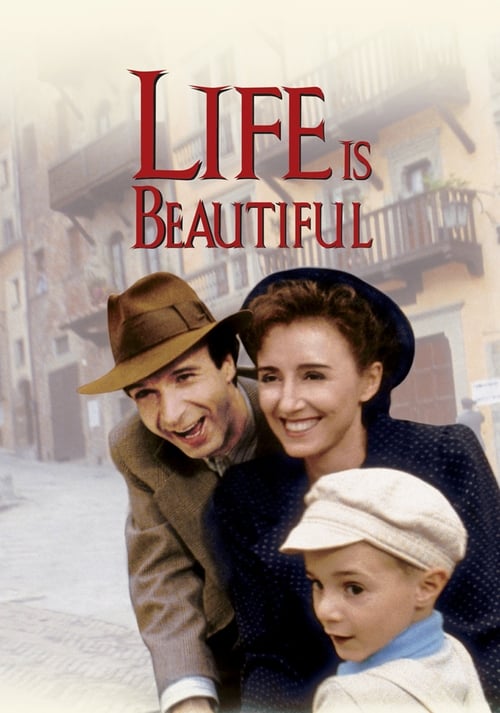
Life Is Beautiful
1997 · Roberto Benigni
For when you need a good cry and want to feel that love can outmaneuver horror, at least for one child. Emotionally heavy but ultimately warming — bring tissues, not popcorn.
What it's about
In late-1930s Tuscany, a charming, irrepressible Jewish bookseller courts the woman of his dreams with elaborate romantic schemes — and wins her. Years later, he, his wife, and their small son are deported to a concentration camp, where he stakes everything on one desperate act of imagination: convincing the boy that the camp is an elaborate game, with a real tank as the grand prize.
The experience
It begins as sunny romantic farce and turns into something that will wreck you — the comedy never stops, which is exactly what makes it devastating. Few films swing this hard between laughter and grief in a single sitting.
Performances
Roberto Benigni's whirlwind performance — clown, romantic, and desperate father in one body — won him the Academy Award for Best Actor, a historic rarity for a non-English-language role. The little boy's unforced sweetness is what makes the whole gamble work.
The craft
Benigni conceived, co-wrote, directed, and stars, and the film's boldest choice is tonal: it approaches the Holocaust as a fable, using comedy's machinery obliquely where realism would go head-on. Nicola Piovani's Oscar-winning score carries the shift from sunlight to shadow.
Why it matters
An international phenomenon — Grand Prix at Cannes, three Academy Awards, and one of the most successful foreign-language films ever released — it also ignited a lasting debate about whether comedy can honestly depict atrocity.
Snapshot
Life Is Beautiful (La vita è bella) is an Italian tragicomedy that splits cleanly into two movements: a sun-warmed romantic farce set in late-1930s Tuscany, and a concentration-camp drama in which a father shields his young son from atrocity by recasting the camp as an elaborate game with a tank as its grand prize. Conceived, co-written, directed by, and starring Roberto Benigni — Italy's most popular comic performer of his generation — the film deliberately abandons documentary realism for the register of a fable, using the disarming machinery of comedy to approach the Holocaust obliquely rather than head-on. It became an international phenomenon, winning the Grand Prix at Cannes in 1998 and three Academy Awards, including a Best Actor prize for Benigni that made him the first performer to win that category for a wholly non-English-language lead. It also became one of the most fiercely debated films of its era, dividing critics over whether comedy and the death camps can ethically share a frame. Its lasting significance lies less in formal innovation than in the cultural argument it provoked about representation, allegory, and the limits of laughter.
Industry & production
The film was produced by Melampo Cinematografica — Benigni's own production company, named for the dog in a story he loved — in association with the Cecchi Gori Group, then one of the dominant forces in Italian commercial cinema. Elda Ferri and Gianluigi Braschi are credited as producers; Braschi was the brother of Nicoletta Braschi, Benigni's wife and the film's female lead, situating the production within a tight family-and-collaborator circle that had characterized Benigni's work for years.
By the late 1990s Benigni was a bankable star at home, having drawn enormous domestic audiences with comedies such as Johnny Stecchino and The Monster, and having gained international visibility through his work with Jim Jarmusch (Down by Law) and Federico Fellini's final film, La voce della luna. That commercial standing gave him the latitude to mount a film on so risky a subject. The production filmed in Italy, with the first half's exteriors shot largely in Arezzo, Tuscany, whose medieval streets and squares supply the storybook texture of Guido's courtship. The camp sequences were staged on constructed sets designed to evoke, rather than reproduce, a specific historical location — a choice consistent with the film's allegorical intentions.
Released in Italy in December 1997, the film was a substantial domestic hit before its festival success abroad converted it into a global event. Its international distribution, handled in the United States by Miramax, was accompanied by an aggressive awards campaign of the kind that studio was then famous for, and the film went on to perform exceptionally well for a subtitled release in English-language markets. Precise grosses vary by source and I won't assign a hard figure here, but it is well established that the film ranked among the highest-earning foreign-language releases in the United States to that point.
Technology
Life Is Beautiful is, technologically, a traditional 35mm photochemical production, and it makes no claim to innovation in capture or post-production. Its interest lies entirely in classical craft rather than novel apparatus. There are no significant digital effects; the period world is built through production design, costume, locations, and lighting. In this sense the film is a late example of an artisanal European mode of filmmaking, and the presence of veteran cinematographer Tonino Delli Colli — whose career stretched back to the postwar era — underscores its rootedness in an older technical tradition rather than the emerging digital toolkit of the late 1990s.
Technique
Cinematography
The photography is by Tonino Delli Colli, one of the most distinguished Italian cinematographers of the twentieth century, with credits including Pier Paolo Pasolini's films, Sergio Leone's Once Upon a Time in the West and Once Upon a Time in America, and Fellini's work. Life Is Beautiful was among his last films, and his contribution is central to the picture's split personality. The Tuscan first half is rendered in warm, golden, high-key light that flatters the comic action and the fairy-tale courtship; the camp half shifts toward a colder, grayer, more muted palette without ever tipping into stark monochrome bleakness. Delli Colli's classical compositional sense — clean stagings, unhurried framing — lends the broad comedy a visual dignity it might otherwise lack, and his restraint in the camp sequences keeps the film within its chosen fabular register, declining the graphic explicitness that more realist Holocaust films employ.
Editing
Simona Paggi edited the film. The editing's most consequential decision is structural rather than moment-to-moment: the film hinges on a hard tonal pivot roughly at its midpoint, when the family is deported and the romantic comedy gives way to the camp. The cutting sustains Benigni's verbal and physical comedy with the timing such performance demands, then must manage the far more delicate task of holding comic rhythm against horror in the second half — most famously in the sequence where Guido pretends to translate a German guard's barked orders into the rules of a children's game. The film's coherence depends on the editing maintaining the fiction of the "game" from the boy's restricted point of view while letting the adult audience register the menace underneath.
Mise-en-scène / staging
Staging is where Benigni's roots in physical comedy and Italian popular theater are most visible. The first half is built around elaborately constructed comic set pieces — recurring gags, mistaken identities, a courtship conducted through running visual jokes — staged with the precision of farce and the spatial logic of commedia dell'arte. The camp half repurposes the same comic apparatus toward protective deception: Guido's improvisations are blocked so that his son's sightlines are managed, the horror kept at the edges of the frame. The production design maintains the storybook quality early and a deliberately stylized austerity later, refusing both the touristic prettiness of some period films and the forensic reconstruction of others.
Sound
Nicola Piovani's score is among the film's most celebrated elements and won the Academy Award for Best Original Dramatic Score. Piovani, a frequent collaborator of the Taviani brothers and of Fellini in his later years, supplies a recurring lyrical theme that carries the film's emotional throughline across both halves, lending the comedy sweetness and the tragedy restraint. The music is unashamedly emotive, and critics who admire the film and those who resist it tend to agree that the score is a primary engine of its sentiment. Beyond music, the sound design leans on Benigni's verbal performance — his rapid, musical Italian — and on the comic counterpoint between languages, particularly the celebrated false-translation scene.
Performance
Benigni's central performance fuses the silent-comedy clown tradition with a verbose, motor-mouthed Italian comic energy entirely his own. As Guido he is in near-constant motion, and the film asks him to carry the impossible double task of being funny enough to sustain a comedy and moving enough to anchor a tragedy. Nicoletta Braschi plays Dora with a grounded warmth that offsets Benigni's mania. The young Giorgio Cantarini, as the son Giosuè, is essential: the entire ethical premise depends on his unknowing credulity reading as authentic. The German actor Horst Buchholz appears as a camp doctor whose earlier friendship with Guido curdles into one of the film's bleakest ironies. The performances were widely praised even by critics skeptical of the project's premise.
Narrative & dramatic mode
The film's defining formal gamble is its bifurcated structure and its commitment to fable over realism. Benigni framed the film openly as a fable, and its opening narration cues the audience to read what follows as a story with the moral weight and stylization of a parable rather than a historical reconstruction. The first half follows the conventions of romantic comedy to their happy conclusion — courtship, obstacle, union, a child. The second half inverts every element: the same ingenuity Guido used to win Dora is now deployed to keep his son alive and ignorant. The dramatic engine is dramatic irony at its most extreme — the audience knows what the child must not — and the film's emotional force, as well as the objections to it, flow from that single device. The choice never to depict the mechanics of mass killing directly is integral to the mode: the film keeps atrocity offscreen and at the periphery, consistent with its fabular self-definition.
Genre & cycle
Life Is Beautiful sits at the intersection of two genres usually held apart: the comedian comedy built around a star clown, and the Holocaust drama. It belongs, on one side, to a lineage of films in which a beloved comic persona drives the picture, and on the other to the substantial cycle of Holocaust cinema that intensified in the 1990s in the wake of Schindler's List (1993). What makes it anomalous within that cycle is its refusal of realism. It is most usefully grouped with the small, contentious tradition of films that approach the Shoah through comedy or allegory rather than documentary gravity — a tradition that reaches back to Chaplin's The Great Dictator and Lubitsch's To Be or Not to Be and forward to later films that would invoke Benigni's example.
Authorship & method
The film is the fullest expression of Benigni as an authorial figure: he directed, starred, and co-wrote it with Vincenzo Cerami, a distinguished novelist and screenwriter who had collaborated with him before and who brought a literary architecture to the comic material. Benigni has said the film was inspired in part by the experience of his own father, who was held for a period in a Nazi labor/concentration camp, and that family memory — passed down as stories told in a way that softened their horror for a child — informs the film's central conceit; Benigni himself is not Jewish. His method as a performer-director is rooted in the Italian popular-comic and commedia tradition, privileging physical invention and verbal velocity. His key collaborators form a notably pedigreed team: cinematographer Tonino Delli Colli and composer Nicola Piovani both carried the authority of long careers in Italian art cinema, editor Simona Paggi shaped the film's risky tonal architecture, and Cerami supplied the script's structure. The casting of Nicoletta Braschi, his wife and recurring screen partner, extends the personal character of the authorship.
Movement / national cinema
The film is a product of Italian national cinema in a commercial-popular rather than avant-garde mode, but it converses pointedly with Italy's most prestigious cinematic inheritance. Italian neorealism, born in the immediate postwar years, had established a national grammar for representing wartime suffering through unvarnished realism; Benigni's film, by choosing fable, defines itself partly against that grammar even as the presence of Delli Colli ties it to that lineage's technical pedigree. It also draws on the Italian tradition of the commedia all'italiana — comedy that smuggles serious social and historical reckoning inside popular laughter. The film should be understood as Italian popular cinema reaching for the moral ambition usually reserved for the country's art-house tradition.
Era / period
Made and released in 1997, the film arrived at a moment of heightened cultural attention to Holocaust memory, four years after Schindler's List and amid an expanding body of memorial culture, testimony projects, and museum-building. Its late-1990s production context — the tail end of the photochemical era, the height of Miramax-style awards campaigning — shaped both its making and its reception. The film's diegetic period is the late 1930s through the early 1940s: Fascist Italy's slide into racial law and war, the courtship unfolding against the rise of anti-Jewish persecution that the comedy initially holds at arm's length before it overtakes the family entirely.
Themes
The film's central theme is the protective power of imagination and love against barbarism — the idea that a parent might preserve a child's innocence even inside the machinery of genocide. Tied to this is the redemptive or escapist function of storytelling itself, dramatized in Guido's literal authorship of a counter-narrative for his son. The film meditates on the relationship between comedy and survival, presenting humor not as trivialization but as a strategy of resistance and care. It also dramatizes the persistence of human dignity and tenderness under dehumanizing conditions. The film's title, which Benigni has connected to a remark attributed to Leon Trotsky, points to a stubborn affirmation of life's beauty held against the evidence — an affirmation that critics read as either profound or evasive depending on their stance toward the whole enterprise.
Reception, canon & influence
The reception of Life Is Beautiful is inseparable from its controversy. The film won the Grand Prix (the runner-up prize) at the 1998 Cannes Film Festival, swept Italy's David di Donatello awards, and at the 1999 Academy Awards won Best Foreign Language Film, Best Original Dramatic Score for Piovani, and Best Actor for Benigni — whose exuberant climb over the seats of the auditorium became one of the most replayed moments in Oscar history. Benigni's win was historic as the first Best Actor award for a lead performance in a non-English-language film. Among many critics the film was embraced as a moving humanist fable and a tour-de-force of comic performance.
Yet a substantial and serious body of criticism judged the film a sentimental falsification — arguing that recasting the camps as the setting for a feel-good fable, however well-intentioned, misrepresents the reality of the Shoah and flatters audiences with consolation the history cannot bear. This debate, conducted in major newspapers and film journals, is itself a significant part of the film's legacy, making it a recurring case study in discussions of Holocaust representation, the ethics of comedy, and the dangers of allegory.
The influences on the film run backward to the clown tradition of Chaplin — especially The Great Dictator — and to the Italian commedia and neorealist inheritance, filtered through Benigni's own comic persona and his family's wartime memory. Its influence forward is felt most clearly in the continuing argument it anchors and in later films that approach Nazism and the Holocaust through comedy or a child's-eye fable; works such as Jojo Rabbit (2019) are routinely discussed in relation to Benigni's precedent, whether as inheritors or as correctives. Within Benigni's own career it was the summit: nothing he made afterward — including his troubled Pinocchio — approached its impact. The film endures less as a stylistic model than as a permanent fixture in the canon of films that force the question of what art owes to historical suffering, and whether laughter can ever be an adequate, or honorable, response to it.
A Deleuzian reading
A German guard stamps into the bunkhouse and starts barking rules.
The full Deleuzian reading of Life Is Beautiful →
Reception
A Cannes Grand Prix winner and word-of-mouth phenomenon that became the highest-grossing foreign-language film in the US at the time, sweeping to three Oscars — but the backlash was almost as loud, with critics debating whether it sanitized the Holocaust. Today it lives a double life: a top-tier IMDb crowd favorite that serious critics still eye warily.
How Life Is Beautiful was received, from release to now →
Influences: the films it descends from and the films it influenced
- The Great Dictator (1940) — The dossier's named lineage: the clown's pantomimic body weaponized against the dictator, so that a Jewish everyman's physical comedy deflates Nazi terror rather than confronting it head-on.
- City Lights (1931) — Source of the tonal-pivot architecture — a single arc that slides from broad slapstick into tearful pathos — which Benigni and editor Simona Paggi reproduce when the labor-camp half turns the gags into grief.
- To Be or Not to Be (1942) — Establishes the conceit of theatrical role-play and staged artifice as a survival tactic against Nazi occupiers, the same 'performance outwits barbarism' premise Benigni rebuilds inside the camp.
- Seven Beauties (1975) — The prior Italian tragicomedy that places a comic survivor literally inside a concentration camp, modeling the risky collision of laughter and atrocity that Benigni's tonal gamble depends on.
- Rome, Open City (1945) — The neorealist template the facets name — Nazi-occupied Italy seen through ordinary people and a child's vantage — supplying the documentary-rooted ground beneath Benigni's fable.
- Bicycle Thieves (1948) — The neorealist father-and-son dyad walking a hostile city, the protective-parent relationship Benigni reworks into Guido shepherding Giosuè through the camp.
- The Garden of the Finzi-Continis (1970) — De Sica's account of assimilated Italian Jews swept into deportation under the Racial Laws supplies the specific historical subject Benigni approaches obliquely rather than documentarily.
- The Great War (1959) — A foundational commedia all'italiana that fuses broad comic banter with an abrupt tragic death, the movement's tragicomic recipe Benigni's bifurcated structure inherits directly.
- The Tin Drum (1979) — The child's-eye fabulist distortion of the Nazi years, in which a boy's invented private logic becomes a refusal of and shield against the surrounding horror.
- Schindler's List (1993) — The canonical realist Holocaust drama (the facets' 'post-Schindler's List' era) whose documentary gravity Benigni both presupposes and deliberately reacts against with fable.
- Europa Europa (1990) — Extends the ironic, fable-tinged mode of Holocaust storytelling Europa Europa legitimized, staking the same wager that play and improvisation can carry catastrophe without trivializing it.
- The Postman (1994) — Extends Il Postino's fusion of commedia all'italiana tenderness with looming tragedy to win major Academy recognition for a subtitled film, consolidating the prestige-foreign market Il Postino opened.
- Pan's Labyrinth (2006) — Extends 'imagination against barbarism' and 'storytelling as survival': a child shielded from fascist brutality by an elaborate invented narrative running parallel to the real terror.
- The Boy in the Striped Pyjamas (2008) — Filters the camp through a child's uncomprehending gaze, inheriting the sustained dramatic-irony device by which the boy reads death as a game the audience sees clearly.
- Jojo Rabbit (2019) — The dossier's explicit inheritor — comedy and a child's-eye fable confronting Nazism, routinely measured against Benigni's precedent as either continuation or corrective.
- Good Bye, Lenin! (2003) — The tragicomic maintained-lie engine: a family member sustains an elaborate, loving fiction to shield a vulnerable relative from a brutal political reality.
- Hope (2013) — The direct model for a father who constructs a protective game or fiction — literalized in Hope's mascot costume — to metabolize a child's trauma into something bearable.
- My Father and My Son (2005) — Demonstrates political atrocity made bearable through father-to-child tenderness and frank, unashamed emotional engineering — the sentiment-first dramaturgy that draws the same 'manipulation' charge leveled at Irmak.
- Room (2015) — Establishes the parent who invents a protective fiction/game to shield a child from the truth of confinement, the survival strategy Ma deploys with Jack.
- Swing Kids (2018) — Pioneers the tonal gamble of yoking broad comedy to wartime atrocity and paying it off with the death of the beloved lead — the tonal-whiplash-into-devastation contract Swing Kids signs.
- The Pursuit of Happyness (2006) — The Italian father who shields and inspires his small son through hardship with sentiment foregrounded, the father-son melodrama Muccino extends into an American register.
- Miracle in Cell No. 7 (2013) — Pioneers the device of a father converting imprisonment into clowning and play to shield a child, driving the comedy-banked-then-cashed-for-grief tonal oscillation that is Lee's core method.
- Amarcord (1973) — The Fellini-Piovani axis (Piovani scored late Fellini) and the mode of comic, fabulist memory of fascist-era provincial Italy that softens history into a child-scaled story.
- Once Upon a Time in America (1984) — Cinematographer Tonino Delli Colli's warm, memory-soft, high-key lensing of the past — the same lighting signature he carries into Life Is Beautiful's golden first half.
- Train of Life (1998) — Released the same year, a Holocaust comedy-fable whose villagers stage a fake deportation train — the identical strategy of comic invention as a collective survival fiction.
- My Sweet Orange Tree (2012) — A sibling in the imagination-as-shield tradition, where an adult protector reframes brutal circumstance as an elaborate game precisely to preserve a child's innocence — the same wager on invented narrative as emotional survival.
- Kaos (1984) — Carries forward Nicola Piovani's fable-tinged, tender orchestral voice — the same composer's method of scoring grief as lullaby — that lifts the Kaos episodes from realism into legend.
Similar films
- Schindler's List (1993) — influence & lineage · same viewing thread · often watched together
- Seven Beauties (1975) — influence & lineage · same viewing thread
- Casablanca (1943) — same viewing thread · often watched together
- The Pianist (2002) — same viewing thread
- Inglourious Basterds (2009) — same viewing thread
- To Be or Not to Be (1942) — influence & lineage · often watched together
- Once Upon a Time in America (1984) — influence & lineage · often watched together
- The Great Dictator (1940) — influence & lineage · often watched together
All the films related to Life Is Beautiful →
Watch it with: curated runs of related films
- In the Shadow of the Reich — A run of films about ordinary people inside the Nazi era — surviving it, resisting it, or trying to reckon with how it happened — that rhyme on conscience, complicity, and who chooses to act.