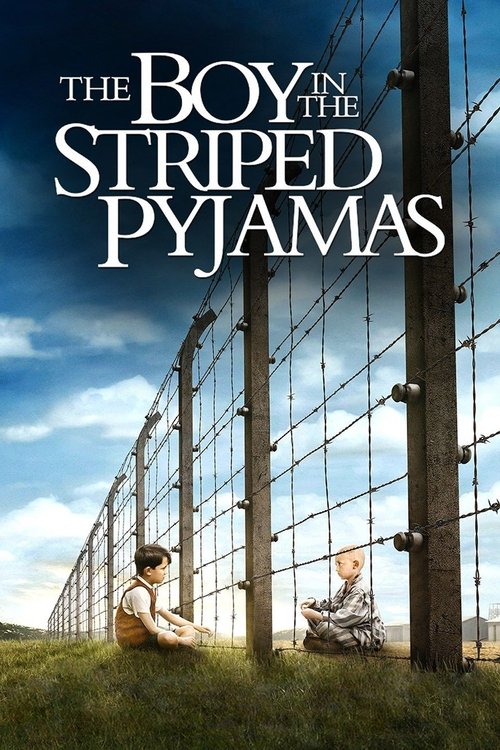
The Boy in the Striped Pyjamas
2008 · Mark Herman
For when you're braced to be wrecked — an accessible, emotionally direct entry point to the hardest subject there is, often watched with older kids and discussed after. Absolutely not a light evening.
What it's about
When his SS-officer father is promoted, eight-year-old Bruno is uprooted from Berlin to a lonely house in occupied Poland, next to what he's told is a 'farm' where everyone wears striped pajamas. Bored and forbidden to explore, he finds his way to the fence and strikes up a friendship with Shmuel, a boy his own age on the other side — never understanding what the place is, or what his own father does there.
The experience
Deceptively gentle for most of its running time — a child's-eye story of boredom, curiosity, and friendship — with horror kept at the edge of the frame, half-understood. The gap between what Bruno sees and what you know builds a dread that pays off with real devastation; it's a film people remember viscerally years later.
Performances
Young Asa Butterfield carries the film with an open, unguarded face that makes Bruno's incomprehension believable, while Vera Farmiga is quietly powerful as a mother slowly realizing what her comfortable life is built on.
The craft
Herman commits almost completely to the child's limited point of view — mishearing names, misreading clues — so the audience assembles the truth Bruno can't. That restraint, plus James Horner's mournful score, gives the film its slow-closing-trap construction and its shattering final movement.
Why it matters
A widely taught, widely wept-over bestseller adaptation that also became a flashpoint: historians and educators still debate whether its child's-eye fable illuminates the Holocaust or softens it. Either way, it shaped how a generation of young viewers first encountered the subject.
Snapshot
The Boy in the Striped Pyjamas is a British-American Holocaust drama adapted by writer-director Mark Herman from John Boyne's 2006 novel. It restricts its perspective almost entirely to Bruno, the eight-year-old son of a Nazi commandant, who befriends a Jewish boy named Shmuel through the wire fence of the extermination camp his father administers. The film's defining formal choice — and the source of both its emotional power and its historical controversy — is that near-total confinement to a child's uncomprehending gaze: the audience is asked to see the machinery of genocide as a bewildered, sheltered boy sees it, half-grasped and mislabeled ("Out-With" for Auschwitz, "the Fury" for the Führer). It belongs to a long line of Holocaust films that approach the subject through the eyes of a child, and it courts the fable's danger — that a story engineered for a specific ironic gut-punch can soften or distort the historical reality it invokes. The picture is compact, restrained, and built entirely toward a single devastating reversal in its final minutes.
Industry & production
The film was produced by David Heyman's Heyday Films in association with BBC Films, with Miramax Films handling production and distribution; it is a UK–US co-production shot largely in Hungary. Heyman is best known as the producer of the Harry Potter franchise, and the project reflects a moment when a prestige literary property with crossover youth appeal could be mounted at mid-budget scale for adult and older-teen audiences alike. Boyne's novel had been a substantial international bestseller, widely adopted in school curricula, which gave the adaptation a built-in readership and a clear educational market — a factor that shaped both its reception and the intensity of the pedagogical objections later raised against it.
Herman both adapted the screenplay and directed, retaining sole writing credit. Principal photography took place in and around Budapest, Hungary, a common stand-in location for period Central European settings owing to cost, architecture, and production infrastructure; the camp exterior and the family's requisitioned house were constructed and dressed for the shoot rather than filmed at any actual historical site. The production is a modestly budgeted prestige drama rather than a large-scale war film, and its resources are concentrated on period detail, a small principal cast, and a controlled number of locations. I do not have reliable box-office figures to cite and will not invent them; the film is generally understood to have performed respectably for a specialized release and to have found a large subsequent audience through home viewing and classroom use.
Technology
The film was photographed on 35mm film, consistent with prestige-drama practice of the late 2000s, before digital acquisition became the norm for this budget tier. There are no notable technological innovations associated with the production — no signature visual-effects breakthrough, no experimental capture method. The technology is in service of a classical, unobtrusive presentation: naturalistic period photography, practical sets and costumes, and restrained optical work. Where the film's ambition lies is in perspective and construction rather than in any tool or technique novel to the medium. This is worth stating plainly, because the film's interest is thematic and structural, not technological.
Technique
Cinematography
Cinematography is by Benoît Delhomme, the French cinematographer whose credits range from Tran Anh Hung's The Scent of Green Papaya to, later, The Theory of Everything and At Eternity's Gate. His work here is disciplined and legible, organized around Bruno's eyeline and physical scale. The camera frequently sits low, at a child's height, and the compositions are dominated by barriers — window frames, banisters, garden walls, and above all the camp fence — that literalize the film's theme of a world seen through and beyond obstructions. The family's Berlin home and the requisitioned house are lit and graded differently: the early Berlin scenes carry a warmer, more open palette, while the new house near the camp is cooler, grayer, and more enclosed, its ash-tinged air a quiet visual motif. The fence encounters are staged with a shallow depth that keeps Bruno and Shmuel in intimate proximity while the wire remains an insistent graphic presence between them. The photography is deliberately controlled rather than showy, withholding the wide, explanatory views of the camp that a more conventional film would supply, so that the audience shares Bruno's partial sightlines.
Editing
The editing, by Michael Ellis, is classical and patient in its first two acts, then tightens sharply in the finale. For most of the running time the cutting favors sustained scenes and clean continuity, allowing performances and the slow accumulation of dread to carry the film. The structural engine is dramatic irony: the audience is positioned to understand more than Bruno does, and the editing rations information to sustain that gap. In the closing sequence the picture cross-cuts between the desperate parents searching outside and the children inside the camp, accelerating the rhythm to build toward the catastrophe. The film's power depends almost entirely on the timing and restraint of this final movement — on what is cut away from and how quickly the ending arrives.
Mise-en-scène / staging
Production and costume design build a persuasive surface of Third Reich domesticity: the crisp uniforms, the ordered household, the propaganda film screened at a dinner party, the servants who are in fact prisoners. The staging repeatedly contrasts bourgeois normality with the horror it borders — a manicured garden abutting a death camp, a birthday celebration held in the shadow of the chimneys. The single most consequential staging decision is the fence itself and what lies beyond it: the film presents an oddly depopulated, quiet stretch of perimeter where a lone child can sit undetected for long stretches, a choice that serves the fable but departs markedly from the reality of a functioning extermination camp. This tension between allegorical staging and historical fact is central to the film's critical afterlife.
Sound
James Horner's score is the film's most prominent sonic element — restrained for much of the running time and swelling at the climax, using strings and a plaintive, childlike simplicity to underline innocence and loss. Sound design otherwise favors quiet: the muffled ambient life of the household, the distant, unseen activity of the camp, and pointed uses of silence. The film generally avoids depicting the sounds of the camp's violence directly, keeping them offscreen and half-heard, consistent with its strategy of partial perception. As with the imagery, the sonic reticence both intensifies the dread and participates in the film's contested habit of holding the historical horror at one remove.
Performance
The performances are the film's ballast. Asa Butterfield, in an early leading role, plays Bruno with an unaffected, watchful naturalism that keeps the child's incomprehension credible; Jack Scanlon as Shmuel is gaunt and grave, and the fence scenes depend on the unforced rapport between the two boys. David Thewlis plays the commandant father with a chilling ordinariness — a devoted family man and an efficient administrator of murder — while Vera Farmiga, as the mother Elsa, charts the film's most dramatically active arc: her gradual, horrified discovery of what her husband's posting actually means. Rupert Friend is coldly brutal as the young Lieutenant Kotler, and Amber Beattie registers the sister Gretel's seduction by Nazi ideology. The ensemble's understatement is essential; the film works to the degree that these are recognizable people rather than monsters, which is also precisely the reading that its critics find morally fraught.
Narrative & dramatic mode
The film's dramatic mode is tragic irony built on a strictly limited point of view. Almost everything is filtered through Bruno's misunderstanding, and the audience's superior knowledge generates a steadily tightening dread. The narrative is essentially a fable — schematic, symmetrical, and engineered toward a single reversal — rather than a realist reconstruction. Its climax delivers a brutal dramatic irony: the commandant who runs the machinery of extermination loses his own child to it, when Bruno crosses under the fence and is swept with Shmuel into the gas chamber. This is the film's raison d'être and its most divisive element. As catharsis it is undeniably potent; as history it inverts the moral reality of the Holocaust by making the emotional catastrophe the death of a German perpetrator's son rather than the deaths of the millions of Jewish victims the camp existed to murder — a critique leveled repeatedly at both novel and film.
Genre & cycle
The film sits within the Holocaust drama, and more specifically within the sub-cycle of Holocaust narratives told through a child's perspective — a lineage that includes the child's-eye estrangement of films like Au revoir les enfants and the tonal experiment of Life Is Beautiful, and that runs alongside other 2008 Holocaust-adjacent prestige releases such as The Reader and Defiance. It also belongs to the broader tradition of the literary adaptation aimed partly at younger audiences and the classroom. Within these overlapping cycles it is distinguished — and attacked — for the radicalism of its restriction to the perpetrator's child and for the counterfactual premise required to sustain its central friendship.
Authorship & method
Mark Herman came to the film from a background in character-driven British comedy-drama — Brassed Off (1996) and Little Voice (1998) — work marked by warmth, strong ensemble playing, and an interest in ordinary people caught in larger social forces. That sensibility is visible here in the domestic texture and the humane attention to the family, even as the subject is vastly darker than his earlier films. As sole screenwriter he made the key adaptive decisions in translating Boyne's spare, allegorical prose into images, including the intensification of the mother's arc and the film's rendering of the camp. His method is fundamentally faithful to the novel's conceit, and the film inherits both its narrative economy and its historical liberties.
Among the key collaborators: cinematographer Benoît Delhomme supplies the barrier-laden, child-scaled visual grammar; composer James Horner provides the score whose plaintive simplicity shapes the film's emotional register and its climactic surge; editor Michael Ellis governs the restraint of the early acts and the cross-cut acceleration of the finale; and producer David Heyman brought the property to the screen through Heyday Films with BBC Films and Miramax. The performances of Thewlis, Farmiga, and the two boys are, in practice, co-authors of the film's effect.
Movement / national cinema
The film is a product of British prestige filmmaking in partnership with American distribution — BBC Films and Heyday on the production side, Miramax on the commercial side — shot in Hungary for economy and period suitability. It does not belong to any formal movement; it is mainstream, classically constructed art-house-adjacent cinema. Its national-cinema identity is essentially transatlantic English-language prestige drama, with the characteristic BBC Films emphasis on literary source material, strong acting, and tasteful craft. Notably, its German characters speak English throughout, a convention that reinforces its status as an anglophone adaptation addressing an international audience rather than a work rooted in German or Central European cinema.
Era / period
The film is set during the Second World War at an unnamed extermination camp readily identifiable as Auschwitz, and it depicts the domestic life of a Nazi commandant's family relocated to the camp's vicinity. As a 2008 production it arrives at a moment when the Holocaust film had a long, self-conscious history and when debates about representation, aestheticization, and the ethics of fiction set at the camps were well established. It participates in a late-2000s cluster of high-profile Holocaust-themed prestige films and reflects that period's tension between the desire to keep the memory vivid for new (and younger) audiences and the risk of distortion inherent in fictionalizing an event of this magnitude.
Themes
The film's central themes are innocence and complicity, and the limits of a sheltered perspective. Bruno's incomprehension dramatizes how ordinary people lived beside atrocity while refusing or failing to see it; the fence is the recurring emblem of divisions — between German and Jew, seen and unseen, knowledge and ignorance — that the child naively crosses. The banality of evil is embodied in the father's dual role as loving parent and mass murderer, and in the household's smooth normality. The mother's arc dramatizes moral awakening within the perpetrator class. Indoctrination is figured through the sister's ideological seduction and the children's tutor. Running beneath all of this is the film's most debated thematic gambit — the equation of a perpetrator's grief with the reader's or viewer's, and the question of whether a fable can honor a historical horror or must inevitably falsify it.
Reception, canon & influence
Critical reception was sharply divided, and that division has hardened over time. Many reviewers and audiences responded to the film's emotional force, the strength of the performances, and the shattering effect of its ending; it was recognized in awards contexts associated with British independent film and festival programming, though I will not attribute specific wins I cannot verify. Against this stood a substantial and, over the years, increasingly dominant body of criticism — from historians, Holocaust educators, and institutions including the Auschwitz-Birkenau Memorial — objecting that the film (like Boyne's novel) rests on historical impossibilities: children Bruno's age were generally murdered on arrival rather than surviving to loiter at an unguarded fence, and the depopulated, quietly accessible perimeter it depicts bears little relation to the realities of the camp. The deeper objection is moral: that by routing the tragedy through the death of a German commandant's son, the story centers perpetrator innocence and risks fostering a false sense of shared victimhood, and that its wide use in schools amplifies these distortions.
Its influences run backward to the tradition of child's-perspective war and Holocaust narratives and to the fable form itself, and directly to John Boyne's source novel, whose conceits and limitations the film faithfully carries. Its forward legacy is twofold and unusual: it became a durable fixture of Holocaust education and a widely watched entry point to the subject for young viewers, and — precisely because of that reach — it became a central case study in ongoing debates about how the Holocaust should and should not be represented in popular fiction. Its lasting significance may lie less in what it shaped stylistically than in the argument it continues to provoke about the ethics of the Holocaust fable — a debate in which the film is now most often cited as a cautionary example.
Reception
A modest arthouse-adjacent hit in 2008 that audiences embraced far more than critics, it became a fixture of school classrooms — and has since been sharply reappraised, with the Auschwitz Memorial and Holocaust educators publicly warning against using it to teach the subject.
How The Boy in the Striped Pyjamas was received, from release to now →
How to watch The Boy in the Striped Pyjamas: what to notice on a first viewing
- Watch how low the camera sits, at a child's height. Delhomme organizes nearly every setup around Bruno's eyeline and his size. Adults are seen from below. The wide explanatory views a war film usually supplies never arrive. You are held to what an eight-year-old can see from where he is standing, which is the film's entire method.
- Count the window frames, banisters, and railings between you and Bruno. Delhomme loads the compositions with barriers. Bruno looks through glass, through stair rails, over garden walls, and finally through wire. Something is almost always in the way. Obstruction arrives as a physical fact in the frame long before anyone in the house talks about it.
- Watch the color cool down once the family leaves Berlin. The Berlin house is warmer and more open. The requisitioned house near the camp is grayer and closed in, with an ash tint in the air that nobody remarks on. The grading tells you what this posting is before any adult in the household will say it out loud.
- Listen for what carries from the camp but is never shown. Herman keeps the violence offscreen and half-heard. Household ambience stays hushed, and distant activity reaches the garden without ever being named or pictured. You are kept at the same distance Bruno is. That distance is the film's engine and the thing Holocaust educators object to.
- Watch how ordinary Thewlis plays the father at home. The commandant is affectionate with his children and efficient at his work, and Thewlis never marks the difference. The household runs smoothly around him: crisp uniforms, dinner parties, servants who are prisoners. The film only works if these read as recognizable people, and that is exactly what the argument about it turns on.
The whole guide to watching The Boy in the Striped Pyjamas, with the keys for a rewatch →
Influences: the films it descends from and the films it influenced
- Forbidden Games (1952) — Establishes the template of filtering wartime death through a child's uncomprehending ritual, letting dramatic irony arise from the gap between the child's play-logic and the adult horror the audience reads over her shoulder.
- Au revoir les enfants (1987) — The direct model for a cross-the-line boyhood friendship staged under limited child POV, where the Jewish reality stays largely unspoken and the deportation is delivered through restraint and offscreen fate rather than depicted atrocity.
- The Tin Drum (1979) — Pioneers the literal child-height camera and low, waist-level framing that renders the rise of Nazism as something glimpsed from below by a boy who refuses or fails to comprehend it.
- Empire of the Sun (1987) — Sustains an entire WWII narrative through a boy's partial, romanticizing comprehension, using boy-scaled framing and awe where the audience supplies the dread the child cannot.
- Come and See (1985) — Anchors atrocity to a single child's face held as helpless witness, binding the viewer to a limited juvenile vantage from which the full scale of murder is sensed rather than shown.
- Schindler's List (1993) — Supplies the color-palette-contrast device (the red coat against monochrome) and the strategy of implying mass killing through offscreen sound and elision, the visual grammar Herman softens into fable.
- Life Is Beautiful (1997) — The decisive precedent for the Holocaust-as-fable gambit — shielding a child from camp reality through invented benign logic — inheriting both its narrative economy and the exact ethical controversy the seed film reignites.
- Hope and Glory (1987) — Domesticates WWII into the texture of family and household seen from a child's eye level, the humane domestic-texture instinct Herman carries over from his character-driven British comedy-drama roots.
- The Diary of Anne Frank (1959) — Codifies confining the Holocaust to a single sheltered vantage where genocide presses in entirely from offscreen, the violence kept beyond walls and only heard or feared.
- The Book Thief (2013) — Extends the BBC-prestige, child-POV literary adaptation of Nazi Germany, using an innocent's limited comprehension and a plaintive orchestral score to sentimentalize the period for a young readership-turned-audience.
- Son of Saul (2015) — The corrective descendant that radicalizes offscreen-violence sound design and shallow-focus limited POV — the camp rendered as blurred, roaring periphery around one face — repudiating the seed film's clean, loiterable fence.
- Jojo Rabbit (2019) — Reworks the child's-eye fable of Nazism through dramatic irony, staging innocence-and-complicity from a boy's indoctrinated vantage while foregrounding, via satire, the very manipulation the seed film leaves earnest.
- The Zone of Interest (2023) — The definitive answer film: it seats the commandant's serene domestic idyll against the camp wall, delivering the banality of evil and the genocide entirely through barrier compositions and offscreen sound — the perpetrator-family frame the seed film uses for pathos, turned to indictment.
- Pan's Labyrinth (2006) — Runs a child's fable structure in parallel with fascist violence and climaxes on crosscutting between innocent ritual and lethal reality, using barrier compositions (thresholds, walls, gates) the same way to divide the child's world from the adult horror.
- The Reader (2008) — A contemporaneous prestige literary adaptation built on the banal-perpetrator performance and the banality-of-evil theme, centering an ordinary German's complicity in the same register Thewlis's commandant occupies.
Similar films
- The Tin Drum (1979) — influence & lineage · same viewing thread
- Come and See (1985) — influence & lineage · often watched together
- Schindler's List (1993) — influence & lineage · often watched together
- Jojo Rabbit (2019) — influence & lineage
- Au Revoir les Enfants (1987) — influence & lineage
- Son of Saul (2015) — influence & lineage
- The Zone of Interest (2023) — influence & lineage
- Empire of the Sun (1987) — influence & lineage
All the films related to The Boy in the Striped Pyjamas →
Watch it with: curated runs of related films
- War Through a Child's Eyes — Watch these in a run for how each sets a small, watchful child in front of a history far too big to understand — occupation, civil war, dictatorship, genocide — so the child's innocence throws the adult brutality into unbearable relief.