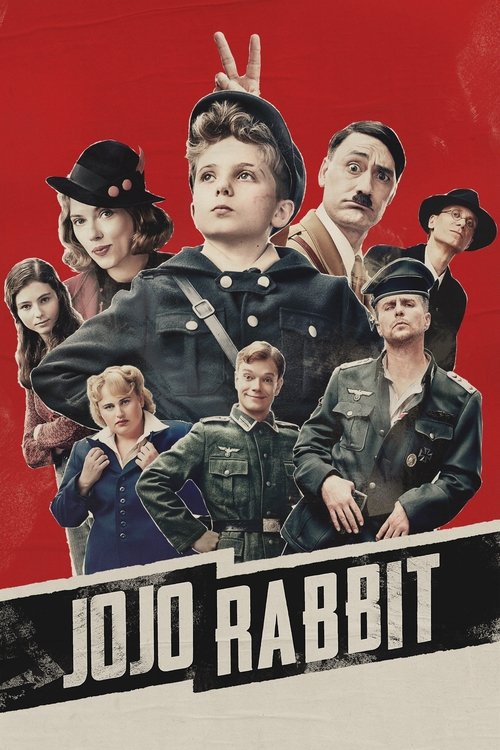
Jojo Rabbit
2019 · Taika Waititi
When you want to laugh and cry in the same evening — a film with a big heart that doesn't let the comedy off the hook. Comfort viewing with teeth; good for a night when you want to feel something without being flattened.
What it's about
In the last months of World War II, ten-year-old Jojo is a lonely, fervent member of the Hitler Youth whose best friend is an imaginary, buffoonish Adolf Hitler. Then he discovers his single mother is hiding a Jewish girl behind the walls of their house. Everything the propaganda taught him collides with an actual person, and the film follows a child slowly unlearning hate while his world falls apart around him.
The experience
A tonal high-wire act that swings from silly to devastating, sometimes within a single scene — you laugh, then it lands a punch you didn't see coming. It's warm and whimsical on the surface with real grief underneath, and the gear-shifts are the whole point.
Performances
Roman Griffin Davis is remarkable as Jojo — funny and heartbreaking in a debut that carries the whole film. Scarlett Johansson brings sly warmth as his mother, Thomasin McKenzie gives the hidden girl wit and steel instead of victimhood, and Sam Rockwell steals scenes as a washed-up Wehrmacht captain. Waititi himself plays imaginary Hitler as a needy clown.
The craft
Waititi's Oscar-winning adapted screenplay threads satire, tenderness, and horror without dropping any of them, helped by candy-colored production design that shows Nazi Germany the way a besotted ten-year-old would see it. Anachronistic pop needle-drops and precise visual gags keep the child's-eye view consistent even as reality darkens.
Why it matters
It premiered to a People's Choice Award at Toronto, won the Academy Award for Best Adapted Screenplay, and cemented Waititi as a filmmaker who could sell a seemingly unmakeable premise as an 'anti-hate satire.' It reignited a long-running argument about whether comedy belongs anywhere near this history.
Snapshot
Jojo Rabbit is a tonal high-wire act: a coming-of-age comedy about a ten-year-old Hitler Youth member set in the collapsing final months of Nazi Germany, narrated through the boy's fantasy of Adolf Hitler as a goofy, reassuring imaginary friend. Taika Waititi wrote, directed, and played the imaginary Führer, billing the project as an "anti-hate satire." Adapted loosely from Christine Leunens's somber 2008 novel Caging Skies, the film grafts Waititi's whimsical, deadpan sensibility onto Holocaust-adjacent material, using a child's-eye view to dramatize how propaganda is absorbed and, painstakingly, unlearned. It premiered at the Toronto International Film Festival in September 2019, won the festival's People's Choice Award — historically a strong Academy bellwether — and went on to win the Oscar for Best Adapted Screenplay, with five further nominations including Best Picture. Critically it was genuinely divisive, embraced for its emotional warmth and attacked for declawing its subject, making it one of the more debated prestige releases of its year.
Industry & production
The film was produced and distributed by Fox Searchlight Pictures, with Waititi's company Defender Films and Czech Anglo Productions among the production entities, and Waititi producing alongside Carthew Neal and Chelsea Winstanley. Its development history is unusually long: Waititi reportedly wrote a draft of the screenplay around 2011–2012, well before his profile rose through Hunt for the Wilderpeople (2016) and Marvel's Thor: Ragnarok (2017). The script circulated and gained industry visibility years before financing came together, and Waititi has said publicly that the project's premise — a sympathetic Hitler Youth protagonist and a comic Hitler — made it a hard sell. His commercial success on Ragnarok is generally credited with giving him the leverage to mount it.
Principal photography took place in 2018 in the Czech Republic, with Prague and the town of Žatec standing in for the fictional German town of Falkenheim. The production notably straddled the Disney acquisition of 21st Century Fox; Jojo Rabbit was among the Fox Searchlight titles that completed and released under Disney ownership, an unusual corporate provenance for a transgressive satire. Exact budget and box-office figures are widely reported but I will not cite specific numbers here without certainty; it is fair to characterize the film as a modestly budgeted prestige production that performed respectably theatrically and outperformed expectations through its awards run. The TIFF People's Choice win was the pivot point of its release strategy, converting a risky property into an Oscar contender.
Technology
Jojo Rabbit is not a technically experimental film in the sense of new capture or post-production tools; its sophistication lies in classical craft executed with precision. It was shot digitally and finished with a controlled, painterly digital color grade that pushes a heightened, storybook palette — autumnal golds, candy reds, dusty greens. The film leans on practical period production design and costume rather than heavy visual effects; its few large-scale elements, including the climactic battle for the town, are staged with a mix of practical action and restrained digital augmentation. Where technology matters most is in the integration of music and image — the precise synchronization of needle-drops to montage — and in the disciplined lighting that keeps a comic-book brightness without tipping into flatness. In short, the film's "technology" is the invisible, conventional infrastructure of mid-budget prestige filmmaking deployed in service of a stylized authorial vision.
Technique
Cinematography
The cinematographer is Mihai Mălaimare Jr., known for his work with Paul Thomas Anderson (The Master) and Francis Ford Coppola. His photography here favors symmetry, centered framing, and a bright, saturated, almost picture-book look that has invited frequent comparison to Wes Anderson. Wide-angle compositions and clean geometric framing render Jojo's world as orderly and toy-like — appropriate to a child who experiences fascism as pageantry and adventure. As the narrative darkens, the visual scheme does not abandon its prettiness so much as let cruelty intrude into it, a deliberate friction between charming surface and horrific substance. Several compositions deploy low angles and the boy's literal sightline to keep the audience inside Jojo's limited, indoctrinated perspective.
Editing
Tom Eagles, Waititi's editor from Hunt for the Wilderpeople, cut the film and earned an Academy Award nomination for it. The editing is central to the comedy: Waititi's humor depends on timing — the held beat, the abrupt cut to an absurd reaction, the deadpan pause — and Eagles's rhythm modulates constantly between farce and gravity. The film's most discussed structural choice is editorial in nature: the sudden, withholding cut at the moment of the mother's fate, which lets visual information arrive before the emotional comprehension does. The montage sequences scored to pop songs are also editorial set-pieces, compressing ideological fervor or emotional release into music-driven bursts.
Mise-en-scène / staging
Production designer Ra Vincent and costume designer Mayes C. Rubeo (both contributed to the film's craft nominations) build a heightened, fabricated Germany that reads as a child's diorama. Interiors — especially the family home with its hidden crawlspace behind a bedroom wall — are richly detailed and warm, contrasting domestic intimacy against the regime outside. Costuming is vivid and slightly exaggerated, with the Hitler Youth uniforms and Captain Klenzendorf's increasingly flamboyant self-designed battle dress functioning as visual commentary on the theatricality of fascist masculinity. The imaginary Hitler is staged as a figure of domestic farce — lounging, snacking, throwing tantrums — deliberately scaled to a ten-year-old's imagination rather than to history.
Sound
The soundtrack is one of the film's signature gestures. Michael Giacchino composed the orchestral score, but the most memorable musical choices are licensed: the film opens on German-language Beatles ("Komm, Gib Mir Deine Hand," i.e. "I Want to Hold Your Hand") laid over archival-style footage of Nazi rallies edited to evoke Beatlemania, drawing a pointed equivalence between fan hysteria and political mania. It closes on the German-language version of David Bowie's "Heroes" ("Helden"). These anachronistic, pop-cultural choices frame fascism as a youth-culture phenomenon and give the film its thesis in sonic form. Diegetic sound and the comic use of silence around violent moments also do significant work.
Performance
The film is anchored by Roman Griffin Davis in his screen debut as Jojo, a performance that must carry naivety, cruelty, grief, and awakening without becoming cloying. Thomasin McKenzie plays Elsa, the hidden Jewish teenager, with a guarded, sardonic intelligence that refuses victimhood. Scarlett Johansson, Oscar-nominated for Best Supporting Actress, plays Rosie, the mother, with a buoyant tenderness that conceals active resistance; her performance supplies the film's moral center. Sam Rockwell's Captain Klenzendorf modulates from comic bureaucrat to ambiguous protector. Archie Yates provides comic relief as Yorki, and Waititi's own Hitler is played broadly as a needy, buffoonish projection. The ensemble's tonal calibration — knowing when to play absurdity straight — is the performance achievement that makes the genre fusion cohere.
Narrative & dramatic mode
The dramatic engine is a child's moral education staged as the dismantling of an internal propaganda apparatus. Jojo's imaginary Hitler is an externalized superego of indoctrination; the film's arc is the gradual discrediting and eventual expulsion of that voice as lived experience — his mother's love, Elsa's humanity, the regime's collapse — overrides ideology. The mode is comic-sentimental with deliberate intrusions of tragedy, structured around dramatic irony: the audience understands the stakes that Jojo cannot. The household-bound nature of the central situation (a hidden person behind a wall) gives the film a chamber-drama tension beneath its broad comedy. Crucially, the film withholds and then delivers grief in ways that recalibrate the comedy retroactively, asking the viewer to feel the cost of what was being laughed at.
Genre & cycle
Jojo Rabbit belongs to the lineage of comedies that satirize Nazism and fascism — a tradition that runs through Charlie Chaplin's The Great Dictator (1940), Ernst Lubitsch's To Be or Not to Be (1942), Mel Brooks's The Producers (1967), and, more controversially, Roberto Benigni's Life Is Beautiful (1997), to which it is most often compared for combining the Holocaust era with sentiment and humor. It also sits within the coming-of-age genre and the "child's-eye view of war" tradition. Its release coincided with a small cluster of late-2010s films and series grappling with resurgent nationalism, and it can be read as part of a contemporary cycle of works using historical fascism as a mirror for present politics. The film's hybridity — refusing to be purely satire, purely drama, or purely whimsy — is exactly what made its genre placement contentious.
Authorship & method
This is unambiguously an auteur work: Waititi wrote the adapted screenplay, directed, played a principal role, and produced. His method fuses the deadpan, improvisation-friendly comic sensibility developed in New Zealand cinema (Boy, What We Do in the Shadows, Hunt for the Wilderpeople) with a sincere emotional core, typically centered on children and surrogate-family dynamics. Of personal note, Waititi is of Māori and Russian-Jewish heritage, a biographical fact he has cited in connection with the audacity of playing Hitler. His key collaborators here are a recurring or carefully chosen team: editor Tom Eagles (a Wilderpeople veteran), cinematographer Mihai Mălaimare Jr., composer Michael Giacchino, production designer Ra Vincent, and costume designer Mayes C. Rubeo. The adaptation method is notably free: Leunens's Caging Skies is a dark, largely humorless psychological novel that continues past the war's end, and the imaginary Hitler is entirely Waititi's invention. The screenplay's transformation of that source into a comic fable is the film's defining authorial decision and the one the Academy specifically honored.
Movement / national cinema
While Jojo Rabbit is an international, Hollywood-financed production shot in the Czech Republic with a multinational cast, its sensibility is rooted in a recognizable wave of New Zealand comedy filmmaking that Waititi helped define — character-driven, deadpan, melancholic-yet-warm, often built around outsider children. In that sense the film exports an Antipodean comic idiom into a European historical setting and a global prestige marketplace. It is not part of a national cinema movement in the strict sense; rather it represents the arrival of a New Zealand auteur sensibility within the Anglo-American studio specialty-film system, a trajectory enabled by Waititi's prior Marvel success.
Era / period
The film depicts the final months of the Third Reich, roughly 1944–45, culminating in the Allied advance and the fall of the town. But its production context — released in 2019 — is inseparable from its meaning. Waititi made and promoted the film explicitly as a response to a contemporary moment of rising nationalism, online radicalization, and resurgent far-right movements in the United States and Europe. The choice to frame fascism as a seductive youth subculture, scored to pop music, reads as a deliberate address to the present rather than a museum-piece period drama. The film thus operates on two temporal registers at once: 1945 as setting, the late 2010s as target.
Themes
The central theme is indoctrination and its undoing — how hatred is taught to children as belonging, identity, and play, and how it can be dislodged by direct human contact with the dehumanized "other." Love, particularly maternal love and the surrogate family, is positioned as the antidote to ideology; Rosie's quiet resistance and Elsa's refusal to be an abstraction are the moral counterweights to Jojo's imaginary Führer. The film examines the theatricality and absurdity of fascist masculinity, the vulnerability of the lonely and the marginal to extremist recruitment, and the persistence of imagination as both a vector for propaganda and, ultimately, a tool of liberation. Dance recurs as a motif of freedom — "let everything happen to you," in the Rilke epigraph the film invokes — and the closing image of dancing in the street crystallizes the theme of survival as joyful defiance.
Reception, canon & influence
Critical reception was strongly divided, and that division is itself the film's most interesting reception fact. Admirers praised its tonal daring, its emotional generosity, Johansson's and the child actors' performances, and its rendering of indoctrination from the inside; the TIFF People's Choice Award and six Academy Award nominations — Best Picture, Best Adapted Screenplay (won), Best Supporting Actress (Johansson), Best Film Editing, Best Production Design, and Best Costume Design — testify to substantial industry endorsement. Detractors argued that the satire was toothless, that the whimsical mode trivialized or sanitized the Holocaust, and that a comic, lovable Hitler risked defanging the very evil it meant to mock; the "Nazi-lite" critique recurred across several major reviews. This is a film whose canonical status is contested rather than settled.
Influences on the film run backward through the anti-fascist comedy tradition — Chaplin, Lubitsch, Brooks, Benigni — and through the symmetrical, heightened storybook aesthetics associated with Wes Anderson, as well as Waititi's own New Zealand body of work. Its source novel, Leunens's Caging Skies, is the literary substrate, though radically transformed. Looking forward, the film's most concrete legacy is the Oscar-winning screenplay that confirmed Waititi's standing as a major author able to move between blockbuster and personal cinema, and its reinforcement of a strain of "sincere whimsy" in 2010s–2020s prestige comedy. Roman Griffin Davis and Thomasin McKenzie both gained significant career visibility from it. Its longer-term influence on the genre is still being written, and the record there is genuinely thin; what is clear is that Jojo Rabbit became a reference point in the ongoing critical argument over whether, and how, comedy can responsibly confront atrocity.
A Deleuzian reading
A boy stands at the mirror in his brown uniform, working up the nerve to be a good little Nazi, and Adolf Hitler leans into frame to coach him.
The full Deleuzian reading of Jojo Rabbit →
Reception
It split critics hard out of the gate — 'anti-hate satire' was mocked as a marketing tagline even as it won the TIFF People's Choice Award — then rode that audience love to six Oscar nominations and a Best Adapted Screenplay win. The critic-audience gap never really closed; it just settled into the film's identity.
How Jojo Rabbit was received, from release to now →
Influences: the films it descends from and the films it influenced
- The Great Dictator (1940) — Establishes the auteur-comedian personally impersonating Hitler to shrink the tyrant into a ridiculous physical-comedy buffoon — the exact gambit Waititi revives by casting himself as the imaginary Führer.
- To Be or Not to Be (1942) — Pioneers the tonal calibration of broad farce staged literally inside the Reich, daring laughs against occupation and murder without dissolving the threat — Jojo's central tightrope.
- The Producers (1967) — Models defanging-by-kitsch: rendering Hitler as gaudy musical spectacle so ridicule becomes the anti-fascist weapon, the strategy underpinning Jojo's comic-fable mode.
- Life Is Beautiful (1997) — The cited template — an adult's invented game/fantasy shields a child from genocidal reality, supplying the fable structure that converts atrocity into protective play.
- Au revoir les enfants (1987) — Filters the Holocaust through a boy's limited sightline and a cross-divide friendship with a hidden Jewish child — the child's-POV and concealed-Jew armature Jojo inherits.
- The Tin Drum (1979) — Renders Nazi Germany through a child's grotesque, distorted gaze, legitimizing the heightened, childlike sightline on fascism that Jojo adopts.
- Moonrise Kingdom (2012) — Source of the symmetrical centered framing, dollhouse storybook production design, and child-runaway protagonists that define Jojo's visual grammar.
- The Grand Budapest Hotel (2014) — Confectionary symmetrical mise-en-scène with creeping fascism intruding on a pastel toy-world — the precise tension of whimsical design versus historical horror Jojo replicates.
- Harold and Maude (1971) — Marries morbid subject matter to whimsical tone and a pointedly curated pop soundtrack, prefiguring Jojo's tonal mix and anachronistic needle-drop scoring.
- Marie Antoinette (2006) — Scores a period setting with anachronistic pop needle-drops to collapse historical distance — the soundtrack device Jojo deploys via German-language Beatles and Bowie.
- Fight Club (1999) — Builds an externalized imaginary companion who embodies the protagonist's id as a fully staged character, the formal device behind Jojo's superego-made-flesh Adolf.
- Boy (2010) — Waititi's own prototype: a child clings to an idealized fantasy figure projected as a character, fused with New Zealand deadpan — the imaginary-mentor mechanism Jojo perfects.
- Belfast (2021) — Extends the sincere-whimsy strain by viewing sectarian political violence through a child's warm, storybook sightline, the prestige-comedy-of-atrocity mode Jojo helped cement.
- Thor: Love and Thunder (2022) — Perfected Waititi's comedy-tragedy braid — staging a child's and a mother's death through whimsical comic setups — the exact tonal machine reused for Jane's cancer and Gorr's dead daughter.
- What We Do in the Shadows (2014) — Codifies Waititi's deadpan comic timing and punchline-via-delayed-cut rhythm, the editing sensibility Jojo applies to genocidal subject matter.
- Thor: Ragnarok (2017) — Imports Waititi's improvisation-friendly tonal calibration and deadpan into large-scale spectacle, demonstrating the authorial method Jojo applies to historical material.
- Good Bye, Lenin! (2003) — Tragicomedy that filters an authoritarian regime through a protective childlike fantasy, balancing whimsy against political horror in the same tonal tightrope as Becker's domestic fable.
- Devils on the Doorstep (2001) — Tunes occupation comedy so the farce collapses precisely at the moment violence becomes literal, echoing this film's editing pivot from comic tempo to horror.
Similar films
- Au Revoir les Enfants (1987) — influence & lineage
- The Great Dictator (1940) — influence & lineage
- The Tin Drum (1979) — influence & lineage
- Hunt for the Wilderpeople (2016) — influence & lineage
- Joker (2019) — shared sensibility
- The Boy in the Striped Pyjamas (2008) — shared sensibility
- The Boy and the Heron (2023) — shared sensibility
- Guillermo del Toro's Pinocchio (2022) — shared sensibility