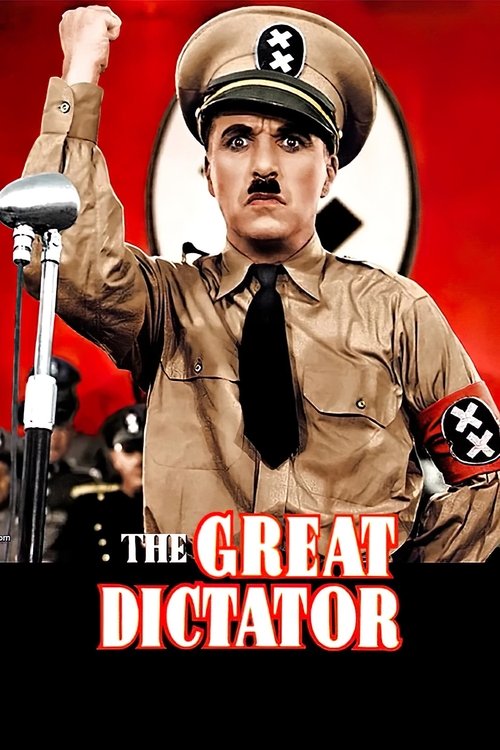
The Great Dictator
1940 · Charlie Chaplin
For when you want comedy with a spine — to laugh at a tyrant and come away moved. Great when the news has you despairing and you need proof that art can talk back.
What it's about
Charlie Chaplin plays two men with the same face: Adenoid Hynkel, the strutting dictator of Tomainia with dreams of empire, and a humble Jewish barber who returns from a long hospital stay to find his neighborhood under the boot of Hynkel's regime. Made while Hitler was at the height of his power, it dares to answer fascism with slapstick — pratfalls, mistaken identity, and a dictator dancing with a globe.
The experience
Genuinely funny — the physical comedy is vintage Chaplin — but with a moral seriousness that keeps breaking through the gags. It builds to a finale of startling directness that still lands like a punch eighty years on.
Performances
Chaplin's double act is astonishing: the barber all silent-era tenderness, Hynkel a full-body caricature of ego, spitting gibberish oratory. It's a masterclass in playing power and powerlessness in one face.
The craft
Chaplin's first true sound film, and he uses the new tool brilliantly — nonsense speeches, comic sound gags, and set pieces choreographed like ballet, including a dance with an inflatable globe that's among the most famous scenes ever shot. He wrote, directed, scored, and starred.
Why it matters
One of the boldest acts of political satire in movie history — a Hollywood star ridiculing Hitler in 1940, before America entered the war — and Chaplin's biggest box-office hit.
Snapshot
Charlie Chaplin's The Great Dictator is a satirical comedy about the rise of fascism in a thinly veiled version of Nazi Germany, following two men who share an identical face: Adenoid Hynkel, the megalomaniacal dictator of Tomainia, and a nameless Jewish barber who has spent years recovering from a World War I head wound in a hospital and returns to his ghetto unaware of how profoundly the world has changed. The film climaxes in one of cinema's most discussed endings — a direct address to the audience in which the barber, mistaken for Hynkel, steps to a podium and delivers an impassioned plea for human brotherhood. It was Chaplin's first fully dialogue-driven sound film, his most commercially successful production, and the last work in which he deployed anything resembling his silent-era Tramp persona. Released in October 1940, while the United States remained officially neutral and Britain stood alone against Germany, the film constituted an act of political courage as well as an artistic gamble.
Industry & production
Chaplin began developing the project in the late 1930s, financing it entirely himself through his arrangement with United Artists, the studio he had co-founded in 1919 with Douglas Fairbanks, Mary Pickford, and D.W. Griffith. His independence from the major studios gave him the freedom to make a film that the Hollywood establishment, acutely wary of alienating European markets and of provoking accusations of warmongering, would not have green-lit. Principal photography took place at the Charles Chaplin Studios on La Brea Avenue in Hollywood, beginning in late 1938 and extending through mid-1939, with post-production and reshoots continuing into 1940.
The casting reflected Chaplin's characteristic mix of loyalty and deliberate choice. Paulette Goddard, his companion and later wife, played Hannah, the barber's neighbor and eventual love interest; she had appeared in Modern Times (1936) and brought an energetic physicality suited to the ghetto scenes. Jack Oakie was hired to play Benzino Napaloni, the buffoonish dictator of Bacteria (a barely coded Mussolini), and his performance — broad, blowsy, irrepressible — earned him an Academy Award nomination. The supporting cast included Henry Daniell as Garbitsch, Hynkel's cold ideological adviser, and Billy Gilbert as Herring, his hapless military attaché.
Production was shadowed by the escalating crisis in Europe. By the time the film was released in October 1940, France had fallen and the Battle of Britain was underway. The film's tone, consequently, landed differently than it might have even a year earlier; what had been conceived partly as absurdist comedy arrived as something closer to political document.
Technology
The Great Dictator represented Chaplin's full capitulation to sound, a technology he had famously resisted long after the rest of Hollywood adopted it. City Lights (1931) and Modern Times (1936) had both incorporated synchronized music and sound effects while eschewing synchronized dialogue; The Great Dictator was the first Chaplin film built around the spoken word. His voice — clipped, mid-Atlantic, expressive — proved a genuine instrument, capable of comic timing as precise as any physical gag.
The production used synchronous sound recording throughout, with the studio facilities at Chaplin's own lot. One technical curiosity: the infamous "Phooey" speech and several of Hynkel's pseudo-German tirades were recorded with careful attention to rhythm over intelligibility, functioning almost as sonic slapstick — a reminder that even in sound, Chaplin was thinking in musical rather than strictly linguistic terms.
The globe sequence, in which Hynkel dances in ecstatic solitude with an enormous inflatable balloon painted to resemble the earth, required both a large practical prop and careful choreography to preserve the illusion of weightlessness. When the balloon finally bursts, the practical effect carries symbolic weight no optical trick could have achieved as cleanly.
Technique
Cinematography
The film was shot by Roland Totheroh, who had been Chaplin's cameraman since the mid-1910s and whose long collaboration gave the director a reliable, unfussy visual grammar, and Karl Struss, brought in to supplement Totheroh with a more polished Hollywood-industry approach to lighting and composition. Struss had photographed Sunrise (1927) for Murnau and brought to The Great Dictator a controlled luminosity, particularly evident in the ghetto sequences, where low-key interiors convey warmth and enclosure simultaneously.
The visual strategy bifurcates to match the film's dual world. Hynkel's palace and parade grounds are rendered with expressionistic ambition: vast, high-ceilinged spaces, banners and insignia, diagonal shadow. The ghetto is kept intimate, shot in tighter compositions that emphasize human proximity. When the camera follows Hannah and the barber through cobblestone streets, the scale contracts around them in a way that feels protective. This contrast is never schematic but consistently operative.
Editing
Chaplin maintained close editorial control throughout his career, and The Great Dictator is no exception, though the credited collaborators on post-production are less celebrated than his cinematographers. The pacing reflects his silent-film instincts: gags are allowed to breathe, scenes are not cut until they have run to completion, and the globe dance is permitted an unbroken, almost hypnotic duration that would make most studio editors uneasy. The structural cut between Hynkel and the barber is managed through parallel editing, alternating worlds without the kind of ironic juxtaposition that might feel cheap; the comedy arises from accumulation rather than collision.
Mise-en-scène / staging
The set design for Tomainia's palace and public spaces — directed by J. Russell Spencer — is explicitly satirical, aping the architectural megalomania of the Third Reich at a scale large enough to dwarf Hynkel but slightly off enough to read as parody. The double-cross insignia replaces the swastika; the angular, blocky typefaces mimic Nazi graphic design; the goosestepping soldiers are regimented to the point of mechanical absurdity.
Chaplin's staging of the Hynkel–Napaloni confrontation — a prolonged sequence of one-upmanship involving barber chairs, a banquet table, and a bathtub — works as pure physical comedy rooted in spatial dominance. Who sits higher, who enters first, who speaks louder: the mise-en-scène externalizes the ego-politics of fascist alliance without a word of exposition.
Sound
Chaplin composed the film's score himself, as he had for his pseudo-silent pictures, and the musical choices are pointed. The barber's shaving scene in the ghetto is set to Brahms's Hungarian Dance No. 5, the lathery efficiency of his razor-strokes synchronized to the music in a deliberate echo of the machinery-and-body ballet from Modern Times. The globe dance, Hynkel's most famous sequence, is accompanied by the Prelude to Wagner's Lohengrin — a choice that carries an unmistakable irony given Wagner's centrality to Nazi cultural mythology, the music turned against the ideology that had appropriated it.
The pseudo-German of Hynkel's speeches deploys sound as its own comedic register: recognizable phonemes, recognizable rhetoric cadences, zero communicative content. It is perhaps the most sophisticated use of nonsense-language in Chaplin's career and prefigures later strategies of satirizing authoritarian speech by exposing its sonic rather than semantic power.
Performance
Chaplin's dual performance is the film's organizing formal achievement. He differentiates Hynkel and the barber not through prosthetics or radically altered physicality but through postural adjustment and emotional register: Hynkel is puffed, gesticular, perpetually performing for an imagined audience; the barber is diminished, reactive, interior. The comedy of mistaken identity depends on the audience perceiving what the characters cannot — that the same body houses utterly different souls. Jack Oakie's Napaloni provides essential counterpoint, his expansiveness throwing Hynkel's brittle vanity into relief.
Narrative & dramatic mode
The film's central mechanism — the doppelganger plot, a foundational comic device — is handled with structural seriousness. The barber and Hynkel never share the screen until the final substitution, a discipline that keeps their worlds from canceling each other out. The ghetto sections function at times as near-realist drama; the persecution is real, the fear is real, and the community of Jewish residents has texture beyond caricature.
This tonal doubleness reaches its crisis in the final speech, where the film abandons comedy altogether. Whether the speech "works" as cinema has been debated since the film's release; Chaplin himself later expressed ambivalence about it, acknowledging that the device of a barber suddenly eloquent on the subject of world peace strains narrative credibility. What it achieves is a kind of fourth-wall rupture that refuses the audience the comfort of satirical distance — the laughter is suddenly compelled to account for itself.
Genre & cycle
The Great Dictator belongs to the anti-fascist comedy cycle of the late 1930s and early 1940s, a group that includes Ernst Lubitsch's To Be or Not to Be (1942) — the two films are often paired as the period's major Hollywood responses to Nazism through comedy. Lubitsch's film is more tonally controlled, more committed to screwball architecture; Chaplin's is more emotionally exposed, more willing to break the satirical contract in the name of sincerity.
More broadly, the film participates in the tradition of political satire through physical comedy that runs from Aristophanes through commedia dell'arte, through vaudeville, and into the twentieth century. Its specific American genealogy connects to the silent-comedy tradition's persistent concern with the little man and institutionalized power, a theme Chaplin had been exploring since the Keystone and Mutual years.
Authorship & method
Chaplin was, to a degree rare even among the most controlling directors, the total author of his films: writer, director, star, composer, and (through United Artists) producer. The Great Dictator amplifies this tendency because the subject matter was so personally felt. He had been publicly critical of Hitler, had recognized with some unease the visual coincidence between the Tramp's toothbrush mustache and Hitler's since at least the mid-1930s, and had received reports about conditions in Europe that deepened his urgency.
Roland Totheroh's long collaboration with Chaplin meant that the cinematographic partnership was less a dialogue between two aesthetic sensibilities than a highly refined service relationship — Totheroh understood how Chaplin wanted to be photographed and what the frame needed to contain. Karl Struss's involvement introduced a degree of studio-professional polish. The composer credit belongs wholly to Chaplin, whose musical instincts were self-taught but sophisticated; his scores are invariably functional, occasionally inspired, and deeply integrated with the rhythm of performance.
Movement / national cinema
Chaplin was British-born and had become the most famous film performer in the world through the American silent-comedy industry, but he was never comfortably assimilable to a national cinema. The Great Dictator exists somewhat outside the Hollywood mainstream — independently produced, subject matter the studios avoided, ending that violates classical narrative decorum — while simultaneously being a prestige Hollywood production in its scale, its stars, and its distribution.
The film's European reception was necessarily limited: it was banned in Germany, Italy, Spain, Vichy France, and several occupied territories. It was not exhibited in Britain until the government relaxed its initial reservations. In the United States, its release required navigating genuine political controversy about American involvement in European affairs.
Era / period
The film sits at the hinge between classical Hollywood's consolidation and the wartime period that would reshape the industry's relationship to government, propaganda, and social purpose. It was made during the Phoney War and released during the Blitz, facts that shaped how audiences received it. Its moral seriousness — particularly its final ten minutes — anticipates the more explicitly earnest register that American cinema would adopt after Pearl Harbor.
Within Chaplin's own career, it marks the end of the Tramp era in everything but name; his subsequent films — Monsieur Verdoux (1947), Limelight (1952) — feature different personae, different comic modes, and a progressively darker view of the audience's appetite for sentiment.
Themes
The film's central preoccupation is the relationship between power and absurdity — the argument, conducted through physical comedy and architectural satire, that fascism is not merely evil but genuinely ridiculous. Hynkel's ego is so vast that it collapses under its own gravity; his alliance with Napaloni is a farcical negotiation between competing vanities that exposes the machinery of geopolitical theater.
Counterpoised against this is the theme of ordinary endurance: the Jewish barber and Hannah and their neighbors sustaining daily life under persecution, maintaining humor and affection in the face of systemic violence. The ghetto as a site of community rather than solely of victimhood reflects a moral commitment that the satirical mode could easily have occluded.
Mistaken identity, as always in Chaplin, carries metaphysical weight. That the most powerful man in Tomainia and its most marginal citizen share a face is not merely plot convenience; it suggests something about the arbitrariness of the social hierarchies fascism claims as natural law.
Reception, canon & influence
The Great Dictator was nominated for five Academy Awards — Best Picture, Best Actor (Chaplin), Best Supporting Actor (Oakie), Best Original Screenplay, and Best Original Score — winning none, a reflection perhaps of industry ambivalence about the film's political directness and its formal idiosyncrasies. It was commercially successful by any measure, performing strongly in the United States and in the markets where it could be exhibited.
Critical reception at the time was warm but not unanimous. Some reviewers praised its audacity; others found the final speech tonally dissonant, a betrayal of the comic contract. James Agee, writing later, identified the ending as a genuine problem, an opinion that has remained influential even among the film's admirers. The question — whether political urgency can override narrative convention — is one the film refuses to resolve cleanly.
The influences on the film are multiple. Chaplin drew on the physical-comedy tradition he had spent thirty years perfecting, on operetta and music-hall performance conventions, on the theatrical tradition of the quick-change double role. The visual satire of fascist architecture and ritual was made possible by the newsreel footage that had made Hitler's spectacles internationally visible. Reports from Jewish communities in Europe, and from refugees who reached Hollywood, provided moral urgency that mere political observation could not have supplied.
The film's forward legacy is substantial and still accumulating. Mel Brooks has cited Chaplin's willingness to ridicule Hitler directly as a precedent for The Producers (1967) and To Be or Not to Be (1983). The double-role structure as a vehicle for social allegory runs through later political comedy. The globe dance has achieved the status of a free-floating cultural image, reproduced, parodied, and repurposed across eight decades. The final speech continues to be excerpted and recontextualized in political discourse worldwide, stripped of its narrative frame and circulated as free-standing rhetoric — a fate that would have surprised Chaplin, who was making a film, not a manifesto, and who understood better than most viewers that the barber's eloquence is itself a kind of implausibility the film never quite resolves.
Chaplin later wrote, with characteristic directness, that had he known the full extent of the Nazi atrocities at the time of making the film, he could not have made it as a comedy. The statement is often quoted as evidence of the film's naivety; it is more accurately read as evidence of the film's historical position — made in the moment before full knowledge, shaped by that not-yet-knowing, and forced to mean something different by the world that overtook it.
A Deleuzian reading
Hynkel alone in his chancellery, lifting a balloon painted like the earth, beginning to dance.
The full Deleuzian reading of The Great Dictator →
Reception
Hugely controversial to even attempt in 1940 — Hollywood was nervous, Britain initially planned to ban it — but it became Chaplin's biggest box-office hit and earned five Oscar nominations; today it's canonized as one of cinema's bravest acts of political satire. Chaplin himself later said that had he known the true extent of the Nazi camps, he could not have made the film.
How The Great Dictator was received, from release to now →
Influences: the films it descends from and the films it influenced
- Triumph of the Will (1935) — Chaplin built Hynkel's palace and rally sequences as a direct shot-for-shot parody inversion of Riefenstahl's mass-rally compositions — the podium angles, crowd geometry, and banner-draped architecture are copied wholesale and then punctured by slapstick, converting propaganda iconography into its own critique.
- Metropolis (1927) — Lang's bifurcated visual grammar — monumental expressionist halls for the powerful, compressed intimate settings for the oppressed — is the direct precursor to Chaplin's contrasting visual registers: Hynkel's vast Palladian corridors versus the warm, tight-framed ghetto streets where the barber lives.
- Sunrise: A Song of Two Humans (1927) — Karl Struss, who co-photographed The Great Dictator alongside Roland Totheroh, carried his Sunrise-era technique of luminous close-up intimacy directly into the ghetto sequences — the same controlled chiaroscuro that renders rural faces in Murnau's film suffuses the domestic interiors of the Jewish quarter.
- City Lights (1931) — Chaplin's immediately preceding film achieved full synchronous music and sound effects while keeping all dialogue pantomimic — the arc from City Lights to The Great Dictator maps the precise steps by which Chaplin learned to use his own voice as a comic instrument after fifteen years of silent performance.
- M (1931) — Lang's first sound film established cutting between two parallel worlds — criminal underworld and institutional authority — with sound as ironic connective tissue; The Great Dictator applies the same structure, with Hynkel's radio broadcasts literally crossing into the barber's ghetto, a sonic bridge that makes the doppelgänger worlds share acoustic space before they share a body.
- Modern Times (1936) — The gibberish song performed in mock-Italian is the direct technical rehearsal for Hynkel's pseudo-German tirades, establishing the principle that nonsense vocalization functions as sonic slapstick independent of linguistic content — a formal device The Great Dictator scales to political satire.
- The Prisoner of Zenda (1937) — Selznick's Ruritanian adaptation codified the doppelgänger-plot grammar Chaplin reworks: a commoner physically identical to a sovereign is substituted during a crisis and must perform royalty through postural and vocal discipline — the specific narrative engine and performance challenge of dual-role differentiation that The Great Dictator inherits and politicizes.
- Duck Soup (1933) — The Marx Brothers' dismantling of a fictional European government through military farce, synchronized sonic gags, and Harpo's silent-film physicality persisting into the sound era shares the formal logic that absurdist performance can mock political authority more effectively than earnest protest — McCarey's synchronized anarchic comedy is the direct sibling register of Chaplin's political satire.
- To Be or Not to Be (1942) — Lubitsch's film uses the same formal logic as The Great Dictator: a theatrical troupe impersonating Nazi officers exposes fascism through the semiotic gap between costume and the body wearing it — comedy generated by the distance between appearance and identity, the same device that drives the barber-as-Hynkel substitution.
- Monsieur Verdoux (1947) — Chaplin's own follow-up extends The Great Dictator's climactic device: the direct-address final speech in which a condemned man turns to the camera to challenge the audience's moral complicity — more caustic than the barber's plea for brotherhood, but deploying the identical formal break between diegetic fiction and direct political address.
- The Producers (1967) — Brooks' 'Springtime for Hitler' musical number extends Chaplin's pseudo-German nonsense-language device to its logical extreme — fascist rhetoric so enthusiastically performed it collapses into self-parody, the comedy of excess making political critique through accumulation rather than argument, the same mechanism as Hynkel's ranting speeches scaled to Broadway production values.
- Dr. Strangelove or: How I Learned to Stop Worrying and Love the Bomb (1964) — Kubrick inherits Chaplin's anti-fascist comedy grammar: the ironic use of a sentimental song over images of catastrophe ('We'll Meet Again') echoes the Wagner-Lohengrin score over Hynkel's globe dance; Sellers' triple performance extends the dual-role postural differentiation; and the absurdist logic that political authority is inherently self-defeating is The Great Dictator's thesis carried to nuclear conclusion.
- Cabaret (1972) — Fosse extends Chaplin's dual-register structure by making the performance space itself the ironic frame: Kit Kat Klub numbers slide from comic entertainment to political allegory as the SA grows stronger outside, the same tonal grammar by which Chaplin's ghetto comedy and Hynkel's pomposity coexist in morally charged counterpoint without ever directly colliding.
- Life Is Beautiful (1997) — Benigni's film is the most direct descendant of The Great Dictator's central formal gambit: a Jewish man deploys comic improvisation and invented fictional language to shield his child from fascist reality, the same principle by which Chaplin's barber inhabits Hynkel's role — performance as survival mechanism, comedy as resistance, the pathos-absurdism tonal balance as political form.
- Jojo Rabbit (2019) — Waititi borrows the pseudo-German language gag, the satirical fascist architecture rendered as comic set-dressing, and crucially the structural pivot from farce to devastating pathos — the tonal arc by which The Great Dictator moves from slapstick to direct-address tragedy is the template Waititi re-deploys, with Hitler himself reimagined as an imaginary friend in the Hynkel grotesque tradition.
- The Death of Stalin (2017) — Originates the moral wager the film stakes its tone on: that ridicule deflates a tyrant's monumentality more effectively than reverence, mocking the dictator's self-image to diminish him.
- Minions & Monsters (2026) — Chaplin's mock-Germanic Tomanian rants — nonsense syllables that carry emotional and comic meaning through cadence and mime alone — are the direct precursor to Minionese's invented-language comedy.
- Seven Beauties (1975) — Establishes comedy as a mode of moral confrontation with fascism — the bad-taste dare Wertmüller adopts as method.
- Michael Madana Kama Rajan (1990) — Chaplin's split of one face into two morally opposed men, distinguished purely by gait, posture and vocal register, is the performance grammar MMKR extends to four.
- Ivan Vasilyevich Changes His Profession (1973) — The single actor playing both a meek commoner and the tyrant he physically doubles, deflating despotism through the resemblance, is the dual-role engine Yakovlev drives as both Bunsha and Ivan the Terrible.
- You’re Missing the Point (1940) — Chaplin's own 1940 pivot from physical to vocal comedy — the mock-German gibberish oratory that sounds like authority while meaning nothing — is a parallel invention of the same authoritative-nonsense device as cantinflear.
Similar films
- Duck Soup (1933) — influence & lineage · same viewing thread · often watched together
- To Be or Not to Be (1942) — influence & lineage · same viewing thread · often watched together
- Cabaret (1972) — influence & lineage · same viewing thread
- Modern Times (1936) — influence & lineage · often watched together
- City Lights (1931) — influence & lineage
- Triumph of the Will (1935) — influence & lineage
- Monsieur Verdoux (1947) — influence & lineage
- Jojo Rabbit (2019) — influence & lineage
All the films related to The Great Dictator →
Watch it with: curated runs of related films
- Comedy Declares War on Fascism — A run of satires and cabaret turns that meet tyranny with ridicule — watch these together to see performers puncture dictators and expose the void behind the uniform.