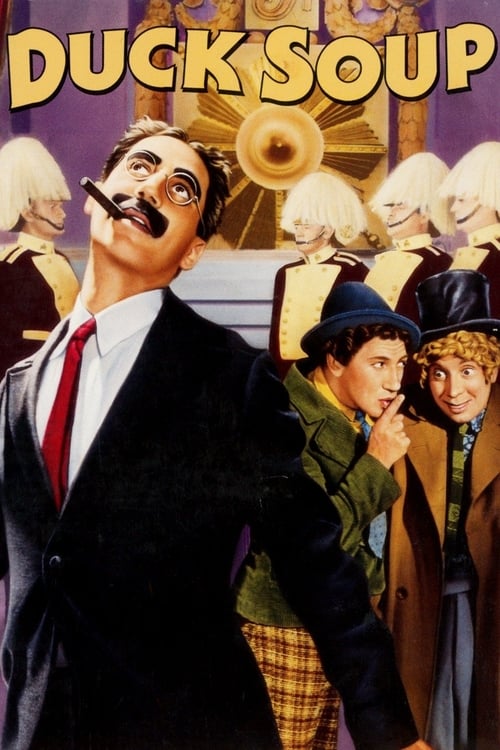
Duck Soup
1933 · Leo McCarey
For when you want to laugh hard at authority — a short, zero-commitment blast of chaos that works as both a party watch and a wickedly relevant satire when the news gets absurd.
What it's about
The bankrupt nation of Freedonia gets a new leader: Rufus T. Firefly, installed at the whim of a wealthy widow and armed with nothing but insults and total shamelessness. Through spies, wounded vanity, and escalating diplomatic catastrophe, he cheerfully maneuvers his country into war with neighboring Sylvania. It's the Marx Brothers versus government itself, and government never stood a chance.
The experience
Anarchic, breakneck, and dense with jokes — barely over an hour long and wasting none of it, from verbal machine-gun fire to some of the purest silent-style slapstick ever filmed. The absurdity of politics and war curdles into something that feels sharper, not staler, with time.
Performances
Groucho's insult-a-second Firefly is his definitive role, Harpo and Chico's lemonade-stand feud and the celebrated mirror sequence are pantomime perfection, and Margaret Dumont is the immortal straight woman — the dowager whose dignity exists to be demolished.
The craft
Leo McCarey, a veteran of silent comedy, gives the brothers their tightest, least sentimental picture — no romantic subplots, no padding, just set-piece after set-piece built with a craftsman's timing. The mirror scene alone is a masterclass in staging a gag without a single word.
Why it matters
A flop that ended the brothers' Paramount run, it was later reclaimed as their masterpiece and the high-water mark of American screen anarchy, echoing through political satire and absurdist comedy ever since.
Snapshot
Duck Soup is the Marx Brothers' fifth feature and the last they made for Paramount, a lean, anarchic political farce that runs barely over an hour and wastes almost none of it. Groucho plays Rufus T. Firefly, installed as leader of the bankrupt mythical nation of Freedonia at the insistence of its wealthy benefactress, Mrs. Teasdale (Margaret Dumont); through a cascade of insults, misunderstandings, and wounded vanity, Firefly maneuvers his country into war with neighboring Sylvania. Around this thread the film hangs some of the most celebrated set-pieces in American comedy — the mirror sequence, the lemonade-vendor hat-swapping feud, the delirious musical build-up to war. Directed by Leo McCarey, a veteran of the Hal Roach comedy factory, it is the most tightly constructed and least sentimental of the brothers' Paramount pictures, stripping away the harp and piano interludes and the romantic subplot that padded their earlier features. Commercially underwhelming on release and only politely reviewed, it has since been reassessed as the Marxes' masterpiece and one of the essential comedies of the sound era. It was among the earliest films selected for the U.S. National Film Registry (1990).
Industry & production
Duck Soup was produced and distributed by Paramount Pictures and released in November 1933, at the depth of the Great Depression and in the twilight of the pre-Code period. It arrived at a fraught moment both for the studio and for the act. Paramount was in severe financial distress in the early 1930s, and the Marx Brothers were in open contractual and financial dispute with the studio over profit participation; Duck Soup was made as their contract with Paramount was expiring, and it proved to be their final film there. The picture's relatively disappointing commercial performance — it did not match the reception of Horse Feathers (1932) — has often been cited as a factor in the break, though the exact figures are not something to assert with precision here. What is well documented is the aftermath: the brothers moved to MGM, where Irving Thalberg reshaped their formula toward more plotted, romance-and-music-laden vehicles beginning with A Night at the Opera (1935), and Zeppo, the straight-man fourth brother, left the act. Duck Soup is therefore his last screen appearance with them.
The film was also touched by the era's political sensitivities: it is frequently reported that the film was banned in Mussolini's Italy, the dictator supposedly taking Firefly's buffoonery as a personal affront. This anecdote is widely repeated but poorly sourced, and it should be treated as film folklore rather than settled fact.
Technology
Duck Soup is a product of the fully established sound era, made roughly six years after The Jazz Singer and well past the technical growing pains of the earliest talkies. It was shot on 35mm black-and-white film with standard Academy-ratio framing and recorded with the optical sound-on-film systems standard at Paramount by 1933. There is nothing technologically experimental about the picture; its innovations are entirely in performance, timing, and construction rather than apparatus. If anything, its significance is that the technology had matured enough to become invisible — the camera and microphone are stable and unobtrusive enough that verbal wit, physical business, and musical rhythm can carry the film without the staginess that hampered many 1929–31 comedies.
Technique
Cinematography
The cinematography, by Henry Sharp, is clean, bright, and functional in the classical studio manner — its virtue is legibility rather than expression. Sharp lights the sets evenly and frames to serve the gags, giving performers room to move and keeping the geography of a scene clear so that the audience always understands spatial relationships (essential to a bit like the lemonade-stand feud or the mirror sequence, both of which depend on precise blocking). The camera generally holds steady and lets business play out in wider framings, cutting in only when a reaction demands it. This restraint is a deliberate comic asset: it preserves the integrity of physical performance and avoids editorializing where the joke can speak for itself.
Editing
Edited by LeRoy Stone, Duck Soup is notable within the Marx filmography for its economy and pace. At roughly 68–70 minutes it is the leanest of their features, and the cutting reflects a comic sensibility — very possibly McCarey's — that values momentum. The film moves briskly from set-piece to set-piece with minimal connective padding, and the war sequence near the climax is its most aggressively edited passage, cutting rapidly among gags, costume changes, and musical beats to generate a mounting sense of absurd escalation. Elsewhere the editing follows the classical principle of letting a gag build in a sustained take and then punctuating it with a cut on the reaction.
Mise-en-scène / staging
The staging is where the film's craft is most visible, and it is largely a matter of choreography. The mirror sequence — Firefly confronting a disguised intruder (Harpo) mimicking his every movement in an empty doorframe, later joined by Chico — is a masterclass in synchronized physical staging, its comedy generated entirely by the precision and mischief of two bodies negotiating an imaginary reflection. The lemonade-vendor confrontation with Edgar Kennedy is built on escalating, ritualized retaliation, each insult and act of sabotage staged with the patient rhythm of a Hal Roach two-reeler. Set design by Paramount's art department (Hans Dreier's unit) supplies serviceable operetta-kingdom interiors — a suitably grand reception hall, a courtroom, a palace — whose slight theatrical artificiality suits the mock-Ruritanian world of Freedonia.
Sound
As a mature talkie, Duck Soup is fundamentally a sound comedy: Groucho's rapid-fire verbal assault, the puns and non-sequiturs, and Chico's dialect wordplay are the film's primary engine, and they depend on clear, intelligible recording. Just as important is the film's use of silence and music around the two non-speaking dimensions of the act — Harpo's pantomime and the songs. Kalmar and Ruby's musical numbers, especially the extended "war is coming" production number, integrate song, dance, and gag into a single rhythmic crescendo, making sound design and score inseparable from the film's structure rather than decorative interludes.
Performance
Performance is the film's true medium. Groucho gives perhaps his most concentrated screen turn as Firefly, the greasepaint mustache, crouched lope, and cigar deployed in service of relentless verbal aggression and moral indifference. Harpo's Pinky is pure anarchic pantomime — scissors, horn, and childlike malice — while Chico's Chicolini supplies the pun-laden dialect logic that ties the brothers' scenes together, the two frequently working as a spy-team double act. Zeppo, in his final outing, is the nominal romantic-and-straight fourth, underused by design. Crucially, the film pairs the brothers with two indispensable foils: Margaret Dumont, whose imperturbable dignity as Mrs. Teasdale is the fixed target Groucho needs to play against, and Louis Calhern as the scheming Ambassador Trentino, who supplies the plot's straight-faced villainy. Edgar Kennedy's slow-burn vendor is a reminder of the McCarey/Roach lineage of reciprocal-destruction comedy.
Narrative & dramatic mode
The dramatic mode is farce raised to the pitch of absurdism. There is a functional plot — Trentino's plot to annex Freedonia, his romantic designs on Mrs. Teasdale, the espionage subplot with Chicolini and Pinky, and the slide into war — but the film treats narrative causality as a scaffold to be dismantled. Motivations are petty and arbitrary (war is declared, essentially, because Firefly imagines he has been insulted), and the story repeatedly abandons plausibility for the sake of a gag or a musical number. This is comedy in which the anarchic energy of the performers is deliberately set against, and allowed to overwhelm, the machinery of story. The film's refusal to resolve into sentiment — even the closing gag mocks the very idea of gratitude and reconciliation — distinguishes it sharply from the more emotionally domesticated Marx films that followed at MGM.
Genre & cycle
Duck Soup belongs to two overlapping cycles: the Marx Brothers' own run of Paramount anarchic comedies (The Cocoanuts, Animal Crackers, Monkey Business, Horse Feathers, Duck Soup), and the broader tradition of 1930s clown comedy that carried vaudeville and revue sensibilities onto the sound screen. It is simultaneously a political-satirical comedy and, in its final act, a war satire — the operetta setting of a bankrupt statelet like Freedonia gently parodies the Ruritanian romances and musical operettas popular in the period. Within the Marx cycle it is the purest and least compromised entry, precisely because it omits the concessions (a supporting romance, virtuoso harp and piano solos) that the earlier and especially the later films made to variety and sentiment.
Authorship & method
The film's authorship is genuinely divided among a distinctive comic team. Leo McCarey, the director, is the crucial shaping hand. Trained in silent comedy at the Hal Roach studio — where he helped develop the pairing of Laurel and Hardy and refined the "reciprocal destruction" gag structure — McCarey brought an instinct for pacing, physical business, and the slow build that the material's writers alone could not supply. He is often credited (including by Groucho) as one of the few "name" directors the brothers worked with who genuinely understood screen comedy, and the film's tightness and its physical set-pieces bear his imprint; the lemonade-stand escalation is essentially a McCarey/Roach construction. Accounts of the production also suggest McCarey found the anarchic Marxes difficult to corral, a friction that arguably sharpened the film.
The screenplay is credited to Bert Kalmar and Harry Ruby, the songwriting-and-writing team, who supplied story, structure, and the musical numbers, with additional dialogue by Arthur Sheekman and Nat Perrin. Kalmar and Ruby also wrote the songs, which are woven into the action rather than sitting apart from it. Henry Sharp photographed, LeRoy Stone edited, and Paramount's Hans Dreier–led art department supplied the design. The method, in the end, was collaborative and partly improvisational: written material set the frame, but the brothers' performance instincts and McCarey's gag sense determined how it played.
Movement / national cinema
This is thoroughly a product of classical Hollywood studio filmmaking — Paramount in the early 1930s — and it is not affiliated with any avant-garde movement. Its deeper roots, however, lie in American vaudeville and the New York revue stage, from which the Marx Brothers emerged and whose verbal and knockabout traditions the film transposes to film. Two of the Paramount features preceding it were adapted from Broadway shows; Duck Soup, written directly for the screen, represents the act's most fully cinematic distillation of that stage heritage. Its later reception abroad — its embrace by European critics and its enthusiastic later adoption by figures associated with surrealism, who prized its irrationalism — connects it retrospectively to a transnational appreciation of comic absurdism, even though the film itself is a native Hollywood product.
Era / period
Duck Soup is inextricable from its moment: 1933, the trough of the Depression, the final months of the pre-Code era, and a period of rising authoritarianism in Europe (the same year as Hitler's ascent to power in Germany). Its satire of a bankrupt nation whose blustering, incompetent leader stumbles into a war over wounded pride reads, in hindsight, as remarkably attuned to the political anxieties of the decade, even if the filmmakers' intentions were comic rather than programmatically political. The pre-Code freedom is audible in the film's cheerful cynicism and its willingness to mock patriotism, governance, and the machinery of war without offering any redemptive counterweight — a latitude that would narrow after the Production Code began to be enforced in 1934.
Themes
The film's central theme is the absurdity and vanity of power. Firefly's Freedonia is a satire of governance as caprice: laws, diplomacy, and warfare are all revealed to be extensions of ego, grievance, and appetite. War, in particular, is stripped of glory and shown as a chaotic carnival — the climactic sequence dissolves military heroism into slapstick, mismatched costumes, and song. Related themes run throughout: the hollowness of institutional dignity (embodied and punctured through Margaret Dumont's Mrs. Teasdale), the anarchic individual's contempt for authority and rule, and the collapse of rational cause and effect into pure comic impulse. The film advances no positive program; its "argument," insofar as it has one, is destructive and deflationary — that the solemn structures of state are ripe for ridicule.
A necessary qualification: the war production number ("the country's going to war" material) draws on minstrel and spiritual pastiche in ways that modern viewers rightly find racially problematic, a reminder that the film's anarchism operated within the casual prejudices of its period.
Reception, canon & influence
On release, Duck Soup was received without the acclaim posterity would grant it. Contemporary reviews were mixed to lukewarm, and its box-office performance disappointed relative to the brothers' earlier hits — an outcome that contributed to the end of their Paramount tenure and to the retooling of their act under Thalberg at MGM. For a time it was regarded as a lesser, even a failed, Marx picture.
Its reputation rose steadily over subsequent decades. Critics came to prize precisely the qualities that had once seemed like liabilities — its brevity, its refusal of sentiment, its concentrated anarchy — and to recognize the mirror scene and the war sequence as landmarks of screen comedy. By the later twentieth century it was routinely ranked among the greatest American comedies and greatest films generally, and its 1990 selection to the National Film Registry confirmed its canonical standing.
Influences on the film (backward): Duck Soup draws on the American vaudeville and revue traditions that formed the Marxes, on the political-operetta parody of Ruritanian romance, and on the Hal Roach school of physical, escalating gag comedy that McCarey carried into the production. The celebrated mirror routine itself has a lineage in earlier comedy — a version appears in Max Linder's silent feature Seven Years Bad Luck (1921), and the doubling gag has vaudeville antecedents — so the film should be understood as brilliantly refining an existing bit rather than inventing it.
Legacy (forward): The film's influence radiates broadly through political and absurdist comedy. Its vision of a preening leader blundering into war anticipates a long line of satire, and its mirror sequence has been quoted and parodied countless times across film and television (including in animation and later comedy features). It became a touchstone for later filmmakers and comic writers who admired its purity of anarchy; Woody Allen famously used the film as a life-affirming emblem in Hannah and Her Sisters (1986). More broadly, Duck Soup helped establish the template for the anti-authoritarian screen comedy in which institutional pomp exists to be demolished — a mode whose descendants run through the work of later comic ensembles and satirists. That a modestly received 1933 programmer became, in retrospect, the Marx Brothers' most enduring and most imitated film is the central irony of its history.
A Deleuzian reading
A man in a nightshirt tiptoes to a doorway and meets himself coming the other way.
The full Deleuzian reading of Duck Soup →
Reception
A box-office disappointment in 1933 that got the Marx Brothers dropped by Paramount, it's now near-universally ranked their masterpiece and one of the greatest comedies ever made — the textbook flop-to-classic arc.
How Duck Soup was received, from release to now →
How to watch Duck Soup: what to notice on a first viewing
- Watch the mirror scene until you can't tell them apart. Harpo mimics Groucho's every move in an empty doorframe with no mirror at all, staged so precisely you lose track of the double and the original. For a full minute the copy is exactly as real as the man.
- Listen for how fast Groucho's lines link to nothing that follows. His puns and non-sequiturs keep breaking the expected connection between one line and the next, so a sentence rarely lands where you think it will. You are laughing at severed logic as much as at any single joke.
- Watch the lemonade stand feud escalate one small retaliation at a time. Edgar Kennedy and the brothers trade hat-swaps and sabotage in a slow, ritualized cycle of tit for tat rather than one big blowout. Each tiny act of revenge sets up the next one, like a chain reaction in miniature.
- Notice how steady the camera holds during the physical gags. Cinematographer Henry Sharp lets scenes play in wide, held shots so you can track the blocking of a gag like the mirror bit without cutting away. You get to watch the whole trick happen, not just its punchline.
- Notice how the songs and gags blend into one continuous number. The musical build-up integrates song, dance, and joke into a single rhythmic sequence rather than separate interludes. The film treats music as another kind of joke machine, not a break from the comedy.
The whole guide to watching Duck Soup, with the keys for a rewatch →
Influences: the films it descends from and the films it influenced
- Seven Years Bad Luck (1921) — Its silent mirror-doubling routine — a man mimicking his own 'reflection' across an empty frame — is the direct template McCarey and Groucho/Harpo refine into Duck Soup's celebrated mirror sequence.
- Big Business (1929) — This Roach-studio Laurel & Hardy short perfected the 'reciprocal destruction' structure — calm, alternating, escalating tit-for-tat demolition — that McCarey developed there and carried into the lemonade-stand and hat-swapping escalations.
- Two Tars (1928) — Another Roach reciprocal-destruction comedy in McCarey's orbit, its methodical, patient build of mutual retaliation is the gag grammar McCarey imposed on the Marxes' otherwise scattershot anarchy.
- The Cocoanuts (1929) — The first filmed Marx vehicle establishes the transfer of their vaudeville/revue act to screen — Groucho's cascading insult patter and Harpo's mute prop-comedy — that Duck Soup strips of stage-boundness and compresses.
- Animal Crackers (1930) — Its Captain Spaulding set-pieces codify Groucho's verbal-aggression monologue as a comic engine, the non-sequitur logic-demolition Duck Soup weaponizes against statecraft.
- Horse Feathers (1932) — The immediate predecessor: an anarchic ensemble assault on a pompous institution (the college) whose president Groucho is installed to wreck — the exact satirical machine Duck Soup redirects at a nation-state.
- A Night at the Opera (1935) — Thalberg's deliberate retooling — grafting romance, sympathetic stakes, and audience-tested structure onto the act — is a direct corrective reaction to Duck Soup's commercially punishing refusal of sentiment.
- The Great Dictator (1940) — Chaplin extends Duck Soup's vision of a preening leader whose vanity tips a nation into war, the balletic globe dance answering Freedonia's inflated ceremonial pomp with the same puncturing absurdity.
- To Be or Not to Be (1942) — An anti-authoritarian war farce that treats military and dictatorial pomp as material to be demolished by performers, inheriting Duck Soup's method of deflating tyranny through sheer comic effrontery.
- The Mouse That Roared (1959) — A tiny fictional duchy declaring an absurd war is Freedonia made literal — the Ruritanian-operetta-parody premise of a pipsqueak state blundering into international conflict lifted straight from Duck Soup.
- Dr. Strangelove (1964) — Kubrick's leaders bumbling into catastrophic war through vanity and institutional idiocy extend Duck Soup's political absurdism, the War Room councils echoing Freedonia's self-important cabinet meetings played for satire.
- Bananas (1971) — Allen's anarchic banana-republic coup farce — an absurd figure elevated to rule a comic-opera nation — directly channels Duck Soup's Freedonia, its anti-sentimental gag logic modeled on the Marxes.
- Blazing Saddles (1974) — Brooks perfects the anti-authoritarian ensemble comedy in which institutional and generic pomp exists only to be demolished, inheriting Duck Soup's mandate that no dignity survives the joke.
- Airplane! (1980) — Its relentless gag-density and deadpan verbal-non-sequitur onslaught descend from the Marx model of stacking wordplay and absurdist literalism faster than an audience can process.
- Hannah and Her Sisters (1986) — Allen enshrines Duck Soup itself on screen as a life-affirming emblem of pure anarchic comedy, making explicit the film's status as touchstone for the absurdist-comic tradition he works in.
- Dr. Strangelove or: How I Learned to Stop Worrying and Love the Bomb (1964) — McCarey's staging of Freedonia's war cabinet as a vaudeville comedy troupe — Groucho's deliberations indistinguishable from stand-up — established the formal model of political institutions rendered as performance spaces, which Kubrick literalizes in the War Room's roundtable functioning as an improv stage.
- The Awful Truth (1937) — McCarey's own Marx Brothers feature where he refined his method of letting actors discover gags on the floor rather than executing a locked script — the same improvisatory trust he imposed on Grant and Dunne.
- Delicatessen (1991) — Anarchic Marx Brothers ensemble comedy where every tenant is a self-contained comic engine, modeling the film's apartment-block-as-vaudeville-troupe staging.
- Monkey Business (1931) — A near-plotless vehicle built as pure escalating anarchy with the four brothers as interchangeable agents of chaos, the anti-narrative purity Duck Soup pushes to its extreme.
- His Girl Friday (1940) — Hawks builds comedy from overlapping, machine-gun verbal economy and interruption — the same prizing of rapid-fire dialogue-as-aggression that drives Groucho's exchanges, engineered for maximum pace.
- Modern Times (1936) — McCarey's editing of the Marx Brothers' anarchic set pieces—timing cuts to land gag punchlines as rhythmic percussion rather than to serve narrative continuity—runs parallel to Chaplin's assembly-line editing grammar, both treating the cut as a comic instrument calibrated to physical action rather than to dialogue.
Similar films
- The Great Dictator (1940) — influence & lineage · same viewing thread · often watched together
- To Be or Not to Be (1942) — influence & lineage · same viewing thread · often watched together
- A Night at the Opera (1935) — influence & lineage
- The Producers (1968) — same viewing thread
- The Death of Stalin (2017) — same viewing thread
- The Rules of the Game (1939) — often watched together
- Modern Times (1936) — often watched together
- A Useful Ghost (2025) — often watched together
All the films related to Duck Soup →
Watch it with: curated runs of related films
- Comedy Declares War on Fascism — A run of satires and cabaret turns that meet tyranny with ridicule — watch these together to see performers puncture dictators and expose the void behind the uniform.