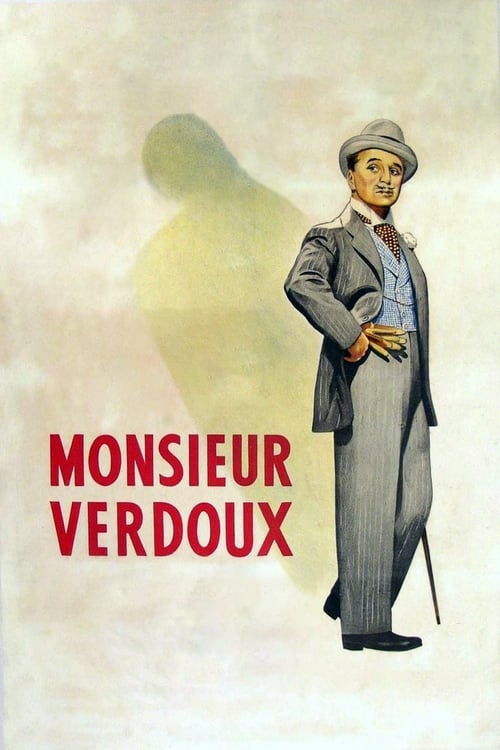
Monsieur Verdoux
1947 · Charlie Chaplin
For when you want comedy with teeth — something witty and elegant that turns out to be genuinely provocative. Not a cozy pick; it's a film to argue about afterward.
What it's about
A fussy, soft-spoken bank clerk is thrown out of work by the Depression and finds a new profession: courting rich widows, marrying them, and murdering them for their money, all to keep his invalid wife and young son comfortable in the countryside. Charlie Chaplin retires his beloved Tramp entirely to play this immaculate killer, who treats homicide as just another form of business. The scheme runs like clockwork until two very different widows refuse to fit the routine.
The experience
It's a strange, bracing watch — drawing-room farce one minute, ice-cold irony the next — and the laughs keep catching in your throat. The comedy of a murderer counting his money like a shopkeeper slowly hardens into a moral argument that's still uncomfortable to sit with.
Performances
Chaplin is fascinating cast against everything he was loved for — dapper, purring, quietly monstrous — and Martha Raye nearly steals the film as a brash, indestructible widow whose scenes with him are the comic high point.
The craft
Chaplin wrote, directed, and scored it, and the precision shows: murder staged with the timing of silent-era slapstick, elegant scene construction, and dialogue that keeps flipping charm into menace. The black-and-white images are handsome in a deliberately genteel way that makes the subject matter land harder.
Why it matters
A commercial disaster and a scandal on release — audiences wanted the Tramp, not a serial killer with a thesis — it has since been reclaimed as one of Chaplin's boldest films and a forerunner of the modern black comedy.
Snapshot
Monsieur Verdoux is Charlie Chaplin's black comedy about a fastidious former bank clerk who, cast out of work during the Depression, supports his invalid wife and small son by courting, marrying, and murdering wealthy widows. Subtitled "A Comedy of Murders," it was the first feature in which Chaplin retired the Tramp entirely and built a film around a wholly separate character — a soft-spoken, bourgeois killer whose crimes are presented as a logical extension of ordinary commerce. The film fused drawing-room farce with macabre subject matter and a mounting moral indictment of capitalism and war, culminating in Verdoux's courtroom argument that his petty homicides are trivial beside the sanctioned slaughter of business and armed conflict: "One murder makes a villain; millions a hero. Numbers sanctify." Released in the United States in 1947 amid intense political hostility toward Chaplin, it was a commercial failure at home, faring better in Europe, and has since been reassessed as one of his most ambitious and intellectually daring works.
Industry & production
Monsieur Verdoux was produced by Chaplin as an independent through his own operation and distributed by United Artists, the company he had co-founded in 1919. By the mid-1940s Chaplin was one of the last true auteur-proprietors of the studio era: he financed his own pictures, owned his studio on La Brea Avenue, worked without the oversight of a front office, and shot at his own deliberate pace. This autonomy is inseparable from the film's character — its willingness to advance an argument no Hollywood studio would have underwritten.
The project's origin is genuinely contested and worth stating carefully. The screen credit reads that the idea was "suggested by Orson Welles." Welles maintained that he had proposed a dramatized documentary about the French serial murderer Henri Désiré Landru — the "Bluebeard" guillotined in 1922 for killing a string of women — with Chaplin in the lead, and that he had done preparatory writing. Chaplin's account, given in his autobiography, was that Welles approached him only with the concept, that Chaplin bought the idea outright to write and direct entirely himself, and that Welles's contribution was limited to the germ. The documentary record supports that Chaplin wrote the finished screenplay; the extent of Welles's underlying work remains disputed, and honest accounts leave it there rather than adjudicating it.
Production coincided with the most damaging period of Chaplin's American life: the Joan Barry paternity suit and Mann Act prosecution of the early 1940s, his public leftism, his refusal to take US citizenship, and the gathering Cold War climate. These pressures shaped the film's reception more than its making, but they colored the atmosphere in which it appeared and hastened its withdrawal after a hostile initial run.
Technology
Technically Monsieur Verdoux is conventional for 1947: black-and-white, standard Academy ratio, monaural optical sound. Chaplin was famously the last major holdout of the silent era, and this is only his second fully dialogued sound feature after The Great Dictator (1940). What matters here is less any technical novelty than Chaplin's late, decisive embrace of the spoken word. Where his silent art had been built on pantomime, Verdoux is a talking picture in the fullest sense — verbally witty, argument-driven, dependent on the cadence and irony of dialogue. The film exploits synchronized sound not for spectacle but for the tonal precision of a man who murders politely and speaks in the measured euphemisms of a businessman.
Technique
Cinematography
Photography was headed by Roland Totheroh, Chaplin's cameraman since the 1910s, with contributions from the German émigré cinematographer Curt Courant (who had shot for Fritz Lang and Jean Renoir's La Bête humaine) and additional camera work by Wallace Chewning. The style is classical and self-effacing: even, high-key lighting, stable framing, and a clarity that keeps the actor legible. Chaplin's camera exists to serve performance and staging rather than to editorialize; the visual restraint throws the film's moral shocks onto the dialogue and the actors' faces rather than onto expressionist effect.
Editing
The film was cut by Willard Nico. Chaplin's editorial approach follows his lifelong preference for the long take and the sustained comic or dramatic beat over rapid cutting. Sequences are constructed to let a gag or a confrontation play out in continuous rhythm — the famous, protracted attempts to drown the irrepressible Annabella are built on comic duration rather than montage. The result is a pacing that can feel stately by Hollywood standards, closer to filmed theater in its confidence that a scene will pay off if held.
Mise-en-scène / staging
Chaplin stages Verdoux like a master of theatrical space. Interiors — parlors, dining rooms, a wine cellar, a boat on a lake — are organized in depth so that the camera can hold wide and let Verdoux move through them with balletic economy. Traces of the silent clown survive in the character's physical grace: the way he counts money with a riffle, tends his roses while a body burns in the incinerator, or vaults a garden fence. This is mise-en-scène as irony — genteel bourgeois settings within which murder is transacted with the same manners as a marriage proposal.
Sound
Beyond dialogue, the film relies on Chaplin's own musical score (discussed below) and on sound as a vehicle for black comic contrast — the domestic calm of Verdoux's household against the businesslike violence of his "profession." Chaplin uses offscreen implication rather than graphic depiction; the murders happen at the edge of the frame or between scenes, their horror carried by understatement.
Performance
The performances are the film's engine. Chaplin's Verdoux is a deliberate erasure of the Tramp — dapper, verbally fluent, brisk, and chillingly reasonable, a portrait of respectability as camouflage. Against this control, Martha Raye supplies the film's comic dynamo as the loud, lucky Annabella Bonheur, the one victim Verdoux cannot kill; their scenes are the picture's most celebrated, a collision of his fastidious menace and her brassy indestructibility. Marilyn Nash plays the young woman Verdoux spares, a figure of ambiguous grace who returns transformed by the film's end, and Mady Correll plays his wheelchair-bound wife, the tender center that supposedly justifies his crimes. Isobel Elsom is among the widows in his sights.
Narrative & dramatic mode
The film's mode is satiric black comedy edging into tragedy and philosophical dialogue. Its structure is episodic — a series of courtships and near-misses strung along Verdoux's "routine" — bracketed by a narrating device in which Verdoux speaks to us from beyond the grave, framing the whole as a confession. The tone modulates constantly: farce (the boating sequence), suspense (a poison that goes astray), pathos (the domestic scenes), and finally the oratorical register of the trial, where the film abandons comic distance for direct address. This willingness to break the comedy open into argument — to let the protagonist indict his audience — is what makes the dramatic mode unusual and, for its first viewers, disorienting.
Genre & cycle
Monsieur Verdoux belongs to the small, potent cycle of postwar black comedies that treat murder as social critique. It looks back to gothic Bluebeard lore and to stage farces of homicide, and it stands as a near-contemporary of Ealing's Kind Hearts and Coronets (1949), with which it is inevitably paired as a study of serial killing rendered as elegant comedy of manners. Where American comedy of the period was largely reassuring, Verdoux is corrosive — closer to European irony than to Hollywood convention. Later, Claude Chabrol would return directly to the source with Landru (1963), and the "reasonable monster" whose logic mirrors respectable society became a durable comic-dramatic type.
Authorship & method
This is Chaplin's film in the most total sense the studio era allowed: he wrote the screenplay, directed, produced, starred, and composed the music. His method — slow development, extensive rehearsal, shooting in continuity, reworking scenes on the floor — served an art built around the actor's body and timing. The score is Chaplin's own; as with his other sound features he supplied melodies that were then orchestrated and arranged by professional collaborators, though the sentimental-ironic musical voice is unmistakably his. His principal technical collaborators were long-standing: Totheroh behind the camera across three decades, with Courant lending European craft, and Nico editing. The Welles credit for the underlying idea, already noted, is the one authorship question the film cannot fully settle, and it should be presented as an open dispute rather than a resolved fact.
Movement / national cinema
Formally the film is an American production, but it sits athwart the classical Hollywood system rather than within it. Chaplin's independence, his silent-comedy lineage, and the émigré European craft on his crew (Courant) give Verdoux a sensibility closer to continental satire than to the domestic studio product of 1947. It is best understood as the work of a singular transnational figure — a British-born artist working in America, formed in music-hall and silent film, addressing a European crime legend with a political argument aimed at the whole industrial world. The film's warmest reception, tellingly, came in France, where a critical tradition existed to receive it.
Era / period
Monsieur Verdoux is a film of its exact historical moment — the immediate aftermath of the Second World War and the dawn of the atomic and Cold War age. Verdoux's defense that private murder is dwarfed by the mechanized killing of war lands with particular force in 1947, two years after Hiroshima. The film also arrived as the House Un-American Activities Committee's Hollywood investigations were beginning and as Chaplin's own loyalty was being publicly questioned. Its bleak equation of capitalism, war, and murder read to many contemporary American commentators not as moral philosophy but as provocation, and the surrounding climate of suspicion shaped its fate.
Themes
The film's governing theme is the continuity between respectable enterprise and murder: Verdoux insists he is only a small businessman driven out of legitimate work and applying its logic to survival. From this flow its other concerns — the hypocrisy of bourgeois morality, which condemns the individual killer while honoring mass violence; marriage and courtship as economic transactions; the moral catastrophe of unemployment and Depression-era desperation; and the relationship between means and ends, since Verdoux commits monstrous acts in the name of protecting a beloved family. War and the atomic bomb hover over the argument as the film's ultimate example of "numbers sanctifying" slaughter. The late encounter with the young woman he once spared introduces a counter-theme of grace and pity that complicates his cold accounting. Verdoux's final composure before the guillotine frames the whole as a moral test posed to the audience rather than a case closed.
Reception, canon & influence
The film's initial American reception was among the most hostile ever accorded a major artist's work. It performed poorly at the box office and was effectively withdrawn from circulation in the United States after a short run; precise figures should be treated cautiously, but its commercial failure at home is well documented. The notorious 1947 New York press conference saw reporters interrogate Chaplin less about the film than about his patriotism, his citizenship, and alleged communist sympathies — an episode emblematic of the political persecution that would culminate in his effective exile from the US in 1952. Against this, the critic James Agee mounted a passionate multi-part defense in The Nation, arguing for the film as a serious moral work; his advocacy became one of the most famous acts of contemporary film criticism. In Europe, and especially in France, the film was received far more sympathetically, and André Bazin was among the critics who took its themes seriously. It earned a single Academy Award nomination, for Chaplin's original screenplay.
Looking backward, the film draws on the historical Landru case and the Bluebeard tradition, on Chaplin's own silent-comedy craft repurposed for a genteel killer, and on the political consciousness that had already surfaced in Modern Times and The Great Dictator. Looking forward, its legacy is substantial. It stands beside and arguably ahead of Kind Hearts and Coronets in the lineage of elegant murder-comedies, and its central conceit — that the polite logic of commerce and war is itself homicidal — anticipates the satirical nihilism of later works, the Cold War black comedy of Kubrick's Dr. Strangelove among them, in spirit if not by direct line. Chabrol's Landru returned to the same source with Chaplin's precedent unavoidable. More broadly, Monsieur Verdoux demonstrated that a beloved comedian could abandon his signature persona to deliver a bitter social argument, and its critical rehabilitation over the following decades helped secure Chaplin's late films their place in the canon as the mature political testament of the twentieth century's most famous clown.
A Deleuzian reading
A man is cutting roses at the bottom of a garden.
The full Deleuzian reading of Monsieur Verdoux →
Reception
Booed at its 1947 New York premiere, picketed, and pulled from US release amid the press campaign against Chaplin's politics — yet Chaplin called it the cleverest film he'd ever made, James Agee defended it across three consecutive Nation columns, and its 1964 reissue kicked off a reappraisal that's landed it among his most admired work.
How Monsieur Verdoux was received, from release to now →
Influences: the films it descends from and the films it influenced
- The Great Dictator (1940) — Verdoux completes the persona-erasure and to-camera moralizing that Chaplin began here, converting the barber's climactic direct-address plea into the killer's courtroom accusation that murder is merely 'business' scaled down.
- Modern Times (1936) — The balletic, metronomic body-timing built for the Tramp is repurposed into Verdoux's fastidious gestures — the money-counting riffle, the hedge-clipping — so silent slapstick mechanics carry a genteel killer's efficiency.
- Trouble in Paradise (1932) — Supplies the suave continental swindler and the 'Lubitsch touch' of ellipsis — the actual murders, like the thefts here, happen just offscreen, implied by cutaways and reaction rather than shown.
- Bluebeard's Eighth Wife (1938) — Provides the drawing-room Bluebeard template — serial marriage played as sophisticated comedy of courtship — that Verdoux literalizes by actually liquidating the wives.
- To Be or Not to Be (1942) — Demonstrated the tonal engineering Verdoux depends on: wringing high comedy directly from mass death and war, licensing a beloved comic voice to treat atrocity as farce.
- Arsenic and Old Lace (1944) — Establishes the high-key, brightly-lit domestic murder farce — homicide staged in cozy parlors with theatrical depth — the visual grammar Verdoux adopts for its lethal households.
- Kind Hearts and Coronets (1949) — Extends the elegant serial-murder comedy — a fastidious killer dispatching victims with impeccable manners — pairing it with the same ironic detachment, though it externalizes Verdoux's interiority as sardonic voiceover.
- The Ladykillers (1955) — Carries the murderous-politeness formula into Ealing black comedy, staging homicidal conspiracy inside a genteel domestic space where lace-curtain respectability masks the body count.
- A New Leaf (1971) — Directly reworks the premise — a ruined gentleman marrying a wealthy woman to murder her for solvency — sustaining the deadpan comedy of a fastidious man treating uxoricide as a bookkeeping problem.
- Landru (1963) — Returns to the identical Landru source with Chaplin's precedent unavoidable, but answers Verdoux's expressionistic ellipsis with cool, ironic pastel realism and inventoried domestic detail.
- Dr. Strangelove (1964) — Inherits Verdoux's central satirical syllogism — that the polite bureaucratic logic of war and commerce is itself mass murder — and pushes its bitter reductio into Cold War nihilism.
- The Discreet Charm of the Bourgeoisie (1972) — Prolongs the argument that impeccable bourgeois manners are a veneer over predation, using civilized ritual (the interrupted dinner) as the engine of comedy the way Verdoux uses courtship.
- To Die For (1995) — Revives the murderer's direct-address self-justification, letting a smiling social climber narrate homicide-for-advancement straight to camera as Verdoux does in his trial and epilogue.
- American Psycho (2000) — Literalizes Verdoux's 'business is murder' thesis into the figure of the immaculate businessman-killer, sustaining the satire that capitalist self-presentation and homicide share the same fastidious grammar.
- The Skeleton of Mrs. Morales (1960) — Establishes the respectable bourgeois husband as methodical wife-killer, weaponizing domestic propriety as both alibi and the true satirical target — the template González and Alcoriza refit to a Mexican household.
- Divorce Italian Style (1961) — Used a serial wife-killer as the ironic mouthpiece for social critique, modeling the morally compromised comic protagonist whose murder is framed as reasonable within a corrupt system.
- The Criminal Life of Archibaldo de la Cruz (1955) — Pioneers the black comedy built on a dapper, respectable serial murderer and, crucially, the recurring comedy of botched or accidentally-thwarted killings that structures Archibaldo's confession.
- The Executioner (1963) — Indicts a whole society through a 'professional killer' reframed as a mild bourgeois breadwinner, prefiguring El verdugo's capital-punishment irony of murder as respectable salaried employment.
- Shadow of a Doubt (1943) — A near-contemporary study of the charming lady-killer preying on widows, whose dinner-table monologues about useless rich women being 'fat, wheezing animals' rhyme with Verdoux's misanthropic anti-capitalist rhetoric.
- Le Boucher (1970) — Chabrol's other return to the killer-among-us, extending the tradition of the tender, courtly murderer whose crimes are staged against placid provincial normalcy rather than sensational thriller mechanics.
Similar films
- Modern Times (1936) — influence & lineage
- The Great Dictator (1940) — influence & lineage
- Trouble in Paradise (1932) — influence & lineage
- The Discreet Charm of the Bourgeoisie (1972) — influence & lineage
- The Ladykillers (1955) — influence & lineage
- A Woman of Paris: A Drama of Fate (1923) — shared sensibility
- Double Indemnity (1944) — shared sensibility
- The Rules of the Game (1939) — shared sensibility