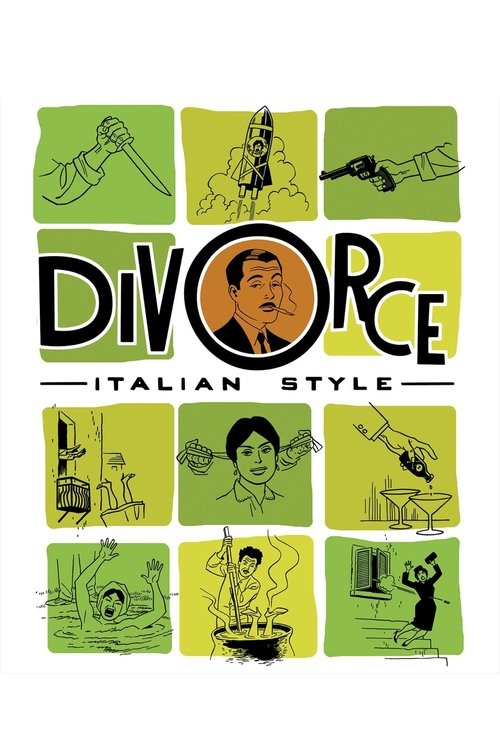
Divorce Italian Style
1961 · Pietro Germi
For when you want comedy with teeth — something elegant and wicked rather than warm, that makes you smirk all evening and think a bit afterward. More a martini than comfort food.
What it's about
In a drowsy, sun-scorched Sicilian town, a threadbare baron named Ferdinando is hopelessly in love with his young cousin Angela — and hopelessly married to his clinging wife Rosalia. Divorce is illegal in Italy, but the law goes easy on a man who kills an unfaithful wife to defend his honor. So Ferdinando begins scheming, in elaborate daydreams and real plots, to push Rosalia into an affair he can 'discover.' It's a murder plan run like a courtship, narrated by the would-be killer himself.
The experience
Deadpan, sly, and quietly savage — you laugh at things you know you shouldn't, then realize the joke is on an entire society. It moves with a lazy Mediterranean rhythm punctured by absurd fantasy sequences, and its wit gets sharper the longer you sit with it.
Performances
Marcello Mastroianni is the whole show: droopy-lidded, slick-haired, with a nervous facial tic and a voice of oily self-regard, he turns a contemptible schemer into one of the funniest characters in Italian cinema — a deliberate demolition of his own romantic image.
The craft
Pietro Germi directs satire with a prosecutor's precision, using voice-over, fantasy inserts, and courtroom logic to let the character convict himself. The black-and-white photography of baking piazzas and shuttered interiors gives the comedy a real, sweat-damp place to live, and the whole film is cut with the timing of a joke that always lands a beat later than you expect.
Why it matters
It crystallized the bitter Italian social comedy for the world, won international acclaim including Oscar recognition for its screenplay, and helped shame the very laws it mocked — Italy's divorce ban and 'honor killing' leniency both eventually fell. It also permanently reshaped Mastroianni's career, proving the great romantic lead was an even greater comic actor.
Snapshot
Divorzio all'italiana is the film that crystallized commedia all'italiana — the bitter, socially barbed Italian comedy — into an internationally exportable form and, in doing so, remade Pietro Germi's career and Marcello Mastroianni's screen persona in a single stroke. Set in a torpid, sun-blasted Sicilian town, it follows the impoverished Baron Ferdinando "Fefè" Cefalù, who, trapped in a loveless marriage he cannot legally dissolve, plots to engineer his wife's adultery so he may murder her under the lenient cover of the delitto d'onore — the "honor killing" that Italian law still treated as a mitigated crime. The film's genius is to weaponize comedy against the law: divorce was illegal in Italy (and would remain so until 1970), while a man who killed an unfaithful wife could expect a sentence of only a few years. Germi turns that legal grotesquerie into a mechanism of farce narrated in Fefè's own languid, self-justifying voice. The picture won the Academy Award for its screenplay and turned Mastroianni — twitching cheek, lidded eyes, cigarette-holder drawl — into an icon of ironic Latin masculinity.
Industry & production
The film was produced in the early 1960s at the height of Italian cinema's postwar commercial and creative boom, when domestic comedies competed successfully with imported product and Italian films were finding robust foreign markets. Germi, a director previously associated with earnest social melodrama, moved decisively toward satire, and the project's provocation was calculated: it took the still-live scandal of Italy's marriage and honor laws and played it as broad farce. Production was centered in Sicily, and the film draws heavily on real Sicilian towns and townscapes — the crumbling palazzo, the piazza, the church, the cinema — as both setting and social evidence. The picture was distributed internationally with conspicuous success and became one of the signature Italian art-comedy exports of its moment; precise box-office figures are not something I can cite reliably here, but its commercial performance and awards profile secured Germi's standing and made the "…Italian Style" formulation a lasting piece of English-language shorthand. Its acclaim also emboldened Germi to make a companion Sicilian satire, Sedotta e abbandonata (Seduced and Abandoned, 1964), extending the same critique of southern codes of honor and shame.
Technology
This is a black-and-white, standard-sound production of the early 1960s, made with the mature 35mm equipment of the period rather than any novel apparatus. There is no technological gimmick at the film's core; its innovations are entirely those of craft and rhetoric. What the technology enables is a documentary-inflected sharpness — deep, legible black-and-white photography of real locations, close synchronized recording of dialogue and Fefè's interior monologue, and precise editing that lets the film cut between "reality" and the protagonist's fantasy without visual trickery beyond conventional dissolves and staging. If anything is worth flagging as period-specific, it is the film's confident use of location shooting in genuine Sicilian settings, a habit inherited from neorealism and by now fully assimilated into commercial filmmaking.
Technique
Cinematography
The black-and-white cinematography — credited to Leonida Barboni, with Carlo Di Palma also associated with the production's camerawork — is one of the film's great, under-praised assets. It renders Sicily as a landscape of glare, dust, and shuttered interiors: bright exteriors where the whole town seems to be watching, and shadowed rooms where Fefè schemes. The camera is frequently complicit with his gaze, isolating Angela in soft, adoring framing while pinning his wife Rosalia in unflattering, near-caricatural closeness. The imagery carries a neorealist documentary texture — real faces, real streets, deep-focus crowds — even as it is bent to expressionistic, subjective ends whenever Fefè's imagination takes over.
Editing
Roberto Cinquini's editing is central to the comedy's mechanism. The film continually crosscuts between the world as it is and the world as Fefè fantasizes it — his wife dispatched by quicksand, by rocket, by a bullet — staging elaborate murder daydreams that are punctured by a return to banal reality. These fantasy inserts are the film's comic engine, and their rhythm, the timing of the cut back to Fefè's deadpan face, is where much of the humor lives. The editing also manages the film's braided structure of present action and retrospective voiceover, moving fluidly across time as Fefè narrates his own scheme.
Mise-en-scène / staging
Germi stages the film as a study in surveillance and social pressure. The Cefalù palazzo, with its peeling grandeur and its extended family crammed under one roof, is a machine for producing the very claustrophobia that motivates the plot. Public space — the piazza, the church, the funeral, the political rally, the cinema — is where reputation is made and unmade, and Germi crowds these scenes with watchful townspeople so that every gesture becomes performance. The décor of aristocratic decay (faded portraits, threadbare finery) does quiet ideological work, marking Fefè as a parasite of a dying order.
Sound
Carlo Rustichelli's score is a defining element: mockingly grand, with lilting, quasi-operatic and folk-inflected Sicilian motifs that inflate Fefè's squalid scheming to the pitch of tragic passion, sharpening the irony. Equally important is the sound design of the community — church bells, band music, the murmur of gossip — that renders the town an ever-present chorus. Above all there is Fefè's voiceover, a near-constant, silken first-person narration whose smooth self-justification is comically at odds with what we see him do.
Performance
The film is a performance showcase built around Marcello Mastroianni, who transforms his handsome leading-man image into something wonderfully seedy: a small, vain, twitching aristocrat, forever fingering a cigarette holder, his affectless drawl and involuntary facial tic externalizing a rotten interior. It is a wholly ironic star turn and remains one of his finest. Daniela Rocca, as the doomed, doting wife Rosalia, gives a brave, deglamorized performance that the film treats cruelly but that grounds its satire in real pathos. Stefania Sandrelli, then very young, makes Angela the luminous, near-blank object of Fefè's obsession. The surrounding ensemble of townspeople, played with a caricatural sharpness inherited from neorealist typing, supplies the film's dense social texture.
Narrative & dramatic mode
The dominant mode is satirical black comedy driven by dramatic irony and confessional voiceover. We are locked into Fefè's perspective and made privy to his monstrous plan, so that the film's suspense is not "will he be caught?" but "will the plan work, and what does our amusement at it say about the law that makes it thinkable?" The retrospective narration frames the whole story as Fefè's own self-serving account, and the film exploits the gap between his mellifluous rationalizations and his contemptible conduct. The plotting has the mechanical precision of farce — a scheme that requires his wife to betray him, complicated by her stubborn fidelity — but the tone is corrosive rather than genial. The famous closing irony, in which the newly "freed" Fefè is already being quietly cuckolded by his young bride, converts the comedy into a mordant statement about the perpetual motion of the codes it satirizes.
Genre & cycle
Divorce Italian Style is a landmark of the commedia all'italiana, the cycle of socially critical Italian comedies that emerged at the turn of the 1960s and distinguished itself from lighter "rosy neorealist" comedy by its willingness to treat serious, even grim, subject matter — poverty, class, sexual politics, crime — in a comic register. Where Mario Monicelli's I soliti ignoti (Big Deal on Madonna Street, 1958) and La grande guerra (1959) are usually cited as the cycle's founding works, Germi's film pushed the mode toward outright satire of law and custom, marrying comedy to crime and social critique. Its blend of murder plot, honor-code parody, and regional portraiture places it at the sharp end of the genre; it belongs, too, to a specific sub-strain of "Sicilian" pictures dissecting southern honor culture, which Germi himself would continue in Seduced and Abandoned.
Authorship & method
Germi is the film's controlling author, but its achievement is emphatically collaborative. The screenplay — credited to Germi with Ennio De Concini and Alfredo Giannetti (with story input associated with the same team) — is the film's engine, and it was this script that the Academy honored. Germi's directorial method here marks a personal pivot: a filmmaker rooted in the moral seriousness of postwar realism turning his social conscience toward mockery, using the tools of neorealist observation (location shooting, non-idealized faces, regional specificity) in the service of satire. His key collaborators shape the result decisively: cinematographer Leonida Barboni (with Carlo Di Palma linked to the camera work) for the film's hard, documentary-yet-subjective look; editor Roberto Cinquini for the fantasy-and-reality crosscutting that carries the comedy; composer Carlo Rustichelli for the mock-heroic score; and above all Mastroianni, whose performance is so integral that it is hard to separate the film's authorship from his creation of Fefè. This is auteur cinema realized through an unusually tight fusion of writing, star performance, and score.
Movement / national cinema
The film sits at the intersection of two currents in Italian cinema. It grows out of neorealism — its location aesthetic, its attention to the material and social textures of the impoverished South, its use of real environments as moral evidence — while decisively rejecting neorealism's earnestness in favor of satire. And it is a central document of the commedia all'italiana, the distinctly national comic movement that used laughter as social diagnosis during Italy's boom years. It is also, self-consciously, a film about Italian cinema: in one celebrated sequence the townspeople crowd into the local cinema to watch Federico Fellini's La dolce vita (1960) — itself a Mastroianni vehicle — a piece of meta-cinematic mischief that binds Germi's satire to the larger ferment of early-1960s Italian film.
Era / period
The film is inseparable from Italy circa 1961: a country modernizing rapidly in its industrial North while the South remained bound by older codes of family, church, and honor, and where the legal apparatus lagged conspicuously behind social reality. Two statutes give the film its subject: the prohibition of divorce (not lifted until the 1970 law, later upheld by referendum in 1974) and the penal treatment of delitto d'onore under the honor provisions of the criminal code, which prescribed markedly reduced penalties for a spouse who killed to avenge dishonor (that provision was not repealed until the 1980s). By dramatizing the murderous logic these laws made rational, Divorce Italian Style functioned as a topical intervention as much as an entertainment, and it is frequently credited as part of the broader cultural pressure that helped make reform thinkable.
Themes
The film's great theme is the perversity of a legal and moral order that criminalizes divorce while extenuating murder — the way honor culture, far from protecting the family, incentivizes violence against women. Bound up with this is a relentless satire of Italian masculinity and vanity: Fefè's obsession with reputation, his self-pity, his conflation of lust with grand passion. The film indicts the Catholic Church and the decayed aristocracy as pillars of a stagnant social system, and it treats the Sicilian community itself — the ever-watching town — as a machine of surveillance and shame. Running beneath the comedy is a bleak view of desire as cyclical and insatiable, made explicit by the ending, in which the achievement of one obsession merely seeds the next betrayal. Women, notably, are the objects rather than the agents of this world, and the film's sympathies are complicated: it mocks the codes that destroy Rosalia even as its narration is filtered through the man who destroys her.
Reception, canon & influence
Critically and institutionally the film was a triumph. It won the Academy Award for Best Original Screenplay, and Germi was nominated for Best Director and Mastroianni for Best Actor at the same ceremony — a remarkable showing for a subtitled comedy. Mastroianni's performance was widely honored (including a Golden Globe recognition for his comic lead), and the film also drew acclaim on the European festival circuit; I would not want to overstate the specific festival prizes without the record in front of me, but its international critical standing was immediate and durable. Over time it has settled firmly into the canon as the definitive early example of commedia all'italiana and one of Mastroianni's essential roles.
Influences on the film (backward): it draws on the observational realism and location practice of neorealism; on the newly minted satirical comedy of Monicelli's late-1950s films; and on a long Italian tradition of anticlerical and anti-provincial satire. Its meta-gesture toward La dolce vita signals a direct awareness of the contemporary art cinema against which it defined itself.
Legacy (forward): the film's success helped internationalize the very idea of Italian comedy — the "…Italian Style" tag entered the English language — and confirmed a market abroad for socially pointed foreign-language comedy. It cemented Mastroianni's ironic-Latin-lover persona that Fellini, De Sica, and others would continue to exploit and subvert. Germi extended its Sicilian satire in Seduced and Abandoned. More broadly, its model of the deadpan, morally compromised narrator recounting a comic crime, and its strategy of using farce to attack a specific unjust law, reverberate through later dark comedies of manners, in Italy and beyond. As a work of advocacy-by-ridicule, it is often cited in accounts of the cultural shift that preceded Italy's divorce and honor-law reforms — a rare case of a comedy credited with helping to change the statute it mocked.
A Deleuzian reading
He is imagining his wife sinking into quicksand.
The full Deleuzian reading of Divorce Italian Style →
Reception
A smash on release — Cannes prize for Best Comedy, then an Oscar for Best Original Screenplay, a rare feat for a foreign-language film. Today it's remembered as the film that crystallized commedia all'italiana, even if Fellini and Antonioni hog the era's canonical spotlight.
How Divorce Italian Style was received, from release to now →
How to watch Divorce Italian Style: what to notice on a first viewing
- Listen to how calm and reasonable Fefè's narration sounds. A silken first-person voiceover narrates the whole scheme, explaining Fefè's plan in a tone completely at odds with what he's actually doing. The mismatch between the calm voice and the monstrous plan is where the comedy lives.
- Notice how differently the camera frames Angela versus his wife. Angela is shot soft and glowing while Rosalia is held in close, unflattering framing, the camera clearly seeing through Fefè's eyes. You are shown, visually, exactly how warped this man's point of view is.
- Notice how crowded and watchful every public scene in town is. The piazza, church, and funeral scenes are packed with townspeople watching each other, turning every gesture into something performed for an audience. The town itself functions like a courtroom, always ready to judge what it sees.
- Watch for a daydream that gets cut short by his own face. The film cuts from an elaborate murder fantasy straight back to Fefè's deadpan expression, the joke landing entirely in that cut. The rhythm of the cut, not the fantasy itself, is where most of the humor actually comes from.
- Watch for the small involuntary twitch in Mastroianni's cheek. Mastroianni gives Fefè a recurring facial tic alongside his affectless drawl and constant cigarette holder, small physical tells under a calm surface. The performance is built from small involuntary things rather than any big dramatic gesture.
The whole guide to watching Divorce Italian Style, with the keys for a rewatch →
Influences: the films it descends from and the films it influenced
- Big Deal on Madonna Street (1958) — Established the deadpan crime-as-farce template Germi inherited — treating a botched criminal scheme with straight-faced neorealist observation rather than slapstick, the tonal bedrock of commedia all'italiana.
- The Great War (1959) — Pioneered deflating a sacrosanct national institution through anti-heroic comedy scored mock-seriously, licensing Germi's use of laughter as a weapon against honor culture and law.
- La Dolce Vita (1960) — Built the ironic-Latin-lover Mastroianni persona that Germi directly cites (the town flocks to a screening of it) and inverts into the seedy, balding, provincial Fefè.
- Bicycle Thieves (1948) — Supplied the Zavattinian method — location shooting, regional specificity, non-idealized faces — that Germi keeps as documentary texture but redirects toward satire instead of pathos.
- Rome, Open City (1945) — Codified the neorealist observational grammar (available light, on-street staging, moral gravity) in which Germi trained before turning those same tools to mockery.
- In the Name of the Law (1949) — Germi's own earnest Sicilian drama of honor, omertà and law — the exact material he would later invert, replaying his neorealist Sicily as farce.
- Kind Hearts and Coronets (1949) — Perfected the suave first-person confessional voiceover of a genteel, self-justifying murderer narrating his own crime as elegant black comedy of manners — Fefè's exact narrative device.
- Monsieur Verdoux (1947) — Used a serial wife-killer as the ironic mouthpiece for social critique, modeling the morally compromised comic protagonist whose murder is framed as reasonable within a corrupt system.
- A Lesson in Love (1954) — Germi deploys voiceover-plus-flashback in which the male protagonist's self-serving narration is undercut by the comic gap between what he says and what we see — the same counter-evidence mechanism Bergman uses — within a European marital farce that uses spatial confinement as its primary comic pressure.
- Il Sorpasso (1962) — Twin peak of commedia all'italiana that likewise weds a mock-heroic pop score to a vain, self-deluding male lead, letting bright comedy curdle into moral indictment.
- Yesterday, Today and Tomorrow (1963) — Exploits and refines the ironic-vain-male Mastroianni turn Germi crystallized, playing his comic passivity against dominant women in episodic honor-and-desire vignettes.
- We All Loved Each Other So Much (1974) — Inherits commedia all'italiana's self-reflexive, film-literate meta-gesture — quoting neorealist landmarks the way Germi quoted La Dolce Vita — to eulogize the movement's own promise.
- Amarcord (1973) — Carries forward the fantasy-and-reality crosscutting and mock-heroic scoring of provincial vanity, staging a small town's honor-and-shame rituals as subjective comic reverie.
- Prizzi's Honor (1985) — Transplants Germi's formula — a deadpan narrator-protagonist coolly plotting a spouse's death within an honor code — into an American register of murderous marital black comedy.
- The War of the Roses (1989) — Extends the strategy of pushing a disintegrating marriage into farce-by-homicide, sustaining comedy through a spouse's escalating fantasies of the other's elimination.
- Gett: The Trial of Viviane Amsalem (2014) — Tragicomic indictment of a legal-religious order that traps spouses because divorce is unavailable, weaponizing satire against marriage law — Gett's blend of institutional critique and dark comedy.
- There's Still Tomorrow (2023) — Founding commedia all'italiana move of weaponizing comic tone and farce to indict Italy's honor-and-marriage laws, so laughter becomes the delivery system for social outrage about violence against women.
- My Friends (1975) — Germi's corrosive satire of Italian male self-delusion, scored by the same composer Carlo Rustichelli with a jaunty recurring theme that ironically undercuts the protagonist's schemes — the exact tonal machinery My Friends inherits from Germi's originated project.
- Love and Anarchy (1973) — Perfects the commedia all'italiana device of dramatic irony and satirical voice trained on Italian sexual-political hypocrisy, the grotesque-comic register Wertmüller inherits and sharpens against Fascism.
- Moonstruck (1987) — Commedia all'italiana's license to run farce and mortality in the same register — operatic Sicilian family honor played for laughs without softening the death and betrayal underneath — which is the tonal permission Moonstruck needs to put a funeral, an amputated hand, and a slap in the same comic frame.
- Mafioso (1962) — Runs the same satirical engine on Sicilian honor culture, using a beloved comic star (Sordi) and abrupt tonal shifts to expose the archaic code beneath modern surfaces.
- Seduced and Abandoned (1964) — Germi's direct companion piece extending the identical Sicilian satire — honor, shotgun marriage, absurd law — with the same hard-lit, subjective-gaze camera and mock-solemn scoring.
- Marriage Italian Style (1964) — Cashes in the '...Italian Style' brand Germi minted, again casting Mastroianni's ironic persona in a marriage-and-deception farce pitched at the international market Germi opened.
- The Skeleton of Mrs. Morales (1960) — Extends the black comedy of marital entrapment in which a respectable spouse plots murder to escape a suffocating marriage, mocking bourgeois honor via ironic narration.
- The Organizer (1963) — A parallel commedia all'italiana experiment in weaponizing laughter for social critique, proving the popular comic idiom could carry serious institutional indictment without turning to sermon.
Similar films
- Mafioso (1962) — influence & lineage
- La Dolce Vita (1960) — influence & lineage
- The Great War (1959) — influence & lineage
- We All Loved Each Other So Much (1974) — influence & lineage
- Big Deal on Madonna Street (1958) — influence & lineage
- Il Sorpasso (1962) — influence & lineage
- 8½ (1963) — shared sensibility
- Investigation of a Citizen Above Suspicion (1970) — shared sensibility