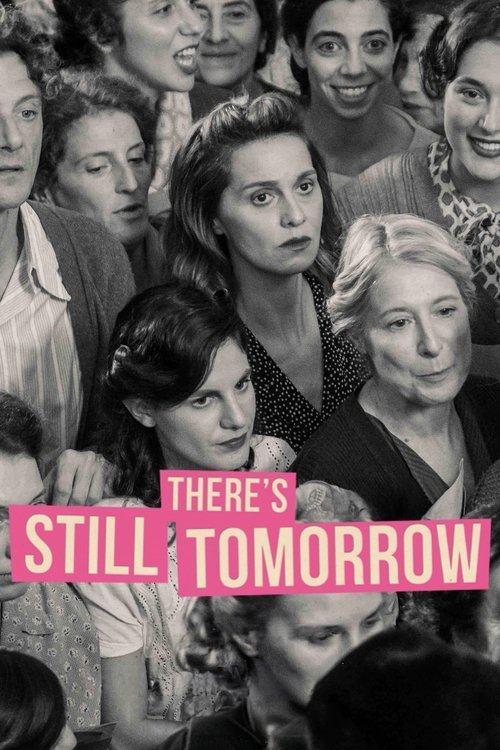
There's Still Tomorrow
2023 · Paola Cortellesi
When you want a film about hard things that never feels like punishment — witty, propulsive, and stirring rather than grim. It's a challenge wrapped in the pleasures of a crowd-pleaser.
What it's about
In the tenement courtyards of Rome in 1946, working-class Delia keeps a household running under a domineering, violent husband while quietly hiding coins in a wall and dreaming of something better for her daughter. Then a mysterious letter arrives, and she starts calculating a way to change her life.
The experience
It moves like a comedy and cuts like a drama — buoyant, musical, and sly, then suddenly chilling, with the two registers sharpening each other. You come out shaken and strangely energized.
Performances
Paola Cortellesi, directing herself, plays Delia with a comedian's timing and a survivor's watchfulness — you can read the whole marriage in how she moves around a room.
The craft
Shot in black and white with the courtyards and ration lines of classic postwar Italian cinema, it keeps deliberately breaking its own period frame: a beating staged as a ballroom dance, bruises appearing and vanishing between steps, anachronistic pop on the soundtrack. The stylization isn't a wink — it makes the brutality watchable enough to be examined.
Why it matters
Cortellesi's directorial debut became the highest-grossing Italian film in years, outdrawing Barbie at home and igniting a national conversation about violence against women.
Paola Cortellesi, one of Italy's most beloved comic actresses, chose for her directorial debut a black-and-white drama about domestic abuse in 1946 Rome — and delivered the highest-grossing Italian film in years, outdrawing Barbie in its home market and igniting a national reckoning with violence against women. The film wears the clothes of neorealism — courtyard tenements, ration lines, an American GI — but keeps breaking its own period frame: the husband's beatings are staged as a ballroom dance, bruises appearing and vanishing between steps, and the soundtrack smuggles in anachronistic pop. These are not postmodern winks but a strategy, making brutality watchable enough to be examined and placing the past in the present tense. Cortellesi plays Delia herself, a woman whose small daily calculations — coins hidden in a wall, a letter kept secret — accumulate into the film's suspense. Italian critics reached for comparisons to the commedia all'italiana's bittersweet masters, but the film's real coup is tonal: it moves from slapstick to dread within a single scene and never once loses its footing.
Reception
It didn't need a reappraisal — it opened the 2023 Rome Film Festival and promptly became Italy's biggest film of the year, out-selling Barbie and Oppenheimer in Italian cinemas. What shifted was its meaning: within weeks it went from box-office fairy tale to national civic event, the film everyone in Italy was suddenly required to have an opinion on.
How There's Still Tomorrow was received, from release to now →
Influences: the films it descends from and the films it influenced
- Rome, Open City (1945) — Establishes the postwar-Rome neorealist grammar Cortellesi quotes wholesale—real bombed-out locations, an ordinary woman's body as the site of political struggle—right down to street-level framing of women moving through a policed, occupied city.
- Bicycle Thieves (1948) — Supplies the episodic 'day in a working life' structure and the walking-through-the-city choreography, where the camera trails a laborer through mundane errands until poverty and dignity become the whole drama.
- Umberto D. (1952) — Its famous maid-waking-and-making-coffee sequence pioneers giving screen time to unglamorous domestic ritual as narrative substance—exactly the texture of Delia's endless housework rounds.
- Two Women (1960) — Model of casting a beloved star (Loren) as a working mother whose endurance of wartime sexual violence is filmed with neorealist restraint rather than melodrama—Cortellesi's Delia inherits that star-as-suffering-everywoman calculus.
- Nights of Cabiria (1957) — Blueprint for the resilient female lead whose face carries abrupt tonal pivots from comedy to devastation, and whose final act reclaims hope through a single expressive gesture toward the camera.
- Divorce Italian Style (1961) — Founding commedia all'italiana move of weaponizing comic tone and farce to indict Italy's honor-and-marriage laws, so laughter becomes the delivery system for social outrage about violence against women.
- Seduced and Abandoned (1964) — Sharpens the tragicomic satire of a patriarchal code that strips women of agency, sustaining a grim accumulating dread beneath the comic surface—the same suspense engine Cortellesi runs under her gags.
- Yesterday, Today and Tomorrow (1963) — Its portmanteau tragicomedy of Italian women navigating men and mores codifies the commedia all'italiana register—warm, ribald, quietly furious—that Cortellesi revives.
- We All Loved Each Other So Much (1974) — Direct precedent for a modern Italian film that lovingly pastiches neorealist black-and-white as an act of cinephile memory, folding film history into its own form the way Cortellesi's monochrome does.
- Roma (2018) — Shares the black-and-white memory-film centered on a working woman's quiet endurance of male abandonment, with meticulous period reconstruction elevating domestic labor to epic weight.
- Cold War (2018) — Parallel use of near-Academy-ratio black-and-white in which love and cruelty between a couple are expressed through choreographed music-and-movement set pieces, kin to Cortellesi's dance-staged intimacy.
- Dancer in the Dark (2000) — Directly rhymes with the abuse-as-ballroom-dance conceit—transfiguring an oppressed woman's brutalization into stylized choreographed musical sequences that reframe pain as reverie.
- Marie Antoinette (2006) — Pioneers the anachronistic pop needle-drop laid over strict period mise-en-scène, collapsing past and present to make a historical woman's interior life feel contemporary—Cortellesi's exact scoring strategy.
- A Knight's Tale (2001) — Earlier deployment of deliberately anachronistic modern-pop cues against a period backdrop to break the frame and signal that the era's power dynamics are still ours.
- Suffragette (2015) — Builds its climax on a working woman's dawning access to the franchise, using the political act of voting as emotional payoff—the same structural device as Delia's 1946 referendum ballot.
- Blancanieves (2012) — Companion revival of expressive monochrome period pastiche that stylizes a woman's abuse and escape through heightened, near-silent-cinema formal devices rather than realism.
Similar films
- We All Loved Each Other So Much (1974) — influence & lineage
- Two Women (1960) — influence & lineage
- Nights of Cabiria (1957) — influence & lineage
- Divorce Italian Style (1961) — influence & lineage
- Cold War (2018) — influence & lineage
- The Great Beauty (2013) — shared sensibility
- Fireworks (2023) — shared sensibility
- I'm Still Here (2024) — shared sensibility
All the films related to There's Still Tomorrow →
Watch it with: curated runs of related films
- Women Refusing to Disappear — Watch these together for one steady study of women taking back the space a violent husband, a famous man, a marriage, or a curated public image has boxed them into.