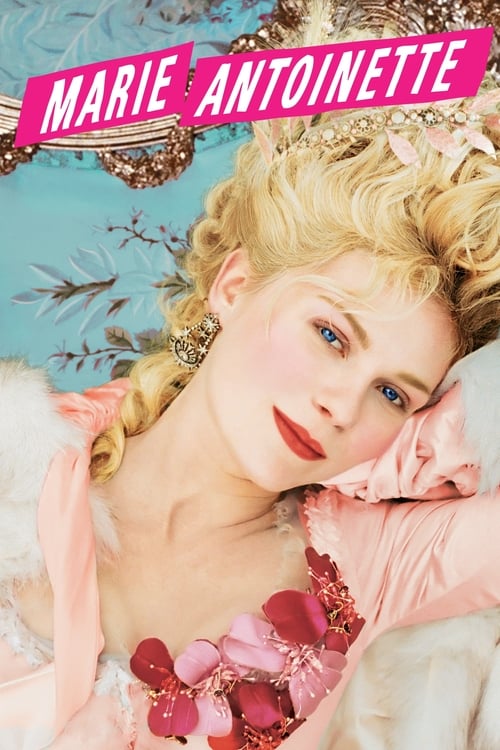
Marie Antoinette
2006 · Sofia Coppola
For when you want to sink into pure atmosphere — gorgeous clothes, great music, a hazy Sunday-afternoon watch that's secretly about being young, watched, and trapped. Comfort viewing with an ache in it.
What it's about
At fifteen, an Austrian archduchess is handed across the border to marry the future Louis XVI; at nineteen she's queen of France. Sofia Coppola follows Marie Antoinette through an unconsummated marriage under relentless court scrutiny, the candy-colored escape of parties, shoes, and champagne, and the growing rumble outside the gates of Versailles — telling it all from inside the bubble of a teenager who was never asked what she wanted.
The experience
Sumptuous and dreamy, with post-punk and new wave needle-drops scoring eighteenth-century rooms — it's playful on the surface and quietly melancholy underneath, more mood than plot. It drifts on purpose, and the loneliness sneaks up on you.
Performances
Kirsten Dunst carries the film almost wordlessly, playing the queen as a bored, luminous teenager — her charm and her isolation both register in glances rather than speeches.
The craft
Shot substantially inside the real Palace of Versailles, dressed in Oscar-winning costumes that treat the period like a pastry shop, and cut to a defiantly anachronistic soundtrack that makes 1770s court life feel like high school. It's one of the most purely beautiful period films of its era, and the images and music deserve the best screen and speakers you have.
Why it matters
Booed by some at Cannes and widely reappraised since, it became the template for the modern anachronistic period film and a defining statement of Coppola's dreamy, interior style.
Snapshot
Sofia Coppola's third feature takes the most over-narrated woman in French history and refuses, almost programmatically, to narrate her. Adapted loosely from Antonia Fraser's 2001 biography Marie Antoinette: The Journey, the film covers roughly two decades — the fifteen-year-old Austrian archduchess handed across the border to marry the Dauphin, the years of unconsummated marriage and court scrutiny, the retreat into the Petit Trianon, and the carriages pulling away from Versailles as the Revolution arrives — and declines to follow her to the Conciergerie or the scaffold. It ends with a wrecked room, not a severed head.
What made the film notorious in 2006 and durable afterward is its method rather than its subject. Coppola shot substantially inside the actual Palace of Versailles, dressed the film in Milena Canonero's Oscar-winning costumes and a candy-colored palette drawn from Ladurée pastel, and scored it with post-punk and new wave — Bow Wow Wow, Gang of Four, New Order, Siouxsie and the Banshees, The Strokes — alongside eighteenth-century material and contemporary ambient composition. Kirsten Dunst plays the queen as a bored, watched, sensorially alive teenager; Jason Schwartzman plays Louis XVI as a shy, hobbyist boy; and the entire cast speaks in unaccented contemporary English, mostly American. Historical drama's usual apparatus of explanation — the councils, the pamphlets, the fiscal crisis, the diamond necklace, the political mechanics of 1789 — is largely offscreen or reduced to murmur.
The result was a genuine critical rupture. Reports of a hostile reception at its Cannes competition premiere in May 2006 attached themselves to the film permanently, and its domestic reviews split along a fault line that is still visible: was this a formally rigorous study of confinement and surface, or an expensive act of aestheticized indifference to the politics of the Ancien Régime? Two decades on, the case for the former has largely won, and the film has become one of the most visually and musically influential American art films of its decade — cited in fashion, in music video, in the "female-gaze period piece" that now runs through prestige television and streaming costume drama.
Industry & production
Marie Antoinette was made by Coppola coming off Lost in Translation (2003), which had won her an Academy Award for Original Screenplay and given her, briefly, a form of leverage that American directors of her scale rarely get: a large-budget period film with a name star, a major studio (Columbia/Sony), and no obligation to conventional biographical structure. The production was mounted through the family firm — American Zoetrope, with Francis Ford Coppola among the producers — in partnership with Ross Katz, Coppola's producer on Lost in Translation, and with French co-production participation, which mattered practically for shooting in France.
The central industrial fact of the film is access. Coppola obtained permission to shoot at Versailles itself, working around the palace's public hours — the widely reported arrangement involved shooting when the château was closed to visitors, principally on Mondays and overnight, with the production moving in and out repeatedly rather than occupying the site continuously. This is not a trivial logistical footnote; it determined the film's shooting rhythm, its reliance on available and practical light in the state rooms, and the specific texture of its interiors, which no built set reproduces. Additional French locations — including the Petit Trianon and its gardens, the Hameau, and the Opéra Royal — extended the same principle. Some interiors were built or dressed elsewhere, and the film's non-Versailles material (the handover pavilion on the border, Vienna, Paris exteriors) was drawn from other sites and constructed sets, but the film's authority rests on the real rooms.
Budget figures for the film circulate around the $40 million range in trade reporting of the period; treat that as approximate rather than audited. Commercially the film was a modest performer domestically and did better in Europe, particularly France, where its reception was warmer than the Cannes anecdote would suggest — but precise grosses should be checked against a reliable database rather than taken from memory, and I won't assert numbers here.
Casting reflected Coppola's method of building around a performer she trusted. Dunst had appeared in The Virgin Suicides (1999) and was, by 2006, an actor whose public image — American, luminous, associated with adolescence and with the Spider-Man franchise — was itself part of the film's argument. Schwartzman is Coppola's cousin. Around them the film assembles an unusually loose ensemble: Rip Torn as Louis XV, Judy Davis as the Comtesse de Noailles, Asia Argento as Madame du Barry, Steve Coogan as Ambassador Mercy, Marianne Faithfull as Maria Theresa, Rose Byrne as the Duchesse de Polignac, Molly Shannon and Shirley Henderson as gossiping aunts. The presence of Faithfull and Argento is a casting gesture in the same register as the soundtrack: rock-cultural bodies placed inside the eighteenth century without comment.
The Cannes premiere became the film's founding legend. Contemporary reports described booing at the press screening; Coppola and others later noted that the response was mixed rather than uniformly hostile, and that applause was also present. The story's persistence tells us something about how thoroughly the film violated expectations for a Cannes competition costume drama by a recent Oscar winner.
Technology
The film sits at a specific technological moment: the last years in which a mid-budget American art film would be shot photochemically without that being a statement. Marie Antoinette was shot on 35mm color negative by Lance Acord, and its look depends on film's response to weak, warm, dispersed light sources — candle, window, overcast garden — in ways that mid-2000s digital sensors handled poorly. The interiors were lit with heavy reliance on the palace's own windows and on practical candlelight supplemented discreetly; the grain and gentle highlight rolloff in the pastel sequences are photochemical properties, not grade effects.
That places the film in a lineage it acknowledges: Kubrick's Barry Lyndon (1975), whose famous fast Zeiss Planar lenses allowed exposure by candle alone. Coppola's film does not attempt Kubrick's technical extremity; it accepts modest supplementary light and does not chase the pure-candlelight stunt. But it inherits the premise that a period interior should be photographed by the light that period possessed, and that the resulting softness is expressive rather than a defect.
Costume and production design carried their own material technologies. Canonero's costumes were built with historical construction methods — stays, panniers, silk taffeta and moiré — while pushing color into a modern confectionary range. Set decoration for the Trianon and the private apartments involved a substantial amount of fabricated period-appropriate material, since the real rooms could not be redressed freely. The much-cited Manolo Blahnik shoes, and the single pair of pale blue Converse sneakers visible in a montage cutaway, are technology in the film's own sense: objects that mark the period's surface and then puncture it.
Technique
Cinematography
Acord — who had shot Lost in Translation, and before that Being John Malkovich and Adaptation — gives the film two registers that alternate rather than blend. The first is observational and slightly detached: static or barely drifting wide shots that place Antoinette inside architecture, frames organized by the palace's enfilades, mirrors, and doorways so that she is repeatedly seen through apertures, watched from a distance, or reduced to a small figure in a very large gold room. The morning lever sequences are the clearest instance — the queen exposed to a semicircle of courtiers, the camera holding at a formal distance that reproduces the court's own act of looking.
The second register is close, tactile, and subjective: shallow-focus fragments of fabric, food, hands, hair, shoes, the back of a neck. Cake frosting, ribbon, feathers, champagne. Here the camera moves handheld or on a slow float, and the cutting attends to sensation rather than action. The film's most famous passage — the "I Want Candy" montage — is built almost entirely from this vocabulary, a rapid inventory of surfaces that functions as both indulgence and diagnosis.
Natural light governs both. Interiors are frequently backlit by tall windows, leaving faces partly in shadow; the exterior Trianon material is shot in overcast diffusion and in low golden sun, with lens flare permitted. The color design moves in blocks: Vienna cold and gray-green, the Versailles state rooms gold and mirror-white, the party sequences saturated pastel, the Trianon soft green and cream, and the final act drained toward gray.
Editing
Sarah Flack, Coppola's editor on Lost in Translation, structures the film as a series of durations rather than a causal chain. Long-held scenes of nothing happening — Antoinette waiting, eating, being dressed, being ignored in bed — alternate with compressed montages that consume years. The film's account of time is deliberately uneven: the unconsummated marriage occupies an enormous stretch of screen time relative to the political collapse, which arrives in a rush of news and departures.
Flack's cutting also does the film's music work. The pop montages are cut to the songs rather than the songs laid over cut sequences; the Hong Kong Garden opening of the Paris opera and masked-ball material, and the Trianon idyll set to Aphex Twin's "Avril 14th," are governed by musical phrase. Elsewhere the editing is notably unhurried, letting scenes end a beat after their dramatic content is exhausted — a technique that produces the film's characteristic sensation of stalled time.
Mise-en-scène / staging
This is the film's core achievement. Coppola stages Versailles as a machine for observation. Doors are opened for the queen by others; she cannot pick up her own shift; she is dressed in public; her failure to conceive is discussed within her hearing. The blocking repeatedly arranges bodies into ranks and corridors, with Antoinette moving through a gauntlet of assessing faces. Judy Davis's Noailles functions as the personification of protocol, narrating rules in the same flat instructional tone whether they concern seating or reproduction.
Against this, the Petit Trianon is staged as a release into informality: fewer people, softer geometry, bodies lying on grass, children, muslin instead of silk. The film's political argument, such as it is, lives in this contrast — the Trianon is both a genuine escape from an intolerable system of surveillance and an expensive private theme park, and Coppola stages it as both without adjudicating.
The famous anachronisms are staged with restraint. The Converse appear for a single beat inside a montage; a slice of blue-frosted cake or a modern-looking macaron pyramid sits in frame without emphasis. The strategy is puncture, not pastiche: the film's period surface is meticulous enough that small modern intrusions register as a jolt rather than a joke.
Sound
The soundtrack is the film's most argued-over element and its most consequential. Music supervisor Brian Reitzell — Coppola's collaborator across her filmography, and a drummer himself — assembled a score that places 1980s post-punk and new wave beside eighteenth-century composition and contemporary ambient work. Bow Wow Wow's "I Want Candy" and "Aphrodisiac," Gang of Four's "Natural's Not in It," New Order's "Ceremony," Siouxsie and the Banshees' "Hong Kong Garden," The Strokes' "What Ever Happened?," The Cure, Adam Ant; alongside Rameau, Vivaldi, Couperin and other period material; alongside Aphex Twin, Air, Squarepusher, and original Reitzell/Kevin Shields contributions.
The logic is not simply "modern music makes the past feel present." Gang of Four's "Natural's Not in It" — a 1979 post-punk critique of leisure as commodity — opens the film over an image of Antoinette lounging while a servant fits her shoe. That is an editorial statement about consumption placed at the film's threshold; it complicates the charge that the film is uncritically infatuated with luxury.
Beyond music, the sound design is attentive to the acoustic experience of the palace: the scrape and rustle of silk, the click of heels on parquet, the murmur of gossip carried down galleries, and long passages of near-silence in which Antoinette is simply alone in a large room. Dialogue is often thrown to the edges of the frame or held at conversational volume against ambient noise, so that we hear the court the way its subject does — as unintelligible pressure.
Performance
Dunst plays Antoinette without the interiority-signaling apparatus of conventional biographical acting: little declamation, few tears on cue, a great deal of watching and being watched. The performance is built on small registers of social discomfort — a held smile, a swallowed reaction, a glance sideways for permission — and on the physical vocabulary of adolescence rendered inside eighteenth-century clothing. Its risk is legibility: critics who disliked the film often read the performance as vacant, which is close to the point but not identical to it. Dunst's Antoinette is a person whose inner life has no permitted outlet, and the performance withholds where a conventional one would disclose.
Schwartzman's Louis XVI is a genuinely unusual piece of casting: awkward, kind, absorbed in locks and hunting, sexually paralyzed. The film treats the marriage's non-consummation with unexpected patience and something like tenderness, and Schwartzman's diffidence is essential to that. Around them, Torn's Louis XV is coarse and appetitive, Argento's du Barry a scandal in human form, Faithfull's Maria Theresa a distant maternal authority delivering instruction by letter, and Coogan's Mercy a courtier of pure diplomatic function. Byrne's Polignac supplies the film's frivolity with a body. The accents remain contemporary throughout — a decision aligned with the soundtrack and with the film's refusal of heritage-drama vocal signaling.
Narrative & dramatic mode
The film's dramatic mode is best described as the elliptical mood piece applied to biography. It has a chronology but not a plot in the causal sense. Events do not produce consequences that produce further events; instead, states of feeling accumulate and then are interrupted. The pressure of the first act — produce an heir — resolves without a clear turning point, and the film's second half drifts through pleasure and motherhood before history arrives from offscreen.
Two structural decisions define it. First, restricted narration: we are almost never given information Antoinette does not have. There is no cutaway to the Paris crowd, to the pamphleteers who invented her as l'Autrichienne, to the treasury, to the National Assembly. When the mob arrives at Versailles, we experience it as noise beyond the windows and torchlight on the ceiling. This is a defensible formal choice and the source of the film's principal critical vulnerability: a film that adopts its subject's perspective without supplying an external frame will be read by some viewers as endorsing her limits.
Second, the withheld ending. The film stops with the royal family leaving Versailles; the final shot is the ransacked bedchamber. The guillotine, the flight to Varennes, the trial, the execution — all omitted. This is a genuine formal argument: the film is about Versailles as a condition, and when Versailles ends, the film ends. It also spares the film the pathos machinery that a scaffold sequence would supply, which is consistent with its refusal to make Antoinette a martyr.
Genre & cycle
Marie Antoinette stands at an angle to the historical biopic and to what British criticism named the "heritage film." It has the surfaces of heritage cinema — great houses, costume, aristocracy, the pleasures of the well-appointed past — while withholding heritage cinema's usual moral and educational scaffolding. It is closer to the strand of self-consciously anachronistic period film that includes Ken Russell's music films, Derek Jarman's Caravaggio (1986) and Edward II (1991), and Baz Luhrmann's Romeo + Juliet (1996) and Moulin Rouge! (2001) — though Coppola's tone is cool and observational where Luhrmann's is maximalist.
Within Coppola's own work it completes a loose trilogy of confined young women: the Lisbon sisters in The Virgin Suicides, Charlotte in the Tokyo hotel of Lost in Translation, Antoinette in Versailles. All three concern female subjects placed inside beautiful enclosures they did not choose, observed rather than heard, and rendered through atmosphere rather than argument.
Its cycle position going forward is considerable: it is a founding text for the "pop period film" — Yorgos Lanthimos's The Favourite (2018), Josie Rourke's Mary Queen of Scots (2018), Autumn de Wilde's Emma. (2020), Tony McNamara and Lanthimos's The Great (2020– ), Chloé Zhao-adjacent auteur-costume experiments, and a wide band of streaming costume drama that treats historical women as contemporary interiorities.
Authorship & method
Coppola writes alone, and her scripts are notably thin on the page relative to their finished films — dialogue sparse, states of feeling indicated rather than dramatized, music and image doing the work of exposition. Her method here is characteristic: adapt a scholarly source (Fraser's biography, which is itself sympathetic and psychologically oriented) for its facts and chronology, then discard its explanatory function in favor of sensation and duration. Fraser's account of Antoinette as a young foreigner subjected to intolerable scrutiny is the film's interpretive engine; Coppola's addition is to make the scrutiny formal — a matter of staging and framing rather than dialogue.
Her collaborative core is remarkably stable and largely accounts for the film's coherence. Lance Acord (cinematography) had established with Coppola on Lost in Translation a shared vocabulary of natural light, shallow focus, and observational distance; his contribution here is the alternation between architectural detachment and tactile closeness. Sarah Flack (editing) supplies the film's temporal logic — long durations against musical compression. Brian Reitzell (music supervision and original music, with Kevin Shields of My Bloody Valentine contributing) is effectively a co-author of the film's argument; the soundtrack is not decoration but the film's principal interpretive layer, and Reitzell's placement of post-punk critique alongside period music is a reading of the material. Milena Canonero (costume design) brought heritage-drama authority — she had won Oscars for Barry Lyndon and Chariots of Fire — and used it to build historically constructed garments in a deliberately un-historical palette; she won the Academy Award for Costume Design for this film, the film's sole Oscar. K.K. Barrett (production design) and Anne Ross (set decoration) handled the near-impossible task of dressing rooms that are also protected national patrimony.
The family dimension is not incidental. American Zoetrope's involvement, Francis Ford Coppola's producer credit, and Schwartzman's casting locate the film inside a working dynasty — a fact critics used both to explain the film's access and to attack its sensibility as inherited privilege examining inherited privilege. That charge is worth taking seriously as a reading, and it is also, arguably, what makes the film's account of gilded confinement feel first-hand rather than researched.
Movement / national cinema
The film belongs institutionally to American independent-adjacent studio filmmaking — the specialty-division era in which Sony, Focus, Fox Searchlight and Miramax financed auteur projects at mid-scale budgets, a model that had largely collapsed by the mid-2010s. Its aesthetic affiliations, however, are transnational: French co-production, French locations, a European art-cinema tolerance for plotlessness, and a lineage running through Kubrick's Anglo-American formalism and the British heritage tradition it critiques.
Its reception in France was distinctive and instructive. French critics and audiences were, on balance, more receptive than the Cannes booing legend implies, and French commentary tended to engage the film as a formal object rather than as a failure of historical duty. Anglo-American criticism, by contrast, was more preoccupied with the question of whether the film had a political obligation to the Revolution.
Era / period
Two periods are in play. The depicted period is 1770–1789: the last two decades of the Ancien Régime, the reign of Louis XVI, the fiscal crisis, the American war, the pamphlet culture that constructed Antoinette as a foreign parasite, and the collapse. The film knows this history and refuses to stage most of it.
The production period is equally legible. 2006 was the height of a mid-2000s Anglo-American media economy organized around young female celebrity, tabloid surveillance, luxury consumption, and moral condemnation of both — the years of the paparazzi economy, of Us Weekly, of the public pillorying of famous young women for spending and partying. It is very difficult to watch the film's account of a teenager installed as a symbol, photographed by protocol, blamed for the treasury, and hated for her clothes, and not read it as a film about celebrity in 2006. Coppola has generally declined to spell this out, but the structural analogy is the film's most persuasive contemporary claim, and it is what has made the film legible to audiences who came to it later, through image culture rather than through history.
Themes
Surveillance and the absence of privacy. The film's central subject is not luxury but exposure. Antoinette is never alone by right; her body, her digestion, her menstrual cycle, and her marriage bed are matters of state. Etiquette is depicted as a technology of control, and the film's formal strategy — watching her being watched — makes this structural rather than anecdotal.
Adolescence inside power. She arrives at fourteen or fifteen and is queen at nineteen. The film insists on this arithmetic and stages her behavior as the behavior of a teenager given unlimited money and no autonomy — a combination it treats as a trap rather than a privilege.
Consumption as symptom. Shoes, cake, gambling, hair. The film films these with real sensual pleasure and simultaneously frames them as the only available agency, then as the instrument of her destruction. The Gang of Four cue at the opening declares this doubleness before a word is spoken.
Boredom and duration. Very little happens for very long. The film treats boredom as a serious historical experience — the phenomenology of a life with no work, no privacy, and no exit.
The failure of the private refuge. The Trianon offers a pastoral of simplicity that is itself an expensive purchase, and the film's most beautiful passages are also its most quietly damning.
Reputation as fiction. The film pointedly omits the pamphlets and the diamond necklace affair, yet the gap they leave is felt: everything the public "knows" about her — including the "let them eat cake" line, which the film has Dunst dismiss directly in an interview-like aside as something she never said — was manufactured.
Reception, canon & influence
Critical reception. The film divided critics sharply and along an unusually clean axis. Detractors — including a strand of American reviewing that found the film politically evasive — argued that Coppola had made a sumptuous music video about a figure whose story is inseparable from the immiseration of a population the film never shows, and that beauty without argument amounts to sympathy for the Ancien Régime. Defenders argued the opposite: that the film's restriction to Antoinette's sensorium is precisely its critique, that a film about a woman who could not see beyond her walls should not see beyond them either, and that its formal control — Acord's light, Flack's durations, Reitzell's soundtrack as commentary — constitutes a serious method rather than an absence of one. Roger Ebert was among the notable defenders of the film's approach to its subject as a teenager rather than a historical thesis. The Cannes press screening, whatever actually happened in the room, became the shorthand for the hostile position.
Institutionally, the film's recognition was narrow: Canonero's Academy Award for Costume Design, and a general acknowledgment of the film as a design achievement rather than a directorial one. That asymmetry — celebrated for its surfaces, doubted for its intelligence — is itself part of the film's history, and it has largely reversed. By the 2010s the film appeared regularly on decade-best and critics' lists, and the revisionist reading (formal rigor, feminist reframing, celebrity allegory) is now the dominant one. It is fair to say the film's stock rose more than almost any other American film of 2006.
Influences on the film (backward). The primary formal ancestor is Barry Lyndon — the natural-light eighteenth century, the architecture-as-frame compositions, the account of a period as a system of manners, the refusal of psychological explanation. Coppola's film borrows the look and inverts the temperature: Kubrick's irony becomes Coppola's empathy. Antonia Fraser's biography supplies the sympathetic-revisionist reading of Antoinette as a young woman crushed by an institution. The anachronistic-period tradition of Russell, Jarman, and Luhrmann licenses the soundtrack strategy, and Jean Cocteau's and Max Ophüls's differing modes of stylized period fantasy sit further back in the lineage. Within Coppola's own work, The Virgin Suicides is the direct template: enclosed girls, dreamy pop, a narration that observes without explaining. There is also a documentary-adjacent ancestor in the "reality of court routine" tradition of Rossellini's La Prise de pouvoir par Louis XIV (1966), which likewise dramatizes power as ritual and clothing rather than as decision — a resemblance worth noting even without a documented statement from Coppola citing it.
Legacy (forward). Three lines of influence are clear.
Aesthetic. The film's pastel-and-Versailles palette entered fashion and advertising almost immediately and has never really left; Coppola's subsequent Dior work and the film's afterlife in editorial photography, music video, and social-media visual culture (the "coquette" and Rococo-revival image repertoires of the 2010s–2020s) descend directly from it. Few art films of the period have been more thoroughly absorbed into non-cinematic image culture.
Formal. The anachronistic-scoring period film became a recognizable mode after 2006. The Favourite, Mary Queen of Scots, Emma., The Great, Dickinson (2019–2021), and Sofia Coppola's own Priscilla (2023) all work in territory this film mapped: contemporary speech, contemporary music, historical women rendered as interior subjects rather than illustrative figures, and a refusal to treat the past as a civics lesson. Whether or not each of these cites Coppola, the mode's legibility to audiences and financiers is substantially her doing.
Critical. The film reframed the argument about what a historical film owes to history. Its detractors' case — that aestheticizing power without depicting its victims is a political act — remains a live position, and the film is now a standard case study in that debate, taught alongside questions of the female gaze, of the biopic's obligations, and of the politics of surface. That the film is still worth arguing about, twenty years on, is the strongest evidence that its method was a method.
A Deleuzian reading
A cold room at Versailles, a semicircle of courtiers, and a chemise traveling hand to hand along a chain of rank.
The full Deleuzian reading of Marie Antoinette →
Reception
Famously met with boos at its 2006 Cannes press screening and dismissed by many as shallow style over substance; it's since been reclaimed as one of Sofia Coppola's best — a knowing film about celebrity, girlhood and gilded isolation that was ahead of its critics.
How Marie Antoinette was received, from release to now →
How to watch Marie Antoinette: what to notice on a first viewing
- Watch the chemise pass hand to hand before she wears it. Coppola stages the morning lever as a chain of rank: each person with higher status touches the garment first, and Antoinette simply waits. This scene turns hierarchy into something you can watch happen, not something explained in dialogue.
- Listen for 1980s post-punk songs playing over 18th-century images. Coppola cuts entire montages to songs like Bow Wow Wow's 'I Want Candy,' letting music carry sensation the dialogue withholds. The wrong-century music treats 1780 and 1979 as equally present, not as history versus now.
- Notice palette shifts: gray-green Vienna, gold Versailles, pastel parties, soft Trianon. Each location gets its own color block, and the final act drains toward gray as the court collapses. Color marks the stages of confinement and escape before a single line of dialogue does.
- Watch Dunst's face for a held smile or a swallowed reaction. Dunst plays discomfort in small, withheld registers, a glance sideways for permission rather than tears or declaration. Her performance shows a person with no permitted outlet for her inner life.
The whole guide to watching Marie Antoinette, with the keys for a rewatch →
Influences: the films it descends from and the films it influenced
- Barry Lyndon (1975) — The template Acord and Coppola work from directly: candle- and window-sourced exposures inside real eighteenth-century rooms, figures pinned small inside symmetrical architecture-as-proscenium framings, and a refusal of psychological interiority that makes period manners themselves the drama — Coppola keeps the optics and the compositional grammar while swapping Kubrick's ironic distance for identification.
- La Prise de pouvoir par Louis XIV (1966) — Dramatizes absolutism entirely as procedure — the levée, the dressing, the ordering of who hands the king his shirt — so that costume and protocol carry the political content; Coppola's morning-toilette scenes, with courtiers ranked by the right to touch, are the same device applied to a queen who is its object rather than its author.
- The Virgin Suicides (1999) — Establishes her working method wholesale: girls enclosed by an institution shot in soft diffusion and long dead-time, a commissioned pop score (Air) laid over montage so the music narrates the feeling the dialogue withholds, and an observational point of view that describes without explaining.
- Lost in Translation (2003) — The prior Acord collaboration that sets the shooting protocol — available light, loose handheld coverage of a young woman waiting inside an alien institution, hotel-corridor and window compositions built as soft confinement, and needle-drops used as her interior monologue rather than as scene-setting.
- Picnic at Hanging Rock (1975) — Bridal-veil diffusion and gauzy over-exposure on girls in white muslin, tactile insert-montages of corsets, stockings and cake, an anachronistic non-period music cue (Zamfir's panpipes) over period image, and a narrative that ellipses its own climax — the exact combination of surface sensuality plus withheld explanation Coppola adopts.
- The Devils (1971) — Licenses the anachronistic period film as a serious mode: contemporary performance registers and deliberately non-period design inside a rigorously researched historical frame, on the premise that fidelity of texture matters more than fidelity of idiom.
- Caravaggio (1986) — Plants modern objects inside the period tableau as visible, unapologetic intrusions (the pocket calculator, the motorbike) rather than errors — the precedent for Coppola's pair of Converse in the shoe montage and for the film's general refusal to hide its own present tense.
- Lola Montès (1955) — Constructs a woman's life as a spectacle staged for paying spectators, with the camera gliding through gilded, over-decorated interiors and framing her through drapery, mirrors and crowds — the Ophülsian machinery of a celebrated woman consumed by her audience that Coppola reuses as Versailles' surveillance architecture.
- The Age of Innocence (1993) — Uses macro inserts of food, porcelain, flowers and calling cards cut into rhythmic montage, plus voiceover-adjacent narration, to render a leisure class as a system of watching in which a whisper across a ballroom is a lethal act — Coppola's pastry-and-slipper montages and her gauntlet-of-courtiers staging work the same way.
- The Scarlet Empress (1934) — The female monarch rendered as pure decorative spectacle, court life staged as surface and pageant over historical narrative — Sternberg's image of the sovereign-as-theater.
- Dangerous Liaisons (1988) — Pushes pre-revolutionary decadence and dressing sequences to the foreground, using costume and confectionary surfaces as the moral and emotional environment Frears first weaponized.
- The Portrait of a Lady (1996) — Deploys anachronistic interpolation (pop scoring, modern framing) exactly as Campion's contemporary prologue and silent-cinema interlude do — estranging the heritage period from inside.
- The Favourite (2018) — Takes the post-2006 mode to its extreme: candlelit and window-lit palace interiors shot on wide/fisheye glass so corridors become surveillance tunnels, plus flatly contemporary diction and profanity in period mouths — court intrigue as a closed ecology of watching, with music (Vivaldi, Messiaen, Anna Meredith) deployed as abrasive commentary rather than period color.
- Spencer (2021) — The clearest structural heir: a royal woman confined to one estate over a few days, shot on available light and 16mm/35mm grain, with palace acoustics (footsteps, doors, the clatter of the equerry's protocol) treated as an oppressive sound design and Jonny Greenwood's score functioning as critique of the institution rather than accompaniment to it.
- Jackie (2016) — An anti-biopic that restricts itself to one woman's sensorium — long close-ups, elliptical time, refusal of the explanatory public-history scene — while Mica Levi's dissonant score comments on the iconography instead of underscoring it; the same argument that formal restriction to the subject's perception *is* the historical thesis.
- Corsage (2022) — Applies the whole Marie Antoinette kit to Empress Elisabeth: lacing and weighing the body as the film's central ritual, deliberately anachronistic props and anachronistic covers (Camille's songs, a modern harp arrangement) as ironic commentary, and empty palace rooms photographed in flat daylight to make monarchy read as boredom under observation.
- Emma. (2020) — Inherits the palette and the scoring strategy almost literally — a confectioner's pastel and mint production design, Blauvelt's soft naturalistic light, tactile montages of ribbons and cakes, and diegetic/contemporary-inflected song used to editorialise on a young woman's self-regard.
- Priscilla (2023) — Coppola's own restatement of the film's grammar in another gilded compound: a teenage bride installed inside an estate whose rooms she cannot leave, dressing and make-up rituals as narrative, dead-time waiting shots, and pop needle-drops standing in for a withheld inner voice.
- Jojo Rabbit (2019) — Scores a period setting with anachronistic pop needle-drops to collapse historical distance — the soundtrack device Jojo deploys via German-language Beatles and Bowie.
- Cruella (2021) — Blueprint for scoring a costume-heavy period world with anachronistic punk/post-punk needle drops, treating couture as the visual grammar of a young woman's self-invention.
- Fear Street: 1666 (2021) — The anachronistic needle-drop technique — contemporary pop laid over a rigorously period setting to collapse historical distance — which the trilogy weaponizes across its era-hopping soundtrack.
- The Bride! (2026) — Post-punk needle drops laid over meticulously researched period interiors — anachronism located in the soundtrack and the odd prop while the staging stays straight, which is precisely the seed's anachronistic production-design contract.
- House of Pleasures (2011) — Established the anachronistic needle-drop as a structural rather than ironic device: contemporary pop scored across a hermetically sealed period luxury world to collapse the historical distance the costumes create.
- Queer (2024) — Legitimizes the anachronistic needle drop as period-film syntax: pop recordings decades out of the diegesis used as the protagonist's interior weather, which Queer extends with Nirvana-by-way-of-O'Connor and New Order over 1950 Mexico City.
- The Bling Ring (2013) — Extends the film's central formal claim — that consumption montage set to contemporary music is itself a critique — by cutting shoes, handbags and closets to rhythm inside real celebrity houses, with Savides's cool available-light long takes replacing explanation of motive.
- Bright Star (2009) — Period film built from fabric and light rather than incident: hand-stitching and needlework as protagonist's craft and the film's texture, natural-light interiors and wind-in-muslin, and long durations of waiting that treat a woman's ordinary time as the story.
- Portrait of a Lady on Fire (2019) — Shares the technical wager — candle and daylight-only period photography, a nearly music-free track so that fire, sea and skirts become the score, and near-total confinement to an enclosed female household — arriving at the same conclusion that restricting the frame to what these women can see is a formal argument, not an evasion.
- Napoleon (2023) — A prior revisionist biopic that renders a foundational French national figure through a deliberately anglophone, anti-reverent lens, prefiguring the irreverence French critics objected to in Scott's portrait.
- Kamikaze Girls (2004) — Deploys rococo pastel excess and anachronistic pop scoring as a girl's armor of self-fashioning — the same 'frivolity and fashion as identity-building courage' thesis Momoko lives out in Baby-the-Stars-Shine-Bright frills.
- There's Still Tomorrow (2023) — Pioneers the anachronistic pop needle-drop laid over strict period mise-en-scène, collapsing past and present to make a historical woman's interior life feel contemporary—Cortellesi's exact scoring strategy.
- "Wuthering Heights" (2026) — Template for the anachronistic pop cue over rigorous period costume — using contemporary music and candied color to render a historical interior as felt, present-tense adolescent hunger rather than museum reconstruction.
- Queen Margot (1994) — Deploys anachronistic pop scoring against pristine period images as a deliberate anti-heritage authorial gesture, the boldest inheritance of Bregović's score-against-image tactic.
Similar films
- Priscilla (2023) — influence & lineage
- The Favourite (2018) — influence & lineage
- Portrait of a Lady on Fire (2019) — influence & lineage
- Barry Lyndon (1975) — influence & lineage
- The Age of Innocence (1993) — influence & lineage
- The Virgin Suicides (2000) — shared sensibility
- Melancholia (2011) — shared sensibility
- Napoleon (2023) — shared sensibility
All the films related to Marie Antoinette →
Watch it with: curated runs of related films
- The Making of a Legend — A run of biopics that watch private people get forged into public icons — the ambition, the pressure, and the loneliness of becoming somebody the world can't stop looking at.