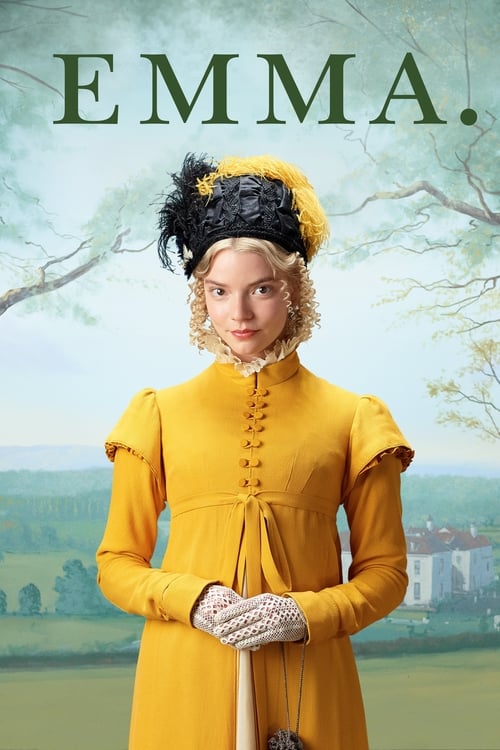
Emma.
2020 · Autumn de Wilde
For a cozy night in when you want wit, beautiful clothes, and a love story that earns its swoon — comfort viewing with a mischievous streak. Perfect with tea, a blanket, and zero cynicism.
What it's about
In Regency England, Emma Woodhouse is rich, clever, beautiful, and completely convinced she knows what's best for everyone — especially who they should marry. Her matchmaking schemes for her friends tangle spectacularly, while the one man willing to call her on her behavior stays irritatingly close at hand. It's Jane Austen's comedy of a heroine whose self-knowledge lags well behind her confidence.
The experience
Crisp, arch, and gorgeous to look at — a comedy of manners played with real bite, where the barbs land as sharply as the romance eventually does. It's paced like a soufflé: light, precise, and more emotional than it first lets on.
Performances
Anya Taylor-Joy makes Emma genuinely spiky — vain, funny, and just unlikable enough that her thaw means something — while Johnny Flynn gives Mr. Knightley an unusual rumpled ardor. Bill Nighy steals scenes as her draft-fearing hypochondriac father.
The craft
Autumn de Wilde, a photographer by trade, composes every frame like a pastel confection — symmetrical rooms, candy-colored gowns, immaculate detail — and the prettiness is itself a joke about this insulated little world. The costume and production design alone reward a big, bright screen.
Why it matters
One of the last big period romances to charm theatrical audiences before the pandemic, it confirmed Anya Taylor-Joy's leading-lady rise and showed that Austen adaptations could be both faithful and visually playful.
Snapshot
Emma. is Autumn de Wilde's feature directorial debut, a fastidiously stylized adaptation of Jane Austen's 1815 comedy of manners about a wealthy young woman whose confidence in her own matchmaking outruns her understanding of herself and everyone around her. Adapted by the novelist Eleanor Catton and led by Anya Taylor-Joy as Emma Woodhouse and Johnny Flynn as Mr. Knightley, the film reframes Austen's most self-satisfied heroine inside a candy-box visual scheme of pastel interiors, symmetrical framings, and immaculate Regency costume — a look that at once flatters and gently satirizes the insulated gentry world it depicts. The trailing period in the title is a deliberate visual joke, flagging both the movie's status as a "period piece" and its air of prim finality. Arriving in February 2020, it stands as one of the last conventional theatrical releases before pandemic closures, and as a key early marker of Taylor-Joy's ascent to stardom.
Industry & production
Emma. is a British production, developed within the ecosystem of prestige UK literary adaptation and released internationally through Focus Features (Universal's specialty arm) in the United States. It was produced by Blueprint Pictures, the company of Graham Broadbent and Pete Czernin best known for the work of Martin McDonagh (In Bruges, Three Billboards Outside Ebbing, Missouri) — a lineage more associated with acerbic dark comedy than heritage romance, which helps explain the film's willingness to lean into Austen's cruelty as well as her charm. (I want to flag production-company attributions as the kind of credit worth verifying against the film's own titles rather than taking on faith; my confidence is high on Blueprint and Focus but not absolute on every co-financing partner.)
The project belongs to a well-established commercial category: the Austen adaptation as reliable mid-budget prestige property. Studios have returned to Emma repeatedly because it offers a bankable combination of comedy, romance, marquee costume, and a ready-made audience. De Wilde's version distinguishes itself in the marketplace less by story than by design sensibility — it was sold heavily on its look, its ensemble comic casting (Bill Nighy, Miranda Hart, Josh O'Connor), and the rising profile of its lead. The theatrical rollout, a platform release expanding through late February and into March 2020, was cut short by the COVID-19 shutdown of cinemas, and the film's commercial life shifted abruptly to premium video-on-demand — an accident of timing that shaped its reach far more than any creative decision.
Technology
Emma. is a contemporary digital-era production in its post-production and delivery, though I'd caution against my asserting a specific camera negative or capture format as fact — cinematographer Christopher Blauvelt has worked in both photochemical and digital registers across his career, and I cannot reliably confirm which he used here without inventing detail. What is safe to say is that the film's technological signature lies not in novel image-capture but in exacting control of the traditional tools of the costume picture: precise color management in the grade to sustain its sherbet palette, and a production and costume pipeline (constructed gowns, period tailoring, dressed interiors) whose craft is analog even where the finishing is digital. The film's "technology" is, in effect, the technology of curated surface — the manufacture of a heightened, almost pâtisserie-perfect version of Regency England.
Technique
Cinematography
Blauvelt's photography is the film's most discussed formal element. The framing favors frontality and symmetry, with characters often centered or arranged in balanced tableaux against wallpapered, pastel walls — a strategy frequently compared to Wes Anderson, though Blauvelt keeps the camera more mobile and the compositions somewhat looser than Anderson's rigorous planimetric style. Light is high and even, giving interiors a bright, doll's-house clarity that flatters the costumes and turns rooms into display cases. The effect is pointed rather than merely pretty: the pristine, over-composed image mirrors Emma's own managed, controlling gaze on her social world, and the beauty of the frame becomes part of the satire of privilege.
Editing
Edited by Nick Emerson, the film cuts for comic timing above all — holding on reaction shots, letting Austen's ironies land in the beat after a line, and building set-piece social scenes (dances, dinners, the disastrous Box Hill outing) through crisp alternation of glances and postures. The rhythm is brisk enough to keep a two-hour costume comedy buoyant, and the editing works closely with the performances to sharpen the movie's needling humor, where a look or a pause carries the joke.
Mise-en-scène / staging
This is the department where de Wilde's authorship is most legible. Production design by Kave Quinn and costume design by the veteran Alexandra Byrne construct a color-coded, confectionery world in which class and character are encoded in fabric and furnishing. Emma's world is ordered, matched, and controlled; disruptions to that order register visually. Staging emphasizes the choreography of manners — where people may stand, whom they may address, the physical comedy of servants materializing to move furniture — foregrounding the rituals and constraints of gentry life. Byrne's costumes in particular do heavy narrative work, marking rank, taste, and social aspiration (the Eltons' vulgarity, Harriet's uncertain status) with real specificity.
Sound
The score is credited to Isobel Waller-Bridge and David Schweitzer, and the soundtrack notably weaves in English folk songs and choral/hymn material, giving the film a rootedness that plays against the artifice of the images. Johnny Flynn — a musician as well as an actor — contributes song material, including a track heard over the end credits, folding his own folk idiom into the film's texture. The sound design elsewhere is attentive to the comedy of the body and the etiquette of rooms: rustling fabric, the clatter of social machinery, the pointed silences of embarrassment.
Performance
The ensemble is the film's engine. Anya Taylor-Joy plays Emma as poised, watchful, and unignorably vain — resisting the temptation to soften the character prematurely, so that the heroine's growth is earned rather than assumed. Johnny Flynn's Knightley is more rumpled and physical than the usual stately incarnation, and the adaptation gives him a startling naturalistic beat — a nosebleed during the emotional climax of the proposal, absent from Austen — that punctures the film's polish at exactly the right moment. Around them, Bill Nighy turns Mr. Woodhouse's valetudinarian anxieties into deadpan physical comedy (his fixation on drafts), Miranda Hart brings genuine pathos to the garrulous Miss Bates, Mia Goth plays Harriet Smith's suggestibility with sweetness, and Josh O'Connor and Tanya Reynolds render the Eltons as comic grotesques of social climbing.
Narrative & dramatic mode
The film hews to Austen's free-indirect comedy of misreading: a heroine convinced of her insight repeatedly misinterprets the desires of those she manipulates, and the plot's engine is the gap between what Emma believes she perceives and what is actually happening. The dominant mode is ironic social comedy shading into romance, with the central pleasure lying in dramatic irony — the audience seeing the truth of the Elton, Harriet, Frank Churchill, and Jane Fairfax entanglements before Emma does. The Box Hill sequence, in which Emma's casual cruelty to Miss Bates is named and rebuked by Knightley, functions as the moral hinge on which the comedy pivots toward self-recognition. Catton's screenplay preserves this architecture while tightening it for the screen and heightening the comic register.
Genre & cycle
Emma. sits at the intersection of the costume/heritage drama and the romantic comedy, but it belongs specifically to the long cycle of Austen screen adaptations that has recurred across film and television for decades. It is also self-consciously a late, revisionist entry in that cycle: rather than the plush realism of the heritage tradition, it adopts an ironic, stylized, quasi-storybook surface that comments on the artifice of the world it depicts. In this it aligns with a broader contemporary tendency to re-approach canonical costume material with formal playfulness and a more openly satirical eye toward class.
Authorship & method
De Wilde came to the film from photography and music-video direction, and that background is everywhere in the movie's emphasis on composed image, color, and surface — the film thinks like a photographer's project, building meaning through arrangement and palette. Her method here is collaborative in a way that foregrounds design: the vision is realized jointly with Byrne's costumes and Quinn's production design as much as through staging of actors.
The key collaborators define the film's character. Eleanor Catton, the Booker Prize–winning New Zealand novelist (The Luminaries), wrote the screenplay — a notable choice to hand Austen to a literary novelist rather than a career adaptor, and one that yields a script alert to Austen's irony. Christopher Blauvelt supplied the cinematography, bringing a strong compositional signature. Isobel Waller-Bridge and David Schweitzer composed the score, integrating folk and choral traditions. Nick Emerson edited. Together they produce a film whose authorship is best described as a design-led ensemble under a first-time director with a very defined eye.
Movement / national cinema
The film is a product of British national cinema's durable prestige-adaptation sector — the same broad tradition that produced Merchant Ivory literary films and the BBC/ITV costume-drama apparatus. But Emma. positions itself against the earnest realism of classic heritage cinema, offering instead a knowing, stylized surface. It thus reads as part of a more recent, revisionist current within British and Anglophone period filmmaking that treats the costume drama as a space for formal experiment and irony rather than reverent reconstruction.
Era / period
The film is set in Regency-era England (the story's early-nineteenth-century world of landed gentry, entailed fortunes, and marriage as social economy). Its treatment of that period is deliberately non-naturalistic: the England on screen is a heightened, immaculate confection, a curated fantasy of the past whose very perfection is part of the point. Produced and released in 2019–2020, the film also belongs to a contemporary moment newly attentive to class privilege and to the labor (servants, dressmakers) that sustains the leisure of Austen's protagonists — an awareness the staging quietly foregrounds.
Themes
At its center are self-knowledge and moral growth: Emma must learn to read others honestly and to recognize her own capacity for unkindness. Bound up with this are the film's themes of class and social power — the way matchmaking is really the exercise of control over other people's lives, and the way Emma's meddling with Harriet reflects an assumption that she may arrange the fates of her social inferiors. Marriage appears as an economic and social institution as much as a romantic one, and the comedy repeatedly exposes the vanity, snobbery, and self-deception that structure genteel society. The film's beautiful, controlled surfaces are themselves thematic: they visualize both the appeal and the confinement of a world governed by manners.
Reception, canon & influence
Critically, Emma. was generally well received, with particular praise for its production and costume design, its comic ensemble (Nighy, Hart, O'Connor), and Anya Taylor-Joy's sharp, unsentimental lead performance; the recurring reservation among skeptical reviewers was that its lacquered stylishness could feel cool or precious, keeping emotion at arm's length. (I'm characterizing the consensus in general terms rather than citing specific scores or figures, which I can't verify precisely.)
Influences on the film (backward): Most immediately, Austen's 1815 novel and the deep bench of prior Emma adaptations — Douglas McGrath's 1996 feature with Gwyneth Paltrow, the 1996 television version scripted by Andrew Davies with Kate Beckinsale, the 2009 BBC miniseries with Romola Garai, and, at a slant, Amy Heckerling's Clueless (1995), which transposed the story to a Beverly Hills high school. De Wilde's version defines itself against the plush realism of those predecessors. Formally, the symmetrical, pastel, storybook aesthetic invites the frequently made comparison to Wes Anderson, and the film sits within the broader heritage-cinema tradition it simultaneously stylizes and needles.
Legacy / what it shaped (forward): The film's most durable effect may be as a career accelerant: released the same year Taylor-Joy became a global figure through The Queen's Gambit, Emma. helped cement her stardom and demonstrated her range in a comic, period register. It also announced Autumn de Wilde as a feature filmmaker with a distinctive design sensibility, and it reinforced a wider vogue for stylized, ironic, color-forward approaches to the costume drama. Its longer-term standing in the Austen-adaptation canon is still settling; because its theatrical run was truncated by the 2020 pandemic closures, much of its afterlife has unfolded on home platforms, and its precise place relative to the McGrath and Davies versions in the film's ongoing reception is a matter on which the record remains genuinely unsettled.
Reception
Well reviewed on release in February 2020, its theatrical run was cut short by COVID — it became one of the first films rushed to home rental in March 2020, and has since settled in as a pandemic-era comfort watch whose stock kept rising as Anya Taylor-Joy became a star.
How Emma. was received, from release to now →
How to watch Emma.: what to notice on a first viewing
- Watch how often Blauvelt centers people against a wallpapered wall. Faces sit dead center, bodies arrange into balanced rows, and the light stays high and even. Rooms become display cases with people set inside them. The over-managed image matches Emma's own managed view of everyone around her, so the frame flatters her and needles her at once.
- Watch the colors and fabrics each character wears. Alexandra Byrne's costumes code rank and taste. Emma's world matches itself exactly. The Eltons overreach in their trimmings, and Harriet's clothes never quite settle what she is. You can read the social map off the wardrobe before anyone says a word about who outranks whom.
- Watch the faces after a line lands, not during. Nick Emerson holds on reactions. The joke usually arrives in the beat after someone speaks, in a look sent across a room or a mouth deciding not to answer. Austen's irony lives in the response rather than the remark, so the cut is where the comedy actually happens.
- Notice the servants working behind the main conversation. De Wilde keeps the background busy with the machinery of gentry life. Fires lit, screens carried in, furniture moved on cue while Bill Nighy's Mr. Woodhouse frets about drafts. The labor stays visible, which keeps reminding you what this comfortable world costs and who is supplying it.
- Watch Taylor-Joy's eyes while someone else is talking. She plays Emma as poised, watchful, and vain, and refuses to soften her early. You can see Emma deciding what to do with people while they are still speaking. You get her confidence and her misreading in the same shot, which puts you a step ahead of her all film.
The whole guide to watching Emma., with the keys for a rewatch →
Influences: the films it descends from and the films it influenced
- Barry Lyndon (1975) — Kubrick's frontal, painterly tableaux composed like framed portraits — figures centered against symmetrical drawing-room architecture — is the template for Blauvelt's static, gallery-like Regency compositions.
- The Draughtsman's Contract (1982) — Greenaway's rigidly symmetrical, front-on framing of a formal English estate as a decorative grid of manners is a direct precedent for Emma.'s treatment of Hartfield as an ornamental, geometrically staged social space.
- A Room with a View (1985) — The Merchant-Ivory heritage grammar — lush costume/production design as the film's primary carrier of class meaning — is the tradition Emma. adopts wholesale and then over-polishes into self-aware artifice.
- Emma (1996) — The immediate feature-adaptation predecessor whose plush naturalism supplies the scene architecture and matchmaking-comedy beats that de Wilde deliberately re-stages as lacquered stylization.
- Clueless (1995) — Established Emma's plot as a comedy of misreading driven by a well-meaning matchmaker's blindness, foregrounding costume-as-status and dramatic irony that de Wilde restores to Regency dress.
- Pride & Prejudice (2005) — Wright's insertion of bodily, unglamorous physical realism into Austen (muddy hems, flushed skin, awkward hands) is the lineage behind Emma.'s naturalistic nosebleed puncturing the proposal's romance.
- Marie Antoinette (2006) — Coppola's candy-colored, pastry-palette revisionism — treating the period as pop confection with anachronistic tonal knowingness — models Emma.'s color-forward, ironic approach to the costume drama.
- The Grand Budapest Hotel (2014) — Anderson's dead-center frontal framing, dollhouse symmetry, and pastel storybook palette are the explicit visual grammar de Wilde borrows for Hartfield's tableaux and whip-timed ensemble gags.
- Rushmore (1998) — Its deadpan comic editing — cutting on precisely composed centered inserts and chapter-card structure — is the rhythmic model for Emma.'s clipped comic timing and intertitle season-cards.
- The Witch (2015) — Anya Taylor-Joy's breakout established the watchful, unsentimental stillness she brings to Emma, where her sharp, minimal reactions carry the dramatic irony without mugging.
- Bridgerton (2020) — Extends the high-key, saturated color-coded Regency palette and stylized-costume-as-character grammar into serialized television, amplifying Emma.'s ornamental approach to the period.
- Persuasion (2022) — Directly downstream Austen revisionism that pushes the ironic, knowing register further via fourth-wall address, extending Emma.'s comedy-of-misreading dramatic irony into direct-to-camera commentary.
- Mr. Malcolm's List (2022) — A Regency comedy of matchmaking and social misreading built on the color-forward, symmetrically staged, storybook costume-drama aesthetic Emma. helped re-popularize.
- Poor Things (2023) — Carries forward the stylized, hyper-designed, color-saturated revisionist period film in which artificial production design and ironic tone are the point, the maximalist endpoint of Emma.'s lacquered surface.
- Love & Friendship (2016) — A near-contemporaneous Austen adaptation (Lady Susan) that pitches the material as arch verbal comedy of manners, prioritizing irony and social maneuvering over romantic sincerity, exactly as Catton's script does.
- The Favourite (2018) — Shares the revisionist-period-comedy mode: formally aggressive wide framing, acid social satire, and bodily indignity deployed to needle the dignified heritage costume drama from within.
- The Personal History of David Copperfield (2019) — A concurrent literary-heritage adaptation that treats the period as playful, brightly staged artifice with comic ensemble timing, sharing Emma.'s stylized, un-reverent handling of a canonical source.
- Little Women (2019) — A parallel color-warm, women-authored literary-heritage reinvention foregrounding domestic staging and moral self-knowledge, part of the same 2019–20 vogue for design-led revisionist period drama.
- Enola Holmes (2020) — Deploys heightened pastel storybook staging and costume-as-characterization in a knowing period comedy, sharing Enola's use of dress and production design as active narrative signals.
- "Wuthering Heights" (2026) — Sibling in the pop-inflected, hyper-saturated costume adaptation — arch, doll-house tableau framing and a stylist's palette that treats the period picture as contemporary design object.
Similar films
- Pride & Prejudice (2005) — influence & lineage
- Little Women (2019) — influence & lineage
- The Favourite (2018) — influence & lineage
- Poor Things (2023) — influence & lineage
- Sense and Sensibility (2026) — shared sensibility
- Sense and Sensibility (1995) — shared sensibility
- Promising Young Woman (2020) — shared sensibility
- "Wuthering Heights" (2026) — shared sensibility