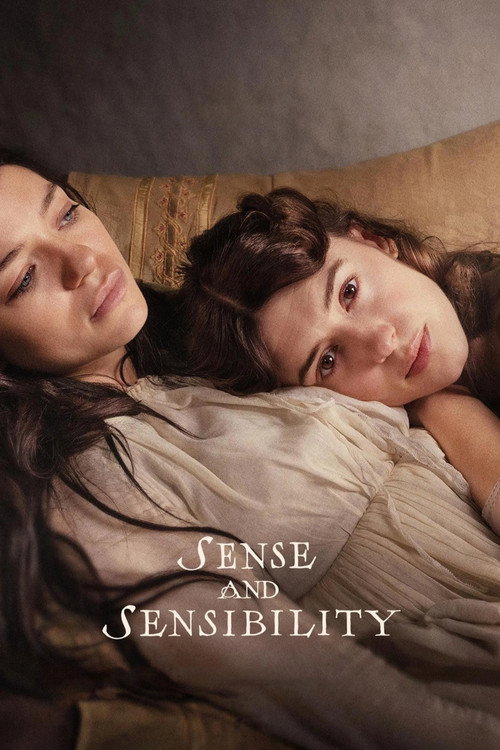
Sense and Sensibility
2026 · Georgia Oakley
For a grey Sunday when you want a period romance with mud on its hem — something slow-burning and melancholy to sink into rather than a cozy comfort watch. Reach for it when you'd rather feel longing than be charmed.
What it's about
When their father dies and the estate passes to a half-brother who's talked out of helping them, the Dashwood women — a widowed mother and her daughters — are pushed out of their grand home and into a damp farmhouse on the Devon moors. There, steady, self-contained Elinor and headlong, romantic Marianne each fall into a courtship that tests them: one with a quiet, awkward suitor bound by obligations he can't speak of, the other with a dashing stranger who seems too good to last. Adapted from Jane Austen's novel, it puts the bond between the two sisters — not the romances — at the story's heart.
The experience
Slow, hushed, and deliberately windswept — this is Austen played for ache rather than sparkle, with long stretches of waiting and wanting that press down on you. It's tender toward its sisters and quietly bruising about everything around them; less laugh-out-loud than most versions, more likely to leave you wistful.
Performances
Daisy Edgar-Jones gives Elinor's composure the sense of feeling held forcibly in check, and Esmé Creed-Miles is the film's emotional engine as Marianne; their real history working together shows in an unforced sisterly intimacy. Fiona Shaw and Caitríona Balfe add weight around them.
The craft
Shot almost entirely on location in real English houses and on Dartmoor, with costumes dyed in plant dyes and a dark, muted, low-light palette that divides viewers — painterly to some, murky to others. Director Georgia Oakley keeps the camera close to skin and weather rather than at polite period distance, and stages the ballroom dances as the one place touch is allowed, which makes them crackle. The landscape photography rewards a big screen.
Why it matters
The first major English-language film of the novel in three decades, it reframes the story as a sister story first and tests whether raw, naturalistic period style can hold a mainstream audience in the glossy Bridgerton era. It also marks Georgia Oakley's leap from acclaimed indie debut to studio-scale filmmaking.
Snapshot
Georgia Oakley's Sense and Sensibility is the first major English-language feature adaptation of Jane Austen's 1811 novel since Ang Lee's 1995 film. Working Title Films produced it, with Tim Bevan, Eric Fellner, India Flint and Jo Wallett as producers, and Focus Features released it in the United States. Australian novelist Diana Reid wrote the screenplay. Daisy Edgar-Jones plays Elinor Dashwood and Esmé Creed-Miles plays Marianne, with Caitríona Balfe as Mrs. Dashwood, George MacKay as Edward Ferrars, Frank Dillane as Willoughby, Herbert Nordrum as Colonel Brandon and Fiona Shaw as Mrs. Jennings. The film premiered in Leicester Square, London, on 15 September 2026, opened in UK and Irish cinemas on 25 September and in the US on 16 October.
Two choices define the finished film. It treats the bond between the two sisters as the story's center, with the courtships secondary — Oakley has said that when she read the book it was above all a love story between the two sisters — and it gives the Regency world an earthy, naturalistic texture: plant-dyed dresses, loose garments, hair worn down and disheveled, bare feet, a palette of sepia and earth tones. Critics split along exactly those lines. Some called it a bracing renewal that steps out of the 1995 film's shadow; others felt it traded Austen's comic wit for gloom and murk.
Industry & production
The film belongs to the long-running British heritage-adaptation tradition, and specifically to Working Title's line of literary period films. That company's best-known Austen title is Joe Wright's Pride & Prejudice (2005), which also turned toward muddy hems and rural realism, and the new film extends that naturalist strain much further.
Oakley did not initiate the project: Working Title approached her in 2024 to direct a script Reid had already written, when Blue Jean (2022) was her only feature. Principal photography began in July 2025 in the United Kingdom. The budget was $25 million, modest by studio standards and typical of a prestige period drama aimed at adult audiences. Within that budget Oakley fought for and won one expensive commitment — shooting on 35mm film — which she has described as integral both to the film's look and to her working process, while acknowledging it was a tricky ask at that scale and one she expected to be discouraged from.
Technology
The film was shot on 35mm. Oakley has said she pushed for the format against the expected resistance, knowing it might be difficult at the budget, because it mattered to her both as process and as image: the grain and color response of film stock underpin the antique, tea-stained look critics described. The approach sits in a recognizable lineage of celluloid naturalism in the British period film — Oakley has cited Andrea Arnold's Wuthering Heights (2011) and Robbie Ryan's period cinematography as reference points — and the film's commitment to low available light drew comment on both sides: atmospheric to some reviewers, frustrating to others. The photochemical purism was not absolute; Monica Castillo of the A.V. Club complained that digitally created candle flames in the interiors read as conspicuously fake.
Technique
Cinematography
Arnaud Potier shot the film. Reviews converge on its look even where they disagree on its merits: a palette of sepia and earth tones shot through with rich yellows and deep forest greens, and compositions Castillo described as antique-looking. The camera is mobile and close rather than composed at the tableau distance of classical heritage cinema. Devan Suber of the Film Stage noted a roving, handheld style he likened to Terrence Malick, voiceover included, and a recurring device of using mirrors in interior scenes to shift focus between speakers. Oakley's stated aim was that audiences should feel they could reach through the screen and touch the characters, and she has named Bergman's Persona as a touchstone for framing and emotional distance.
The film is strongest outdoors. Olly Richards of Time Out judged it most itself out in the elements, untamed, in the Arnold vein, while finding the London interiors comparatively generic. The dissents target the same qualities: Odie Henderson of the Boston Globe found passages so dark that the action was hard to see, and Castillo flagged awkward shot choices alongside the praise for the palette.
Editing
Izabella Curry, who also cut Blue Jean, edited the film. Its rhythm is deliberately unhurried, and the pacing became one of the main critical fault lines: Henderson felt the film lingers where it should move, and contrasted its stateliness with the briskness of Oakley's debut. The film opens with a running sequence — motion bursting against a story otherwise built on constraint — and Kimberley Jones of the Austin Chronicle noted running as a structural motif. The overall structure keeps the novel's broad geography, moving from the countryside into a London section.
Mise-en-scène / staging
Production designer Francesca Di Mottola and costume designer Grace Snell carry the film's earthy idea through décor and dress. The costumes were colored with natural dyes — logwood for Elinor, elderberries for Marianne — and Edgar-Jones has said the effect was to make the Dashwoods feel a part of the earth. Screen Daily's reviewer registered the result on screen: characters with their hair down and disheveled, their garments loose. Oakley chose barefoot scenes and unmade hair deliberately, wanting audiences to see human beings like themselves rather than museum figures, and for costume the team looked to John Schlesinger's Far from the Madding Crowd (1967) and Céline Sciamma's Portrait of a Lady on Fire (2019).
Dance is a key staging device. Oakley has described the film's two ball scenes as choreographed emotional moments rather than decorative set pieces — the ballroom as the sanctioned space of contact in a world otherwise defined by restraint.
Sound
Roger Goula composed the score. The film also uses voiceover, part of the Malickian register Suber identified in its camera style. Peter Bradshaw's three-star Guardian review allowed that the film consistently looks and sounds handsome even where he found its feeling wanting, which is representative of the critical attention: the soundtrack drew little separate comment, absorbed into the film's overall atmospheric address.
Performance
The film's design rests on the sisters. Oakley has said that because she read the book as a love story between the two sisters, it was essential to cast actors relatively close in age — a departure from versions that widened the gap between Elinor and Marianne. Richards observed that Edgar-Jones and Creed-Miles do not look like sisters but play the bond utterly convincingly.
Creed-Miles's Marianne is the emotional engine: Screen Daily described her as a joyful, messy whirl of energy and passion against Edgar-Jones's more restrained Elinor, though Jones, less persuaded, read the performance as sullen. Edgar-Jones's composed, self-suppressing Elinor continues the screen lineage Emma Thompson defined in 1995; one review highlighted on Rotten Tomatoes credited her and MacKay with making repression itself seem charged. Castillo took the opposite view, finding that Elinor fades into the background and that the chemistry with MacKay barely registers. The one performance critics agreed on across camps was Fiona Shaw's Mrs. Jennings, singled out by Screen Daily, Time Out and the Austin Chronicle alike.
Narrative & dramatic mode
The premise is Austen's. The Dashwood women — the restrained Elinor, the passionate Marianne, their mother and youngest sister Margaret (Bodhi Rae Breathnach) — are dispossessed after Mr. Dashwood's death and move to the countryside, where Marianne is swept up by the dashing Willoughby while Elinor quietly holds her attachment to the diffident Edward Ferrars; the story later moves to London.
Reid's adaptation shifts the emphasis rather than the events. Screen Daily's reviewer observed that where Emma Thompson's 1995 screenplay ran on pointed wit, Reid's script runs on observations about sisterhood and money. The mode is melancholy, contemplative drama rather than social comedy, pushed at times toward open emotional weather: Jones argued the film wrings out every available drop of melodrama and lands closer to Brontë than to Austen, which she meant as a complaint and others took as the point. Robbie Collin's much-circulated verdict framed it as Austen stripped of the heritage film's bonneted politeness, and the Rotten Tomatoes critics' consensus held that while it may not surpass previous adaptations, it achieves a wistful identity of its own.
Genre & cycle
The film is a period literary adaptation and a romantic drama, part of the recurring Austen cycle on screen. Its direct precedents are the BBC serials of 1971, 1981 and 2008 (the last written by Andrew Davies) and Ang Lee's 1995 film, whose Oscar-winning Emma Thompson screenplay set the modern standard. Looser variations include Rajiv Menon's Tamil Kandukondain Kandukondain (2000) and the Latina-set comedy From Prada to Nada (2011).
More broadly, the film arrived in the post-Bridgerton moment, when Regency romance is again a mainstream commercial genre. It positions itself against that franchise's glossy, anachronistic pleasures and inside the naturalist strand of the period film: Wright's Pride & Prejudice, Arnold's Wuthering Heights, the tactile, desaturated period worlds of 2010s and 2020s art cinema. It also reads alongside Autumn de Wilde's Emma. (2020) and Netflix's Persuasion (2022), recent attempts to refresh Austen's tone in opposite directions — heightened artifice and modern comic address respectively. Oakley's film chose earnest naturalism, and Linda Marric's mixed review located its weakness precisely there: suspended, she argued, between a conventional period drama and the edgier contemporary retelling it gestures toward.
Authorship & method
Georgia Oakley (director) is a British filmmaker whose debut feature Blue Jean (2022) followed a closeted lesbian PE teacher in Newcastle in 1988, as Section 28 became law. It premiered in Venice's Giornate degli Autori section, won its audience award, and was widely honored in British film awards. Blue Jean established her concern with women's inner lives under social constraint, with performances that convey suppressed feeling, and with carefully textured period settings; Elinor's self-suppression rhymes, at a distance, with the concealment at the heart of the debut. Sense and Sensibility carried those concerns into studio-scale production as her first project directing existing material. She has said she went into the project naively not thinking about the 1995 film, which she had not revisited in some fifteen years and does not count as an inspiration, remarking that there have been six versions of Wuthering Heights in her lifetime. Her stated reference points instead were Persona, Arnold's Wuthering Heights and Robbie Ryan's period work, with Far from the Madding Crowd and Portrait of a Lady on Fire guiding the costume approach. She has argued the book needed no modernizing because Austen was writing about things that were inherently contemporary.
Diana Reid (screenplay) is an Australian novelist known for Love & Virtue (2021) and Seeing Other People (2022), both focused on young women's relationships, friendship and moral judgment. This is her first produced feature screenplay, and its sisters-first, money-conscious emphasis is continuous with her fiction.
Arnaud Potier (cinematography), Izabella Curry (editing, returning from Blue Jean), Roger Goula (music), Francesca Di Mottola (production design) and Grace Snell (costume) complete the key creative team.
Movement / national cinema
The film is a product of British national cinema at its most internationally financed: a Working Title production for a Universal-owned US distributor, shot on British locations that make up the visual heritage of "Englishness" on screen. It belongs to what scholars such as Andrew Higson have called the heritage film, while sharing in the revisionist current that has, since at least Patricia Rozema's Mansfield Park (1999), tried to complicate the heritage film's nostalgia — here through an emphasis on dispossession, women's economic vulnerability and the roughness of landscape and weather. The creative team is notably international: an Australian screenwriter, an Irish actress as Mrs. Dashwood, a Norwegian Colonel Brandon in Herbert Nordrum (best known from Joachim Trier's The Worst Person in the World), and a French cinematographer, reflecting how contemporary British period production is made.
Era / period
Shot in 2025 and released in autumn 2026, the film arrived during a sustained revival of period romance driven by streaming and renewed interest in classic novels as source material, and in theaters it was a PG-rated, mid-budget adult drama at a time when such films struggle commercially. Against a $25 million budget, it opened in fifth place in the US, slightly ahead of pre-release tracking, but its worldwide theatrical gross fell short of the budget, confirming it as a modest theatrical performer before post-theatrical revenue. Notably, paying audiences liked it more than critics did, grading it A– on CinemaScore.
Themes
- Sisterhood as the primary love story. The film's organizing idea, stated plainly by its director: the romantic plots act as tests of the bond between Elinor and Marianne, played by actors cast close in age so the relationship reads as a partnership of near-equals.
- Money. Reid's script replaces much of Austen's drawing-room wit with a steady attention to the economics of the Dashwoods' fall — inheritance, dependency, and what marriage is worth.
- Reason and feeling. The title opposition is kept but softened: Elinor's restraint is played as deep, contained feeling, and critics on both sides noted how much the film invests in repression as its own form of intensity.
- Nature and the body. Plant-dyed clothes, bare feet, loose hair, running, weather: the film ties emotional life to the physical world, and reviewers agreed it is most alive outdoors.
- Touch and restraint. The two ball scenes are choreographed as emotional events, the sanctioned spaces of contact in a world of distance — a design the mirror shots and close handheld camera extend indoors.
- Melodrama within the period frame. The film courts open emotional weather, closer at moments to the Brontës' register than Austen's comedy, which is precisely where admirers and detractors part ways.
Reception, canon & influence
Critical reception. Reviews were broadly positive but genuinely divided, with Metacritic registering a generally favorable consensus and audiences warmer still — an A– CinemaScore and a verified Rotten Tomatoes audience score of 89%. The champions: Robbie Collin in the Telegraph hailed it as a wild, plangently beautiful successor to earlier versions; Olly Richards (Time Out, four stars) argued that where every Austen adaptation lives in another's shadow, this one does enough to start casting shadows of its own; Rebecca Onion in Slate found it visceral and even hilarious, as committed to the feeling of passion as Marianne herself; Suber in the Film Stage judged that Oakley more than justified returning to the well. The dissenters: Henderson (Boston Globe, three stars) called it serviceable, worth seeing for Austen devotees but stodgy in palette and pacing and short of both Lee's film and Blue Jean; Bradshaw (Guardian, three stars) found some of the sensibility lacking; Castillo (A.V. Club, C+) faulted awkward shots, fake-looking digital candlelight and a receding Elinor; Jones (Austin Chronicle, 2.5/5) found the marriage plot plodding and the melodrama overworked.
The dominant frame, pro and con, was Ang Lee. Marric felt the 1995 film's coziness and sincerity were never quite earned here; FlixChatter's Ruth Maramis ranked it below both the Lee film and the 2008 serial; World of Reel's roundup argued Lee had already gotten this novel about right. On the other side, Onion contended that Oakley's Marianne keeps a vitality the 1995 film finally drains away, and Richards and Suber treated the comparison as successfully shrugged off.
Influences on the film (backward). Austen's novel and its Dashwood women; the 1995 Lee–Thompson film as the inescapable interlocutor, whatever Oakley's disclaimers; Wright's Pride & Prejudice as the Working Title precedent for landscape-led Austen; and the director's stated touchstones — Persona, Arnold's Wuthering Heights and Robbie Ryan's period photography, Far from the Madding Crowd and Portrait of a Lady on Fire for costume. Oakley's own Blue Jean informs its study of female restraint.
Legacy (forward). The film's immediate effect has been to reopen the question of what an Austen adaptation owes its predecessors: the critical conversation it generated was as much about 1995 as about 2026. Its lasting significance is likely to lie in reframing Sense and Sensibility as a sister story first, and in demonstrating both the appeal and the commercial limits of shooting the Regency on 35mm in a dark, naturalist key amid Bridgerton-era expectations. For Oakley it marks the move from acclaimed independent debut to studio-scale filmmaking, with the gap between critics' reservations and audiences' approval the most suggestive datum for where she and the heritage film go next.
Sources consulted: Wikipedia); Screen Daily review; Time Out review; Boston Globe review; The Film Stage review; A.V. Club review; Austin Chronicle review; Slate review; HeyUGuys review; FlixChatter review; Letterboxd Journal interview; TheWrap interview; Fangirlish interview; SlashFilm box office; World of Reel roundup; Rotten Tomatoes
Reception
After a Leicester Square world premiere in mid-September 2026 and a Focus Features US rollout on October 16, critics landed at generally favorable while audiences ran warmer, with an 89% Popcornmeter score and an A- CinemaScore; the North American opening took fifth place, beating its modest $4-7 million pre-release tracking.
How Sense and Sensibility was received, from release to now →
How to watch Sense and Sensibility: what to notice on a first viewing
- Count how often someone runs. Oakley opens with a running sequence, motion bursting against a story built on constraint, and Jones at the Austin Chronicle noted running as a motif that keeps returning. Running is the one outlet the rules allow, so each run marks a feeling the manners cannot hold.
- Watch the mirrors in the indoor scenes. Suber noted Oakley and Potier keep using mirrors in interiors to shift focus between speakers, with a camera that stays close and handheld rather than at the tableau distance of heritage films. Indoors is the world of restraint, and the glass carries your attention between people who cannot cross the room to each other.
- Notice how little light the rooms have. Potier shoots 35mm in low available light, a palette of sepia and earth tones cut with rich yellows and deep forest greens; Henderson found passages so dark the action was hard to see. The murk is a choice against candlelit prettiness; the film wants mud and weather, not a museum.
- Look at the sisters' dresses, hair and bare feet. Snell dyed the costumes with plants, logwood for Elinor and elderberries for Marianne, and Oakley asked for loose garments, hair down and bare feet so the Dashwoods would look like people rather than museum figures. Edgar-Jones said the dyes made the sisters feel part of the earth, and the film is most alive out in the weather.
- Watch Edgar-Jones hold still while Creed-Miles moves. Oakley cast the sisters close in age so they read as near-equals. Creed-Miles plays Marianne as a messy whirl of energy; Edgar-Jones keeps Elinor composed, and critics on both sides noted how charged the restraint is. The title's opposition is on their bodies, so you can read who feels what without a line of dialogue.
The whole guide to watching Sense and Sensibility, with the keys for a rewatch →
Influences: the films it descends from and the films it influenced
- Sense and Sensibility (1995) — Emma Thompson's screenplay made Elinor the film's center of restraint and paid it off with her sobbing collapse at Edward's proposal, the release of held-in feeling that Oakley's Elinor is built to echo and test.
- Pride & Prejudice (2005) — Roman Osin's natural-light, Steadicam-led camera moving through real historic houses and muddy landscapes set the Working Title model for an unglamorous Austen, and the shot of Darcy flexing his hand after touching Elizabeth made a single permitted touch the erotic event.
- Persuasion (1995) — Michell and DP John Daly removed heritage gloss with unpowdered faces, candlelit interiors and dirt on clothes and skin, the first screen Austen to treat melancholy rather than manners as the main register.
- Mansfield Park (1999) — Rozema reframed an Austen novel around dispossession and economic dependence, presenting the great house as a place of confinement rather than aspiration, which is the revisionist-heritage move the 2026 film extends.
- Barry Lyndon (1975) — John Alcott's candle-only interiors, shot on f/0.7 Zeiss lenses, are the founding precedent for period rooms lit at historically plausible low light levels, the basis of the film's dark, muted look.
- Days of Heaven (1978) — Néstor Almendros's magic-hour natural light and landscape-first editing are the Malick light-and-nature attention the cast explicitly cites for the film's exterior work.
- The Piano (1993) — Stuart Dryburgh's blue-green, desaturated palette and tight framing of hands, fabric and skin gave a template for showing a nineteenth-century woman's suppressed desire through texture and proximity instead of dialogue.
- Bright Star (2009) — Greig Fraser's soft daylight interiors and Janet Patterson's homespun, hand-sewn costumes, with Fanny's needlework as the story's thread, anticipate the film's natural-dye costuming and its patient, languorous attention to a young woman's feeling.
- Wuthering Heights (2011) — Robbie Ryan's handheld, near-square, natural-light camera, pressed close to mud, wind and animal bodies, is the tactile period realism the dossier names directly as an influence.
- Jane Eyre (2011) — Adriano Goldman shot real historic houses such as Haddon Hall largely by candle and window light in a cold, desaturated grade, a direct precedent for the film's low-light historic-house look.
- Blue Jean (2022) — Oakley's debut built a performance of concealment out of long close-ups on a face holding back feeling, the same method she now applies to Elinor's self-suppression.
- Lady Macbeth (2016) — Ari Wegner's static, symmetrical frames of near-empty rooms in a real country house, with almost no score, make the architecture itself the instrument of a woman's confinement, a close relative of the film's 'architecture of dispossession'.
- Little Women (2019) — Gerwig rehearsed overlapping, crowd-like sister dialogue and shot it in close group framings so that the sisters' bond carries the film, the same sisterhood-first restructuring of a canonical novel.
- Portrait of a Lady on Fire (2019) — Claire Mathon's intimate framing built on exchanged looks, the near-total absence of non-diegetic music, and costumes limited to one dress per woman make a period setting feel present-tense and female-centered, an approach the film shares.
- Ammonite (2020) — Stéphane Fontaine's gray-brown, overcast palette and slow, wordless scenes of manual work treat emotional reticence in a nineteenth-century woman as the subject in its own right, as the 2026 film does with Elinor.
- Hamnet (2025) — Łukasz Żal's natural-light, nature-led camera and the film's slow building of grief inside a domestic period setting are a direct contemporary parallel to the film's Malick-inflected melancholy heritage register.
Similar films
- Sense and Sensibility (1995) — influence & lineage
- Pride & Prejudice (2005) — influence & lineage
- Little Women (2019) — influence & lineage
- Hamnet (2025) — influence & lineage
- "Wuthering Heights" (2026) — shared sensibility
- Emma. (2020) — shared sensibility
- Girls Like Girls (2026) — shared sensibility
- Far from the Madding Crowd (2015) — shared sensibility