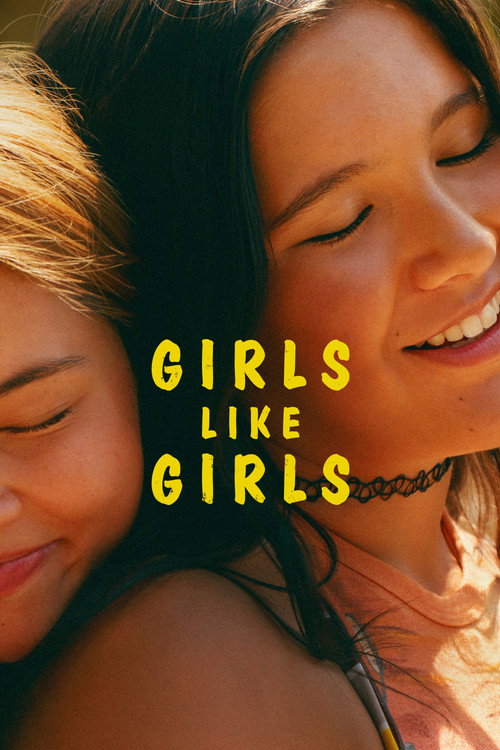
Girls Like Girls
2026 · Hayley Kiyoko
For a soft night in when you want to feel the flutter and heartbreak of falling for someone for the first time — comfort viewing with a real emotional undertow. Reach for it when you need a story about being young, scared, and brave anyway.
What it's about
In rural Oregon, seventeen-year-old Coley is trying to find her footing after losing her mother, keeping most people at arm's length. Then she meets Sonya, and something sparks that neither girl has a map for — Coley wrestling with grief and self-doubt, Sonya navigating feelings for a girl for the first time. It's a first-love story about two teenagers learning to trust what they feel before fear talks them out of it.
The experience
Tender and aching in the way first love actually is — full of charged glances, near-misses, and the terror of saying the true thing out loud. It moves at the pace of a long summer, sweet one moment and bruising the next, and it treats teenage emotion as serious business rather than melodrama.
The craft
Hayley Kiyoko directs the story she first told in song and then in her own novel, and that lineage shows: the film runs on mood, music, and the unspoken, letting silences and body language carry what the characters can't say. It has the warm, intimate texture of a memory — small-town light, close faces, a soundtrack doing real emotional work.
Why it matters
Part of the recent wave of sapphic coming-of-age stories reaching mainstream screens, and a notable evolution for Kiyoko, who has carried this story across a decade from pop song to music video to novel to feature film.
Snapshot
Girls Like Girls is a feature-length narrative film that closes a loop nearly a decade in the making: it draws its title, its emotional architecture, and its central romance from Hayley Kiyoko's 2015 song and music video "Girls Like Girls," which she wrote and conceived, and from her 2023 young-adult novel of the same name, which expanded that four-minute video into a full prose narrative. The finished film — Kiyoko's feature directing debut, written with Stefanie Scott — is set in the summer of 2006 in rural Oregon, where seventeen-year-old Coley (Maya da Costa), shy and newly adrift after the loss of her mother, moves to town and meets Sonya (Myra Molloy), the popular girl who draws her into a friend group and into a friendship that teeters on becoming something more. Focus Features premiered the picture on June 9, 2026 at the Coolidge Corner Theatre in Brookline, Massachusetts, released it to American theaters later that month, and brought it to Peacock on August 14. At 95 minutes, it belongs squarely to the queer coming-of-age cycle — a summer-set, small-town intimacy drama in which desire and grief are braided together — and it was received as exactly that: a warm, sun-soaked, personally felt debut, admired more for sincerity and craft than for formal novelty, landing an 88% approval score on Rotten Tomatoes across 64 reviews and a 70 on Metacritic.
Industry & production
The most reliable frame for understanding the film's production is its lineage as intellectual property. "Girls Like Girls" began as a self-authored music video in 2015, an unusually complete piece of visual storytelling for the pop format — it had a beginning, a betrayal, and a fight, and it circulated as a viral text far beyond music-video audiences. Kiyoko subsequently novelized that story in 2023 for the young-adult market, giving the property the long-form narrative spine a feature requires. The 2026 film therefore arrives as the third iteration of a single, tightly controlled authorial vision rather than as an outside acquisition — and it followed the recognizable contemporary pattern of a musician-creator with a large, loyal, demographically young and queer audience translating owned material into a feature through specialty-distribution channels.
The concrete production record bears this out. Focus Features, the prestige-independent arm of Universal, handled the release, with the Peacock streaming window following two months after the theatrical run — the mid-budget, streaming-adjacent pathway that has absorbed most LGBTQ+ coming-of-age filmmaking since the mid-2010s. Principal photography ran a tight month, from July 3 to August 2, 2024, in Kelowna, British Columbia, standing in for rural Oregon; Kiyoko has noted that the location sat near her grandparents' home, folding a personal geography into an already personal project. The casting process was exhaustive by her own account — she reviewed roughly four thousand auditions before settling on her two young leads. The key credits mark it as a film built largely by women: Sonja Tsypin shot it, Christine Armstrong and Sabine Hoffman edited, Jessica Rose Weiss composed the score, Lindsey Moran designed the production, and Kelli Dunsmore the costumes. Zach Braff and Levon Hawke round out the principal cast as Curtis and Trenton. The theatrical gross was modest, consistent with the film's scale and its swift move to streaming.
Technology
The film was captured digitally on the Arri Alexa Mini LF, the large-format system that has become a staple of American independent production, paired — unusually and tellingly — with vintage Canon K35 prime lenses, glass from the 1970s prized for its soft flare and gentle rendering of skin. Tsypin has explained the large-sensor choice as a bid for a sense of grandness: an intimate two-hander given the optical breadth normally reserved for bigger canvases, so that the emotional scale of first love registers as physically large. The vintage primes, meanwhile, supply in-camera the warmth and bloom that the summer-romance mode usually chases; the look is substantially built at the lens rather than manufactured entirely in the grade. The color pipeline was put to deliberate dramatic use: Tsypin worked with the production designer on off-wheel hues — periwinkle, salmon — and designed a palette that migrates across the film from warm gold, peach, and lime toward jewel tones, cyan, and muted steel blue as Coley's arc darkens. Color, in other words, is the film's principal technological instrument, keyed to interior state rather than to period decoration.
Technique
Cinematography
Tsypin's photography extends the grammar Kiyoko established in the 2015 video — golden, close, body-attentive, organized around glances and physical proximity rather than spectacle — and critics registered it immediately: reviewers described a sun-soaked indie romantic look, a near-perpetual magic-hour glow, and a honeyed quality to the lensing. But the visual strategy is more systematic than mere prettiness. Tsypin built the coverage around shallow focus trained on a point of hyper-fixation — the narrow aperture of attention of a girl who cannot yet let herself see widely — with depth of field that gradually deepens as Coley gains self-awareness, so that the optics literalize the coming-out arc. Camera movement is similarly coded: handheld operation carries the kinetic, charged scenes of connection between the girls, while Curtis, the stabilizing adult presence in Coley's life, is framed in static setups. Tsypin's stated reference points place the film in a specific art-house lineage: Lukas Dhont's Close (2022), Jeremiah Zagar's We the Animals, and the work of Andrea Arnold, especially American Honey — the contemporary canon of tactile, light-drunk youth cinema.
Editing
Christine Armstrong and Sabine Hoffman's cut sustains proximity and hesitation across the feature without the compression a music video enjoys — the narrative's engine, self-doubt delaying connection, is fundamentally an editing problem, and the film solves it with an unhurried rhythm punctuated by passages of concentrated audiovisual intensity. Reviewers noted sequences with the charge and polish of music-video construction, and, just as pointedly, an effective deployment of silence between songs: the cutting alternates between lyrical acceleration and held, quiet duration. The rhythm also reflects Kiyoko's working method on set — she cut takes not on technical grounds but on whether the feeling was present, an intuition-first standard the editors then had to honor in assembly.
Mise-en-scène / staging
The rural-Oregon setting does structural work, not merely decorative work, and Lindsey Moran's production design makes the film's class and emotional geography concrete. Moran scouted extensively to reconstruct 2006 rural Oregon in British Columbia, and — invoking a New York Times observation she cites — treated the characters' homes as instruments for communicating class distinction. The design's central contrast is between the two girls' bedrooms and houses: Sonya inhabits a peach-toned dreamworld, densely lived-in with trinkets and dance mementos, while Coley's home is sparse, marked by absence — her mother's and her own. The period dressing (AOL Instant Messenger, iPods) drew specific critical praise for serving emotion rather than nostalgia-baiting: 2006 is rendered as the texture of a particular adolescence — crucially, a pre-social-media one, where intimacy had to be conducted in person and in secret — rather than as a referential game. Kiyoko has said that assembling mood boards was difficult because so few existing images depict this story; the design team was, in a real sense, inventing the visual archive of the rural sapphic teenage 2000s rather than quoting one.
Sound
Music is where the film's authorship is most audible, and its soundtrack has an origin story worth recording. When licensing period songs proved too expensive, Kiyoko turned the constraint into method: she finished compositions she had begun as a teenager and wrote new ones for the film, including a track built on a vocal sample of herself recorded in 2006 — the very year the story is set — so that the soundtrack literally contains the voice of the adolescent who lived the feelings the film dramatizes. She also re-recorded the title song with orchestral accompaniment, giving the property's founding pop artifact a new, cinematic register for its third iteration. Jessica Rose Weiss's score works alongside this songbook, and the sound design's most remarked-upon quality is restraint: critics singled out the film's willingness to let silence carry scenes between its musical peaks.
Performance
The film rests on two young performances and the chemistry between them, and the casting — the product of that four-thousand-audition search — was widely judged its strongest asset. Maya da Costa plays Coley with a quiet, guarded watchfulness that suits a grieving newcomer learning whether it is safe to be seen; Myra Molloy's Sonya layers charm and confidence over a legible sadness, so that the popular girl reads as someone performing ease rather than possessing it. Critics found the chemistry between them playful in its early beats and increasingly volatile and tender as the bond deepens. Zach Braff, cast against his comic register, anchors the adult world as Curtis, a steadying presence formally set apart by the camera's stillness around him. Kiyoko's direction of actors followed the same intuitionist principle as her cutting: she steered scenes by the emotional experience rather than by blocking cues, and the performances' unforced, felt quality — the trait the Rotten Tomatoes critical consensus gathered under the judgment that the film is personal and finely acted — is the audible result.
Narrative & dramatic mode
The dramatic mode is intimate realism organized around a coming-out and first-love arc, with bereavement as its underlayer. Structurally, the story runs on internal rather than external obstacle: the impediment to Coley and Sonya's connection is self-doubt, unfamiliarity, and the pressure of social and family expectation, not a villain or a concrete prohibition. The 2015 video, by contrast, resolved partly through external conflict — a boyfriend, a physical altercation — a compression the format demanded. The feature relocates the drama inward, toward hesitation, grief, and the slow labor of allowing oneself to feel, and that shift is the clearest evidence of how the property matured across its three iterations; it aligns the film with the quiet, interiorized register that became the prestige default of the queer coming-of-age film after Moonlight (2016) and Call Me by Your Name (2017). Critics described the arc as conventional — predictable, in one assessment, on purpose: the film trades surprise for the emotional reliability of a well-worn shape, rendered with unusual sincerity. The most substantive dissent concerned depth rather than shape — the Austin Chronicle's review found that the screenplay gestures toward the girls' backstories without fully exploring them, leaving some characterization thin at the edges.
Genre & cycle
Girls Like Girls sits at the intersection of romance and drama, within the cycle of LGBTQ+ coming-of-age cinema that consolidated in the second half of the 2010s. That cycle's touchstones — Blue Is the Warmest Color (2013), Carol (2015), Moonlight (2016), Love, Simon (2018), Booksmart (2019), Portrait of a Lady on Fire (2019) — established conventions the film inherits: the summer setting, first queer love as a vehicle for self-knowledge, and a tonal preference for tenderness over trauma. Within that field, its particular niche is the sapphic, working-class-coded, rural American variant — a less crowded corner than the urban or period-costume strains, with clear kinship to The Miseducation of Cameron Post (2018) in its non-metropolitan setting. The 2006 period setting adds a further generic layer: the mid-2000s teen film, whose textures critics found the movie handling with affection, one reviewer tracing a blend of John Hughes-style adolescent vulnerability with a visual language shaped by 2010s Instagram aesthetics, suffused in what she called an atmosphere of endless summer melancholy. Its most distinctive generic feature remains provenance: a coming-of-age romance that originated as a pop-cultural text and carries that text's built-in audience with it.
Authorship & method
The authorship story is unusually clean and unusually central. Kiyoko is the organizing intelligence across every version of the material — she conceived the 2015 video, authored the 2023 novel, and co-wrote the screenplay with Stefanie Scott before directing — making Girls Like Girls a rare case of total authorial continuity from three-minute pop artifact to feature film, the culmination of a decade-long single-author project rather than a discrete new work. The autobiographical seam runs deeper than property ownership: Kiyoko has said the mid-2000s setting corresponds to the period when she herself fell in love, and the soundtrack's embedded 2006 vocal sample makes that correspondence material. Her method on set was confessional in procedure as well as in subject — directing by emotional experience rather than technical blocking, rejecting takes that didn't carry the feeling. Her public persona, embraced by a devoted queer fanbase under the affectionate epithet "Lesbian Jesus," is inseparable from an artistic practice built on visible, un-closeted sapphic desire, and the film reads as an elaboration of that recurring subject. Around her, the key collaborators — Tsypin's optics of attention, Armstrong and Hoffman's patient cut, Weiss's score, Moran's class-coded interiors — translated an intuitionist directing style into coherent craft.
Movement / national cinema
The film belongs to American independent cinema — specialty-distributed by Focus Features, shot across the border in Canada per standard production economics — and, more specifically, to the contemporary wave of queer American filmmaking that has moved from the margins toward the mainstream over the past decade. It is also a defining instance of a distinct 2020s phenomenon: the migration of pop musicians into feature direction, bringing pre-built audiences with them. It does not belong to a formal aesthetic movement in the art-cinema sense, though Tsypin's acknowledged debts to Andrea Arnold, We the Animals, and Close place its image-making within the international school of sensory, naturalist youth cinema.
Era / period
As a 2026 release, the film arrived at a moment when LGBTQ+ coming-of-age narratives had become an established, commercially legitimate category rather than a transgressive one — a normalization that both enabled the project and shaped its stakes — and amid a documented backlash against LGBTQ+ visibility in parts of the United States, which gives a sincere, affirming sapphic love story in a rural American setting a particular charge. The film answers that present obliquely, through its period frame: by setting the story in 2006, before social media and before the mainstreaming of queer teen narratives, it recovers an era when a love like Coley and Sonya's had almost no public images to model itself on — a scarcity Kiyoko encountered literally when she found there were few existing pictures from which to build the film's mood boards.
Themes
The film's dominant themes, as realized on screen and registered by its critics, are these. First and most centrally: self-acceptance and the recognition of desire — the movement from self-doubt to avowal that structures both leads' arcs, mirrored formally in the photography's widening depth of field. Second: grief and its entanglement with intimacy — Coley's loss of her mother is not incidental but the ground from which her openness to Sonya must grow, and reviewers identified parental disconnection and reconciliation as one of the film's primary currents. Third: identity and belonging — the pull between the safety of a friend group and the risk of being truly known within it. Fourth: pre-social-media intimacy — the film's 2006 world of AIM chats and iPods frames first love as something conducted in private, analog channels, a historically specific texture critics found the movie using for feeling rather than nostalgia. Fifth, implicit in the whole enterprise: visibility and affirmation — the value, especially for a young queer audience, of seeing sapphic love rendered tenderly and without punishment, the commitment Kiyoko's entire career has foregrounded.
Reception, canon & influence
The film's critical reception settled quickly into a legible consensus: warmly positive, with reservations about familiarity. It holds an 88% approval rating on Rotten Tomatoes from 64 critics, with an average score of 6.9 out of 10, and a Metacritic score of 70 from 17 reviews; the aggregated critical consensus praised it as bracingly personal and finely acted. The strongest notices, such as Michael Conway's 8/10 review for JoBlo, celebrated its sun-soaked craft, its music-video-caliber sequences balanced by expressive silence, and its emotionally grounded period detail. The more measured responses, exemplified by Alejandra Martinez's three-star Austin Chronicle review, admired the warm, melancholy atmosphere and the leads' chemistry while finding the screenplay's character development underfed; another assessment summarized the film as a lovely debut that breaks no new ground for its genre. The theatrical run was brief and commercially modest, with the Peacock release two months later likely its primary route to the young audience it addresses.
The influences on the film (backward) are firmly established: Kiyoko's own 2015 video and 2023 novel supply story, character, and tone; the prestige queer coming-of-age cycle of the 2010s — Moonlight, Call Me by Your Name, Portrait of a Lady on Fire, The Miseducation of Cameron Post, Love, Simon — supplies its conventions of interiority, seasonal setting, and non-punitive desire; and the cinematography's declared models (Close, We the Animals, Andrea Arnold's work) supply its sensory naturalism, with older sapphic cinema (Carol, Blue Is the Warmest Color) as a more distant backdrop.
Its legacy (forward) is necessarily early to judge, four months after release. Its clearest historical significance is as a completed case study in a specific 2020s pathway: the full-length realization of a story that began as a viral pop text, authored throughout by the same artist — a template now proven feasible at specialty scale, critically respectable, and commercially modest. It also consolidates the sapphic rural-American coming-of-age story as a durable subgenre, and its soundtrack method — a musician-director scoring her own adolescence with her own teenage recordings — stands as one of the more genuinely novel authorial gestures the cycle has produced.
A Deleuzian reading
Watch the edges of the frame.
The full Deleuzian reading of Girls Like Girls →
Reception
It arrived already carrying a decade of anticipation: the 2015 music video became a sapphic anthem first, and the 2026 film opened to warm reviews (86% on Rotten Tomatoes) as the payoff fans had been asking for since the Obama era.
How Girls Like Girls was received, from release to now →
How to watch Girls Like Girls: what to notice on a first viewing
- Notice how little of the frame is in focus. Tsypin trains shallow focus on a single point of fixation, the thing Coley cannot stop looking at, and leaves the rest soft. Da Costa's face, guarded and watchful, is often all that is sharp. The lens sees the way a girl who cannot yet let herself see widely sees; a feeling held in a face, not acted out.
- Watch when the camera is handheld and when it sits still. Tsypin goes handheld for the charged scenes between Coley and Sonya and locks the camera off for Curtis, Braff's steadying adult, so each person gets a different kind of movement. The camera tells you who unsettles Coley and who steadies her before she can say it.
- Look at the two girls' bedrooms. Moran dresses Sonya's room as a peach-toned dreamworld dense with trinkets and dance mementos, and Coley's home sparse, marked by her mother's absence and her own. The 2006 props, AIM and iPods, serve feeling rather than nostalgia. The houses state class and grief at a glance, and tell you which girl has something to protect and which has an empty room.
- Listen for the silence between the songs. Kiyoko wrote the songs herself when licensing 2006 tracks proved too expensive, finishing pieces begun as a teenager; between the music-video-charged passages, Armstrong and Hoffman let scenes run quiet. The songs are the rush and the silence is the hesitation; the film is paced by which one you are in.
- Watch who looks at whom, and who looks away first. Tsypin organizes the coverage around glances and physical nearness rather than spectacle. Molloy's Sonya performs ease over a legible sadness while da Costa's Coley watches to learn whether it is safe to be seen. Nothing is declared early, so the looks are the dialogue; a glance returned is the plot moving.
The whole guide to watching Girls Like Girls, with the keys for a rewatch →
Influences: the films it descends from and the films it influenced
- Portrait of a Lady on Fire (2019) — Supplies the shot/reverse-shot grammar of mutual female looking — the held exchange of glances staged as reciprocal authorship rather than a one-directional male gaze — that any contemporary sapphic romance now works from.
- Carol (2015) — Models the language of desire-through-obstruction: longing conveyed via reflections, framing through glass and car windows, and the charged glance across social constraint instead of explicit declaration.
- Moonlight (2016) — Establishes the chaptered, season-marked coming-of-age structure and the sustained, near-motionless facial close-up as the vehicle for queer interiority.
- Call Me by Your Name (2017) — Provides the template of season-as-sensorium — summer heat, water, and sun-drenched landscape deployed as the erotic register that carries first-love feeling.
- The Miseducation of Cameron Post (2018) — Pioneers the specific mode Kiyoko inherits: naturalistic, non-punitive queer-teen realism set in rural/small-town America where desire is not pathologized by the film's own frame.
- Love, Simon (2018) — Supplies the studio-gloss template for a mainstream, feel-good queer teen romance — accessible pop soundtrack, bright coverage, and a reassuring emotional arc pitched at a wide young audience.
- Blue Is the Warmest Color (2013) — Establishes durational, close-framed intimacy and the treatment of a first sapphic relationship as a full bildungsroman rather than an incident.
- Show Me Love (Fucking Åmål) (1998) — Sets the earlier blueprint for small-town, handheld-naturalist sapphic first love among teenagers, with boredom and place rendered as texture around the romance.
- Pariah (2011) — Advances the interiority-forward queer coming-of-age built on saturated, expressive lighting and a protagonist's private self-narration of emerging desire.
- But I'm a Cheerleader (1999) — Originates the candy-colored, comedic yet affirming register for queer teen desire, staging the coming-out arc without tragic punishment.
- Purple Rain (1984) — The foundational case of the musician-authored feature: a pop artist's persona and song catalog extended into a narrative film built around their own image, the pathway Kiyoko consummates.
- Lemonade (2016) — Shares the method of a pop auteur expanding her own songs into long-form, image-driven narrative authored throughout by the performer herself.
- The Half of It (2020) — Runs a parallel craft: a sincere, epistolary sapphic teen romance rooted in a specific small-town American milieu with restrained, warm naturalism.
- Sing Street (2016) — Extends the same fusion of original pop songwriting and period coming-of-age, letting music-making itself drive the narrative and the visual set-pieces.
- Queen & Slim (2019) — A parallel transfer of music-video craft into features — a director schooled in pop-promo image-making bringing that heightened, confessional visual grammar to feature-length narrative.
- Crush (2022) — Extends the mainstream, non-punitive sapphic teen romcom into the streaming era with the same bright, pop-scored, feel-good studio idiom.
Similar films
- Pariah (2011) — influence & lineage
- Carol (2015) — influence & lineage
- Sing Street (2016) — influence & lineage
- Love Untangled (2025) — same viewing thread
- Love in the Big City (2024) — same viewing thread
- My First Summer (2020) — shared sensibility
- Young Hearts (2024) — shared sensibility
- Dou kyu sei – Classmates (2016) — shared sensibility
All the films related to Girls Like Girls →
Watch it with: curated runs of related films
- The Long Ache of Growing Up — A run of tender films about first love, self-discovery, and the pull of home — watch them close together and the years, cultures, and heartbreaks start to rhyme.