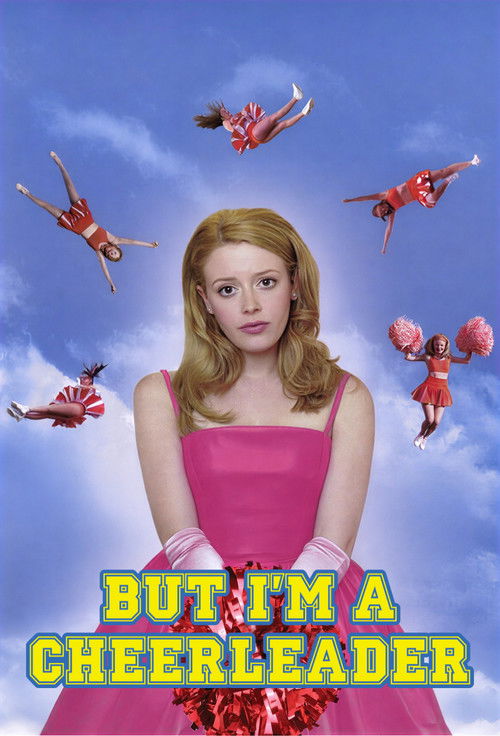
But I'm a Cheerleader
2000 · Jamie Babbit
For when you need to laugh at something that deserves to be laughed at, and fall for a love story anyway — a cult favorite that works equally as a cozy queer comfort watch and a middle finger with great production design.
What it's about
Megan is an all-American cheerleader with a boyfriend and a Melissa Etheridge poster, and she has no idea why her parents have staged an intervention. Shipped off to a 'sexual redirection' camp where girls wear Pepto-Bismol pink and boys powder blue, she's supposed to learn how to be straight — and instead starts figuring out, for the first time, who she actually is.
The experience
A candy-coated satire that gets funnier as its targets get sillier, then blindsides you by being sincerely romantic underneath the camp. It's playful, tender, and quietly furious all at once — a comedy where the absurdity is doing serious work.
Performances
Natasha Lyonne makes Megan's confusion genuinely touching amid all the pastel absurdity, and her chemistry with Clea DuVall gives the film its warm, beating heart. RuPaul, playing an 'ex-gay' counselor, is a running gift.
The craft
Jamie Babbit's production design is the argument: an aggressively artificial world of plastic pinks and blues that makes enforced heterosexuality itself look like the costume. The John Waters-style camp never cheapens the romance — it's the armor that lets the sincerity land.
Why it matters
Savaged by critics in 2000 and slapped with an NC-17 before cuts, it has since completed one of the great rehabilitations in American independent film, becoming a foundational queer cult classic decades ahead of its reviewers.
Jamie Babbit's debut was savaged by critics in 2000 and has since completed one of the great rehabilitations in American independent cinema: a candy-coated satire of conversion therapy that turned out to be decades ahead of its reviewers. Natasha Lyonne plays Megan, a cheerleader shipped off to a 'sexual redirection' camp where the girls wear Pepto-Bismol pink and the boys powder blue — a production design of aggressive artificiality, borrowed from John Waters and the plastic Americana of Douglas Sirk, that makes heterosexuality itself look like the costume. The joke deepens rather than cheapens: beneath the camp is a sincere, swooning romance between Lyonne and Clea DuVall, and the film insists queer desire is the natural thing while the institutions policing it are the grotesque performance. The MPAA slapped it with an NC-17 for content that would barely ruffle a straight teen comedy — Babbit cut to an R and never let the double standard go unmentioned. RuPaul appears out of drag as an 'ex-gay' counselor, one of the film's most delicious ironies.
A Deleuzian reading
The first thing that hits you is the pink.
The full Deleuzian reading of But I'm a Cheerleader →
Reception
Critics in 2000 mostly shrugged — too broad, too campy, trying too hard to be John Waters, they said. Two decades on it's been fully reclaimed as a foundational queer classic, complete with a 20th-anniversary director's cut and think-pieces admitting the critics got it wrong.
How But I'm a Cheerleader was received, from release to now →
Influences: the films it descends from and the films it influenced
- All That Heaven Allows (1955) — Babbit borrows Sirk's strategy of using saturated Technicolor and hyper-designed domestic interiors as an ironic code for social repression, weaponizing 'pretty' color against the systems it decorates.
- Written on the Wind (1956) — The melodramatic assignment of emotional meaning to specific hues (the film's phallic reds and cold blues) prefigures the literal pink-for-girls / blue-for-boys binary Babbit paints across True Directions.
- Pink Flamingos (1972) — Waters' camp-trash aesthetic — reveling in artifice, kitsch, and drag performers playing gender as broad theater — is the direct model for Babbit's tone and her casting of RuPaul out of drag.
- Female Trouble (1974) — Divine's grotesque-glamorous performance style and Waters' treatment of gender as costume seeds Babbit's central conceit that heterosexuality is a learnable, performable set of props.
- The Rocky Horror Picture Show (1975) — Establishes the queer-camp musical template of heightened artifice with a sincere liberationist core, the same tonal balance Babbit strikes between parody and earnest queer affirmation.
- The Stepford Wives (1975) — Its satire of enforced feminine conformity — women literally reprogrammed into idealized housewives — is the structural blueprint for the reprogramming-camp's manufactured gender roles.
- Pee-wee's Big Adventure (1985) — Burton's storybook, candy-colored, deliberately fake production design (a cited touchstone for Babbit) authorizes her use of dollhouse artificiality where every prop looks handmade and unreal.
- Edward Scissorhands (1990) — The pastel suburban tract-home palette used to satirize normative conformity, with an outsider marked as 'unnatural,' is the visual grammar Babbit adapts for her conversion-camp setting.
- Poison (1991) — A founding New Queer Cinema text whose formal audacity and refusal of shame-based framing gives Babbit the movement's license to treat queer desire as natural rather than tragic.
- Go Fish (1994) — Pioneers the low-budget, upbeat lesbian romance with a happy ending inside New Queer Cinema, the exact genre lane Babbit brightens into full romantic-comedy color.
- Nowhere (1997) — Deploys candy-colored pop-art production design and hyper-saturated primary sets for queer teen satire — a palette and staging directly indebted to Araki.
- Hairspray (1988) — Rebuilds the saturated pastel palette and dead-center frontal framing as a queer coming-of-age idiom, using production design that is unmistakably artificial while the performances stay sincere — the sincere-camp calibration taken directly from Waters.
- Saved! (2004) — Directly inherits Babbit's formula of satirizing a faith-based institution's policing of teen sexuality while keeping a sincere, empathetic core beneath the camp.
- D.E.B.S. (2004) — Carries forward the candy-colored, genre-parody lesbian romance — bright artificial design plus knowing camp — that Babbit made commercially legible.
- The Miseducation of Cameron Post (2018) — Reworks the exact conversion-therapy-camp subject as naturalistic drama, defining itself against Babbit's stylization while inheriting her narrative terrain and its critique of the 'ex-gay' apparatus.
- Happiest Season (2020) — Directed by Babbit's own star, it mainstreams the queer romantic-comedy-with-a-heart she prototyped, transposing the camp sincerity into a studio holiday rom-com.
- Bottoms (2023) — Model for the artificial, candy-colored production design and camp theatrical staging used to satirize teen sexuality and queerness rather than naturalistically depict it; a cited influence.
- Girls Like Girls (2026) — Originates the candy-colored, comedic yet affirming register for queer teen desire, staging the coming-out arc without tragic punishment.
- Jawbreaker (1999) — Same-era hyper-saturated, candy-coated high-school satire that pushes teen-movie color into deliberately artificial pop-art excess as a vehicle for dark comedy.
- Josie and the Pussycats (2001) — Extends the strategy of drenching a satire of consumer conformity in eye-searing bubblegum production design so the artifice itself becomes the critique.
- Far From Heaven (2002) — A same-moment, explicitly Sirkian revival that likewise uses immaculate 1950s color melodrama to smuggle in queer content, running parallel to Babbit's Sirk debt in a different register.
Similar films
- Pink Flamingos (1972) — influence & lineage
- Jim Queen and the Quest for Chloroqueer (2026) — shared sensibility
- Hairspray (1988) — shared sensibility
- Hedwig and the Angry Inch (2001) — shared sensibility
- Bottoms (2023) — shared sensibility
- Female Trouble (1976) — shared sensibility
- Mean Girls (2004) — shared sensibility
- Flipped (2010) — shared sensibility
All the films related to But I'm a Cheerleader →