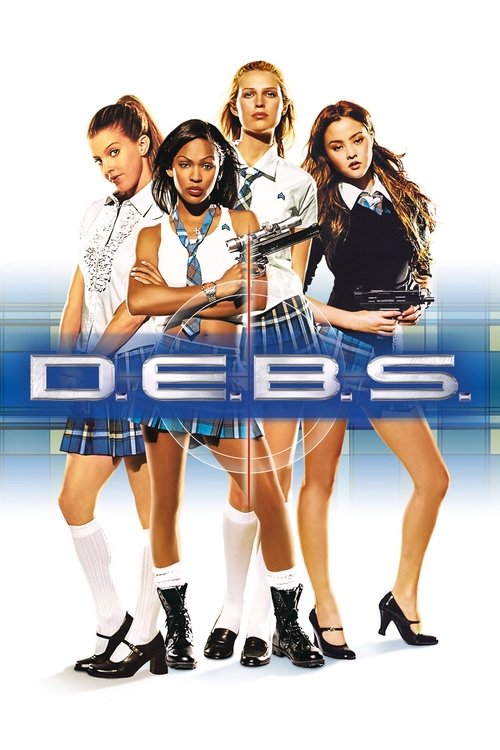
D.E.B.S.
2005 · Angela Robinson
For a fun, low-stakes night when you want to fall in love a little and laugh at spy-movie clichés — pure comfort viewing, especially if you're starved for a queer romance that gets a happy, glittery treatment.
What it's about
A secret aptitude test hidden inside the SAT measures a student's natural talent for lying, cheating, stealing, and killing — and the top scorers are recruited into a paramilitary academy of plaid-skirted teenage spies. The squad's star pupil, the only perfect score in the test's history, is assigned to bring down the world's most wanted criminal mastermind, and instead falls for her. What follows is a candy-colored spy spoof wrapped around a surprisingly sincere love story between the good girl and the villainess.
The experience
Breezy, silly, and completely unashamed of itself — the gadgets and villain lairs are played for laughs, but the romance is played straight, and its sweetness sneaks up on you. It's a fast, frothy watch that knows exactly what it is.
The craft
Angela Robinson expanded her own award-winning Sundance short — first drawn as a college comic — into a feature, and the whole design runs on pop-art pleasure: uniforms, lairs, and gadgets as fashion statement. The spoof structure is really a delivery system for a lesbian love story told plainly at a time when studio comedies almost never did.
Why it matters
A commercial afterthought in 2005 that became a genuine cult classic, embraced by queer audiences as a rare romance of its era with no punishment and no apology in it — and a calling card that launched Robinson's career in film and television.
Snapshot
A paramilitary academy for teenage girls in plaid skirts; a secret aptitude test hidden inside the SAT that measures a candidate's innate capacity to lie, cheat, steal and kill; and, at the center of it, a romance between the program's only perfect score and the world's most wanted criminal. D.E.B.S. is a spy-movie parody whose parodic apparatus exists almost entirely to make room for a lesbian love story told in the plainest, least apologetic terms available to a studio comedy in 2005.
Angela Robinson had drawn the D.E.B.S. as a comic in college, then made them a film twice: first as an eleven-minute short in 2003, financed by a $20,000 grant from POWER UP, the nonprofit founded to support gay women working in entertainment. That short premiered at Sundance in January 2003 and accumulated roughly seven festival prizes, including audience awards at Outfest and the Dublin Gay & Lesbian Film Festival and a best-short prize in New York. On the strength of it, Screen Gems president Clint Culpepper greenlit a feature at a reported $3.5 million. The expanded version premiered at Sundance in January 2004, took a readers' jury prize at that year's Berlinale, and then sat for fourteen months before Sony released it on 25 March 2005 into 45 theaters, where it earned $97,446 in three weeks.
Everything interesting about the film's afterlife follows from that failure.
Industry & production
The production history is a compressed case study in how a queer independent film could, briefly and awkwardly, pass through the studio system in the early 2000s. POWER UP's grant program was explicitly corrective — it existed because lesbian filmmakers were not being financed — and the short it produced functioned as a proof of concept in the most literal sense: not a demo of Robinson's craft but a demonstration that an audience laughed, cheered and turned up.
Screen Gems was an unusual home for it. Sony's genre label was then in the business of Resident Evil and Underworld — modestly budgeted, high-concept pictures aimed at young audiences and engineered for a long tail on DVD. D.E.B.S. fit that template on paper (girls, guns, uniforms, 91 minutes) while being, in practice, a romantic comedy about two women. Robinson has said publicly that the studio protected the relationship rather than diluting it, describing the romance as remaining the heart of the film and Screen Gems as supportive. The available record does not document a hostile recut, and it would be irresponsible to invent one; the more revealing industrial fact is the release itself. A film that premiered at Sundance in January 2004 and did not reach theaters until spring 2005, in 45 venues, was not being suppressed so much as quietly reclassified — moved out of the theatrical business and into the home-video business, where its actual audience was expected to find it.
The feature was recast almost entirely from the short: only Jill Ritchie carried over. In came Sara Foster as Amy Bradshaw, Jordana Brewster (two years past The Fast and the Furious) as Lucy Diamond, Meagan Good as squad leader Max, Devon Aoki as the imperious French Dominique, with Michael Clarke Duncan and Holland Taylor supplying adult institutional authority and Jimmi Simpson as Lucy's henchman-confidant Scud. Producers were Andrea Sperling and Jasmine Kosovic. Sperling's presence matters: she came up through Gregg Araki's Teenage Apocalypse films and produced Jamie Babbit's But I'm a Cheerleader, and would later executive produce Transparent. Her credit places D.E.B.S. squarely on a continuous line of American queer production rather than treating it as an anomaly.
Robinson's own trajectory after this is the other half of the story. She shot Herbie: Fully Loaded for Disney, released three months after D.E.B.S. in 2005, then moved into television — The L Word, True Blood, Hung, How to Get Away with Murder — before writing and directing Professor Marston and the Wonder Women in 2017. A Black lesbian filmmaker going from a $20,000 grant short to a studio tentpole inside two years was, at that moment, close to unprecedented, and the near-total commercial collapse of the personal film in that pair is not incidental to how the rest of the career unfolded.
Technology
D.E.B.S. is technologically modest by design and by necessity, and the two are hard to separate. It originated on 35mm, as studio features in its budget class did, and its visual identity comes from lighting, color and production design rather than from optical or digital manipulation. Visual effects supervision is credited (David Tecson, Mark Thompson), but the effects work is sparing and mostly in service of gadgetry.
That restraint reads as a position. The film arrives at the end of a decade in which the spy picture had been progressively digitized — the Bond films' CG-assisted set pieces, the xXx and Mission: Impossible escalation — and it answers with props that look like props: toy-grade weapons, hand-labeled equipment, a lair that is clearly a set. The "technology" of the D.E.B.S. universe is deliberately unconvincing, which is the joke and also the alibi; a film that cannot afford spectacle converts its poverty into tone.
The genuinely determining technology here is distribution. D.E.B.S. was made at the peak of DVD, when a title could fail theatrically and still find its audience on a shelf at a rental store, and its cult was built almost entirely in that channel and then on the early social internet — clip circulation, LiveJournal and later Tumblr fandom, streaming catalogs. The film's canonization is a distribution-technology story more than a critical one.
Technique
Cinematography
M. David Mullen (later of Jennifer's Body and The Marvelous Mrs. Maisel) shoots the film in a high-key, saturated register: bright, frontal, poster-like, with a candy palette that keeps the world legible as cartoon. Space is color-coded — the D.E.B.S. house in clean whites and pastels, Lucy's world in reds and blacks — so that Amy's drift between them registers chromatically before it registers dramatically.
The most consequential choice is a modulation. The comic and action material is lit flat and shot wide, in the idiom of a studio teen movie; the scenes between Amy and Lucy tighten, warm and soften into the grammar of a conventional romance. The film's formal argument is embedded in that shift: the spoof is the joke, and the love story is the part shot as though it were true.
Editing
Robinson cut the feature herself, which is unusual for a studio release and clarifies a great deal about its rhythm. The picture moves in gag beats and montage rather than in action geography. Fights and raids are brief and elliptical — established, punctuated, abandoned — because the cutting is organized around a romantic comedy's clock, not an action film's. Pop-graphic transitions, wipes and card-like punctuation give it a comic-book cadence consistent with the property's origins as Robinson's own drawings. The trade-off is real: the plot mechanics are thin and the film knows it, so it never lingers where scrutiny would cost it.
Mise-en-scène / staging
Production designer Chris Anthony Miller and costume designer Frank Helmer built the film's single most durable object: the uniform. The plaid skirt, blazer and knee socks fuse the Catholic schoolgirl, the sorority pledge and the pin-up into one silhouette, and the film is knowingly double-coded about it — the outfit is simultaneously an instrument of institutional discipline and an obviously eroticized costume. The D.E.B.S. house is staged as barracks-as-sorority, a girls' world that is at once surveilled and sheltering. Lucy's lair, by contrast, is a domestic space played straight: she has a best friend, relationship anxieties and a bad blind date. Villainy is staged as ordinary life, which is precisely how the film dismantles the moral binary it inherited.
Sound
The soundtrack works in the teen-comedy mode of the period — song-forward, with Steven M. Stern's score filling in around the needle drops rather than dominating. Action sound design is systematically deflated: the film declines the low-end weight that would make its violence feel consequential. The expository prologue, delivered in the register of an instructional film, establishes the mock-official voice the movie keeps returning to whenever the institution speaks. Dialogue is foregrounded throughout; this is a talk-driven comedy wearing an action costume.
Performance
The register is broad but sincere, closer to sitcom than to farce. Sara Foster plays Amy with a deadpan earnestness that lets the romance land without irony; Jordana Brewster plays the world's deadliest criminal as a lovesick romantic, which is the film's best structural joke and its emotional engine. Meagan Good does the heaviest comic lifting as Max, whose thwarted ambition and loyalty give the squad plot its only real friction — her work drew a Black Movie Awards nomination in 2005. Devon Aoki's flat hauteur and Jill Ritchie's naïveté fill out the type-comedy; Holland Taylor and Michael Clarke Duncan play authority absolutely straight, which is why it's funny.
Narrative & dramatic mode
The film's structural move is to import a romantic comedy whole and let the spy plot serve as its obstacle machinery. Meet-cute at gunpoint; secret courtship; the confidante who must be lied to; the socially acceptable boyfriend who functions as a placeholder; exposure; the third-act grand gesture. What makes it more than a template exercise is the substitution at the center: Amy's secret is not that she desires women — the film treats that as unremarkable — but that she desires the enemy. Queer disclosure is displaced onto genre allegiance, so that "coming out" arrives as a confession of criminal association, and the institution's horror is legible as homophobia without ever being spoken as such.
The ending refuses the standard settlement. Amy does not reconcile with the academy, reform Lucy, or die for the transgression. She defects. In a genre whose logic requires the agent to return to the institution, and in a queer-film tradition still heavily populated by punished or dead lesbians, elopement with the supervillain is the film's real argument.
Genre & cycle
D.E.B.S. belongs to a specific early-2000s cycle: the post-Charlie's Angels girl-squad action comedy, running alongside Alias on television, the Spy Kids films, Miss Congeniality, and the animated Totally Spies and Kim Possible. It draws equally on the teen-comedy wave of 1999–2002 — Bring It On, Legally Blonde, Josie and the Pussycats — and on the Bond-parody lineage codified by Austin Powers.
Its genuine novelty lies in the intersection. Camp lesbian genre filmmaking had a precedent in But I'm a Cheerleader, but a lesbian romantic comedy financed and released by a major studio's genre label, with a happy ending and no illness, no martyrdom and no social-problem framing, had almost no company. The film scholar Claire Hines has read it in exactly these terms, as a text that both extends the female action-hero tradition and works against the heteronormative conventions of the spy film.
Authorship & method
Robinson wrote, directed and edited D.E.B.S., having originated the characters in her own college comics — an authorship chain about as unbroken as studio filmmaking permits. Her method across a career is consistent: take a mass genre form with a fixed shape and install queer desire at its center rather than at its margins. The spy film here; the superhero origin story and the history of kink in Professor Marston and the Wonder Women; the serialized ensemble drama in her television work. Costume, discipline and roleplay recur as her materials, which makes the plaid uniform less a gimmick than a signature.
Her key collaborators reinforce the point. Mullen supplies a bright, non-leering camera. Producer Andrea Sperling connects the film to two decades of American queer independent production. Stern's score, Miller's design and Helmer's costumes hold a consistent pop-graphic surface. Below-the-line documentation for this film is genuinely thin in the scholarly record, and it should be said plainly: much of the crew's specific contribution has never been written up in any depth.
Movement / national cinema
The film sits in the aftermath of New Queer Cinema. The 1990s movement — Haynes, Araki, Kalin, Troche — was formally aggressive and frequently bleak, committed to refusing positive-image respectability. What followed in the late 1990s and 2000s was a genre-friendly, pleasure-first queer cinema: But I'm a Cheerleader, Saving Face, Imagine Me & You. D.E.B.S. is one of the purest examples, and Sperling's producing credits on both Araki's films and Babbit's make the succession concrete rather than theoretical.
It is also an American studio-independent hybrid, and worth reading through race as well as sexuality: a Black woman directed it, Black and Asian American actors occupy two of the four squad roles, and the central romance is nonetheless between two white women — a tension the film does not address and that later criticism has fairly raised.
Era / period
Its moment is unmistakable. A post-9/11 security apparatus is rendered as a slumber party with weapons; national defense is an all-girls boarding school. More pointedly, the film was shot and released across 2003–2005, the years of the Massachusetts same-sex marriage ruling, the proposed Federal Marriage Amendment and a wave of state ballot measures. A studio-distributed comedy in which two women simply drive off together, unpunished, was a political object in that climate whether or not it was received as one.
Reception, canon & influence
Contemporary reviews were mixed to poor: 42% at Rotten Tomatoes across 64 critics, 42/100 at Metacritic across 21. Peter Travers gave it one star in Rolling Stone and called it dimwitted satire; Stephen Hunter in the Washington Post was among the defenders, crediting it with sparkly production values and extreme confidence. The recurring complaint was thinness — that the parody was too gentle and the plotting too slight — and the recurring blind spot was that the parody was scaffolding for something the reviewers largely declined to weigh.
Backward, the film is assembled from Bond and its spoofs, Charlie's Angels, the girl-group and cheerleader comedies, magical-girl team anime, and Robinson's own comics. Forward, its influence is real but must be described honestly as affinity and precedent rather than documented causation. The film became a fixture of queer fandom through DVD and the early social web, its uniform a cosplay staple and its enemies-to-lovers structure a template that later work — from Killing Eve to Bottoms — would recognizably rhyme with. Critics have repeatedly named it a precursor to the current wave of high-concept lesbian comedies.
The institutional turn came late and unmistakably. In 2024 the film was programd at BFI Southbank in its Woman with a Movie Camera strand, and its twentieth anniversary was marked with a Cinespia screening at Hollywood Forever Cemetery in partnership with LA Pride, where Robinson reunited with Meagan Good and Sara Foster. A film that played 45 theaters and grossed under $100,000 now screens to thousands in a cemetery on a summer night. The reappraisal did not correct the initial verdict so much as reveal what it had been measuring: D.E.B.S. was never trying to be a good spy movie.
A Deleuzian reading
The world's most wanted criminal comes home from a bad blind date and complains about it to her best friend.
The full Deleuzian reading of D.E.B.S. →
Reception
Screen Gems barely released it in 2005 and critics wrote it off as a Charlie's Angels knockoff — it grossed almost nothing. Two decades on it's been fully reclaimed as a landmark of sapphic cinema, the rare 2000s lesbian romance played for joy instead of tragedy, complete with anniversary screenings and a BFI retrospective slot.
How D.E.B.S. was received, from release to now →
How to watch D.E.B.S.: what to notice on a first viewing
- Watch the D.E.B.S. house in pastels against Lucy's reds and blacks. Mullen color-codes the two worlds, clean whites and pastels for the academy, deep red and black for the villain's world, so Amy's drift registers by hue first. You can watch Amy fall for Lucy by tracking which color scheme she's standing in.
- Watch the plaid skirt and blazer worn like a uniform. Helmer's costume fuses schoolgirl, sorority pledge, and pin-up into one silhouette that's simultaneously an instrument of discipline and an obviously eroticized outfit. The uniform that disciplines these girls is the same uniform designed to be looked at.
- Notice comic scenes shot flat and wide, romance scenes shot close. The spy-parody material stays bright, frontal, and poster-flat, while every scene between Amy and Lucy tightens, warms, and softens into a different visual grammar. The spoof is shot as a joke. The love story is shot as though it were true.
- Watch how briefly every fight and raid actually lasts. Robinson, who cut the film herself, establishes and abandons the action beats quickly, following a romantic comedy's clock rather than an action film's geography. The plot mechanics are thin on purpose, so the movie never lingers where scrutiny would cost it.
The whole guide to watching D.E.B.S., with the keys for a rewatch →
Influences: the films it descends from and the films it influenced
- Goldfinger (1964) — Supplies the exact grammar D.E.B.S. deflates — the pre-credits mission tag, the gadget-briefing scene, the villain who explains the scheme inside an architecturally absurd lair — and Robinson's lair-as-domestic-space staging works only because Ken Adam's cavernous, hard-edged sets are the assumed default being redecorated with throw pillows.
- Charlie's Angels (2000) — The direct structural template: a squad of women in coordinated undercover costume, whip-pan pop-graphic transitions and freeze-frame character intros, action cut for attitude rather than legibility — Robinson keeps the editorial pop and the squad-as-family staging but strips out McG's leering camera, which is precisely what makes Mullen's non-ogling coverage of the same bodies legible as a correction.
- Austin Powers: International Man of Mystery (1997) — Establishes the affectionate-not-savage spy-spoof register — saturated primary-color production design and title-card typography played straight while the plot mechanics are treated as beneath discussion — the tonal permission slip for a parody whose jokes never actually wound the genre.
- Clueless (1995) — The plaid-uniform double coding is inherited whole: Mona May's yellow-tartan schoolgirl kit as simultaneous costume, class marker and camp object, plus the sincere-sitcom performance register in which characters deliver absurd dialogue with total emotional conviction rather than winking.
- Bring It On (2000) — The girl-squad comedy's engine — rival uniformed teams, choreographed group blocking, chants and drills shot as spectacle — and the mock-instructional framing device (the opening cheer that explains the film's own rules) that Robinson converts into her voiceover explaining the D.E.B.S. test.
- Sailor Moon R: The Movie (1993) — Magical-girl team grammar: color-coded squad members each assigned a personality slot and a palette, transformation-by-uniform as the moment of empowerment, and villain-heroine attraction played as romantic rather than merely antagonistic — the anime source for D.E.B.S.'s enemies-to-lovers spine.
- But I'm a Cheerleader (1999) — The template for pink-and-blue color-coded space as queer critique — production design that assigns saturated hues to enforced gender roles — and it shares producer Andrea Sperling, the direct production-lineage line connecting D.E.B.S. to two decades of American queer independent filmmaking.
- The Incredibly True Adventure of Two Girls in Love (1995) — Post-New Queer Cinema's pivot from Haynes/Araki transgression to genre-comfortable romantic comedy in which the couple's obstacle is class and family, not homophobia as tragedy — the structural precondition for D.E.B.S. treating its central romance as a screwball problem to be solved.
- Go Fish (1994) — Establishes the lesbian ensemble comedy's mode of address — a self-contained community with its own rules, jargon and gossip economy, addressed to insiders rather than explained to a straight audience — which is why the D.E.B.S. dorm scenes never stop to justify themselves.
- D.E.B.S. (short) (2003) — The literal source text: Robinson's black-and-white Sundance short, itself expanded from her college comics, whose gags, uniform design and enemies-to-lovers premise the feature reshoots in saturated color — an unusually unbroken comic-to-short-to-feature authorship chain with Robinson writing, directing and editing at each stage.
- Kick-Ass (2010) — Extends the comics-to-screen pop-graphic transition vocabulary and the schoolgirl-uniform-as-combat-costume image (Hit-Girl's plaid), though it inverts Robinson's deflated sound design into hyper-amplified violence — the same double-coded costume put to opposite acoustic use.
- Killing Eve (2018) — Recognizably rhymes with the D.E.B.S. structure — the agency operative and the assassin whose mutual pursuit is coded and then written as desire, with the spy-thriller's tradecraft scenes repurposed as courtship — reversing the register from sincere-sitcom to arch, but running the identical enemies-to-lovers armature.
- Bottoms (2023) — The clearest inheritor of the girl-squad action-comedy with a queer center: high-concept premise played with sincere-sitcom conviction, plaid-uniform school setting, and fight choreography cut elliptically for comic timing rather than impact — repeatedly named by critics alongside D.E.B.S. in the current wave of high-concept lesbian comedies.
- Whip It (2009) — Carries forward the uniformed-female-team comedy with intra-squad flirtation and a sincere emotional register beneath the costume gag, from the producer-star whose Charlie's Angels supplied D.E.B.S.'s structural template — the girl-squad film returning to earnest sports drama with the queer subtext left legible.
- Josie and the Pussycats (2001) — The nearest formal twin: a high-key, candy-saturated palette with color-coded character spaces, comic-panel derived staging, and satire aimed at the marketing apparatus rather than at its own heroines — both films were dismissed as thin on release and both were doing surface work as argument.
- Undercover Brother (2002) — The parallel move of installing a marginalized identity at the dead center of the spy-spoof form rather than at its margins, using the same deflated-action sound design — punches and gunfire mixed small and comic — so the genre machinery reads as toy rather than threat.
- Professor Marston and the Wonder Women (2017) — Robinson's own method restated in a different genre — take a fixed mass-culture origin story and install queer desire at its center, with costume, discipline and roleplay as the literal materials (the lasso and bondage gear standing where the plaid uniform stood).
- Herbie Fully Loaded (2005) — Made immediately after and demonstrating the same register modulation on studio scale: a legacy family-franchise form staged with high-key saturated color and deflated, weightless action beats, confirming the D.E.B.S. surface was a directorial signature rather than a low-budget accident.
Similar films
- Bottoms (2023) — influence & lineage
- Mädchen in Uniform (1931) — shared sensibility
- Lady Bird (2017) — shared sensibility
- Linda Linda Linda (2005) — shared sensibility
- Girls Like Girls (2026) — shared sensibility
- The Breakfast Club (1985) — shared sensibility
- Pariah (2011) — shared sensibility
- Barbie (2023) — shared sensibility