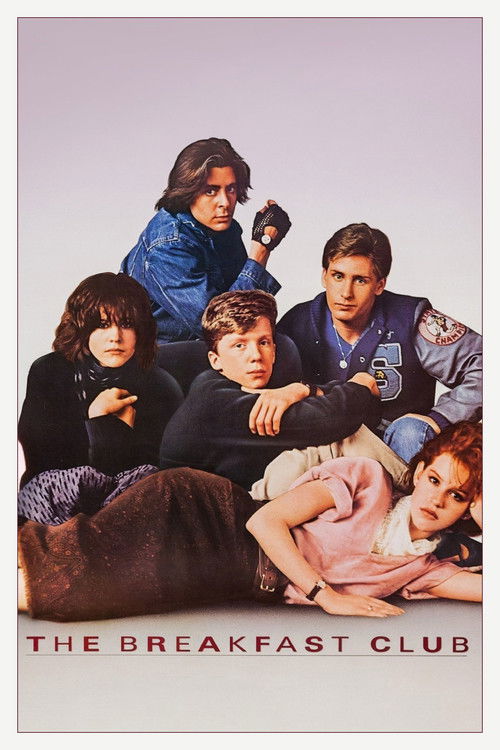
The Breakfast Club
1985 · John Hughes
When you want to feel understood — or remember being seventeen and certain nobody understood you. Great for a nostalgic night, a group rewatch, or handing to an actual teenager to see if it still hits (it does).
What it's about
Five high schoolers who'd never speak in the hallway — a rebel, a princess, a jock, a brain, and an outcast — are stuck together for a Saturday of detention in the school library, under the eye of a vice principal who's given up on all of them. With nothing to do but needle each other, they start talking, and the labels everyone arrived with begin to crack.
The experience
It plays like a pressure cooker that keeps switching between hilarious and raw — you're laughing at the insults one minute and blindsided by a confession the next. By the end it earns a lump in the throat that eighties teen comedies almost never reach for.
Performances
The five-way ensemble — Molly Ringwald, Judd Nelson, Emilio Estevez, Anthony Michael Hall, and Ally Sheedy — carries an entire film on talk alone, each of them letting a stereotype slowly come apart on camera.
The craft
John Hughes strips the teen movie down to one room, one day, and eight hours of dialogue, betting everything on writing and performance — and wins. The confinement is the point: with no plot to hide behind, every shift in who sits where and who looks at whom lands like an event.
Why it matters
It became the defining teen film of the 1980s and the flagship of the Brat Pack era, establishing the idea that teenagers' inner lives deserve to be taken as seriously as adults' — a premise every good high school movie since has inherited.
Snapshot
The Breakfast Club is John Hughes's chamber piece about American adolescence: five teenagers, one Saturday detention, a single library set, and roughly eight hours of confession, antagonism, and fragile solidarity. Released by Universal Pictures in February 1985, it distilled Hughes's emerging thesis — that the inner lives of teenagers deserve the seriousness usually reserved for adults — into its most austere and theatrical form. Where Hughes's other mid-decade films sprawled across suburbs, schools, and shopping malls, this one confines itself almost entirely to a room, betting everything on dialogue, performance, and the slow erosion of social armor. It became a touchstone of the so-called Brat Pack era and is frequently cited as the defining "teen film" of the 1980s, less for spectacle than for its insistence that high-school caste — brain, athlete, basket case, princess, criminal — is both arbitrary and quietly devastating.
Industry & production
The film was produced in the wake of Hughes's screenwriting success and the box-office performance of Sixteen Candles (1984), his directorial debut, which gave him the leverage to make a deliberately small, contained picture. The Breakfast Club was shot in and around the Chicago suburbs — Hughes's lifelong creative territory — with the central library set constructed inside the disused Maine North High School in Des Plaines, Illinois, the same building that doubled for locations in Sixteen Candles. The production is widely reported to have been modestly budgeted by studio standards, a reflection of its single principal location and small cast; precise figures vary across sources, so I won't assign a number I can't securely attest.
The picture belongs to Hughes's intensely productive Universal/Paramount period of the mid-1980s, when he wrote and directed at a remarkable clip. Channel partners and the cast's youth made it a relatively low-risk venture, and its commercial success helped consolidate Hughes's autonomy as a writer-director who could greenlight teen-centered material on his own terms. The film's marketing leaned on its ensemble and its now-iconic one-sheet image of the five leads, framing it as a generational statement rather than a conventional comedy.
Technology
Technologically, The Breakfast Club is unshowy by design. It was photographed on 35mm film, the industry standard of the period, and makes no use of optical spectacle, visual effects, or the era's emerging video and computer imaging. Its single most important "technology" is arguably acoustic and architectural: the production's reliance on a large, hard-surfaced library interior, with its mezzanine, balustrades, and open central floor, gives the film a natural stage on which bodies can be arranged at varying heights and distances. The synthesizer-driven score and the prominent use of a recorded title song place it squarely within the sonic technology of mid-1980s pop production, where the synth and the radio single were as much a part of a teen film's apparatus as the camera. Beyond that, the film deliberately forgoes technological display; its modernity is in its candor, not its hardware.
Technique
Cinematography
The cinematography, by Thomas Del Ruth, faces the central problem of any single-location drama: how to keep a static room visually alive across a feature's length. The solution is patient and architectural. Del Ruth uses the library's vertical geometry — the upper gallery, the railings, the sunken central seating — to stage characters at different elevations, so that power and isolation are continually re-mapped onto physical position. The camera favors clean, legible compositions over flamboyance, with measured movements that track the shifting alliances among the five. Lighting is naturalistic, simulating a long Saturday's passage with a soft, even daylight quality that subtly warms and cools as the emotional temperature changes. The film's most discussed visual figure is the circle: late in the day the five sit on the floor in a loose ring for their long confessional exchange, the composition flattening the hierarchies that the room's architecture had earlier enforced.
Editing
Edited by Dede Allen — a major figure in American editing, celebrated for her work on Bonnie and Clyde and Dog Day Afternoon — the film is paced as a series of conversational movements rather than action beats. The cutting privileges reaction: much of the film's meaning lives in how each teenager's face registers another's disclosure, and Allen's coverage lets those reactions breathe. The editing accelerates only in set-piece interludes — the famous corridor wandering, the dance sequence — where montage briefly releases the pressure of the confined dialogue before returning to the slower rhythm of confession. Allen's involvement lends an unexpectedly distinguished pedigree to what might have been treated as a disposable teen comedy, and her instinct for the human pause is visible throughout.
Mise-en-scène / staging
Mise-en-scène is where the film most resembles filmed theater, and intentionally so. The library is a near-unity of place; props become motifs — the lunches that telegraph class and family, the apparatus of detention, the sliding glass doors through which the principal patrols. Staging is choreographic: Hughes repeatedly redistributes the five across the space to externalize the social distance between them, then collapses that distance as the day wears on. Costume functions as shorthand for the caste system the film both deploys and critiques — Claire's affluent polish, Bender's layered denim and flannel, Allison's shapeless black, Andrew's varsity wear, Brian's neat ordinariness. The single set is not a limitation the film overcomes so much as the very engine of its meaning.
Sound
Sound is dominated by two elements: dialogue and the score. The screenplay is talk, and the sound design keeps speech forward and intimate, the room's slight reverberance lending the confessions a confessional-booth resonance. The score and song work by Keith Forsey, including the title song "Don't You (Forget About Me)" performed by Simple Minds, frames the narrative as anthem — the song's placement over the opening and closing gives the film its bracketing emotional argument. The track became one of the defining pop songs of the decade and is now inseparable from the film's memory, a case where a single needle-drop fused permanently with a movie's identity.
Performance
Performance is the film's true medium. The young ensemble — Emilio Estevez (Andrew), Anthony Michael Hall (Brian), Judd Nelson (Bender), Molly Ringwald (Claire), and Ally Sheedy (Allison), with Paul Gleason as Principal Vernon and John Kapelos as the janitor Carl — works in a register that moves from broad comic friction to raw, near-improvisational vulnerability. Hughes reportedly encouraged extended rehearsal and gave the actors room to find the long central confession sequence, and the film's power rests on the ensemble's ability to modulate from posturing to exposure within a single scene. Nelson's abrasive Bender and Ringwald's guarded Claire anchor the central antagonism; Sheedy's near-silent early presence and later transformation, and Hall's heartbreaking account of academic pressure, are among the most cited performances of the cycle.
Narrative & dramatic mode
Structurally the film observes a near-classical unity of time, place, and action — a single day, a single room, a single arc of revelation — that aligns it more with the well-made stage play than with the episodic teen comedy. Its dramatic mode is confessional and dialectical: the engine is not plot but disclosure, each character's defended self gradually breached by the others' testimony. The narrative withholds conventional incident almost entirely; there is no chase, no romance plot mechanics until late, no external threat beyond the petty tyranny of detention itself. Instead Hughes builds toward catharsis through talk, culminating in the circle confession and Brian's closing letter — the essay the principal demanded, repurposed as the film's own thesis statement, read in voiceover. That voiceover bookend turns the movie into a self-aware document: the teenagers narrate their own taxonomy and then refuse it.
Genre & cycle
The Breakfast Club sits at the center of the 1980s American teen-film cycle, a body of work Hughes more than any other single figure defined. Within that cycle it occupies the "serious" or dramatic pole, distinct from the raunchier teen comedies of the era and from Hughes's own lighter entries. It is conventionally grouped with the "Brat Pack" films — a journalistic label, coined in a 1985 New York magazine piece, that lumped together the young actors recurring across these movies. The film hybridizes comedy and drama freely, but its lasting generic contribution is the template of the cross-clique ensemble forced into proximity and mutual recognition, a structure endlessly reworked in subsequent teen film and television.
Authorship & method
The film is, more than most studio products, the work of a single authorial intelligence: John Hughes wrote, directed, and produced it, and its preoccupations — suburban adolescence, the cruelty and arbitrariness of social hierarchy, the absent or failing adult — are continuous with his broader output. Hughes's method here favored the actors: extended rehearsal, attention to the cadence of teenage speech, and a willingness to let scenes run long in service of emotional truth. His key collaborators elevate the material beyond its modest scale. Cinematographer Thomas Del Ruth solved the single-set problem with architectural staging. Editor Dede Allen brought a master's sense of human rhythm. Composer Keith Forsey supplied the synth-pop scaffolding and the immortal title song (Simple Minds performing). The ensemble cast functioned almost as co-authors of the central confessional passages. The result is auteurist in conception but genuinely collaborative in execution, with Hughes orchestrating rather than dominating.
Movement / national cinema
The film is a thoroughly American product, rooted specifically in the Chicago suburbs that Hughes treated as a recurring imaginative homeland. It belongs to no formal movement in the art-cinema sense; rather it is part of a commercial Hollywood current — the 1980s teen film as a marketable, youth-targeted genre. Its national-cinema significance lies in how vividly it encodes a particular American social geography: the public high school as a microcosm of class and conformity, the suburb as a landscape of comfortable alienation. If there is a "movement" here it is the loose Hughes school of suburban-realist teen cinema, an authorial rather than collective phenomenon.
Era / period
The film is saturated in its moment: Reagan-era middle-American anxiety about achievement, status, and family pressure runs beneath the comedy. The synth score, the fashion, the music-video-inflected dance interlude, and the pop-anthem framing all mark it as mid-1980s to its core. Yet its confinement and its emphasis on talk give it a curiously timeless quality; stripped of the period signifiers, the central situation — adolescents discovering that their assigned types conceal shared wounds — has aged less than the surrounding decor. The film thus sits at a productive tension between period specificity and durable theme, which partly explains its continued circulation among audiences with no memory of the decade that produced it.
Themes
At its core the film interrogates identity as social assignment. Its governing conceit is the high-school caste system — articulated explicitly in Brian's closing taxonomy of brain, athlete, basket case, princess, and criminal — and its dramatic project is to show those labels as both inadequate and inescapable. Adjacent themes proliferate: the pressure of parental and institutional expectation (Brian's near-breakdown over grades, Andrew's account of his father's demands); the inheritance of cruelty across generations, with the adults — Vernon especially — figured as the teenagers grown bitter; the loneliness beneath each social role; and the fragile, possibly temporary nature of cross-clique solidarity, which the film honestly acknowledges may not survive Monday morning. Sexuality, class, and family dysfunction surface as the masks come off. Crucially, the film refuses a tidy resolution of its central question — whether the day's intimacy will last — leaving its hope deliberately provisional.
Reception, canon & influence
The Breakfast Club was a commercial success on release and has grown steadily in critical and cultural standing since. Contemporary reviews were mixed-to-positive, with some critics moved by its sincerity and performances and others resistant to its talkiness or its pop-psychology resolutions; over time the appraisal has tilted decisively toward esteem, and the film is now routinely treated as a key American teen film and a cultural landmark of its decade. I'd flag that the granular detail of its first-run critical reception is unevenly documented across accessible sources, so I'll avoid attributing specific reviews I can't verify.
Looking backward, the film's influences are more theatrical and literary than cinematic: the single-set ensemble confessional drama owes an evident debt to the well-made stage play and to the broader tradition of the "group confined together discovers itself" structure. Hughes's own Sixteen Candles established the suburban-teen idiom that this film deepened and darkened.
Looking forward, its legacy is vast and easy to underestimate precisely because it is so absorbed into the culture. The cross-clique ensemble structure became a default template for teen film and television for decades, and the film is endlessly invoked, parodied, and homaged — the freeze-frame fist-raise over Simple Minds is one of the most recognizable closing images in American popular cinema. The film was selected for preservation in the United States National Film Registry by the Library of Congress, a marker of canonical status. Its dialogue, its archetypes, and its central question about whether labels can be transcended remain reference points whenever popular culture returns to the subject of adolescence. Few films of its scale have cast so long a shadow from so small a room.
A Deleuzian reading
Allison doesn't speak for almost an hour.
The full Deleuzian reading of The Breakfast Club →
Reception
A modest sleeper hit in 1985 that many critics initially shrugged off as just another teen movie, it's since been canonized as THE teen movie — inducted into the National Film Registry in 2016 as the defining document of 80s adolescence.
How The Breakfast Club was received, from release to now →
Influences: the films it descends from and the films it influenced
- 12 Angry Men (1957) — The template of strangers locked in one room across near-real-time who confess and transform—solving the single-set problem with architectural staging and progressively tighter lenses to register the room shrinking, exactly Del Ruth's strategy in the library.
- Who's Afraid of Virginia Woolf? (1966) — The chamber confessional in which confined antagonists strip away social masks through escalating, theatrically-derived talk—the well-made-stage-play dramaturgy Hughes inherits for the truth-telling circle.
- Bonnie and Clyde (1967) — Editor Dede Allen, who cut both films, brings the same instinct for cutting on the rhythm of human behavior rather than plot mechanics—her reaction-driven, breath-led pacing shapes the confessional passages.
- Rebel Without a Cause (1955) — Establishes the suburban-teen archetype set—jock, princess, outcast—and the compressed single-day reckoning driven by failing, absent adults, the generational-cruelty frame Hughes adopts wholesale.
- American Graffiti (1973) — Pioneers wall-to-wall pop needle-drops functioning as both score and era-marker across a multi-protagonist youth ensemble compressed into one continuous span—the soundtrack-as-emotional-scaffold method Forsey reprises.
- Diner (1982) — Lets ensemble scenes run long on overlapping, naturalistic youth-vernacular talk with no plot engine—the hangout dramaturgy and patience with teenage speech-cadence Hughes pushed his cast to find in rehearsal.
- The Big Chill (1983) — Confines an ensemble to a single house for a weekend of group self-examination scored to pop standards used as emotional triggers—the confined-group-discovers-itself confessional structure immediately preceding Hughes.
- Sixteen Candles (1984) — Hughes's own film that established the suburban-teen idiom, archetype casting, and synth-pop framing that The Breakfast Club deepens and darkens—the direct authorial predecessor.
- Fast Times at Ridgemont High (1982) — Takes the archetype-ensemble-in-a-school-space structure and Ridgemont's premise that teen speech deserves verbatim attention, then reverses the method — sustained monologue and confessional articulacy in place of Crowe's clipped, evasive overheard talk.
- Ferris Bueller's Day Off (1986) — Same Hughes authorial signature—classical-unity single-day compression, direct-address/voiceover framing, and suburban social-caste preoccupations—made the same year by the same orchestrating sensibility.
- Heathers (1989) — Weaponizes the Breakfast Club clique-taxonomy and generational-cruelty theme into satire, treating the high-school caste labels as a literal lethal system rather than something to be transcended.
- Dazed and Confused (1993) — Inherits the one-day classical-unity hangout structure and period needle-drop wall, dispersing the cross-clique ensemble across a town the way Hughes confined it to a room.
- Clueless (1995) — Carries forward the voiceover-bookend narration and the high-school-as-stratified-caste-system taxonomy, mapping cliques as anthropology in the Breakfast Club mold.
- Mean Girls (2004) — Makes explicit the cross-clique cafeteria taxonomy and the central question of whether social labels can be transcended—the Breakfast Club thesis literalized into a map of the lunchroom.
- The Perks of Being a Wallflower (2012) — Revives the confessional outcasts-find-each-other ensemble framed by a voiceover bookend and a curated needle-drop emotional arc, descended directly from the library circle's intimacy.
- The Spectacular Now (2013) — Extends the suburban-realist-teen lineage's commitment to long-running, naturalistic two-handers and reaction-driven cutting that privileges emotional truth over teen-film plotting.
- The Fault in Our Stars (2014) — Established the tradition of taking adolescent interiority seriously through hyper-articulate ensemble dialogue that underwrites Fault's smart-teen voice.
- Teenage Mutant Ninja Turtles: Mutant Mayhem (2023) — The Hughes high-school template — an outsider ensemble, overlapping naturalistic teen dialogue and adolescence-as-subject — is the comedic-DNA the film inherits, reinforced by casting actual teenagers to voice the Turtles.
- Pretty in Pink (1986) — Hughes-scripted dramatization of high-school social caste and class romance, extending his archetype taxonomy and synth-pop needle-drop scoring under a directorial surrogate.
- The Outsiders (1983) — Builds its star ensemble directly from this film's casting pool, inheriting the 'Brat Pack' template of treating a tight teen ensemble as serious dramatic protagonists.
Similar films
- Ferris Bueller's Day Off (1986) — influence & lineage
- The Perks of Being a Wallflower (2012) — influence & lineage
- Rebel Without a Cause (1955) — influence & lineage
- Dazed and Confused (1993) — influence & lineage
- Heathers (1989) — influence & lineage
- The Big Chill (1983) — influence & lineage
- Mean Girls (2004) — influence & lineage
- Fast Times at Ridgemont High (1982) — shared sensibility