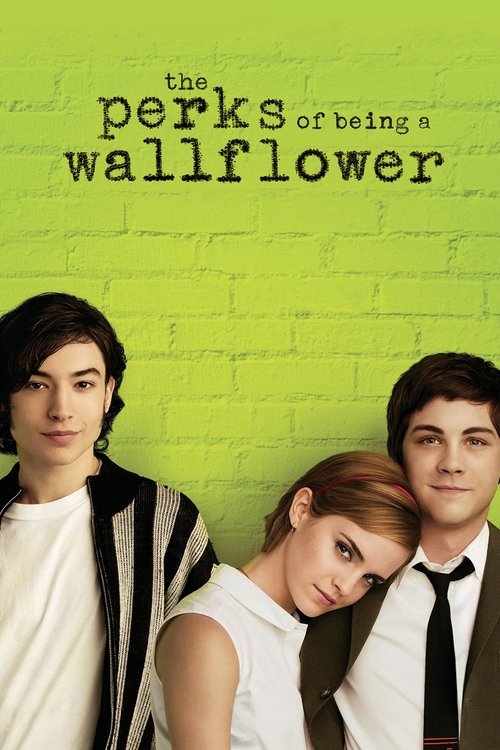
The Perks of Being a Wallflower
2012 · Stephen Chbosky
For when you need to feel something — a good cry that earns it, nostalgia for being seventeen even if your seventeen was nothing like this. Comfort viewing with a bruise in the middle; keep tissues close.
What it's about
Pittsburgh, 1991. Charlie, a fragile and watchful high-school freshman, spends his days on the sidelines until two magnetic seniors — Sam and her stepbrother Patrick — pull him into their orbit of mixtapes, Rocky Horror midnight shows, and late-night drives. Over one school year he discovers friendship, music, and first love, while something he can't yet name keeps surfacing from his past.
The experience
Tender and completely unironic — it takes teenage feeling seriously in a way almost no high-school movie does, so the euphoric highs (that tunnel scene) land as hard as the quiet devastations. It builds gently, then hits you somewhere you didn't expect.
Performances
Logan Lerman's guarded stillness holds the whole film together, Emma Watson sheds a decade of Hermione, and Ezra Miller is a live wire of warmth and hurt as Patrick — the three of them feel like a real found family.
The craft
Stephen Chbosky adapted and directed his own beloved novel — a thing almost no novelist pulls off — and the book's letter-writing intimacy survives as voiceover that feels confided rather than narrated. The film thinks in songs: the soundtrack is how these characters tell each other the truth, and the needle drops are structural, not decoration.
Why it matters
It became a generational touchstone — the coming-of-age film a wave of young viewers found at exactly the right moment — and set the sincere, music-driven template for the decade of teen cinema that followed.
Stephen Chbosky did what almost no novelist manages: he adapted and directed his own beloved book, and made the definitive version. Pittsburgh, 1991 — a fragile, watchful freshman named Charlie is adopted by two magnetic seniors, and the film charts a single school year of mixtapes, Rocky Horror midnight shows, first love, and the slow surfacing of things Charlie cannot yet name. What distinguishes it from the teen-movie shelf is its refusal of irony; Chbosky treats adolescent feeling with complete seriousness, and his cast — Logan Lerman's guarded stillness, Emma Watson shedding a decade of Hermione, Ezra Miller's live-wire warmth — meets him there. The novel's epistolary form survives as intimate voiceover, and the film's emotional architecture is musical: songs are how these characters tell each other the truth, culminating in a tunnel drive scored to a track the characters themselves can't identify. It has become a generational handshake, passed between teenagers the way the book once was. 'We accept the love we think we deserve' entered the language; the film earns the line.
Reception
A modest Tumblr-era indie hit in 2012, it quietly snowballed into THE millennial coming-of-age touchstone — the kind of film a generation rewatches annually and defends like a diary entry.
How The Perks of Being a Wallflower was received, from release to now →
Influences: the films it descends from and the films it influenced
- The 400 Blows (1959) — Establishes the empathetic first-person portrait of a wounded adolescent whose abuse is withheld until it erupts, resolving not in plot but in a suspended emotional release — the ancestor to Perks' climactic-confession-then-liberation ending.
- Ordinary People (1980) — Model for the survivor's-guilt teen whose repressed trauma (a death he blames himself for) is unpacked gradually through a therapeutic relationship rather than exposition — the same slow-reveal architecture Perks uses for Charlie's aunt.
- Stand By Me (1986) — Frames a single formative chapter through retrospective first-person narration by an adult-writer voice, the direct precedent for Perks' epistolary 'Dear friend' voiceover addressing an unseen confidant.
- The Breakfast Club (1985) — Pioneers the confessional structure where misfit teens disclose buried pain in unguarded monologue, treating adolescent suffering as serious without ironic deflation — Perks' core tonal debt.
- Say Anything… (1989) — Codifies music-as-declaration (the boombox) and the curated mixtape as a vocabulary of romantic sincerity, which Perks literalizes in Charlie's homemade tapes and 'the perfect song' motif.
- Dead Poets Society (1989) — The validating mentor-teacher who recognizes the sensitive outcast through literature and hand-picked books — directly echoed in Mr. Anderson gifting Charlie novels and calling him talented.
- Harold and Maude (1971) — Scores a death-haunted misfit's interiority to a single artist's songbook (Cat Stevens), pioneering the needle-drop-as-emotional-diary that Perks inherits for its 80s/90s alt-rock scoring.
- The Rocky Horror Picture Show (1975) — Directly cited and staged within Perks; supplies the midnight-movie participatory ritual as an on-screen subculture haven where outcasts perform and belong.
- Rushmore (1998) — The literary, theatrical outsider whose amateur stage performance becomes the vehicle of self-actualization — the same conceit as Charlie's friends performing Rocky Horror.
- Almost Famous (2000) — Period-precise needle-drop soundtrack curated as emotional autobiography, plus the collective music-communion scene ('Tiny Dancer'), the template for Perks' tunnel-drive 'Heroes' catharsis.
- Me and Earl and the Dying Girl (2015) — Extends the outcast-narrator teen film with self-conscious literary/cinephile framing and a mortality throughline, inheriting Perks' confessional voiceover and sincerity-over-quirk register.
- The Edge of Seventeen (2016) — Carries forward the candid first-person teen outsider paired with a wry mentor-teacher, mixing acerbic voice with earnest emotional exposure exactly as Perks does with Charlie and Mr. Anderson.
- Lady Bird (2017) — Adopts the single-school-year structure and period specificity to dramatize self-worth, championing sincerity over irony in the same coming-of-age key Perks helped revive.
- Wonder (2017) — Chbosky's own follow-up as author-director, reprising his multi-perspective empathy and unabashed sincerity-over-irony to affirm an outsider's self-worth.
- Love, Simon (2018) — Builds its narration on epistolary confessions (emails to an unknown 'friend') mirroring Perks' 'Dear friend' letters, delivering the same sincere teen self-acceptance arc.
- All the Bright Places (2020) — The novelist-directs-own-adaptation configuration guarding interiority, plus the tunnel/threshold-crossing motif and needle-drop songscape used to make teen mental illness and suicide speakable — the exact bridge-threshold and dual-authorship debt.
- The Spectacular Now (2013) — Contemporaneous naturalistic teen drama that treats addiction and family trauma with the same non-ironic sincerity across a single senior year, casting adolescent hurt as adult-weight.
- The Way Way Back (2013) — Shares the withdrawn-teen-lifted-by-a-mentor structure and single-season arc, using an outsider community (the water park) as the belonging-refuge Perks finds in its friend group.
- Before I Fall (2017) — An author-adapts-own-novel YA film built on confessional first-person voice, empathy and bullying/trauma, and a curated needle-drop soundtrack deployed as emotional architecture.
Similar films
- Rushmore (1998) — influence & lineage · same viewing thread
- Almost Famous (2000) — influence & lineage · same viewing thread
- The Breakfast Club (1985) — influence & lineage
- Stand by Me (1986) — influence & lineage
- Dead Poets Society (1989) — influence & lineage · same viewing thread
- Moonrise Kingdom (2012) — same viewing thread
- Dazed and Confused (1993) — same viewing thread
- The Fault in Our Stars (2014) — shared sensibility
All the films related to The Perks of Being a Wallflower →
Watch it with: curated runs of related films
- Restless Youth, Rigid Walls — Watch these as one long walk through the school years — the teachers who crack you open, the friends who pull you off the sidelines, the first loves and the institutions you push against — where a beloved tearjerker and a surreal boarding-school revolt turn out to be cousins.