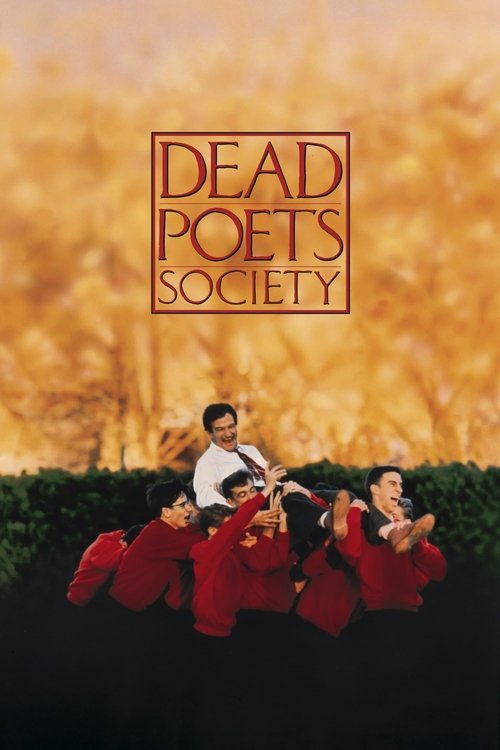
Dead Poets Society
1989 · Peter Weir
For when you need to be reminded why anything matters — a graduation, a rut, a crossroads. It's a comfort film with real teeth: bring tissues and expect to want to reread a poem afterward.
What it's about
At a buttoned-up New England boarding school in 1959, where tradition and discipline rule everything, a new English teacher named John Keating arrives and teaches poetry as a dare: seize the day, find your own voice, live deliberately. A circle of boys takes him at his word — reviving a secret literary club, chasing first loves, and defying the futures their fathers have planned — while the school's old guard watches with growing hostility.
The experience
Warm, rousing, and sneakily emotional — for long stretches it's the pleasure of watching young people wake up to their own lives, and then it deepens into something that can genuinely wreck you. Few films move so cleanly from inspiration to heartbreak.
Performances
Robin Williams dials his comic energy down to a glow, making Keating magnetic without ever tipping into shtick — it's one of his defining dramatic roles — and a young Ethan Hawke is quietly wonderful as the shyest boy in the class finding his voice.
The craft
Peter Weir shoots the school's autumn grounds and candle-lit caves with a painterly romanticism that makes rebellion feel sacred, and the screenplay's classroom scenes are so well built they've been imitated for decades. It's a film of faces and firelight that plays beautifully on any screen but rewards giving it your full attention.
Why it matters
'Carpe diem' and 'O Captain! My Captain!' entered the culture through this film; it became the template every inspiring-teacher movie since has been measured against and marked a career peak for both Weir and Williams.
Snapshot
Dead Poets Society is Peter Weir's chamber drama of pedagogy and rebellion, set at the fictional Welton Academy, an elite New England preparatory school, in the autumn of 1959. An unorthodox English teacher, John Keating (Robin Williams), returns to his alma mater and exhorts his students to "seize the day," teaching poetry not as a discipline to be measured but as a summons to live deliberately. His influence catalyzes a small circle of boys — the painfully shy Todd Anderson (Ethan Hawke), the aspiring actor Neil Perry (Robert Sean Leonard), the romantic Knox Overstreet (Josh Charles), the provocateur Charlie Dalton (Gale Hansen) — who revive a secret literary club Keating once belonged to. The film's arc bends from intoxicating liberation toward tragedy: Neil's defiance of a domineering father over his acting ends in suicide, and the school scapegoats Keating, expelling him. The closing image — boys standing on their desks in silent tribute, intoning "O Captain! My Captain!" — became one of the most quoted set-pieces of late-1980s American cinema. Written by Tom Schulman, it won the Academy Award for Best Original Screenplay and crystallized a sentimental-yet-genuine vision of the teacher-as-liberator that has shaped the inspirational-classroom genre ever since.
Industry & production
The film was produced and released by Touchstone Pictures, the Disney label created to handle more adult, non-family material, in partnership with Silver Screen Partners IV financing. Its development history is well documented in its essentials: Tom Schulman wrote the screenplay drawing on his own experience at Montgomery Bell Academy in Nashville, Tennessee, and the project passed through several hands before Weir came aboard. Director Jeff Kanew was attached at one stage, and Dustin Hoffman was reportedly involved as a potential director and/or star before departing; Liam Neeson is often cited among actors considered for Keating. These attachments are part of the project's reported pre-history rather than its finished form, and the specific details vary between accounts.
What is firmly established is that Weir, an Australian director with a strong commercial and critical track record by the late 1980s, took the material and reshaped its tone away from broader comedy toward something more elegiac. The casting of Robin Williams — then primarily known as a manic comic force from Good Morning, Vietnam (1987) and stand-up — was the production's central gamble: a performer whose improvisational energy had to be harnessed and partly restrained to serve a more contained dramatic role. The young ensemble was largely composed of relative newcomers; Dead Poets Society was a significant early showcase for Ethan Hawke and Robert Sean Leonard.
Principal photography took place primarily at St. Andrew's School in Middletown, Delaware, whose Collegiate Gothic architecture and lakeside grounds supplied Welton's cloistered, autumnal world. The film was a substantial commercial success on release in 1989 — one of the year's notable adult-drama hits — and a strong awards performer. It received four Academy Award nominations: Best Picture, Best Director (Weir), Best Actor (Williams), and Best Original Screenplay, winning the last. Williams lost the lead-actor Oscar to Daniel Day-Lewis (My Left Foot). The film also won the BAFTA for Best Film and the César in France for Best Foreign Film, an unusually warm reception abroad for an American school drama.
Technology
Dead Poets Society is a conventional 35mm production of its era, and its technological interest lies less in innovation than in disciplined classical craft. It was shot photochemically and finished for standard theatrical release. The most notable technical-aesthetic choice belongs to the score: composer Maurice Jarre, working in a period that increasingly blended orchestral and electronic textures, built much of the music around synthesizer voicings rather than a large traditional orchestra. This was consistent with Jarre's late-career embrace of electronic instrumentation (as in his scores for Weir's Witness and The Year of Living Dangerously), and it gives the film's emotional cues a warm, slightly synthetic glow distinct from the lush strings one might expect of a period piece. Beyond this, the film does not foreground technological novelty; its commitments are to a transparent, "invisible" production technology in service of performance and landscape.
Technique
Cinematography
The photography is by John Seale, the Australian cinematographer who had already shot Witness (1985) and The Mosquito Coast (1986) for Weir. Seale renders Welton in a palette of burnished autumn — amber leaves, fog over the lake, candlelight and lamplight in wood-panelled interiors — that aligns the film's seasonal setting with its themes of transience and ripening. The compositions favor classical balance and frequently use the architecture (arched windows, corridors, the geometry of the chapel and classroom) to frame the boys as small figures within institutional order. Keating's classroom scenes, by contrast, are staged with more mobility and intimacy. The cinematography is restrained rather than showy, but it does crucial thematic work: the natural light of outdoor sequences (the cave gatherings, the soccer field) reads as freedom against the controlled, shadowed interiors of authority. Seale's eye for the New England landscape gives the film much of its mythic, memory-tinted quality.
Editing
Edited by William M. Anderson (with Lee Smith credited among the editorial team in some accounts), the film moves at a measured, classical pace that lets scenes breathe — particularly the pedagogical set-pieces, where the rhythm is built around Williams's delivery and the students' reactions. The cutting is at its most expressive in two registers: the lyrical montage of the boys' nighttime treks to the cave, scored and elliptical; and the gathering dread of the final act, where the tempo tightens around Neil's crisis and death. The decision to handle Neil's suicide largely through restraint and aftermath rather than graphic depiction is as much an editorial as a directorial choice, and the film's most famous beat — the desk-standing finale — is constructed through accumulating cutaways that build the collective gesture into a crescendo.
Mise-en-scène / staging
Weir's staging draws a consistent visual argument between conformity and individuality. Welton's rituals — the opening convocation with banners proclaiming Tradition, Honor, Discipline, Excellence; rows of identical blazers; regimented study — establish an environment of enforced uniformity. Keating disrupts this spatially: he leads boys into the courtyard to march and expose the dangers of conformity, has them tear the introduction from their poetry textbooks, and stands on his desk to insist they view the world from a new angle. The recurring motif of standing on the desk is pure staging-as-theme, and its return in the final scene completes the figure. Production design contrasts the school's austere institutional spaces with the womb-like, candlelit cave where the boys read poetry — a space of imagination set against the daylight world of obligation.
Sound
Beyond Jarre's score, the sound design supports the film's lyrical and naturalistic registers: wind, water, footsteps in stone corridors, the hush of the chapel. The aural centerpiece, however, is the human voice — specifically the spoken word. Poetry recited aloud (Whitman, Thoreau's "suck out all the marrow of life," Frost, Tennyson's "Ulysses") is the film's true sonic texture, and the drama repeatedly turns on whether a boy can find or raise his voice, literalized in Todd's breakthrough when Keating coaxes a spontaneous poem out of him. Williams's vocal performance — his impressions, his shifts in register — is itself a primary sound element.
Performance
The acting is the film's engine. Robin Williams gives a deliberately modulated performance: the comic improviser is present (the Marlon Brando and John Wayne impressions reading Shakespeare), but the role's gravity comes from the restraint between the bursts, the watchfulness and melancholy Williams allows Keating in repose. It remains one of the defining performances of his career and a model of a comic star reaching for dramatic weight. Around him, the young ensemble is unusually strong: Robert Sean Leonard gives Neil a luminous, doomed eagerness; Ethan Hawke's Todd carries the film's emotional throughline from paralyzing shyness to the final act of courage; Josh Charles, Gale Hansen, Dylan Kussman, Allelon Ruggiero, and James Waterston flesh out a credible adolescent social world. In supporting authority roles, Norman Lloyd's headmaster Nolan embodies institutional rigidity, and Kurtwood Smith makes Neil's father a chilling study in loving control turned destructive.
Narrative & dramatic mode
The film operates as a classical tragedy nested inside a coming-of-age ensemble drama. Its dramatic mode is fundamentally sentimental-romantic — it asks the audience to feel deeply and to side, unambiguously, with passion against repression — but it is disciplined by a genuinely tragic structure. The carpe-diem philosophy that liberates the boys also helps set the conditions for catastrophe: Neil's seizing of his acting dream collides fatally with paternal authority, and the question of Keating's responsibility (did he give them inspiration without the armor to survive its consequences?) is left morally complex rather than resolved. The narrative withholds easy vindication: Keating is fired, the institution closes ranks, and the boys' rebellion succeeds only as a private, symbolic gesture. This refusal of a triumphant ending — liberation that costs a life and a teacher's career — gives the film more moral seriousness than its many imitators.
Genre & cycle
Dead Poets Society sits at the intersection of the boarding-school film, the coming-of-age drama, and the inspirational-teacher subgenre. It draws on a long tradition of school-set British and American fiction and film (the lineage of Goodbye, Mr. Chips and Tom Brown's School Days hovers behind it), and it belongs to a recognizable cycle of teacher movies — alongside To Sir, with Love (1967) and Stand and Deliver (1988) before it. More than any other single film, however, Dead Poets Society codified the modern template of the charismatic mentor who transforms students against institutional resistance, and its DNA is visible in later entries from Mr. Holland's Opus to Freedom Writers. Its distinguishing move within the cycle is to fuse the inspirational arc with tragedy rather than uplift.
Authorship & method
The film is a meeting of strong, complementary authorships. Peter Weir brought the sensibility evident across his Australian and American work — Picnic at Hanging Rock, Gallipoli, Witness — for groups of people set against landscape and institution, for the eruption of mystery or repressed feeling within ordered worlds, and for a humane, often melancholy romanticism. Weir's particular contribution was tonal: tempering Williams and steering the script away from broad comedy toward elegy. Tom Schulman's Oscar-winning screenplay supplied the structure and the autobiographical grounding, and its dialogue (the rallying phrases, the poetry citations) became the film's cultural shorthand. John Seale's cinematography and Maurice Jarre's synthesizer-based score were both extensions of established collaborations with Weir, lending continuity of vision. William M. Anderson's editing shaped the film's classical pacing and its two great rhythmic achievements, the cave montages and the final crescendo. The film is thus best understood not as a single auteur statement but as a tightly aligned collaboration around Weir's controlling sensibility.
Movement / national cinema
Dead Poets Society is an American studio production, but it is also a key film of the "Australian in Hollywood" current — part of the wave of Australian directors (Weir, Bruce Beresford, Fred Schepisi, George Miller) who moved into American filmmaking through the 1980s after the Australian New Wave. Weir's outsider perspective on American institutional culture — the WASP rituals of the East Coast prep school observed with both affection and critical distance — is arguably sharpened by that vantage. The film does not belong to a formal movement so much as to mainstream classical Hollywood storytelling, but its sensibility carries traces of the Australian New Wave's preoccupation with landscape, repression, and the individual against the collective.
Era / period
The film is set in 1959, on the cusp of the 1960s, and its choice of period is pointed: Welton's regimented conformity represents the buttoned-down Eisenhower-era world against which the coming counterculture would rebel, and Keating's romantic individualism reads as a premonition of the 1960s. The film was made and released in 1989, at the end of the Reagan decade, and it can be read as a Reagan-era meditation on conformity, ambition, and the cost of self-determination — its nostalgia tinged with an anxiety about institutions and the pressures placed on the young. Its period dress is exact enough to evoke the late 1950s while its emotional concerns are legible to a contemporary audience.
Themes
The film's central theme is carpe diem — the romantic imperative to seize the day and live authentically — set against the countervailing forces of conformity, tradition, and authority. Around this core cluster several others: the tension between romanticism and pragmatism (Keating's poetry against the school's "four pillars"); the formation of individual identity within institutional and familial pressure; the relationship between freedom and responsibility, dramatized in the ambiguity of Keating's culpability; and the destructive potential of paternal authority, embodied in Mr. Perry. Poetry itself is thematized as a life-force — "we don't read and write poetry because it's cute… we read and write poetry because we are members of the human race, and the human race is filled with passion." The film is finally ambivalent about its own romanticism: it celebrates the awakening Keating offers while refusing to pretend that awakening is without peril.
Reception, canon & influence
Critical reception in 1989 was strong but not unanimous. The film was widely praised for Williams's performance, Weir's craftsmanship, and its emotional power, and it was rewarded richly at the Oscars, BAFTAs, and Césars. A significant strand of criticism, however, found it sentimental, manipulative, or intellectually facile in its treatment of poetry and pedagogy — the charge that it flatters anti-intellectualism while pretending to celebrate literature, or that its emotional effects are unearned. This split — beloved by audiences, eyed skeptically by some critics — has persisted in its reputation.
Looking backward, the film's influences are the long tradition of school fiction and inspirational-teacher narratives, the Romantic and Transcendentalist literary canon it quotes (Whitman, Thoreau, Frost, Tennyson, Herrick), and Weir's own body of work on institutions and repressed feeling. Looking forward, its legacy is outsized. It fixed the modern grammar of the inspirational-teacher film and supplied enduring cultural touchstones: "Carpe diem, seize the day," "O Captain! My Captain!," and the image of students standing on their desks have circulated far beyond the film, in everything from advertising to political tribute (notably resurfacing in remembrances after Robin Williams's death in 2014). It launched or elevated the careers of its young cast, particularly Ethan Hawke and Robert Sean Leonard. The film endures as a touchstone for debates about teaching, individualism, and the responsibilities of inspiration — its sincerity and its sentimentality alike keeping it firmly in the popular canon.
A Deleuzian reading
He climbs onto his own desk and asks the boys why he's up there.
The full Deleuzian reading of Dead Poets Society →
Reception
A box-office smash in 1989 that critics were split on — Roger Ebert famously trashed it as manipulative even as it earned a Best Picture nomination and won the Original Screenplay Oscar. Robin Williams' death in 2014 only deepened its hold, and it's now firmly a beloved classic rather than a contested one.
How Dead Poets Society was received, from release to now →
Influences: the films it descends from and the films it influenced
- Picnic at Hanging Rock (1975) — Weir's own template of a repressive girls'-college institution ruptured by mystery, shot in soft diffused light with dread humming beneath the order — the bodies-against-institution grammar DPS transposes onto Welton Academy.
- Gallipoli (1981) — Weir's ensemble of doomed young men whose affection is built up and then whose violent death is withheld through elliptical cutting — the exact restraint-of-violence editing logic DPS reuses for Neil's suicide.
- Witness (1985) — The John Seale / Maurice Jarre partnership formed here — Seale's golden natural-light interiors and Jarre's synthesizer-based score — is carried wholesale into DPS as an established Weir collaboration.
- The Year of Living Dangerously (1982) — Earlier Weir–Jarre pairing where the synthesizer score underscores repressed feeling within an ordered world, establishing the electronic-elegy sound palette DPS inherits.
- if.... (1968) — Codified the boarding-school film as a study of ritualized conformity versus individual revolt — masters, dorms, tradition, and uprising — the institutional architecture DPS adopts in gentler form.
- Zéro de conduite (1933) — The poetic schoolboy-rebellion film: the classroom as site of lyric, anarchic uprising against deadening masters — direct ancestor of DPS's insurgent staging where students physically defy the room's authority.
- The Prime of Miss Jean Brodie (1969) — The charismatic teacher whose seductive inspiration overreaches and culminates in a pupil's destruction — the tragic-mentor structure DPS softens but structurally reproduces in Keating and Neil.
- Goodbye, Mr. Chips (1939) — Established the beloved-schoolmaster narrative and the elegiac arc of a teacher remembered, supplying the sentimental emotional template the inspirational-teacher genre — and DPS's final crescendo — runs on.
- Tea and Sympathy (1956) — The New England prep-school drama of a sensitive nonconformist boy persecuted by a masculine-conformist institution — DPS's closest setting-and-theme ancestor in the conformity-vs-individuality strand.
- Good Morning, Vietnam (1987) — Advances the comic-to-dramatic turn the film unlocked, channeling Williams's verbal exuberance toward a teacher-as-liberator role with restrained pathos.
- Mr. Holland's Opus (1995) — Directly applies DPS's teacher-as-life-changer arc and its accumulating-then-releasing emotional crescendo, closing on students testifying to the teacher's impact exactly as DPS does.
- Good Will Hunting (1997) — Extends Robin Williams's DPS persona into the wounded mentor whose breakthroughs come through literature and felt emotion rather than authority — the same tempered-Williams register Weir engineered.
- Finding Forrester (2000) — A reclusive man of letters mentoring a gifted youth through writing and seize-the-day risk — a near-explicit reworking of DPS's poetry-as-liberation mentorship.
- Mona Lisa Smile (2003) — The 'female DPS': a freethinking teacher against a conformist elite institution at the same late-1950s cusp, replicating the inspire-rebellion-then-reckon-with-cost structure beat for beat.
- The History Boys (2006) — Extends the literature-teacher-as-liberator into poetry-saturated dialogue and an examination of pedagogy's seductions, darkening DPS's romance of the inspiring schoolmaster.
- Whiplash (2014) — Adversarial descendant that inverts the inspirational mentor into a tyrant, directly interrogating the carpe-diem 'push them to greatness' pedagogy DPS romanticized and its lethal cost.
- The Perks of Being a Wallflower (2012) — The validating mentor-teacher who recognizes the sensitive outcast through literature and hand-picked books — directly echoed in Mr. Anderson gifting Charlie novels and calling him talented.
- Like Stars on Earth (2007) — Codifies the unorthodox teacher who liberates pupils from a regimented, rote institution, and the staging grammar of oppressive uniform spaces versus zones of creative freedom that Taare uses to contrast boarding school and art class.
- 3 Idiots (2009) — The anti-rote-learning classroom drama pitting a free-thinking mentor against a conformist academic machine, including a student suicide caused by parental/institutional pressure — the tonal and thematic scaffold 3 Idiots reworks.
- Udaan (2010) — The specific engine of a young man's suppressed artistic vocation (writing/poetry) crushed by a rigid patriarch's career decree — the freedom-against-inheritance conflict Udaan localizes through its would-be writer and his factory-owner father.
- Radical (2023) — Codifies physical reorganization of classroom space as pedagogy (standing on desks, leaving the room) — a blocking grammar Radical inherits in its floor-sitting, furniture-cleared 'transformable classroom.'
- Before the Fall (2004) — The prep-school template Gansel deliberately grafts onto the Third Reich — seasonal calendar structure, the sensitive writing boy in a warrior institution, the awakening mentor, the suicide of the son who cannot meet the father's demand — so the audience's genre reflexes deliver them into the ideology before they notice.
- Stand and Deliver (1988) — Same-moment inspirational-teacher film fixing the template in parallel: a charismatic instructor lifting students above institutional low expectations through performance-driven pedagogy.
- Educating Rita (1983) — Runs the same education-as-liberation engine through a charismatic literature teacher, using the recitation of poetry as the device that awakens the pupil to a larger self.
- The Postman (1994) — The mentor-pupil drama in which poetry awakens an inarticulate young man, the charismatic-tutor structure paralleling Neruda's tutelage of Mario.
- The Holdovers (2023) — The New England boarding-school transformative-teacher genre, whose autumnal prestige aesthetic Holdovers deliberately honors and then inverts (the teacher stays broken).
- The Chorus (2004) — Model for the compassionate-mentor-versus-authoritarian-headmaster axis inside an all-boys institution, where the teacher's method is to unlock individual expression against a system built to suppress it.
Similar films
- Good Will Hunting (1997) — influence & lineage · same viewing thread · often watched together
- Picnic at Hanging Rock (1975) — influence & lineage · same viewing thread
- Tea and Sympathy (1956) — influence & lineage
- if.... (1968) — influence & lineage · same viewing thread
- The Perks of Being a Wallflower (2012) — same viewing thread
- Rushmore (1998) — same viewing thread
- The Graduate (1967) — same viewing thread
- Fast Times at Ridgemont High (1982) — same viewing thread
All the films related to Dead Poets Society →
Watch it with: curated runs of related films
- Restless Youth, Rigid Walls — Watch these as one long walk through the school years — the teachers who crack you open, the friends who pull you off the sidelines, the first loves and the institutions you push against — where a beloved tearjerker and a surreal boarding-school revolt turn out to be cousins.