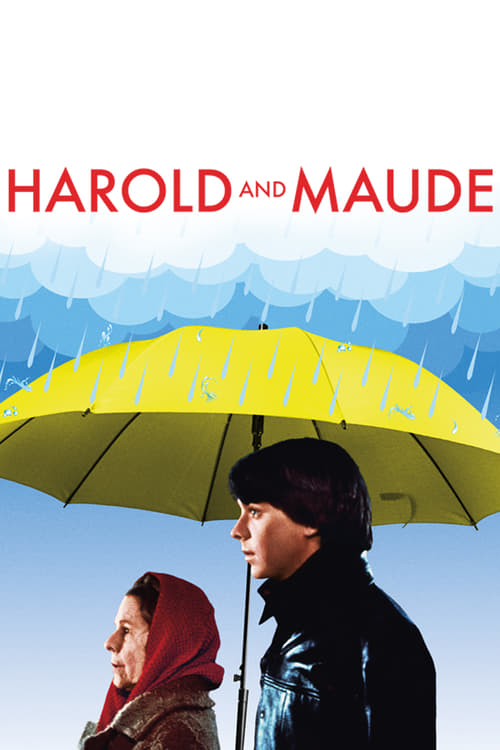
Harold and Maude
1971 · Hal Ashby
For when you're feeling stuck, numb, or a little too serious about everything and need a film to shake you loose — equal parts dark laugh and warm hug. It's comfort viewing for people whose comfort runs a bit gothic.
What it's about
Harold is a wealthy young Californian so obsessed with death that he stages elaborate fake suicides to rattle his unflappable mother and spends his free time attending strangers' funerals. At one of them he meets Maude, a seventy-nine-year-old anarchic free spirit who steals cars, poses nude, and treats every rule as a suggestion — and who decides to teach him how to actually live. What starts as an odd friendship deepens into a love story nobody around them is prepared to accept.
The experience
Deadpan and macabre one minute, unexpectedly tender the next — it keeps a straight face through the darkest gags and then sneaks real feeling up on you. By the end the morbid comedy has quietly turned into an argument for joy, and it lingers.
Performances
Ruth Gordon is irresistible as Maude, radiating mischief and hard-won wisdom without a drop of sentimentality, and Bud Cort's pale, saucer-eyed deadpan makes Harold's thaw genuinely moving. The chemistry between them is the film.
The craft
Hal Ashby directs with a light, off-kilter touch, letting the fake-suicide gags play out in patient wide shots so the comedy comes from composure rather than punchlines. Cat Stevens's songs run through the whole picture and do half the emotional work — the soundtrack is inseparable from the film's cult.
Why it matters
A flop that critics didn't know what to do with in 1971, it became one of American cinema's great cult objects through years of repertory and campus screenings, and now sits firmly in the New Hollywood canon and the National Film Registry.
Snapshot
Harold and Maude is the second feature directed by Hal Ashby, a deadpan black comedy about a death-obsessed young man from a wealthy San Francisco family who falls in love with a seventy-nine-year-old free spirit named Maude. From an opening that stages an elaborate fake suicide to a final reversal in which Maude calmly ends her own life on her eightieth birthday, the film yokes morbid farce to a sincere argument for living without fear. Written by Colin Higgins and released by Paramount, it was a commercial disappointment and met a largely hostile or baffled press on release, then accrued one of the most durable cult afterlives in American cinema, sustained for years by repertory and campus screenings. It now sits comfortably inside the New Hollywood canon, was inducted into the Library of Congress National Film Registry in 1997, and remains a touchstone for the bittersweet, tonally unstable comedy that later filmmakers — Wes Anderson above all — would inherit. Ruth Gordon's Maude and Bud Cort's Harold, scored almost wall-to-wall by Cat Stevens, give the film its enduring face.
Industry & production
The project originated with Colin Higgins, who developed the story out of his graduate work at the UCLA film school; he was at the time employed in the household of producer Edward Lewis, and the script reached the screen through Lewis and his wife Mildred Lewis. Paramount Pictures financed and distributed it during a fertile, turbulent period for the studio, when executives — chastened by the runaway success of youth-oriented pictures like Easy Rider — were granting unusual latitude to young, idiosyncratic talent. Charles B. Mulvehill served as producer alongside the Lewis camp. Ashby came to the film fresh off his 1970 debut The Landlord, itself a studio project that had passed to him from Norman Jewison; he was still establishing himself as a director rather than the celebrated editor he had been.
By the economics of the day the budget was modest and the picture was not a hit; it underperformed sharply in its initial release. Reliable, specific box-office figures from 1971 are not something the public record fixes with confidence, so the safest claim is the well-documented one: it failed commercially on first run and recouped its standing only slowly, through sustained repertory bookings across the 1970s. That second life — long theatrical runs in single houses, a fixture of revival and college circuits — is central to the film's history and is better attested than any opening-weekend number.
Technology
Harold and Maude was shot on 35mm color film stock in and around the San Francisco Bay Area using conventional early-1970s production equipment; it is not a film of technological novelty. Its interest on this axis is musical and editorial rather than photographic. The picture belongs to a brief moment — opened by The Graduate (1967) and its Simon and Garfunkel songs — in which a contemporary singer-songwriter's recorded catalog was used as a near-continuous pop score in place of an orchestral one. The reliance on Cat Stevens's existing studio recordings (drawn largely from Mona Bone Jakon and Tea for the Tillerman) plus two songs written for the film makes the soundtrack a product of the album era and the LP-driven music industry as much as of film scoring. Notably, no commercial soundtrack album accompanied the release; an official album did not appear for decades, a quirk that became part of the film's lore among fans who could not buy the music they had heard.
Technique
Cinematography
The photography is by John A. Alonzo, one of the defining American cinematographers of the decade (he would shoot Chinatown three years later). His work here is restrained and observational, favoring a naturalistic Northern California palette — overcast skies, autumnal cemeteries, the muted grays and greens of the Bay — against which the staged suicides and Harold's funereal black register as deadpan punctuation. Alonzo frames Harold's controlled, airless world in symmetrical, often static compositions and lets Maude's scenes breathe with more handheld looseness and movement, a visual grammar that mirrors the central opposition between rigidity and vitality without underlining it.
Editing
Ashby had won the Academy Award for editing In the Heat of the Night (1967), and the cutting of Harold and Maude is its most distinctly authorial technical feature. Credited to William A. Sawyer and Edward Warschilka, the editing relies on comic precision of timing — the long-held reaction, the abrupt cut that delivers a sight gag, the deadpan refusal to flinch from the staged hangings, drownings, and immolations Harold performs. The recurring fake suicides function as structural refrains, each cut and timed to read as routine until the joke lands. The marriage of pop song to montage — most famously sequences set to "If You Want to Sing Out, Sing Out" and "Trouble" — is built in the cutting room, and the rhythmic interplay of image and Cat Stevens's recordings is inseparable from Ashby's editorial sensibility.
Mise-en-scène / staging
The film's production design draws a hard line between two worlds. Harold's home is a cavernous, mausoleum-like mansion of dark wood, antiques, and oppressive order, presided over by his briskly indifferent mother; Maude lives in a converted railway carriage crowded with sculpture, oddments, and life. Harold's props — the hearse he drives, the Jaguar E-Type his mother buys him that he promptly rebuilds into a hearse — externalize his death fixation as physical comedy. Staging repeatedly isolates Harold within rigid frames and large empty rooms, then releases both characters into open exterior spaces (fields, the seashore, a sunflower-strewn meadow) as the romance opens him up.
Sound
Beyond the songs, the film's sound design is unshowy and largely realist. The crucial expressive choice is musical: Cat Stevens's voice and acoustic guitar serve as a near-constant emotional narration, sometimes ironic against the morbid action, sometimes earnestly carrying the film's carpe-diem message. Dialogue is recorded plainly, the better to land Higgins's dry one-liners — Maude's aphorisms, Harold's flat monosyllables, the brittle social patter of his mother and the would-be brides arranged for him.
Performance
Performance is where the film lives or dies, and its two leads pitch their work in deliberately opposed registers. Bud Cort — already associated with the off-center youth comedy of Robert Altman's Brewster McCloud and MASH — plays Harold as a pale, watchful near-mute, almost all of the performance carried in stillness and tiny shifts of expression. Ruth Gordon, by contrast, is voluble, mercurial, and warm; a veteran actress and Oscar winner for Rosemary's Baby* (1968), she gives Maude an unsentimental wisdom that keeps the character from curdling into whimsy. Vivian Pickles is sharply funny as Harold's imperious mother, and the supporting cast — Cyril Cusack, Charles Tyner as the one-armed militarist Uncle Victor, Ellen Geer — works in a broad, satirical key that throws the central duo's tenderness into relief.
Narrative & dramatic mode
The film operates as picaresque romantic comedy braided with a coming-of-age and a memento mori. Its dramatic engine is tonal collision: scenes of genuine feeling are detonated by gallows farce, and vice versa. Harold's repeated fake suicides and his deadpan war with his mother's matchmaking supply an episodic comic structure; the deepening bond with Maude supplies the emotional through-line. The mode is fundamentally ironic but not cynical — the irony protects a sincere, almost didactic thesis ("a lot of people enjoy being dead") that the film ultimately delivers straight. The ending refuses easy comfort: Maude keeps her vow to die at eighty, and Harold's response — sending his hearse over a cliff and then walking away, banjo in hand — converts grief into the film's only un-ironic affirmation of life.
Genre & cycle
Harold and Maude belongs to the early-1970s American black comedy, kin to Where's Poppa?, Catch-22, and the Altman comedies, and to the broader New Hollywood cycle of pictures centered on alienated young protagonists at odds with affluent or institutional America (The Graduate is the obvious antecedent). It also inaugurates, more or less single-handedly, a durable sub-genre: the quirky, music-scored, life-affirming indie comedy of sensibility, in which an emotionally frozen young person is thawed by an eccentric. The transgressive May–December romance — with the genders and ages of the usual older-man/younger-woman formula inverted and exaggerated to scandalous extreme — is the device that gave the film both its initial notoriety and its lasting distinctiveness.
Authorship & method
The film is a meeting of two strong sensibilities. Hal Ashby brought the editor's instinct for rhythm and the New Hollywood director's humanism; Harold and Maude established the empathetic, tonally adventurous voice he would extend through The Last Detail (1973), Shampoo (1975), Bound for Glory (1976), Coming Home (1978), and Being There (1979), one of the most admired director's runs of the decade. Colin Higgins, the screenwriter, supplied the conceit and its philosophical spine, having grown the script from his UCLA studies; he went on to a successful career writing and directing mainstream comedies (Foul Play, Nine to Five, The Best Little Whorehouse in Texas) before his death in 1988. John A. Alonzo gave the film its plain, true light; Cat Stevens effectively co-authored its emotional texture, contributing not only catalog songs but two written for the film, "Don't Be Shy" and "If You Want to Sing Out, Sing Out." Editors William A. Sawyer and Edward Warschilka realized the comic timing on which the whole enterprise depends. Ruth Gordon, herself a distinguished screenwriter as well as actress, brought decades of theatrical craft to a role that anchors the film's argument.
Movement / national cinema
The film is a product of New Hollywood (the "Hollywood Renaissance"), the period roughly 1967–1976 when the collapse of the old studio system and the success of youth-oriented films empowered a generation of director-driven, European-influenced American filmmaking. Harold and Maude shares that movement's preoccupations — anti-authoritarianism, the generation gap, distrust of bourgeois conformity, an attraction to downbeat or unresolved endings — and its tonal freedom. It is a fully American film, rooted specifically in the Northern California counterculture, and its sensibility is inseparable from the post-1960s Bay Area.
Era / period
Made and set in 1971, the film registers the comedown after the 1960s: the war in Vietnam shadows it (embodied by the absurd, saber-rattling Uncle Victor), and its critique of suburban affluence, organized religion, psychiatry, and the military reflects the era's countercultural disillusion. Maude's identity deepens this historical placement — the film glimpses, very briefly and without dialogue, a number tattooed on her forearm, a widely noted detail read as marking her a survivor of a Nazi concentration camp. The film never states this outright; the restraint is deliberate, and it situates Maude's radical embrace of life against an unspoken twentieth-century history of death.
Themes
The governing theme is the embrace of life in full knowledge of death — a carpe diem argument staged through its inversion, a young man enthralled by mortality and an old woman radiant with vitality. Around it cluster the film's other concerns: individualism against conformity (Maude liberates objects, people, and Harold himself from cages of various kinds); the hollowness of inherited wealth and social ritual; the absurdity of authority in its religious, psychiatric, military, and parental forms; and the transformative, regenerative power of love untethered from convention. Transience is built into the film's deepest logic — Maude's belief that life must be released, not clutched, is enacted in her own chosen death, which the film frames not as tragedy but as the consummation of her philosophy.
Reception, canon & influence
On release the film was, by consensus of the surviving record, a critical and commercial disappointment; trade and major-press notices ran from dismissive to hostile, with reviewers troubled by its tone and its central romance. (Roger Ebert's well-known negative review is frequently cited as representative of the initial reception.) That verdict was decisively overturned not by re-criticism but by audiences: the film became a repertory phenomenon, running for extraordinarily long engagements and circulating through college campuses throughout the 1970s, where its anti-establishment sincerity found its true constituency. The reappraisal hardened into canon — induction into the National Film Registry in 1997 and inclusion on the American Film Institute's list of the funniest American films among the markers of its rehabilitation.
Looking backward, the film draws on The Graduate for both its alienated-youth-versus-affluence subject and its pop-song scoring strategy, on the absurdist black comedy and counterculture satire of its moment, and on Ruth Gordon's long lineage of stage and screen craft. Looking forward, its influence is broad and specific. It is the clear ancestor of the American indie comedy of sensibility — the deadpan, music-driven, melancholy-but-affirming mode later associated with Wes Anderson (whose Rushmore and The Royal Tenenbaums echo its tone, its needle-drop scoring, and its damaged young men), and visible across decades of "quirky" independent film. Its central template — a frozen protagonist thawed by an eccentric outsider — became a durable, much-imitated narrative engine. And its pairing of a singer-songwriter's catalog with bittersweet comedy helped normalize a scoring practice now ubiquitous. Few American comedies have traveled so far from initial failure to foundational status.
A Deleuzian reading
The first thing Harold does is hang himself.
The full Deleuzian reading of Harold and Maude →
Reception
A genuine flop in 1971 — critics were hostile and it died at the box office — but years of packed midnight and repertory screenings turned it into the definitive cult classic, and it entered the National Film Registry in 1997.
How Harold and Maude was received, from release to now →
Influences: the films it descends from and the films it influenced
- The Graduate (1967) — Supplied the template Ashby builds on: scoring alienated-youth-vs-affluence drama with a singer-songwriter catalog (Simon & Garfunkel) used as ironic emotional commentary rather than underscore — Cat Stevens replaces it function-for-function.
- Rosemary's Baby (1968) — Established Ruth Gordon's late-career screen register — the indelibly eccentric, blithely amoral older woman who dominates scenes through theatrical timing — which Maude directly extends and warms.
- The Loved One (1965) — Black-comic satire built around funerals, death rituals and American mortuary culture played for absurdist deadpan — the same morbid-comedy register Harold's staged suicides and funeral-crashing inhabit.
- King of Hearts (1966) — Pioneered the repertory/campus cult model of a gentle anti-authority fable carried by 'embrace life over death' sentiment — the exact counterculture exhibition path and sincere-whimsy tone Harold and Maude later rode for years.
- Zorba the Greek (1964) — Codified the 'frozen, repressed young man thawed by an exuberant life-force elder' two-hander, with the older figure as embodied carpe-diem philosophy — the narrative engine Maude reprises.
- Being There (1979) — Caps Ashby's run with the same editor's-rhythm deadpan and a serene innocent moving untouched through a corrupt adult order — the Harold-figure's blankness turned satirical.
- Rushmore (1998) — Directly inherits the needle-drop catalog scoring, deadpan melancholy, and the damaged-young-man-meets-unlikely-older-partner premise, down to the may-December cross-generational attachment.
- The Royal Tenenbaums (2001) — Extends the pop-song montage and bittersweet-comedy texture, including a literal suicide-attempt scene staged with the same tonal collision of morbidity and pop-scored tenderness Harold pioneered.
- Rushmore-adjacent: Garden State (2004) — Builds an entire feature on Harold's template — a numbed young man revived by an eccentric free-spirited woman, scored wall-to-wall with curated singer-songwriter needle-drops as emotional authorship.
- Eternal Sunshine of the Spotless Mind (2004) — Inherits the manic-pixie-outsider-thaws-frozen-protagonist engine and the melancholy-but-affirming indie tone that Harold and Maude originated and Anderson formalized.
- Submarine (2010) — Openly models its morbid teenage protagonist, deadpan voice, and a commissioned singer-songwriter score (Alex Turner standing in for Cat Stevens) on Harold and Maude's song-as-emotional-co-author method.
- Little Miss Sunshine (2006) — Carries the death-haunted American black comedy of sensibility and the indie tonal-collision mode — affirmation wrung from mortality and dysfunction — descended from Harold's lineage.
- Where the Heart Is / Wristcutters: A Love Story (2006) — Turns Harold's mock-suicide black comedy into an entire afterlife premise, pairing morbid deadpan with a folk/indie needle-drop score in the post-Harold quirky-melancholy idiom.
- Licorice Pizza (2021) — Ashby sustains a romantic attraction across a radical age and status asymmetry without pathologizing the desire or forcing resolution, establishing the precise model LP follows in leaving the Alana-Gary attachment in productive irresolution.
- Igby Goes Down (2002) — Supplies the deadpan death-obsessed privileged-youth tragicomedy and the strategy of scoring morbid comic material with melancholic singer-songwriter needle-drops to undercut the gallows tone.
- The Life Aquatic with Steve Zissou (2004) — Pairs deadpan tragicomedy with a single curated pop catalog (Cat Stevens) used as emotional connective tissue — the precursor to Anderson's music-driven tableaux, here the Seu Jorge Bowie covers.
- Jojo Rabbit (2019) — Marries morbid subject matter to whimsical tone and a pointedly curated pop soundtrack, prefiguring Jojo's tonal mix and anachronistic needle-drop scoring.
- A Thousand Clowns (1965) — Shares the anti-conformist eccentric-vs-institution comedy of opposed performance registers, where a free-spirit's refusal of bureaucratic society is staged as both joke and moral argument.
- The Last Detail (1973) — Ashby extends his own method here — naturalistic light, loose New Hollywood humanism, and comedy mined from tonal collision between institutional rigidity and individual feeling.
- Chinatown (1974) — John A. Alonzo's cinematography — the plain, true, naturalistic palette he gave Harold and Maude — becomes a defining New Hollywood look, the same unfussy available-light realism applied to period noir.
- Ruth Gordon vehicle: Where's Poppa? (1970) — Contemporaneous black comedy weaponizing Ruth Gordon's eccentric-elder timing against taboo (death, sex, family), the same performance instrument Maude refines a year later.
- Shampoo (1975) — Continues Ashby's post-sixties-comedown satire — naturalistic Alonzo-style light, comic timing built in the cut, and melancholy threaded through social comedy about a culture's exhaustion.
- Juno (2007) — Pioneers scoring a whole morbid-whimsy comedy with one singer-songwriter's homemade catalog (Cat Stevens) as character extension — the exact needle-drop strategy Juno runs with Kimya Dawson.
- A New Leaf (1971) — A contemporaneous New Hollywood black comedy that yokes death to romance and plays morbidity for deadpan tenderness, sharing May's era-defining tonal register of love braided with mortality.
Similar films
- Being There (1979) — influence & lineage · often watched together
- Shampoo (1975) — influence & lineage
- The Graduate (1967) — influence & lineage
- Rushmore (1998) — influence & lineage
- Bonnie and Clyde (1967) — often watched together
- The Long Goodbye (1973) — shared sensibility
- Carnal Knowledge (1971) — shared sensibility
- McCabe & Mrs. Miller (1971) — shared sensibility