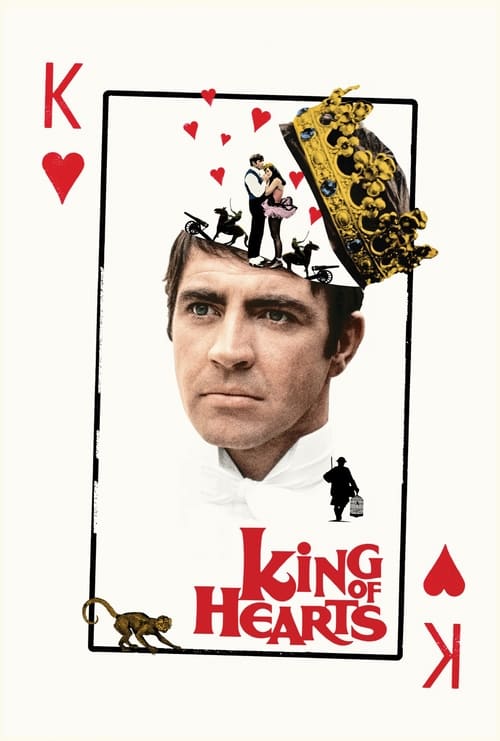
King of Hearts
1966 · Philippe de Broca
For when you want something warm, eccentric, and quietly wise — a fable to reach for when the news has worn you down and you'd like your anti-war sentiment delivered with confetti instead of carnage.
What it's about
In the last days of World War I, a retreating German garrison rigs a small French town to explode, and a Scottish private — actually an ornithologist who tends the battalion's pigeons — is sent in alone to find the bomb. The townspeople have fled; the only souls left are the patients of the local asylum, who wander out of their unlocked gates, dress up as the vanished barbers, bishops, and duchesses, and cheerfully crown the bewildered soldier their King of Hearts.
The experience
Whimsical, colorful, and gently absurd, with a clock ticking underneath all the pageantry — it plays like a costume party staged on a powder keg. It charms you first and then asks a pointed question about who the real lunatics are.
Performances
Alan Bates is winning as the flustered ornithologist swept up in the madness, and a young Geneviève Bujold is luminous as the asylum's would-be tightrope dancer.
The craft
De Broca stages the whole conceit as a sustained theatrical masquerade — a town transformed into a stage set, filled with costumes, parades, and circus color, while the war machine grinds grayly at its edges. The contrast between carnival brightness and military absurdity is the film's whole visual argument, and it's lovely on a big screen.
Why it matters
A modest release at home that became a legendary cult phenomenon in America, running for years on end at repertory houses and adopted by the Vietnam-era generation as a gentle anti-war anthem.
Snapshot
King of Hearts (Le Roi de cœur) is Philippe de Broca's whimsical anti-war fable, a Franco-Italian co-production released in 1966 and starring Alan Bates and a young Geneviève Bujold. Its premise is a parable dressed as farce: in the closing days of the First World War, a retreating German garrison rigs a small French town to explode, the townspeople flee, and into the abandoned streets wanders Private Charles Plumpick — a Scottish ornithologist and battalion pigeon-keeper dispatched to find and defuse the device. The only inhabitants left are the patients of the local asylum, who stroll out through their unlocked gates, assume the costumes and titles of the vanished bourgeoisie, and crown the bewildered soldier their King of Hearts. From this inversion de Broca builds a sustained conceit: the "mad" who play at duke, bishop, general and courtesan are gentle and joyous, while the sane world beyond the walls marches mechanically toward mutual slaughter. The film failed commercially on first release and was dismissed by much of the French press, then enjoyed an extraordinary second life as an American campus cult object during the Vietnam years, becoming one of the defining anti-war touchstones of the late-1960s and 1970s repertory circuit.
Industry & production
The film belongs to the most productive phase of de Broca's career, immediately following his international success with the Jean-Paul Belmondo adventure-comedy That Man from Rio (L'Homme de Rio, 1964). It was a French-Italian co-production — de Broca's own production interests were involved alongside the Artistes Associés (United Artists' French arm), and the casting of Italian players such as Adolfo Celi reflects the co-production architecture typical of mid-1960s European cinema. The screenplay was written by Daniel Boulanger, de Broca's habitual collaborator, from a story credited to Maurice Bessy; Boulanger had supplied scripts for Cartouche, That Man from Rio, and other de Broca pictures, and his hand is visible in the film's blend of literary whimsy and picaresque structure.
Principal photography took place on location in France, with the historic town of Senlis (Oise) standing in for the fictional Marville — its medieval streets, squares and ramparts giving the production a real, lived-in stage rather than a backlot. Casting paired the English Alan Bates, then rising through both British New Wave realism and continental work, with the twenty-three-year-old Québécoise Geneviève Bujold as the tightrope-dreaming asylum girl Coquelicot; the film was an early showcase for Bujold before her breakthrough in Anne of the Thousand Days. The supporting ensemble assembled a roster of established French character actors — Pierre Brasseur, Jean-Claude Brialy, Micheline Presle, Françoise Christophe — alongside Celi, lending the "inmates" the faces of an entire vanished social order.
The hard fact of the production is its commercial reception: by the consistent account of later histories, King of Hearts lost money in France and made little impression at home. The financial record beyond that is thin in the public scholarship, and I will not assign figures the sources do not support; what is well established is the gap between its tepid first run and its eventual cult profitability abroad.
Technology
King of Hearts was shot on 35mm in color, an unsurprising choice for a mid-1960s commercial feature aimed at international distribution. The decision to work in color is itself meaningful: where the dominant register of contemporaneous war cinema and of the French New Wave's social films leaned toward black-and-white austerity, de Broca embraces saturated color as part of the film's argument — the costumes, banners and circus regalia of the inmates' invented court depend on a palette that black-and-white could not carry. The film uses no technology that calls attention to itself; its means are conventional for its moment, and its innovations are matters of staging, performance and tone rather than of apparatus. Where the record on specific lenses, stocks or laboratory processes is sparse, I note that rather than reconstruct it speculatively.
Technique
Cinematography
The photography is the work of Pierre Lhomme, one of the more distinguished French cameramen of the era, whose credits span the documentary modernism of Le Joli Mai to, decades later, the lavish Cyrano de Bergerac. Lhomme's images here serve the fable's double tone. The location shooting in Senlis grounds the fantasy in genuine stone and daylight, so that the inmates' pageantry plays out against a verifiably real town rather than a stylized set; the contrast between the concrete medieval architecture and the soft, festive color of the costumes is much of the film's visual charm. The camera tends to follow Plumpick's bewildered point of view, discovering the populated-then-depopulated town as he does, and it opens up into wider, more ceremonial framings for the set-pieces of coronation, procession and the climactic confrontation at the town gates.
Editing
The cutting, credited to Françoise Javet, manages the film's tonal oscillation between gentle reverie and farcical acceleration. De Broca's comic sensibility was built on tempo — his Belmondo films are studies in momentum — and King of Hearts modulates between the languid, dreamlike rhythm of the inmates' play and the brisk mechanics of the surrounding military plot (the ticking bomb, the converging armies). The editing's chief structural task is to keep the parable's two worlds legibly distinct so that their final collision lands with its intended irony.
Mise-en-scène / staging
Staging is where the film does its real thinking. The central device — patients donning the abandoned identities of a fled bourgeoisie — turns the whole town into a theater, and de Broca directs it as such: the brothel, the cathedral, the barbershop and the ducal palace become stations in a continuous performance. The choreography of crowds, costumes and processions carries the satire without recourse to speeches. The most celebrated staging is the climax at the gates, where the two real armies, having returned, annihilate one another in a tidy mutual massacre while the "lunatics" look on — and the closing image of Plumpick presenting himself naked at the asylum gate, birdcage in hand, choosing to be readmitted to the madhouse over rejoining the sane world. That final tableau is the film's thesis rendered as a single picture.
Sound
The score by Georges Delerue is integral rather than decorative. Delerue — the composer most identified with Truffaut and a frequent de Broca collaborator — supplies a lilting, waltzing, faintly melancholy theme that became inseparable from the film's identity on the repertory circuit. The music sentimentalizes the inmates' world just enough to make their innocence affecting rather than merely quaint, and it pointedly withholds the martial idiom that the war plot might invite, so that the soundtrack itself takes the inmates' side against the soldiers.
Performance
Alan Bates anchors the film as the gentle, perpetually astonished Plumpick, a performance of reactive bewilderment that lets the surrounding eccentrics shine while keeping the audience's sympathy located in a recognizable human center. Geneviève Bujold's Coquelicot is luminous and unguarded, the emotional fulcrum of Plumpick's eventual choice. The ensemble of veteran French players — Brasseur, Brialy, Presle and the others — pitches the inmates as dignified rather than grotesque, which is essential: the satire only works if their "madness" reads as a purer sanity. The decision to play the lunatics straight, with tenderness rather than caricature, is the production's most important interpretive choice.
Narrative & dramatic mode
The film operates as allegorical fable rather than realist drama. Its plot machinery — the planted bomb, the deadline, the mistaken-identity premise — is the apparatus of farce and suspense, but it is deployed in service of a moral parable about war and reason. The dramatic mode is essentially ironic and inverted: every value the surrounding war culture asserts (duty, sanity, order, heroism) is reassigned to the "mad," while the sane are revealed as the truly deranged. The structure is picaresque, a sequence of encounters as Plumpick moves through the populated town, and it resolves not through conventional victory but through a renunciation — the hero's choice of the asylum is an anti-climax by design, a refusal of the war story's expected ending.
Genre & cycle
King of Hearts sits at the crossroads of comedy, drama and war film, and resists each. It belongs most clearly to the 1960s cycle of anti-war satire — the international wave of films that treated modern warfare as absurd rather than tragic or heroic, a sensibility shared with works such as Dr. Strangelove, Oh! What a Lovely War and the dark service comedies that followed. Within French cinema it draws on the long national tradition of poetic fantasy and gentle anarchism. Its asylum-as-true-sanity conceit places it in a recognizable lineage of "the inmates are saner than the keepers" stories, a trope with deep theatrical and literary roots that the film renders cinematic and topical.
Authorship & method
Philippe de Broca came up through the French New Wave's apprenticeship system, working as an assistant on early films of Claude Chabrol and François Truffaut before establishing himself as a popular commercial director with a distinctive light touch — the maker of effervescent adventure-comedies (Cartouche, That Man from Rio) rather than an austere modernist. King of Hearts is often read as his most personal and ambitious film, the one in which his characteristic charm is bent toward a serious moral statement. His method here is to wrap a genuinely pacifist argument in the candy-coloured wrapping of comedy, trusting whimsy to carry weight that earnest treatment might not.
The authorship is genuinely collaborative in the New Wave-adjacent manner. Screenwriter Daniel Boulanger supplied the literary, anecdotal texture; cinematographer Pierre Lhomme grounded the fantasy in real light and stone; composer Georges Delerue gave it its emotional signature; editor Françoise Javet governed its tonal rhythm. The recurrence of Boulanger and Delerue across de Broca's filmography marks them as something closer to co-authors of his sensibility than hired hands.
Movement / national cinema
The film is a product of mid-1960s French popular cinema standing slightly apart from the New Wave proper. De Broca shared the Nouvelle Vague's formative experiences — the apprenticeships, the Cahiers-adjacent milieu — but pursued mainstream entertainment rather than formal rupture, and King of Hearts should be understood as belonging to that commercial, internationally-oriented French cinema rather than to the movement's experimental wing. Its co-production status and English-speaking lead also locate it within the increasingly transnational European film economy of the period, made for export as much as for the domestic market — which, in the event, is precisely where it found its audience.
Era / period
Made in 1966 but set in 1918, the film speaks to two moments at once. Its First World War setting evokes the foundational European catastrophe, the war that made "the futility of war" a modern commonplace. But its sensibility is unmistakably that of the mid-1960s, the threshold of the counterculture, and its reception belongs to the Vietnam era that followed. The film's anti-authoritarian, anti-militarist, gently psychedelic embrace of the "mad" as the keepers of innocence chimed perfectly with the late-1960s and 1970s youth culture that adopted it — a case in which a film's true period is the moment of its reception rather than its release.
Themes
The governing theme is the inversion of madness and sanity: the proposition, dramatized rather than argued, that the institutionalized "lunatics" possess a humanity, joy and gentleness that the rational, dutiful world of soldiers and generals has lost. From this flows the film's pacifism — war is figured not as tragedy but as collective insanity, never more so than in the climax where two armies exterminate each other to no purpose while the supposed madmen watch. Secondary themes include innocence and its preservation (Coquelicot, the circus, the birds), the theatricality of social roles (the inmates' effortless assumption of titles suggests that the "sane" order is itself only a costume), and the individual's choice between conformity and a freer, "mad" authenticity — sealed in Plumpick's final decision to return to the asylum.
Reception, canon & influence
The reception history of King of Hearts is one of the most striking divergences between initial verdict and ultimate standing in postwar cinema. On release the film underperformed commercially and met a cool critical response in France; it was not a success on the terms it was made. Its reputation was made elsewhere and later. In the United States it became a genuine cult phenomenon of the repertory and campus circuit, embraced by a Vietnam-era audience that found its anti-war parable irresistible. It is widely reported to have enjoyed an extraordinarily long continuous run at the Central Square Cinema in Cambridge, Massachusetts, where it played for years and became a fixture of student culture — a run frequently cited as one of the longest in repertory exhibition history. (The precise duration is given variously in popular accounts; I report the phenomenon as documented without certifying a specific figure.) This afterlife rescued the film commercially and installed it in the canon of beloved anti-war cinema.
Looking backward, the film draws on the French tradition of poetic, anarchic fantasy and on a long theatrical lineage of asylum-inversion satire; its anti-war absurdism is of a piece with the international 1960s wave that ran from Dr. Strangelove to the era's other service comedies and pacifist fables. Looking forward, its influence is felt less in direct stylistic imitation than in its cementing of the "the mad are the only sane ones" anti-war conceit as a popular touchstone, and in its model for how a gentle, fantastical comedy could carry a serious political charge. Its cultural reach extended beyond film: a Broadway musical adaptation, also titled King of Hearts, reached the stage in 1978, testifying to the property's enduring resonance even as the original's box-office life had been so uneven. Within de Broca's own career it remains the film most often singled out as his masterwork — the picture in which a director of light entertainments made something that audiences, if not initially critics, took permanently to heart.
A Deleuzian reading
Start with the moment the town empties.
The full Deleuzian reading of King of Hearts →
Reception
A flop in France on its 1966 release, it was resurrected by American college audiences during the Vietnam era and became one of the defining cult films of the 1970s — its anti-war whimsy landing far harder abroad than at home.
How King of Hearts was received, from release to now →
Influences: the films it descends from and the films it influenced
- Zéro de conduite (1933) — Establishes the French strain of anarchic poetic-fantasy in which the institutionalized innocents (here schoolboys, there lunatics) overturn the rational adult order through lyrical, dreamlike revolt rather than argument.
- Le Million (1931) — Models the French popular-cinema treatment of a whole town as a playful operetta stage, where streets and crowds choreograph into near-musical comic set-pieces — the staging grammar de Broca turns into Marville-as-theater.
- La Grande Illusion (1937) — Carries its pacifist argument through human warmth and cross-line camaraderie rather than polemic, the model de Broca cites for wrapping an anti-war thesis in charm.
- Les Enfants du Paradis (1945) — Builds the theatricality-of-social-roles conceit in which performers and 'real' life blur, feeding the film's vision of madmen donning society's costumes and playing its parts straight.
- Marat/Sade (1967) — Extends the asylum-inversion satire with inmates playing their parts dead straight, dramatizing politics as a performance staged by the mad — the theatrical lineage King of Hearts popularized on film.
- How I Won the War (1967) — Pushes anti-war farce through abrupt tonal oscillation between slapstick and atrocity, the same editing rhythm that lets comedy carry a lethal charge.
- Oh! What a Lovely War (1969) — Stages WWI as a pageant of theatrical tableaux and song, weaponizing whimsical artifice and a culminating staged image against war just as King of Hearts ends on its theatrical final tableau.
- M*A*S*H (1970) — Carries forward the pacifist service-comedy in which clowning irreverence is the only sane response to institutional slaughter.
- Catch-22 (1970) — Builds its whole structure on the madness-versus-sanity inversion — sanity itself disqualifies you from escaping the war — the conceit King of Hearts cemented as a popular touchstone.
- One Flew Over the Cuckoo's Nest (1975) — Inherits the 'the inmates are the only sane ones' premise, casting the asylum as a truer society than the rationalized authority outside its walls.
- Amélie (2001) — Revives French popular cinema's saturated candy-color whimsy and gentle-fable mode, trusting fantastical charm and a storybook palette to carry genuine emotional and moral weight.
- Harold and Maude (1971) — Pioneered the repertory/campus cult model of a gentle anti-authority fable carried by 'embrace life over death' sentiment — the exact counterculture exhibition path and sincere-whimsy tone Harold and Maude later rode for years.
- The Fisher King (1991) — Codifies the holy-fool conceit that the institutionalized madman perceives more truly than the sane world, the moral inversion Parry embodies as a non-clinical rebuke to rational society.
- Mediterraneo (1991) — The anti-war pastoral fable in which soldiers are abandoned in a place the war has forgotten and the suspension itself becomes a comic utopia — Mediterraneo's premise with the madhouse swapped for an island.
- That Man from Rio (1964) — Same de Broca–Boulanger–Delerue authorship machine: a breathless picaresque structure driven by an ingenuous hero swept through escalating set-pieces in saturated, sunlit color.
- Jules et Jim (1962) — Showcases Georges Delerue's lyrical, waltzing scoring that gives bittersweet tonal swerves their emotional signature — the same composer-as-co-author voice de Broca (Truffaut's former assistant) relies on.
- Le Joli Mai (1963) — Pierre Lhomme's roving, observational handling of real Paris light and stone — the documentary grounding he brings to anchor de Broca's fantasy in tangible texture.
- Army of Shadows (1969) — Pierre Lhomme's cinematography grounding a wartime France in cold real architecture and natural light, the same eye that lends King of Hearts' whimsy a stony documentary weight.
- Dr. Strangelove (1964) — The defining 1960s anti-war absurdism that locates true insanity in the rational war-makers — the international wave the dossier names as King of Hearts' kin.
Similar films
- One Flew Over the Cuckoo's Nest (1975) — influence & lineage
- Army of Shadows (1969) — influence & lineage
- Grand Illusion (1937) — influence & lineage
- The Manchurian Candidate (1962) — shared sensibility
- The King's Man (2021) — shared sensibility
- The King and the Mockingbird (1980) — shared sensibility
- Heart of Glass (1976) — shared sensibility
- Pierrot le Fou (1965) — shared sensibility