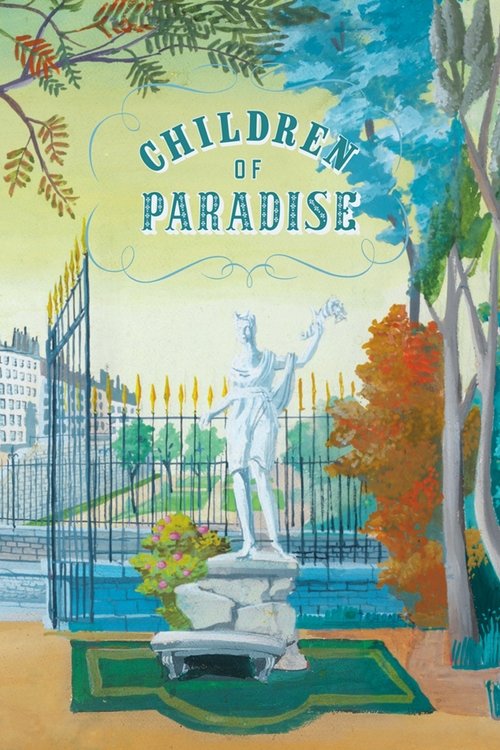
Children of Paradise
1945 · Marcel Carné
For when you want to be swept away by a grand, old-fashioned epic romance and have a whole evening to give it. A challenge in length, pure pleasure in everything else.
What it's about
In the teeming theater district of 1820s Paris — a boulevard of mimes, actors, pickpockets, aristocrats, and courtesans — the shy stage mime Baptiste falls hopelessly in love with Garance, a worldly, self-possessed woman who belongs to no one. Three other men want her too: a flamboyant actor, an elegant criminal, and a wealthy count. Over years, their lives keep colliding on and off the stage.
The experience
Sweeping and unhurried, it's a three-hour immersion in a vanished world that feels alive in every corner of the frame, with wit in the dialogue and a deep romantic sadness underneath. It casts a spell rather than grabs you — surrender to its rhythm and it's transporting.
Performances
Jean-Louis Barrault's Baptiste is astonishing — his white-faced mime sequences are worth the film alone — and Arletty gives Garance a warmth and irony that explain why every man in Paris falls for her.
The craft
Shot on enormous sets under the German Occupation, it recreates an entire boulevard of theaters and crowds with staggering ambition, and Jacques Prévert's script is one of the most quotable ever written for French cinema. The theater scenes-within-the-film are staged with a showman's love of the stage itself; see it as big as you can.
Why it matters
Released as the Occupation ended, it became a national monument of French cinema — routinely voted among the greatest French films ever made and the high-water mark of the country's studio era.
Snapshot
Les Enfants du Paradis is the towering monument of French studio cinema, a three-hour-plus historical romance conceived and shot under the German Occupation and released in the spring of 1945, as that occupation ended. Directed by Marcel Carné from a screenplay by the poet Jacques Prévert, it reconstructs the theatrical demimonde of Paris's "Boulevard du Crime" (the Boulevard du Temple) in the 1820s and 1830s, weaving real historical figures — the mime Jean-Gaspard Deburau, the boulevard actor Frédérick Lemaître, the dandy-criminal Pierre-François Lacenaire — around the luminous, unattainable courtesan Garance. The film is at once an intimate meditation on the impossibility of love and a vast fresco of a world of theater, crime, and spectacle. Its title points to the "paradis," the cheap upper gallery (English "the gods") where the poor crowd watched the players: the children of paradise are both the audience and the performers who live for them. Frequently voted the greatest French film ever made, it stands as the culminating work of the Carné–Prévert partnership and a defiant assertion of French cultural identity made under enemy occupation.
Industry & production
The film was produced under conditions that have themselves become legendary. Principal photography began in August 1943 at the Victorine studios in Nice, then in the Italian-occupied zone; the Italian armistice that September disrupted the shoot, and production was suspended and resumed, with later work carried out in Paris. The result was a protracted, expensive, and repeatedly interrupted production — by reputation the most lavish French film of its era, built around an enormous reconstruction of the Boulevard du Temple. The Occupation imposed restrictions on feature length, and the film was conceived and presented in two parts ("Le Boulevard du Crime" and "L'Homme blanc"), together running over three hours.
Two of the most important creative contributors worked clandestinely. The Hungarian-born production designer Alexandre Trauner and the composer Joseph Kosma, both Jewish, were barred from screen work under the anti-Jewish statutes of the period and contributed in hiding, their work credited to others or unacknowledged at release. The casting also bore the marks of the war: the actor Robert Le Vigan, initially cast as the ragpicker Jéricho, fled France because of his collaborationist associations and was replaced by Pierre Renoir, requiring reshoots. After the Liberation, the star Arletty was arrested and punished for her wartime relationship with a German officer, a shadow that fell across the film's triumphant reception. These circumstances are well documented in the historical record, though precise budget figures and shooting-day counts vary between accounts and should be treated with caution.
Technology
Les Enfants du Paradis was made on 35mm black-and-white film in the standard Academy ratio, with optical monophonic sound — the conventional professional format of the period. There is nothing technologically experimental about the apparatus; the film's grandeur is a matter of resources and craft rather than innovation in the recording medium. What is remarkable, given material shortages under the Occupation — limited film stock, scarce labor and materials, electrical and logistical constraints — is the sheer scale of what was achieved: large standing exterior sets, crowd scenes, and elaborate theatrical interiors realized with studio resources that were under severe wartime strain. The film is, in a sense, a demonstration of what disciplined studio craft could accomplish in the absence of any technological advantage.
Technique
Cinematography
The cinematography is credited to Roger Hubert. The visual style is one of deep, burnished theatricality: a controlled, painterly black-and-white that lends both the boulevard exteriors and the candle-and-gaslight interiors a sense of staged spectacle. The camera favors composed tableaux and fluid movement through dense, populated spaces — the teeming Boulevard du Temple is the film's signature image, a frieze of humanity in motion. Lighting is keyed to the theatrical metaphor that governs the whole film, repeatedly framing characters as performers caught in pools of light against shadow. The look is less the moody, fog-bound chiaroscuro of Carné's prewar poetic realism than a richer, more frontal, almost operatic clarity suited to the period subject.
Editing
Henri Rust is credited with the editing. The film's rhythm is deliberately expansive, organized around long scenes that give performances room to breathe rather than around rapid cutting. The two-part structure functions as the film's largest editorial gesture, with a substantial ellipsis of years separating the halves, so that the editing operates as much at the level of dramatic architecture as of the individual cut. Within scenes the cutting is classical and unobtrusive, subordinated to staging and performance.
Mise-en-scène / staging
Mise-en-scène is the film's supreme achievement, and Trauner's sets are central to it. The reconstructed Boulevard du Temple — a deep, layered street thronged with mountebanks, hawkers, spectators, and pickpockets — is one of the most celebrated sets in film history, a complete world rather than a backdrop. The film is built on a sustained doubling of stage and life: scenes on the boards of the Funambules and the Grand Théâtre rhyme with and comment upon the offstage drama, and Carné stages the relationship between the performers and their gallery audience (the "paradis") as a recurring motif. Crowds are choreographed with great precision, and the framing repeatedly treats the city itself as a theater.
Sound
The sound design integrates the noise of the boulevard, the hush and applause of the theater, and Joseph Kosma's score (with contributions associated with Maurice Thiriet) into the film's central conceit of performance. Pantomime — Baptiste's art — is rendered through music and movement rather than speech, and the film draws a pointed contrast between the silent eloquence of the mime and the verbal flourish of the spoken-theater actor Lemaître. Prévert's dialogue, delivered with theatrical relish, is itself treated almost as music.
Performance
The acting is the film's living core. Arletty, with her unmistakable husky Parisian voice and impassive, knowing grace, makes Garance an enigma of self-possession — desired by all, possessed by none. Jean-Louis Barrault, trained in mime, gives Baptiste Deburau a heartbreaking corporeal lyricism, his white-faced Pierrot the film's emblem and its emotional center. Pierre Brasseur's Frédérick Lemaître is all expansive bravura; Marcel Herrand's Lacenaire is a cold, literary dandy of crime; Louis Salou's Count de Montray embodies aristocratic possessiveness; and María Casarès, as Nathalie, gives the film its note of faithful, unrequited devotion. The ensemble fuses several distinct performance traditions — boulevard pantomime, classical stage declamation, screen naturalism — into a single coherent world.
Narrative & dramatic mode
The film's mode is romantic tragedy raised to the level of myth. Its structure is built on a quartet of men orbiting a single woman, each loving her in his own register — Baptiste with pure idealization, Frédérick with playful sensuality, Lacenaire with a perverse intellectual disdain, the Count with proprietary passion. The drama unfolds across two movements separated by years, the second returning to its characters changed and bound. Carné and Prévert privilege fate, missed chances, and the gulf between desire and fulfillment; the famous closing image — Baptiste lost in a carnival crowd, unable to reach Garance — is the definitive statement of the film's theme that love is forever a beat too late. The narrative continually folds theater into life, so that the characters seem to be both living their stories and performing them.
Genre & cycle
The film sits at the intersection of historical costume drama, romantic melodrama, and the backstage "theater film." It belongs loosely to the lineage of French poetic realism associated with Carné and Prévert, but it transcends and partly departs from that cycle: where the prewar poetic-realist films (Le Quai des brumes, Le Jour se lève) are contemporary, fatalistic, and intimate, Les Enfants du Paradis is a sprawling period fresco. It is best understood as the grand summa of the Carné–Prévert collaboration and of the French "quality" tradition of literate, studio-bound prestige filmmaking, executed at a scale that the cycle rarely otherwise attempted.
Authorship & method
The film is the supreme product of the partnership between Marcel Carné and Jacques Prévert, who had already made several of the defining poetic-realist films of the 1930s. Carné's authorship lies in his orchestration of mise-en-scène, performance, and design into a unified theatrical vision; Prévert's lies in the literary architecture, the wit and melancholy of the dialogue, and the conception of the characters from their historical originals. The contribution of the clandestine collaborators is integral rather than incidental: Alexandre Trauner's sets are inseparable from the film's meaning, and Joseph Kosma's music shapes its emotional and rhythmic life. Roger Hubert's cinematography and Henri Rust's editing complete the team. The method was that of the fully resourced studio production — extensive sets, large casts, controlled staging — pursued, exceptionally, under occupation. The authorship is thus genuinely collective, a fact the film's wartime credits could not openly acknowledge.
Movement / national cinema
Les Enfants du Paradis is a cornerstone of French national cinema and the high-water mark of its studio tradition. It carries the inheritance of 1930s poetic realism while embodying the "tradition of quality" — literary, polished, set-bound — that would dominate French production into the 1950s. Made under the Occupation, it is also a document of French cultural self-assertion in a moment of national subjection: a film about the vitality and continuity of French theatrical and artistic life, released as France emerged from defeat. Its stature in the national canon is such that it has repeatedly been named, in critics' polls, the greatest French film ever made.
Era / period
The film operates on two temporal planes. Its setting is the Paris of the July Monarchy era — the 1820s and 1830s — and the popular theater of the Boulevard du Temple, a world of pantomime, melodrama, crime, and class spectacle that the film reconstructs in loving detail and populates with historical personages. Its moment of making is the other plane: produced in 1943–44 under German occupation and Vichy rule, released in March 1945 as the war in Europe neared its end. The tension between these eras gives the film much of its resonance, and many critics have read its celebration of a free, teeming, theatrical France as an oblique response to the constraints of occupation, though such allegorical readings remain interpretive rather than documented intent.
Themes
At its heart the film concerns the impossibility of consummated love and the gap between the ideal and the real — Baptiste's worship of Garance can never survive contact with ordinary life. Closely bound to this is the theme of theater and life as mirrors of one another: art as both escape from and intensification of feeling, the mask of the mime expressing what speech cannot. The film explores social class and freedom (Garance's refusal to be possessed, her movement among ragpickers and aristocrats alike), the relationship between the artist and the crowd, and the workings of fate and missed timing. Crime, performance, and desire are continually braided together, most pointedly in the figure of Lacenaire, who treats both murder and love as forms of theater.
Reception, canon & influence
The film opened in Paris in March 1945 to immediate acclaim and became a defining cultural event of the Liberation period, celebrated as a vindication of French cinema. Over the following decades its reputation only grew: it has been the subject of repeated restoration and revival, and in critics' surveys — notably a 1995 poll of French critics marking the centenary of cinema — it has been ranked the finest French film ever made. Its canonical standing is now essentially unquestioned.
Looking backward, the film draws on a deep substratum of nineteenth-century French theatrical and literary culture — the historical Deburau, Lemaître, and Lacenaire, the traditions of pantomime and boulevard melodrama, and the Romantic theater of Hugo and his contemporaries that Lemaître's career touched. It is the culmination of the poetic-realist sensibility Carné and Prévert had developed across the 1930s, refined and enlarged into historical epic.
Looking forward, its influence is broad and lasting. It became a touchstone for filmmakers and critics worldwide as an exemplar of what literate, large-scale studio cinema could achieve, and it has been cited admiringly by figures across later film culture; François Truffaut, despite the New Wave's polemic against the "tradition of quality," is among those who held the film in particular esteem. Its central images — Barrault's white Pierrot, the thronged Boulevard du Temple, the final shot of Baptiste swallowed by the carnival crowd — entered the permanent iconography of cinema. The film also stands as the enduring emblem of the Carné–Prévert collaboration, which never again reached such heights, and as proof that a national cinema could produce a masterwork under occupation. Beyond specific lines of stylistic imitation, its deepest legacy is as a perennial reference point for the ambition of cinema itself: the film most often invoked when critics ask what the medium, at full stretch, is capable of.
A Deleuzian reading
A man in whiteface stands on the boards of the Funambules and says nothing.
The full Deleuzian reading of Children of Paradise →
Reception
A smash hit in newly liberated Paris in 1945, it never really needed rescuing — it went straight into the canon and stayed there, crowned 'Best French Film of All Time' in a 1995 poll of some 600 French critics and industry professionals.
How Children of Paradise was received, from release to now →
Influences: the films it descends from and the films it influenced
- La Kermesse héroïque (1935) — Carné apprenticed as Feyder's assistant here, and the film's Trauner-designed 'living painting' tableaux — period crowds composed and lit like Flemish canvases — are the direct template for the Boulevard du Temple staging.
- Napoléon (1927) — Established the massed historical crowd as kinetic spectacle, the model for treating the thronged Boulevard du Temple as a teeming animate organism rather than mere backdrop.
- Sunrise (1927) — Its wholly studio-built world, fairground sequence, and painterly chiaroscuro modeling of faces and depth prefigure Carné and Hubert's controlled, lamp-sculpted tableau lighting.
- Le Quai des brumes (1938) — The founding Carné–Prévert–Trauner poetic-realist statement: fatalist doomed romance and atmosphere-as-destiny that Children of Paradise enlarges to epic scale.
- Le Jour se lève (1939) — Same Carné–Prévert team plus Kosma's scoring; its architecture of inexorable fate and lovers undone by timing is the dramatic blueprint refined four years later.
- Les Visiteurs du soir (1942) — The immediate predecessor — a Prévert-scripted period costume drama with Trauner's clandestine sets, where the team learned to mount large historical pageant under Occupation conditions.
- The Kid (1921) — Barrault's white-faced Baptiste descends from the silent screen's pantomime pathos, the Pierrot-clown whose mute gesture carries the emotional weight a word would cheapen.
- The Red Shoes (1948) — Extends the backstage-performance film in which the staged art and the performers' offstage lives fatally mirror and consume one another — Baptiste's mime/love doubling writ as ballet.
- Les Parapluies de Cherbourg (1964) — A through-composed romantic tragedy of lovers separated by timing and circumstance, Demy's avowed homage to the Carné–Prévert fusion of stylization and heartbreak.
- Jules et Jim (1962) — Truffaut, an avowed admirer despite the New Wave's anti-tradition-of-quality polemic, sustains the romantic triangle governed by fate and missed timing.
- Day for Night (1973) — Transposes the theater-and-life doubling into a film-within-a-film, where the making of the work and the makers' tangled loves continuously interpenetrate.
- The Last Metro (1980) — Truffaut's most direct tribute: a theater troupe staging a play under German Occupation, fusing the backstage-theater film with Carné's own circumstance of art-under-Occupation.
- Shakespeare in Love (1998) — A backstage-theater film whose entire plot machinery stages the doubling of playhouse and life, the onstage drama narrating the lovers' offstage fate.
- Topsy-Turvy (1999) — Immerses the period backstage-theater film in the granular labor of stagecraft — rehearsal, costume, performers' lives behind the proscenium — extending the genre's theater-as-world.
- The Apartment (1960) — Alexandre Trauner built Carné's Boulevard du Crime using theatrical forced-perspective to make a confined stage read as a world; he transferred that methodology exactly to The Apartment's Consolidated Life offices, where diminishing desk-rows and proportionally smaller rear-set furniture are a direct technical transplant from French poetic-realist stagecraft into Hollywood corporate satire.
- Smiles of a Summer Night (1955) — Carné's theatrical spatial composition — staging ensemble romantic triangles in a period setting with post-beat-linger cutting that holds on the actor's face after the line — gives Bergman a cinematic language for the theater-derived blocking he brings from the stage.
- King of Hearts (1966) — Builds the theatricality-of-social-roles conceit in which performers and 'real' life blur, feeding the film's vision of madmen donning society's costumes and playing its parts straight.
- Mephisto (1981) — Establishes the theater-within-film grammar Szabó adopts, where backstage intrigue and onstage performance interpenetrate so the actor's life is read through the roles he plays.
- Rendez-vous (1985) — The template of the backstage-theater film in which the playhouse becomes the arena for love-and-death, and an actor's stage role bleeds into real passion, is the genre frame Téchiné inherits and modernizes.
- Casque d'or (1952) — Renders a period working-class Parisian milieu and a doomed Belle Époque romance as luminous, painterly tableau, continuing poetic realism's marriage of milieu and fatalism.
- The Earrings of Madame de... (1953) — Carries forward the melodrama of fate and missed timing — desire circulating until tragedy closes the loop — sharing the tradition-of-quality's literate romantic architecture.
- La Ronde (1950) — Frames life explicitly as theater via a raisonneur/master-of-ceremonies, dramatizing the theater-and-life conceit through an overtly staged, presentational apparatus.
Similar films
- Jules and Jim (1962) — influence & lineage
- Napoleon (1927) — influence & lineage
- The Last Metro (1980) — influence & lineage
- The Umbrellas of Cherbourg (1964) — influence & lineage
- Daybreak (1939) — influence & lineage
- The Count of Monte Cristo (2024) — shared sensibility
- Cyrano de Bergerac (1990) — shared sensibility
- Jean de Florette (1986) — shared sensibility
All the films related to Children of Paradise →